
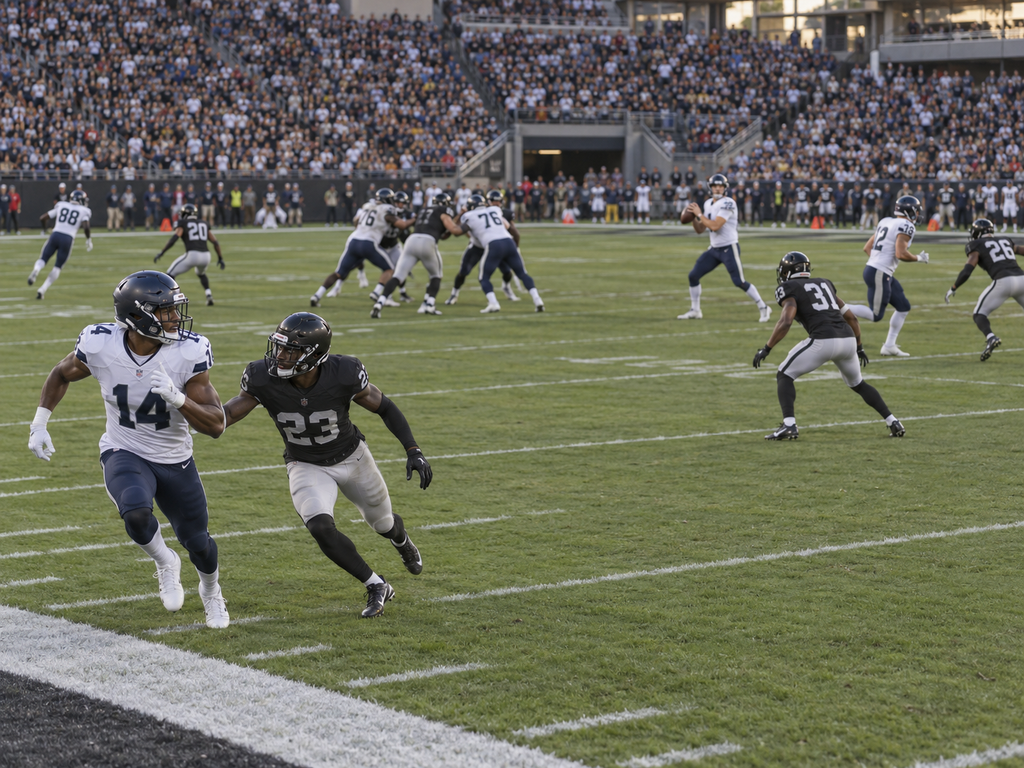
The offense lines up with three wide receivers on the right side of the field. The quarterback takes the snap, and one receiver runs toward the sideline while another crosses the middle.
A defensive back follows the crossing receiver closely. Nearby, a linebacker moves toward the sideline and reacts to the second route entering his area.
Both defenders are attempting to prevent a successful pass, but their responsibilities may be very different.
One defender might be responsible for a particular receiver. The other might be protecting an area of the field while reacting to offensive movement.
These are two fundamental approaches to pass defense: man coverage and zone coverage.
Understanding man coverage vs zone coverage helps intermediate football players recognize how defenders organize their responsibilities, communicate during passing plays and respond when receivers change direction.
It also helps offensive players understand why the same passing concept can produce different opportunities against different defensive structures.
However, modern football is not always divided into two completely separate systems. Some defenses combine man and zone principles or use pattern-matching rules that change how a defender responds to a receiver.
This guide examines how man and zone coverage work, the strengths and limitations of each approach and how players can better understand their responsibilities during actual football situations.
What Is Man Coverage in American Football?
Man coverage is a defensive approach in which a defender is generally responsible for covering a particular eligible receiver.
Rather than primarily protecting a fixed area, the defender reacts to the assigned receiver’s movement.
For example, a cornerback may be responsible for an outside wide receiver.
If that receiver runs toward the middle of the field, the cornerback usually follows according to the coverage rules.
If the receiver breaks toward the sideline, the cornerback adjusts to remain in position.
The goal is to prevent the receiver from gaining an effective passing opportunity.
How Man Coverage Works
Imagine the offense has two outside receivers and one slot receiver.
The defense may assign individual defenders to cover these players.
Each defender needs to understand the assignment and whether additional help is available.
For example, an outside cornerback may be responsible for the receiver while knowing that a safety is positioned to provide deep support.
That help can influence the cornerback’s leverage and technique.
Man coverage is therefore not always a collection of isolated one-on-one matchups.
Why Man Coverage Requires Individual Technique
In man coverage, the defender must respond to the receiver’s acceleration, route breaks and changes of direction.
Poor footwork or positioning can create separation.
A defender who reacts too aggressively to an initial movement may struggle when the receiver changes direction.
Successful man coverage requires disciplined movement, awareness and an understanding of the assigned technique.
What Is Zone Coverage in American Football?
Zone coverage is a defensive approach in which defenders are responsible for specified areas, route distributions or coverage relationships within the defensive structure.
In traditional spot-drop zone coverage, defenders protect assigned areas while reacting to receivers entering those areas.
For example, a linebacker may be responsible for an underneath middle zone.
If a receiver enters that area, the linebacker reacts to the passing threat.
When the receiver leaves, the linebacker may redirect attention toward another eligible target according to the coverage rules.
How Zone Coverage Works
Imagine an offense sends one receiver into a short sideline area while another runs toward the middle.
A defender responsible for the flat may react toward the sideline.
Another defender responsible for an inside area may respond to the crossing receiver.
The defensive structure distributes coverage responsibilities across different parts of the field.
The objective is to challenge passing opportunities through coordinated positioning.
Zone Does Not Mean Standing Still
A common misunderstanding is that zone defenders simply remain in one location.
In reality, defenders must react to offensive formations and routes.
They may gain depth, move laterally, pass a receiver to another defender or adjust positioning based on the quarterback and nearby receiving threats.
The exact movement depends on the coverage system.
Zone coverage requires active awareness and communication rather than passive waiting.
Man Coverage vs Zone Coverage: Key Differences
The most important difference is how each system organizes defensive responsibilities.
| Feature | Man coverage | Zone coverage |
|---|---|---|
| Primary responsibility | Assigned receiver | Assigned area or route distribution |
| Main attention | Receiver movement and coverage technique | Receiving threats, spacing and coverage rules |
| Defensive movement | Often follows the assigned receiver | Responds to routes entering or leaving assigned responsibility |
| Main challenge | Maintaining position against individual routes | Coordinating coverage across multiple receiving threats |
| Common advantage | Can challenge receivers closely | Can provide coordinated coverage across the field |
| Common weakness | Individual matchups may be exploited | Gaps or timing windows may develop between responsibilities |
| Communication | Assignments, switches and available help | Passing off routes, spacing and responsibility changes |
These comparisons describe general principles.
Actual coverage systems may combine characteristics from both approaches.
Understand Leverage in Man Coverage
Leverage describes a defender’s position relative to the receiver.
A cornerback may begin inside, outside or directly across from the assigned target.
The starting position influences which routes the defender can challenge most effectively.
Inside Leverage
A defender using inside leverage begins closer to the middle of the field than the receiver.
This may help challenge inside releases or routes breaking toward the center.
However, outside routes may become more accessible depending on the defensive help and technique.
Outside Leverage
Outside leverage places the defender closer to the sideline.
It may help discourage outside releases or boundary routes.
The defender must understand whether inside help is available.
Head-Up Positioning
A defender aligned directly across from the receiver may have a relatively balanced starting position.
However, the final responsibility cannot be determined from that alignment alone.
Why Leverage Matters
Consider a cornerback assigned to cover a receiver running an out route.
If the cornerback begins with outside leverage, the receiver may need to work harder to create space toward the boundary.
If the defender begins inside, the receiver may have a different opportunity.
But the defense may deliberately use leverage based on nearby safety responsibilities.
An intermediate player should learn to evaluate leverage as part of the full defensive call rather than as an isolated technique.
Understand Spacing in Zone Coverage
Zone coverage depends on defenders maintaining useful relationships with nearby teammates and receiving threats.
A defender may be responsible for an area, but that responsibility must fit into the larger coverage structure.
Vertical Spacing
Defenders may protect different depths of the field.
Some operate underneath, while others handle deeper passing threats.
If an underneath defender moves too far forward or backward, an offense may gain access to an intermediate passing window.
Horizontal Spacing
Defenders also need to coordinate movement across the width of the field.
For example, a flat defender may move toward a receiver near the sideline while another defender protects an inside area.
If their movements create excessive separation, a passing concept may challenge the space between them.
Communicating Routes
When receiving threats move across coverage responsibilities, defenders may need to communicate.
A player can signal that a receiver is entering another area or that the offensive formation has changed.
The exact communication depends on the defensive system.
The important principle is that zone coverage requires coordinated responses rather than every player reacting independently.
How Man Coverage Responds to Crossing Routes
Crossing routes can be challenging for man defenders because receivers move horizontally across the field.
Imagine a slot receiver running from the right side toward the left.
A defender assigned to that receiver may need to follow through traffic created by other players and routes.
Maintaining the Assignment
The defender must understand whether the coverage requires following the receiver throughout the route.
If so, the defender needs efficient movement and awareness of nearby players.
Switch Responsibilities
Some defenses include calls that allow defenders to exchange assignments when routes cross.
This can help manage certain route combinations.
However, those switches must be planned or communicated according to the defensive system.
Two defenders independently deciding to switch can leave a receiver uncovered.
Legal Contact Matters
Defenders must follow rules governing illegal contact, holding and pass interference.
A defender cannot simply grab a crossing receiver to prevent separation.
Good man coverage depends on legal positioning and movement.
How Zone Coverage Responds to Crossing Routes
Crossing routes also challenge zone defenses, but the interaction is different.
In a traditional spot-drop zone, a defender may react to a receiver moving through the assigned area.
When the receiver moves beyond that responsibility, another defender may become involved.
Example: Shallow Crossing Route
A receiver runs a shallow route from one side of the field to the other.
An underneath defender initially reacts as the receiver approaches.
The receiver continues moving across the formation.
Another defender may need to respond as the route enters a different area.
If the defenders fail to maintain proper spacing or communication, a passing window could develop.
Passing Off Receivers
In some zone systems, defenders effectively pass responsibility for a route to another teammate.
The process requires awareness of both the receiver and the nearby defensive structure.
Why Offenses Use Crossing Concepts
Crossing routes can challenge the timing of defensive responses and create movement across multiple coverage areas.
However, well-coordinated zone defenses can respond effectively.
A crossing route is not guaranteed to defeat zone coverage.
Strengths of Man Coverage
Man coverage can provide several advantages when defenders have suitable technique and assignments.
Close Individual Coverage
A defender may remain closely connected to the assigned receiver throughout a route.
This can challenge the quarterback’s ability to find an open passing window.
Flexible Defensive Pressure
Some man-coverage structures allow defenses to send additional rushers while assigning the remaining coverage players to eligible receivers.
However, coverage help may be reduced when more defenders rush.
The defensive coordinator must account for that trade-off.
Clear Individual Responsibility
In straightforward man assignments, defenders understand which receiver they must cover.
This can simplify certain responsibilities.
However, switches, motions and safety-help rules may still create complexity.
Weaknesses of Man Coverage
Man coverage also creates potential problems.
Difficult Individual Matchups
A receiver with strong acceleration or change-of-direction ability may challenge a defender in space.
One unfavorable matchup can influence the play.
Crossing Route Traffic
Receivers running across the field can create movement challenges for defenders who must follow them.
Defenders also need to avoid collisions and maintain legal coverage.
Limited Vision Toward the Quarterback
Some man techniques require defenders to focus primarily on the receiver.
This may reduce opportunities to observe the quarterback throughout the play.
The extent depends on the coverage technique and defender positioning.
Vulnerability to Scrambling
When defenders follow receivers downfield, fewer coverage players may remain positioned to react immediately if the quarterback runs.
The defensive system must account for quarterback containment and support responsibilities.
Strengths of Zone Coverage
Zone coverage provides a different set of advantages.
Coordinated Field Coverage
Defenders can distribute responsibilities across different areas.
This helps teams account for multiple receiving threats as part of a coordinated structure.
Vision and Ball Awareness
In many zone techniques, defenders can maintain awareness of the quarterback while monitoring nearby routes.
This may help them react to throws entering their responsibilities.
However, defenders must still use the proper eye discipline for the specific call.
Support Against Multiple Routes
A defender may influence more than one receiving threat by maintaining appropriate positioning.
This can make certain passing windows difficult to access.
Adaptability to Offensive Formations
Zone structures can provide organized responses to different route distributions.
However, the defense must still communicate adjustments when the offense uses motion, shifts or unusual formations.
Weaknesses of Zone Coverage
Zone coverage is not automatically safer than man coverage.
Passing Windows Between Defenders
Offenses can use route combinations to challenge spaces between coverage responsibilities.
For example, one route may influence an underneath defender while another develops behind that player.
Communication Breakdowns
When multiple receivers enter neighboring coverage areas, defenders must understand their responsibilities.
Confusion can create an unintended opening.
Difficult Route Distribution
Some offensive concepts place several receiving threats in one part of the field.
A defense must respond while maintaining the overall coverage structure.
Timing-Based Passing Opportunities
An offense may deliver a pass before a zone defender can react to the receiving window.
Even when the coverage is structurally sound, precise offensive execution can succeed.
Understand Pattern-Match Coverage
Modern defensive systems frequently include coverage concepts that do not fit neatly into traditional man or spot-drop zone categories.
Pattern-match coverage begins with rules that depend on how offensive receivers distribute their routes.
A defender might initially appear responsible for an area but then carry a receiver based on a specific route release or direction.
Example of a Match Responsibility
Imagine a cornerback facing an outside receiver.
The defense begins with a zone-like alignment.
After the snap, the receiver runs vertically.
Under certain match rules, the cornerback may carry that receiver downfield in a manner resembling man coverage.
On another route, the cornerback may respond differently based on the defensive call.
The exact responsibilities vary considerably between systems.
Why Pattern-Match Matters
A quarterback may observe a defender following a receiver and assume the defense is playing man coverage.
But the defender could be executing a pattern-match responsibility.
Likewise, a defender remaining in a particular area does not establish that the entire defense is using spot-drop zone.
Understanding this distinction prevents overly simple conclusions.
Intermediate players do not need to memorize every pattern-match system immediately.
They should recognize that modern coverage can combine individual and area-based responsibilities.
How Offensive Players Can Recognize Coverage Differences
Offensive players benefit from recognizing general coverage tendencies.
However, defensive alignments can be disguised.
Observe Defender Alignment
A cornerback playing directly across from a receiver may suggest a possible man matchup.
A defender positioned with more space between several receivers may suggest zone-related responsibilities.
Neither alignment proves the coverage.
Watch Responses to Motion
An offensive player moving across the formation may cause a defender to follow.
This can provide information about the defense.
However, some zone and match systems also move defenders with motion.
Motion responses should be treated as clues rather than definitive answers.
Observe Post-Snap Movement
Once the play begins, defenders reveal more of their actual responsibilities.
A player may track one receiver across the field.
Another may react to routes entering a particular area.
But the complete structure still matters.
The goal is recognizing how defenders behave, not assigning a coverage label based on one movement.
Four Practical Coverage Scenarios
Scenario 1: Outside Receiver Against Man Coverage
The offense places a wide receiver near the sideline.
A cornerback is assigned to that receiver.
The receiver runs an intermediate out route.
Defensive responsibility: The cornerback follows the receiver according to the man technique and available help.
Key challenge: Maintaining positioning through the receiver’s change of direction.
Lesson: Man coverage emphasizes the relationship between the assigned defender and receiver.
Scenario 2: Crossing Routes Against Zone
Two receivers run routes across different underneath areas.
The defense uses a zone structure with linebackers responsible for neighboring regions.
Defensive responsibility: Players react to receiving threats according to their areas and coverage rules.
Key challenge: Maintaining spacing and communication as routes move across the field.
Lesson: Zone coverage depends on coordinated responsibilities.
Scenario 3: Motion Against a Match Defense
A receiver moves from the right side toward the left before the snap.
The defense adjusts its positioning.
After the snap, a cornerback carries a vertical route.
Defensive responsibility: The cornerback follows the route according to the team’s match rules.
Key challenge: Understanding the route distribution and related coverage responsibilities.
Lesson: Following a receiver does not always prove traditional man coverage.
Scenario 4: Quarterback Scramble Against Man
The quarterback drops back while defenders follow their assigned receivers.
The pass protection breaks down, and the quarterback begins moving forward.
Defensive responsibility: Coverage players must follow their assigned rules while the defense maintains appropriate containment and pursuit.
Key challenge: Preventing the quarterback from exploiting open space without abandoning defensive responsibilities.
Lesson: Coverage strategy must account for the entire offensive play, including quarterback movement.
Common Man and Zone Coverage Mistakes
Assuming Man Coverage Means No Safety Help
Some man concepts include deep or bracket support.
Correction: Understand the defender’s individual assignment and the help available in the defensive structure.
Assuming Zone Defenders Never Follow Receivers
Match coverage can require defenders to carry routes.
Correction: Learn the specific coverage rules instead of relying only on traditional labels.
Watching Only the Quarterback
A defender may lose track of nearby receiving threats.
Correction: Follow the eye discipline required by the assigned technique.
Watching Only the Receiver
A defender in a zone assignment may fail to maintain awareness of neighboring threats.
Correction: Understand how the coverage requires attention to receivers, areas and the quarterback.
Switching Assignments Without Communication
Two defenders independently exchange receiving responsibilities.
Correction: Use established switch and match rules.
Believing One Coverage Is Always Better
A team assumes man coverage is automatically more aggressive or zone coverage is always more conservative.
Correction: Evaluate the complete defensive structure, personnel and game situation.
Five Practical Drills to Understand Man and Zone Coverage
Drill 1: Man Assignment Walkthrough
Purpose: Understand individual coverage responsibilities.
Set up a receiver and defender in an open practice area.
The receiver moves through a simple route at walking speed.
The defender follows according to the coached man assignment.
Pause the repetition to discuss leverage, spacing and available help.
Begin without contact.
Drill 2: Zone Responsibility Walkthrough
Purpose: Understand how defenders react to routes entering their assigned areas.
Use cones to mark simplified underneath coverage areas.
Receivers move through the areas at a controlled pace.
Defenders practice responding according to their coached zone rules.
The coach pauses the drill to explain responsibilities and communication.
Drill 3: Crossing Route Recognition
Purpose: Compare man and zone responses to the same offensive movement.
Have two receivers execute shallow crossing routes.
In the first repetition, defenders use prescribed man assignments.
In the second, defenders apply a simple zone structure.
Observe how the responsibilities differ.
Drill 4: Motion Response Practice
Purpose: Improve communication before the snap.
An offensive player moves across the formation.
Defenders execute their team’s planned response for the assigned coverage.
Repeat with different motion patterns.
The objective is consistent communication rather than guessing the offensive play.
Drill 5: Coverage Film Comparison
Purpose: Identify the difference between traditional man, spot-drop zone and match responsibilities.
Review several short clips.
For each, record the initial alignment and post-snap movement.
Identify which defender appears responsible for each receiving threat.
Confirm the coverage with a coach or reliable play description whenever possible.
Avoid claiming certainty from a camera angle that does not show every defender.
How to Evaluate Coverage Execution
Successful defensive play depends on more than preventing every completion.
An offense may execute a difficult throw even when coverage is appropriate.
A defender may also make an assignment error that goes unpunished.
Evaluation should focus on the responsibilities of the defensive call.
| Evaluation area | Man coverage | Zone coverage |
|---|---|---|
| Assignment | Correct receiver and help responsibility | Correct area and route responsibility |
| Positioning | Appropriate leverage and coverage technique | Appropriate spacing and depth |
| Movement | Reacts to assigned receiver | Reacts to receiving threats and coverage rules |
| Communication | Man switches and help calls | Route exchanges and adjustments |
| Awareness | Receiver, route and available help | Receiving distribution and quarterback as required |
| Execution | Maintains legal coverage | Preserves the intended coverage structure |
Film review should separate assignment execution from the final play result.
Choosing Man or Zone Coverage
Defensive coaches choose coverage according to several factors.
Personnel is important.
A team with defensive backs who perform well in close individual matchups may use certain man concepts effectively.
Another team may emphasize zone structures that take advantage of coordinated positioning and awareness.
Opponent tendencies also matter.
An offense relying heavily on crossing routes may present challenges for certain man assignments.
An offense using layered passing concepts may challenge specific zone responsibilities.
However, neither offensive concept guarantees success against a coverage family.
Down, distance, field position and game context can also influence the choice.
The coordinator must consider how the coverage fits with the defensive front, pressure call and overall game plan.
Good coverage selection requires the entire defense to execute the call consistently.
Final Thoughts: Understand the Responsibility Behind the Coverage
The most important distinction in man coverage vs zone coverage is how defenders organize their responsibilities.
Man coverage generally assigns defenders to particular receivers. Zone coverage uses areas, route distributions and coordinated defensive rules.
Both require footwork, communication and awareness.
Man coverage can challenge receivers through close individual positioning, but difficult matchups and crossing routes may create problems.
Zone coverage can distribute defenders across the field, but offenses may challenge its spacing and passing windows.
Modern pattern-match systems further complicate the distinction by combining area-based starting structures with receiver-specific responsibilities.
For intermediate players, the goal is not simply to recognize whether defenders appear to follow receivers.
It is to understand why defenders move, what they are responsible for and how their actions fit into the complete coverage.
Practice both man and zone responsibilities, review film with a knowledgeable coach and learn the terminology used by your team.
As your understanding develops, you’ll become better prepared to recognize defensive structure and execute your assignment within it.
Explore more Intermediate American Football Guides for practical football skills, or continue through the American Football Learning Path for structured lessons in defensive concepts and team execution.