
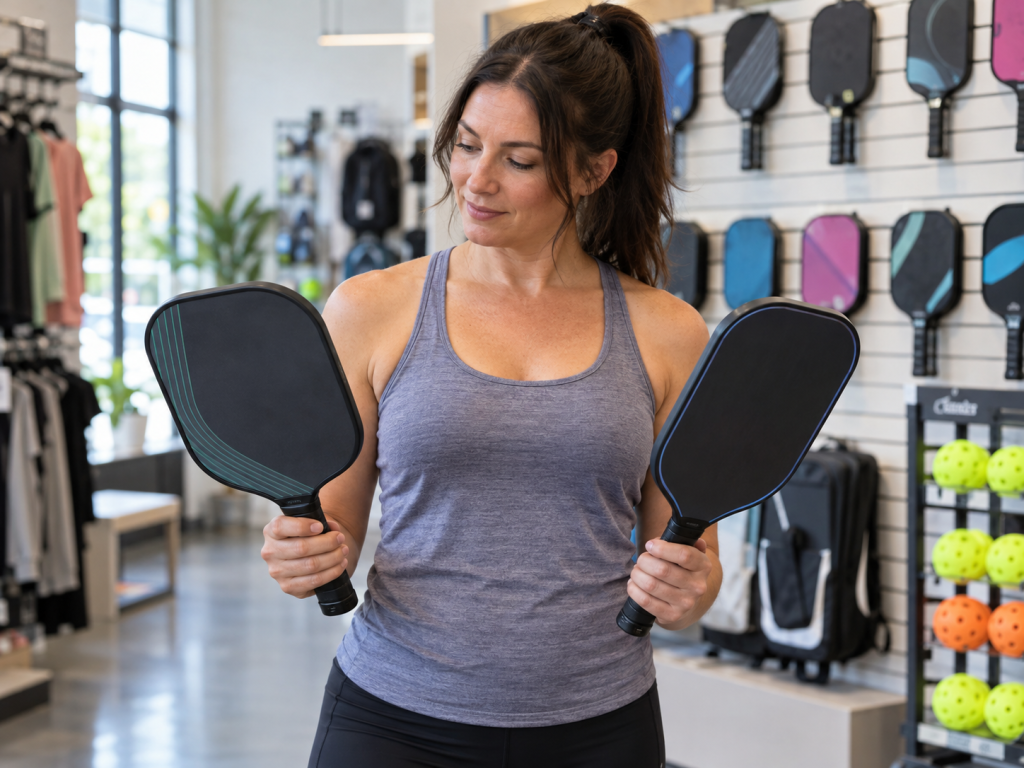
Choosing your first pickleball paddle can feel more complicated than it needs to be.
You will see paddles described by weight, shape, grip size, core thickness, face material, swing weight and other specifications. For a beginner, all those numbers can quickly turn a simple purchase into a technical research project.
The good news is that you do not need to understand every specification to choose a paddle that works well.
For most beginners, the most important things to understand are:
- Paddle weight
- Paddle shape
- Grip size
- Paddle construction
Once you understand what those four things affect, comparing paddles becomes much easier.
Start With Comfort, Not Specifications
A good beginner paddle should feel comfortable in your hand and easy to control.
You do not need the most powerful paddle, the newest material or the most expensive model available. You need something that allows you to swing naturally without feeling too heavy, awkward or difficult to hold.
Think of paddle specifications as tools for narrowing your options rather than numbers you need to memorize.
The goal is simply to find a paddle that feels manageable and suits the way you want to learn the game.
Paddle Weight
Paddle weight is one of the most noticeable differences between paddles.
Even a small change in weight can affect how quickly you can move the paddle and how solid it feels when contacting the ball.
Pickleball paddles are commonly grouped into three broad categories:
Lightweight Paddles
Lightweight paddles are easier to move quickly.
They can feel comfortable for beginners who want:
- Faster paddle movement
- Easier handling
- Less weight in the hand
- Quick reactions near the net
The tradeoff is that lighter paddles usually provide less natural momentum behind the ball.
Players may need to generate more of their own power when hitting deeper shots.
A very light paddle can also feel less stable when the ball is struck away from the center of the paddle face.
Midweight Paddles
Midweight paddles generally provide a balance between maneuverability, stability and power.
For many beginners, this is the easiest category to start with.
A midweight paddle usually feels substantial enough to provide solid contact without becoming difficult to swing.
If you are unsure what weight to choose, starting somewhere in the middle is usually a practical approach.
Heavy Paddles
Heavier paddles create more momentum during the swing.
That extra mass can help produce powerful shots and provide additional stability when contacting the ball.
However, heavier paddles can also feel slower to move.
For a new player, too much weight may make quick reactions more difficult and can cause the paddle to feel tiring during longer sessions.
Beginners generally do not need to choose the heaviest paddle simply because it promises more power.
Control and comfort are usually more valuable while learning.
What Paddle Weight Should a Beginner Choose?
There is no single perfect paddle weight for every beginner.
However, a balanced midweight paddle is often a sensible starting point because it provides a useful combination of:
- Control
- Stability
- Maneuverability
- Power
The important question is not whether one paddle is a few tenths of an ounce heavier than another.
Ask yourself whether the paddle feels easy to move and comfortable to hold.
If it feels noticeably heavy after only a few swings, it may not be the best choice.
Paddle Shape
Pickleball paddles are available in several shapes.
The differences may look small, but paddle shape affects how much surface area you have and where that surface area is positioned.
Most paddles fall into three general categories:
- Standard
- Widebody
- Elongated
Standard-Shaped Paddles
A standard paddle offers a balanced combination of length and width.
For beginners, this type of shape is usually easy to handle and provides a comfortable amount of hitting surface.
It does not emphasize one particular characteristic too strongly.
That makes a standard shape a reliable choice when you are still learning what type of paddle you prefer.
Widebody Paddles
Widebody paddles have a larger surface area across the width of the paddle.
The wider face can provide a generous hitting area, which can be reassuring for beginners who are still learning consistent contact.
A wider paddle may also feel forgiving when contact is slightly away from the center.
Players who value a large, comfortable paddle face may prefer this type of shape.
Elongated Paddles
Elongated paddles are longer and narrower.
The additional length can provide more reach and may create additional leverage during the swing.
However, the narrower paddle face usually means there is less width available for contacting the ball.
That does not make elongated paddles unsuitable for beginners, but they are not automatically better simply because they provide more reach.
A newer player may find a standard or widebody paddle easier to manage.
Which Paddle Shape Is Best for Beginners?
For most beginners, a standard or slightly wider paddle is a comfortable place to start.
These shapes usually provide plenty of hitting surface without making the paddle feel unusually long or narrow.
You can always explore more specialized paddle shapes later after developing preferences of your own.
Your first paddle does not need to be specialized.
It needs to be easy to use.
Grip Size
Grip size refers to the circumference of the paddle handle.
This specification is easy to overlook, but it has a major effect on how comfortable the paddle feels.
A grip that is too large can make the paddle difficult to hold securely.
A grip that is too small may require you to squeeze the handle harder than necessary.
Ideally, the grip should feel secure without forcing your hand to work excessively.
Smaller Grips
A smaller grip can make it easier to move the paddle with your wrist and hand.
It may also be easier to increase the grip size later by adding an overgrip.
Because of that, players who are uncertain between two grip sizes often prefer starting with the smaller option.
Larger Grips
A larger grip can feel more substantial in the hand.
For players with larger hands, this may feel more comfortable and stable.
However, choosing a grip simply because you have large hands is not always enough.
Personal comfort matters more than hand size alone.
How to Check Grip Size
If possible, hold the paddle before buying it.
Wrap your hand naturally around the handle.
You should be able to grip the paddle securely without feeling like your fingers are crowded or stretched.
The handle should feel comfortable rather than oversized.
If you are shopping online and cannot test the paddle, selecting a slightly smaller grip is often easier to adjust because an overgrip can increase the circumference later.
Reducing the size of an oversized grip is more difficult.
Handle Length Also Matters
Grip circumference is not the only handle measurement worth noticing.
Paddles also have different handle lengths.
A longer handle provides more room for your hand and may be useful for players who occasionally prefer placing two hands on the paddle.
A shorter handle leaves more of the paddle’s overall dimensions available for the paddle face.
For a beginner using primarily one hand, either can work.
You do not need to make handle length a major deciding factor unless one option clearly feels more comfortable.
Paddle Construction
Paddle construction sounds technical, but beginners only need to understand two basic parts:
- The paddle face
- The paddle core
The face is the outer surface that contacts the ball.
The core is the material inside the paddle.
Together, they influence how the paddle feels when the ball makes contact.
Paddle Face Materials
Modern pickleball paddles are made with several different face materials.
The most common include:
- Fiberglass
- Carbon fiber
- Graphite
- Composite materials
You do not need to become an expert in materials before buying your first paddle.
Each material can be used to produce excellent paddles.
The final performance of a paddle depends on its complete design rather than the face material alone.
Still, understanding the general differences can help when comparing options.
Fiberglass Paddles
Fiberglass is commonly used in recreational and beginner-friendly paddles.
It can provide a lively response when the ball contacts the paddle face.
Fiberglass paddles are often available at accessible prices, making them a common choice for newer players.
They are perfectly capable of providing a good introduction to the sport.
Carbon Fiber Paddles
Carbon fiber has become extremely common in modern pickleball paddles.
It is often associated with a controlled, consistent feel.
Many carbon fiber paddles are designed to provide good touch and predictable ball response.
However, seeing the words “carbon fiber” on a paddle does not automatically mean it is better than every fiberglass paddle.
Construction quality and overall design still matter.
Graphite Paddles
Graphite paddles are generally lightweight and responsive.
They have been popular in pickleball for many years and remain a reasonable option for beginners and experienced players alike.
As with carbon fiber, the material itself should not be your only reason for choosing a particular paddle.
Composite Paddles
The term “composite” can refer to paddles made using combinations of different materials.
Because the term is broad, two composite paddles may perform very differently.
Do not assume that every paddle labeled composite will feel the same.
Pay more attention to the paddle’s overall weight, shape and feel.
What Is Inside a Pickleball Paddle?
Most modern paddles contain an internal honeycomb-style core.
The core may be made from polymer or another lightweight material.
You may see product descriptions listing the exact core material or construction method.
For a beginner, you usually do not need to analyze every internal detail.
What matters more is how the paddle feels during contact.
A well-designed core can help create a combination of:
- Stability
- Control
- Comfortable impact
- Predictable response
Core Thickness
Core thickness is another specification commonly included in paddle descriptions.
You may see measurements such as 13 mm, 14 mm or 16 mm.
The exact number can look important, but beginners do not need to obsess over millimeters.
As a general idea, thicker paddles are often designed to provide a softer, more controlled feel.
Thinner paddles can feel more responsive or lively.
That does not mean thick is always better for control or thin is always better for power.
Paddle construction involves several factors working together.
For a beginner, a moderately thick paddle can be a comfortable choice if you want a stable and forgiving feel.
Do You Need an Expensive Paddle?
No.
A beginner does not need a premium paddle to learn pickleball.
More expensive paddles may include:
- Higher-end materials
- More advanced manufacturing
- Specialized surface textures
- More refined weight distribution
- Premium branding
Those features can matter to experienced players who already know exactly what they want from a paddle.
They matter much less when you are still developing basic preferences.
A reasonably priced paddle with comfortable weight, shape and grip can be more than enough for your first months of play.
Avoid Choosing a Paddle Based Only on Power
Many paddle descriptions emphasize power.
That can make powerful paddles sound like the obvious choice.
But beginners usually benefit more from a paddle that feels predictable.
If the paddle is extremely powerful, small changes in your swing can produce larger changes in where the ball goes.
A balanced paddle can make it easier to develop confidence and consistent contact.
You can always move toward a more specialized power paddle later if that becomes your preference.
Avoid Choosing Based Only on the Sweet Spot
You may also see manufacturers advertising a large “sweet spot.”
The sweet spot is the area of the paddle face where contact tends to feel most solid and predictable.
A generous sweet spot is useful, especially for beginners.
But there is no universal measurement used by every manufacturer.
That means sweet-spot claims are difficult to compare directly between brands.
Instead of choosing a paddle because the product page claims it has the largest sweet spot, look for a balanced paddle with a comfortable face size and stable construction.
Do Not Overthink Technical Specifications
Once you start researching paddles, you may encounter specifications such as:
- Swing weight
- Twist weight
- Surface grit
- Edge foam
- Thermoforming
- Unibody construction
- Core density
- Balance point
These details can become useful later.
They are not necessary for choosing your first paddle.
A beginner can make a perfectly good choice without understanding any of them.
If two paddles both have a reasonable weight, comfortable grip and beginner-friendly shape, the difference between highly technical construction details is unlikely to determine whether you enjoy playing pickleball.
A Simple Beginner Paddle Checklist
When comparing paddles, ask these questions:
Does the weight feel comfortable?
The paddle should feel easy to swing without becoming tiring.
Is the shape easy to manage?
A standard or widebody shape is usually beginner-friendly.
Does the grip fit comfortably?
You should be able to hold the paddle securely without squeezing excessively.
Is the paddle reasonably well constructed?
You do not need premium materials, but avoid extremely cheap paddles that feel flimsy or poorly finished.
Is the price reasonable for your budget?
Your first paddle does not need to be your final paddle.
Choose something good enough to learn with rather than spending heavily before you know your preferences.
A Good Starting Setup for Most Beginners
If you want to simplify the decision even further, look for a paddle with:
- A comfortable midweight feel
- A standard or slightly wide paddle face
- A grip that feels secure but not oversized
- A polymer-style core
- A fiberglass, graphite or carbon fiber face from a reputable manufacturer
There is plenty of room for personal preference within those guidelines.
You do not need to match them perfectly.
They simply provide a sensible starting point when dozens of paddle options begin to look the same.
Your First Paddle Does Not Need to Be Perfect
One of the easiest mistakes when choosing a pickleball paddle is trying to find the perfect paddle before you have played enough to know what “perfect” means for you.
Your preferences will probably change as you gain experience.
After playing regularly, you may discover that you prefer:
- A lighter or heavier paddle
- A longer paddle
- A wider paddle
- A softer feel
- A more powerful response
- A longer handle
- A different grip size
That is normal.
Your first paddle is primarily a tool for learning what you like.
How to Choose a Pickleball Paddle
Choosing a pickleball paddle becomes much easier when you ignore most of the marketing language and focus on the basics.
Start with weight.
Choose a paddle that feels comfortable and easy to move.
Next, consider shape.
A standard or wider paddle face is often an easy choice for beginners.
Make sure the grip feels secure and comfortable in your hand.
Finally, remember that paddle construction matters, but you do not need to become an expert in materials, cores or manufacturing methods before making a purchase.
For a beginner, comfort, control and confidence matter more than chasing the most advanced specifications.
Choose a paddle that feels manageable, start playing and allow your experience on the court to tell you what you might want from your next one.