
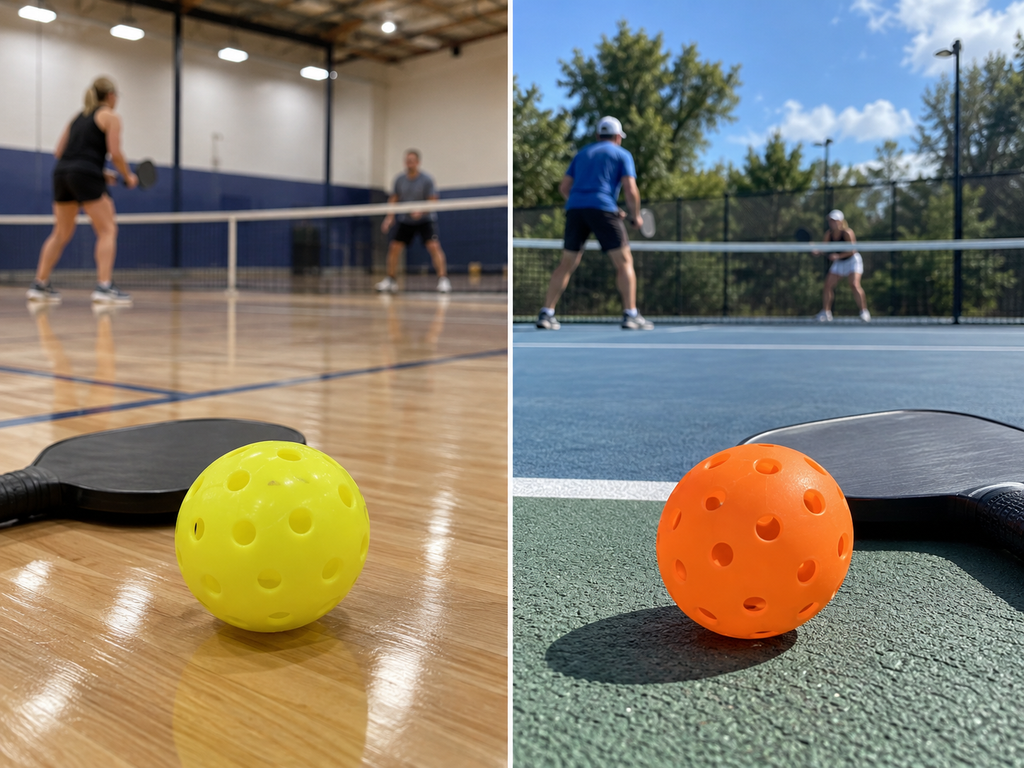
Pickleballs may look almost identical at first glance, but balls designed for indoor and outdoor play are built differently for a reason.
The playing environment affects how the ball moves through the air, how it reacts after bouncing and how much control players have over their shots. Indoor courts are usually protected from wind and weather, while outdoor courts expose the ball to moving air, harder surfaces and changing conditions.
To compensate for those differences, manufacturers adjust features such as the number and size of the holes, the weight and the overall construction of the ball.
For beginners, knowing how to recognize indoor and outdoor pickleballs makes it easier to choose the right ball for the court and understand why the game may feel slightly different when moving between indoor and outdoor play.
What Is an Indoor Pickleball?
An indoor pickleball is designed primarily for play inside gyms, recreation centers and other enclosed courts.
Because indoor environments usually have little or no wind, the ball does not need as much resistance to outside air movement. Indoor balls are therefore commonly made with fewer, larger holes.
A typical indoor pickleball often has around 26 holes, although the exact number can vary by manufacturer and model.
The larger openings allow more air to pass through the ball. This can make the ball feel slightly softer and easier to control during slower exchanges.
Indoor pickleballs are also often somewhat lighter than outdoor balls.
That combination can produce a ball that responds well to controlled shots and touch-based play.
What Is an Outdoor Pickleball?
Outdoor pickleballs are designed to perform on courts exposed to wind, temperature changes and other environmental conditions.
They usually have more holes than indoor balls, with the holes being smaller in diameter.
Many outdoor pickleballs have approximately 40 holes, although designs can vary.
The smaller holes help reduce the effect of wind passing through the ball and contribute to a more stable flight outdoors.
Outdoor balls are also commonly slightly heavier and made from firmer plastic.
This construction helps them handle the harder surfaces typically found on outdoor courts and allows them to maintain more predictable movement in changing conditions.
The Main Difference: The Holes
The easiest way to tell indoor and outdoor pickleballs apart is usually by looking at their holes.
Indoor balls generally have:
- Fewer holes
- Larger holes
Outdoor balls generally have:
- More holes
- Smaller holes
This difference is not simply cosmetic.
The holes influence how air moves around and through the ball while it is in flight.
A ball with larger openings allows more air to pass through it. In a protected indoor environment, this is generally not a problem because wind is minimal.
Outside, however, larger holes could make the ball more affected by moving air. Smaller and more numerous holes help an outdoor ball maintain greater stability.
Why Outdoor Pickleballs Have More Holes
Outdoor courts introduce one major variable that indoor players rarely have to deal with: wind.
Even a relatively light breeze can affect a pickleball because the ball is lightweight and perforated.
Outdoor pickleballs are designed with smaller holes distributed around the surface to help the ball move more consistently through changing air conditions.
This does not mean an outdoor pickleball is unaffected by wind. Strong wind can still influence its direction and speed.
The design simply helps make the ball more suitable for outdoor conditions.
Why Indoor Pickleballs Have Larger Holes
Indoor courts do not usually have significant air movement.
Because manufacturers do not need to compensate for wind to the same degree, indoor balls can use larger openings.
The larger holes contribute to the softer feel commonly associated with indoor pickleballs.
For beginners, this difference may be noticeable during gentle shots. Indoor balls can sometimes feel easier to control when the pace of the rally slows.
The design fits the more predictable environment of an indoor court.
Weight Differences
Indoor and outdoor pickleballs are similar in overall size, but outdoor balls are often slightly heavier.
The additional weight can help outdoor balls remain more stable when playing in breezy conditions.
A heavier ball may also feel slightly faster or firmer when struck.
Indoor balls tend to be lighter because they do not need the same level of resistance to outdoor air movement.
The difference is small, but experienced players can often feel it when switching between ball types.
Differences in Plastic and Firmness
The type and firmness of the plastic can also differ between indoor and outdoor pickleballs.
Outdoor balls are often made from harder, more rigid plastic.
This helps them tolerate contact with outdoor court surfaces, which are frequently harder and more abrasive than indoor flooring.
Indoor pickleballs are often slightly softer.
That softer construction can contribute to a different feel when the ball contacts the paddle.
The exact material and firmness depend on the manufacturer, so not every indoor ball will feel soft and not every outdoor ball will feel extremely hard.
However, firmness is another useful clue when comparing the two types.
How They Bounce
The construction of the ball also affects how it behaves after hitting the court.
Outdoor pickleballs often feel slightly firmer and can produce a more direct or lively bounce.
Indoor balls may feel softer and can react somewhat differently because of their lighter construction and larger holes.
The court surface itself also matters.
Indoor pickleball may be played on wood, synthetic flooring or dedicated indoor court surfaces. Outdoor courts are commonly built from asphalt or concrete with an acrylic coating.
Because both the ball and the surface change, beginners may notice that the bounce feels different even when using similar strokes.
How They Feel When You Hit Them
The difference between indoor and outdoor pickleballs becomes more noticeable once you begin playing regularly.
Indoor balls may feel softer when they contact the paddle.
Outdoor balls often feel firmer and more solid.
Some players describe outdoor balls as producing a sharper response, while indoor balls can feel slightly more forgiving.
These differences are subtle and can vary between brands, but they are part of the reason players often prefer using the ball designed for their environment.
How to Recognize an Indoor Pickleball
If you are unsure whether a ball is designed for indoor play, start by examining the holes.
An indoor pickleball will usually have relatively large holes and fewer of them.
You may also notice that the ball feels somewhat lighter or softer when compared directly with an outdoor ball.
The packaging is usually the most reliable confirmation. Manufacturers normally label their balls as indoor or outdoor.
If the packaging is no longer available, hole size and number are the easiest visual clues.
How to Recognize an Outdoor Pickleball
Outdoor pickleballs typically have many smaller holes distributed across the ball.
If you compare one beside an indoor ball, the difference is usually easy to see.
The outdoor ball may also feel slightly harder or heavier in your hand.
Again, there can be differences between manufacturers, so the exact number of holes should not be treated as the only identifying feature.
Look at the overall design:
More and smaller holes usually indicate an outdoor pickleball.
Indoor vs. Outdoor Pickleballs at a Glance
| Feature | Indoor Pickleball | Outdoor Pickleball |
|---|---|---|
| Hole size | Larger | Smaller |
| Number of holes | Usually fewer | Usually more |
| Common hole count | Around 26 | Around 40 |
| Weight | Usually slightly lighter | Usually slightly heavier |
| Plastic feel | Often softer | Often firmer |
| Main environment | Enclosed indoor courts | Outdoor courts |
| Wind resistance | Less important | More important |
| Typical feel | Softer and controlled | Firmer and more direct |
These are general characteristics rather than strict rules. Pickleball manufacturers can use different designs while still producing balls intended for the same environment.
Can You Use an Indoor Pickleball Outside?
Technically, you can hit an indoor pickleball on an outdoor court.
However, it may not perform the way it was designed to perform.
Because indoor balls usually have larger holes and are slightly lighter, wind may affect them more easily.
Even a moderate breeze can make the ball drift or behave less predictably.
The softer construction may also wear more quickly on rough outdoor court surfaces.
For casual practice on a calm day, an indoor ball may still work, but an outdoor ball is generally better suited to outdoor conditions.
Can You Use an Outdoor Pickleball Indoors?
Outdoor pickleballs can also be used indoors, but they may feel noticeably different.
Because they are usually harder and slightly heavier, they can feel faster or firmer during rallies.
The bounce and paddle response may also feel different from what players expect when using a traditional indoor ball.
Using an outdoor ball indoors is not necessarily a problem for casual play, but indoor balls are specifically designed for that environment and may provide a more suitable feel.
Why the Correct Ball Matters
For a beginner, the difference between indoor and outdoor pickleballs may initially seem minor.
Both are roughly the same size. Both have holes. Both are used with the same paddles and on the same dimensions of court.
But small differences in construction affect how the ball reacts.
Using the correct type of ball helps provide more predictable performance for the conditions in which you are playing.
Indoors, that means using a ball designed for a controlled environment.
Outdoors, it means using a ball designed to handle wind, harder court surfaces and changing weather conditions.
Do All Pickleballs Have the Same Number of Holes?
No.
Although indoor balls commonly have around 26 holes and outdoor balls commonly have around 40, manufacturers are not limited to those exact numbers for every recreational ball.
Hole patterns, hole sizes and plastic construction can vary.
That is why beginners should avoid identifying a ball based only on the exact hole count.
Instead, look at the broader pattern.
Indoor pickleballs generally have fewer and larger holes.
Outdoor pickleballs generally have more and smaller holes.
The product label remains the best way to confirm the intended use.
Does Color Tell You Whether a Pickleball Is Indoor or Outdoor?
No.
Pickleballs come in many colors, including yellow, green, orange, white and other highly visible shades.
Color is normally chosen for visibility rather than to identify whether a ball is intended for indoor or outdoor play.
You cannot reliably determine the ball type simply by looking at its color.
Instead, check the hole pattern, feel and manufacturer labeling.
What Beginners Should Remember
You do not need to memorize every technical specification of a pickleball.
The simplest distinction is enough:
Indoor pickleballs usually have fewer, larger holes. Outdoor pickleballs usually have more, smaller holes.
Indoor balls are designed for controlled environments where wind is not a major factor.
Outdoor balls are designed to remain more stable in open-air conditions and are often slightly heavier and firmer.
Once you know what to look for, the difference becomes easy to recognize.
Final Thoughts
Indoor and outdoor pickleballs are built differently because they have to perform in different environments.
Indoor balls typically use fewer, larger holes and are often lighter and slightly softer. Outdoor balls generally use more, smaller holes along with firmer construction to help them perform more consistently in wind and on harder outdoor courts.
For beginners, the most important thing is learning to recognize those basic differences.
Check the holes, feel the construction and look at the manufacturer label whenever possible. Choosing the ball designed for your playing environment gives you a more consistent experience and helps the ball behave the way it was intended to behave.