
Hit a Pickleball Dink Like a Pro: A Simple Guide for Beginners
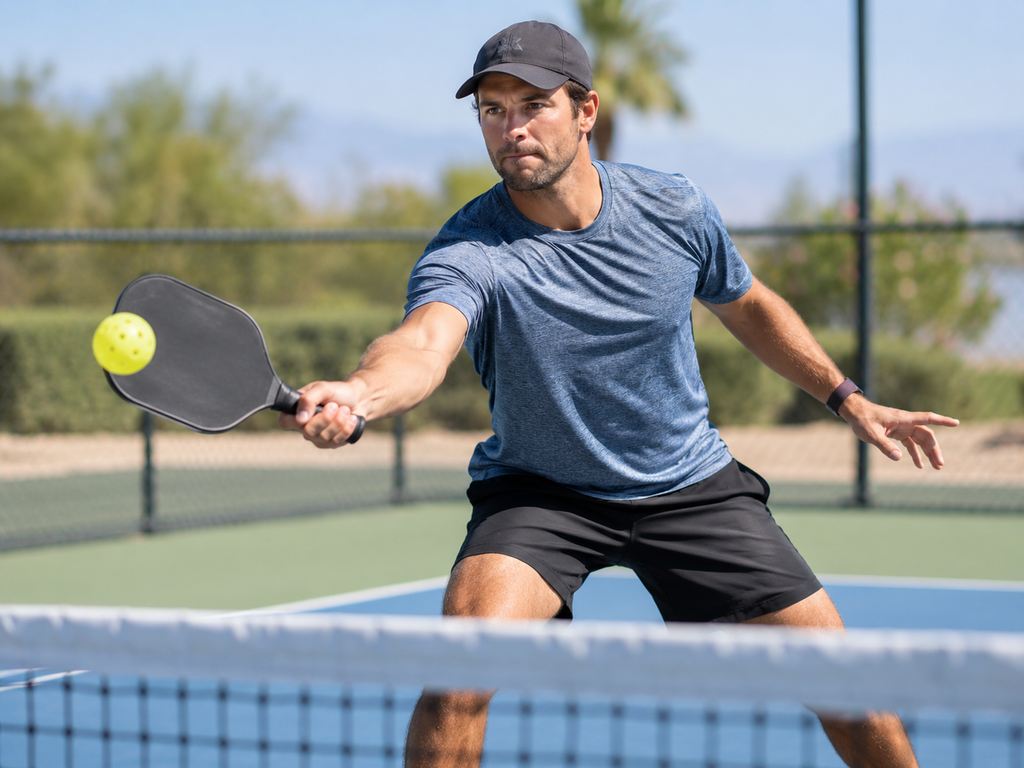
The dink may look like one of the simplest shots in pickleball. It is slow, soft and usually travels only a short distance over the net.
But learning how to hit a pickleball dink consistently is one of the most important steps toward becoming a more controlled and confident player.
Unlike a drive or smash, a dink is not designed to overpower your opponent. The goal is to place the ball softly into the opponent’s non-volley zone, commonly called the kitchen, so they have difficulty attacking it.
For beginners, learning to dink also teaches several fundamental skills at once: touch, paddle control, balance, patience and shot placement.
In this guide, you will learn what a dink is, how to hit one correctly, where to aim, the mistakes beginners commonly make and several simple drills you can use to develop better control.
What Is a Dink in Pickleball?
A dink is a soft, controlled shot that travels over the net and lands in your opponent’s non-volley zone.
It is normally played from near your own non-volley zone line after the ball has bounced.
Instead of trying to hit the ball past your opponent, you are trying to make the ball:
- Clear the net safely
- Drop quickly after crossing the net
- Land inside the opponent’s kitchen
- Stay low enough that your opponent cannot easily attack it
A good dink forces the opponent to hit the ball upward because they are contacting it below the height of the net.
That is what makes the shot useful.
If you hit the dink too high, your opponent may be able to attack it. If you hit it too low, the ball may go into the net.
The challenge is learning to find the controlled middle ground.
Why Beginners Should Learn the Dink
Many new pickleball players naturally want to hit the ball harder.
Hard shots can certainly be useful, but pickleball is not only a power game.
Because players can position themselves close to the net at the non-volley zone line, hitting a hard ball directly at an opponent is not always the best option. A controlled dink can make it difficult for them to attack while giving you time to remain balanced and ready for the next shot.
Learning to dink helps you develop:
- Better paddle control
- Softer hands
- Improved ball placement
- Better balance near the kitchen
- More patience during rallies
- Greater control over the pace of play
- Confidence when playing close to the net
The dink also introduces an important idea that beginners eventually discover throughout pickleball:
You do not have to hit every ball hard to win the rally.
Sometimes making the opponent hit one more difficult ball is the better choice.
Where Do You Hit a Dink From?
Most dinks are played when you are positioned close to the non-volley zone line.
The non-volley zone extends seven feet from the net on each side of the court. USA Pickleball describes the entire 14-foot area surrounding the net as the non-volley zone.
Beginners sometimes believe they are never allowed to step into the kitchen.
That is not the rule.
You may enter the non-volley zone and hit a ball after it bounces. The restriction applies to volleys, which are shots hit before the ball bounces.
You cannot volley while touching the non-volley zone or its line, and your momentum after a volley cannot carry you into the zone.
Because a traditional dink is normally played after the ball bounces, you may step into the kitchen when necessary to reach it.
After making the shot, however, recover toward the non-volley zone line so you are prepared for the next ball.
How to Hit a Pickleball Dink Step by Step
The dink is primarily a control shot. You do not need a large swing or a complicated technique.
Focus on keeping everything simple.
1. Start in a Balanced Ready Position
Stand near the non-volley zone line with your feet approximately shoulder-width apart.
Keep your knees slightly bent and your weight balanced.
Hold your paddle comfortably in front of your body.
You should feel athletic and ready to move in either direction rather than standing completely upright or leaning forward excessively.
Avoid locking your knees.
The lower, balanced position makes it easier to move toward the ball without reaching or falling forward.
2. Move Your Feet Toward the Ball
Do not rely only on your arm to reach the ball.
If the dink is slightly to your left or right, take small adjustment steps so you can make contact from a comfortable position.
Whenever possible, get your body behind the shot.
Reaching too far away from your body makes controlling the paddle face much more difficult.
For very short balls, you may need to step into the kitchen after the ball bounces.
That is allowed.
Just maintain your balance and recover afterward.
3. Keep Your Grip Relaxed
One of the biggest differences between a good dink and an uncontrolled one is grip pressure.
Avoid squeezing the paddle tightly.
You need enough grip pressure to control the paddle, but your hand and arm should remain relaxed.
A tight grip often causes the ball to leave the paddle too quickly and travel too high or too far.
Think of the dink as gently guiding the ball rather than striking it.
4. Use a Short Backswing
You do not need to pull the paddle far behind your body.
Keep the backswing compact.
Large swings introduce unnecessary speed and make it harder to control distance.
For most beginner dinks, the paddle only needs to move slightly backward before beginning a smooth forward motion.
5. Let the Ball Bounce
For a standard dink, allow the incoming ball to bounce before hitting it.
Try to make contact after the bounce while the ball is still comfortably in front of your body.
Do not wait until the ball is so low that you have to scoop it off the court.
If possible, position yourself early enough that you can make contact at a comfortable height.
6. Keep the Paddle Face Slightly Open
Your paddle face will generally be slightly open so the ball has enough lift to clear the net.
However, avoid dramatically opening the paddle face.
Too much upward angle can send the ball high into the air.
The goal is to provide just enough lift for the ball to clear the net and then descend into the kitchen.
7. Lift the Ball With a Smooth Motion
Move the paddle gently forward and slightly upward.
The motion should feel more like a controlled push or lift than a swing.
You are using the paddle to guide the ball over the net.
Keep your wrist relatively stable during the motion. Beginners generally develop better consistency by relying on a simple movement from the shoulder rather than excessive wrist action.
8. Make Contact in Front of Your Body
Whenever possible, contact the ball slightly in front of you.
Making contact too far behind your body often forces you to flick or scoop the paddle just to get the ball over the net.
Contacting the ball comfortably in front allows you to control both the height and direction of the dink more easily.
9. Use a Small Follow-Through
After contact, allow the paddle to continue toward your target.
The follow-through should remain short and controlled.
You do not need the long follow-through you might use on a powerful groundstroke.
Remember:
Small swing, soft contact, controlled finish.
10. Recover Immediately
After hitting the dink, bring your paddle back to a ready position.
Do not stand and watch your shot.
Your opponent may return the ball quickly.
Return to a balanced stance near the non-volley zone line and prepare for the next dink, volley or attack.
How High Should a Dink Travel Over the Net?
There is no single perfect height for every dink.
The important objective is to give yourself enough clearance to avoid hitting the net while keeping the ball low enough that it cannot easily be attacked.
Beginners sometimes try to hit extremely close to the top of the net.
That creates unnecessary errors.
A safer dink that clears the net comfortably and drops into the kitchen is usually better than repeatedly trying to hit a nearly perfect shot that goes into the net.
As your control improves, you can gradually become more precise.
Where Should You Aim a Dink?
When you are first learning, do not worry about hitting tiny targets.
Your initial goal should simply be to land the ball consistently inside the opponent’s kitchen.
Once you can do that, begin practicing different locations.
Middle of the Kitchen
The center is often the easiest target for beginners.
It provides plenty of space and allows you to concentrate primarily on height and distance control.
Opponent’s Backhand Side
Once you become more accurate, you can direct some dinks toward an opponent’s backhand.
Some recreational players are less comfortable controlling soft balls from this side.
Near the Sideline
A wider dink can make your opponent move away from the center of the court.
However, aiming very close to the sideline also gives you a smaller margin for error.
Beginners should develop consistency before trying to paint the lines.
Toward the Opponent’s Feet
Keeping the ball low near an opponent’s feet can make it difficult for them to attack.
If they have to contact the ball below net height, they will usually need to lift it upward.
Forehand Dink
A forehand dink is played on your forehand side using the same basic principles described above.
Start with your paddle in front of your body.
Move into position, let the ball bounce and use a short, smooth forward-and-upward motion.
Avoid turning the dink into a full forehand groundstroke.
The shot does not require significant body rotation or acceleration.
Concentrate on:
- Relaxed grip pressure
- Stable paddle face
- Contact in front
- Smooth lift
- Controlled follow-through
The ball should feel as though you are guiding it toward the target.
Backhand Dink
The backhand dink is equally important because opponents will not always send the ball toward your forehand.
For many players, the backhand dink can actually feel very natural because the paddle begins comfortably in front of the body.
Keep the paddle compact and avoid taking it far behind you.
Move toward the ball, let it bounce and gently push or lift it toward the opponent’s kitchen.
Again, excessive wrist movement usually makes the shot less predictable.
Keep the motion simple.
Crosscourt Dink vs. Straight-Ahead Dink
You can dink either straight ahead or diagonally across the court.
Both are useful shots.
Straight-Ahead Dink
A straight-ahead dink travels more directly across the net.
Because the distance is shorter, you need to control your touch carefully.
The shot can be simple for beginners because the target is directly in front of you, but hitting it too aggressively may send the ball deeper than intended.
Crosscourt Dink
A crosscourt dink travels diagonally into the opponent’s kitchen.
The diagonal path gives the ball more court to travel before reaching the target.
That additional distance can give you more room to hit a controlled shot.
Crosscourt dinks can also pull an opponent toward the sideline, creating movement during the rally.
Beginners should practice both directions rather than developing only one comfortable dink.
What Makes a Good Pickleball Dink?
A successful dink does not need to be spectacular.
For a beginner, a good dink usually has four characteristics:
It clears the net.
A dink cannot help you if it never reaches the opponent’s side.
It lands in or near the kitchen.
If the ball travels too deep, the opponent may have an easier attacking opportunity.
It stays relatively low.
A high dink may give the opponent a chance to hit downward.
It allows you to recover.
Good control helps you remain balanced and prepared rather than falling forward after every shot.
Consistency should be your first goal.
Placement and deception can come later.
Common Pickleball Dinking Mistakes
Dinking can feel frustrating at first because even small changes in paddle angle or swing speed can produce very different results.
Most beginner errors come from a few common problems.
Hitting the Ball Too Hard
This is probably the most common mistake.
Beginners often use the same swing they would use for a groundstroke.
The ball then travels through the kitchen or rises high enough for the opponent to attack.
How to fix it: Shorten your backswing and relax your grip. Think about guiding the ball rather than hitting it.
Taking Too Large a Backswing
A large backswing creates more paddle speed than a dink requires.
It also makes timing more difficult.
How to fix it: Keep the paddle in front of your body and use a compact motion.
Using Too Much Wrist
Trying to flick the ball with your wrist can make paddle angle difficult to repeat consistently.
How to fix it: Keep the wrist relatively stable and create the movement primarily with a smooth shoulder and arm motion.
Standing Too Upright
Straight legs make it harder to reach low balls while staying balanced.
How to fix it: Bend your knees and lower your body toward the ball rather than simply bending forward from your waist.
Reaching Instead of Moving
When the ball lands away from your body, stretching the paddle toward it reduces your control.
How to fix it: Use small adjustment steps whenever you have time.
Hitting the Ball Too High
A dink that sits high above the net can become an attacking opportunity.
How to fix it: Reduce paddle speed and avoid opening the paddle face excessively.
Hitting Too Many Balls Into the Net
Trying to keep every dink extremely low often produces unnecessary errors.
How to fix it: Give yourself more net clearance. Develop reliability before trying to make the shot extremely aggressive.
Watching Your Shot Instead of Recovering
A dink rally can continue quickly.
How to fix it: Return the paddle to your ready position immediately after every shot.
Do Not Be Afraid to Let the Ball Bounce
Beginners sometimes feel pressure to hit every ball out of the air when they are near the net.
That is unnecessary.
If the ball is dropping into the kitchen and is difficult to volley comfortably, allowing it to bounce may give you a much easier shot.
Remember that the kitchen is a non-volley zone, not a zone you are forbidden from entering.
You can step inside it to play a ball that has bounced. USA Pickleball’s rules specifically restrict volleying from the non-volley zone rather than ordinary shots played after a bounce.
Good players do not attack every ball.
Sometimes the correct response is simply another controlled dink.
How to Practice Your Pickleball Dink
You do not need complicated training equipment to improve your dink.
Consistency comes from repeating simple movements and gradually adding difficulty.
Drill 1: Cooperative Dinking
Stand at opposite kitchen lines with a partner.
Dink the ball back and forth without trying to win the rally.
Your goal is simply to keep the ball going.
Start by trying to complete:
- 5 consecutive dinks
- Then 10
- Then 20
- Then as many as possible
This teaches control without the pressure of competition.
Drill 2: Forehand-Only Dinks
Practice several minutes using primarily your forehand.
Concentrate on repeating the same compact motion and paddle angle.
Then switch to your backhand.
This helps you identify which side needs more work.
Drill 3: Crosscourt Dinking
Position yourself diagonally from your practice partner.
Dink crosscourt to one another.
Once you become comfortable in one direction, switch sides.
This improves both directional control and movement.
Drill 4: Target Dinking
Place a cone, marker or other safe target inside the opponent’s kitchen.
Try to land your dink near it.
Do not worry about hitting the target directly.
Instead, measure success by how many balls land within a reasonable area around it.
As your accuracy improves, make the target area smaller.
Drill 5: Move and Dink
Instead of standing in one place, have your partner alternate dinks slightly to your left and right.
Move your feet into position before hitting each ball.
This helps turn a stationary practice stroke into a skill you can actually use during a game.
A Simple Beginner Dinking Routine
If you have 10 to 15 minutes before playing, try this progression:
- Hit 20 cooperative forehand dinks.
- Hit 20 cooperative backhand dinks.
- Dink crosscourt for several minutes.
- Practice alternating forehand and backhand dinks.
- Finish with a rally where either player can direct the ball anywhere inside the kitchen.
Do not count winners.
Count successful controlled shots.
For beginners, developing the ability to repeat the dink is much more valuable than occasionally hitting a perfect one.
When Should You Dink During a Game?
You will commonly dink when you and your opponent are positioned near the non-volley zone line and the ball is too low to attack comfortably.
Instead of forcing a hard shot, you can return another soft ball into the kitchen.
This keeps the ball low and requires your opponent to make another controlled shot.
If your opponent eventually sends the ball too high, you may have an opportunity to attack.
But beginners should avoid becoming impatient.
Trying to turn every dink into a winner often produces more mistakes than points.
Dinking in Doubles
The dink becomes particularly important in doubles because players frequently position themselves near their respective non-volley zone lines.
When all four players are near the kitchen, there may be very little open court available for a hard shot.
Soft shots can therefore become an important way to maintain control.
As a beginner, concentrate first on keeping your dinks low and playable rather than trying complicated angles.
Also remember to recover with your partner after each shot so large openings do not develop between you.
Dinking in Singles
Dinks can also be used in singles, although singles involves more open court and considerably more movement.
Because one player must cover the entire side of the court, opportunities to move an opponent with short, angled shots can arise.
However, beginners should first learn the basic mechanics of the dink before worrying about more advanced singles applications.
Pickleball Dink Rules Beginners Should Know
The most important rule to understand is that the kitchen is officially called the non-volley zone.
A volley is a shot hit before the ball bounces.
Under USA Pickleball’s non-volley-zone rules, volleys must be initiated from outside the non-volley zone. Touching the zone or its line during the act of volleying can result in a fault, and momentum after the volley also matters.
However, you may:
- Stand inside the kitchen when the ball has bounced
- Step into the kitchen to play a bounced ball
- Stay there temporarily after hitting it
Just remember that you cannot legally volley again until you have re-established yourself completely outside the non-volley zone.
Understanding this difference removes a lot of confusion for new players.
How Long Does It Take to Learn a Good Dink?
You can understand the basic dink technique during your first practice session.
Developing dependable touch takes longer.
Because the dink requires precise control over paddle speed, paddle angle and ball height, improvement usually comes through repetition rather than trying to swing harder or learn a complicated technique.
Do not judge your progress by whether every ball is perfect.
Instead, look for gradual improvements:
- Fewer balls into the net
- Fewer dinks hit too deep
- More consistent height
- Better balance
- Longer dink rallies
- Better control with both forehand and backhand
Those are signs that your touch is developing.
Frequently Asked Questions About Pickleball Dinks
What is the purpose of a dink in pickleball?
The purpose of a dink is to send a soft, controlled ball into the opponent’s non-volley zone while keeping it difficult to attack. It can help slow the rally and force the opponent to hit the ball from below net height.
Does a dink have to land in the kitchen?
A traditional dink is intended to land in the opponent’s non-volley zone. A ball that travels much deeper may still be playable, but it is generally not achieving the main objective of the dink.
Can you dink from inside the kitchen?
Yes. If the ball has bounced, you can enter the non-volley zone and hit it. The restrictions concern volleys, not shots played after the bounce.
Can you step on the kitchen line when dinking?
If the ball has bounced, you may step on or inside the non-volley zone line while playing it. The problem occurs when you volley while contacting the non-volley zone or its line.
Should a dink have topspin or backspin?
Spin can eventually become useful, but beginners do not need it to learn an effective dink.
First develop a simple, repeatable stroke with dependable height and distance control. Once you can dink consistently, you can experiment with different types of spin.
Should I use my wrist when dinking?
Some natural wrist movement can occur, but beginners generally benefit from keeping the wrist stable rather than deliberately flicking the ball. A simple shoulder-and-arm movement is easier to repeat.
Why do my dinks keep going into the net?
You may be trying to hit too close to the net, contacting the ball too low or failing to provide enough upward lift. Give yourself slightly more net clearance and concentrate on a smooth forward-and-upward motion.
Why do my dinks keep popping up?
A tight grip, excessive backswing, too much paddle speed or an overly open paddle face can all send the ball too high. Relax your grip and make the stroke smaller.
Focus on Control Before Strategy
When you first start learning the dink, do not make the shot more complicated than it needs to be.
You do not need extreme spin.
You do not need perfect angles.
You do not need to disguise every shot.
You need a repeatable motion that lets you send a soft ball over the net and into the kitchen.
Start with these priorities:
- Get into a balanced position.
- Keep your grip relaxed.
- Use a short backswing.
- Contact the ball in front of you.
- Gently lift the ball over the net.
- Keep the follow-through compact.
- Recover and prepare for the next shot.
Once you can repeat those fundamentals consistently, placement, movement and more advanced dinking patterns become much easier to learn.
Final Thoughts
Learning how to hit a pickleball dink teaches you something that power alone cannot: how to control the ball.
The shot may travel only a few feet, but it requires balance, touch, patience and precision.
Start slowly.
Keep your swing compact, stay relaxed and focus on landing the ball safely in the opponent’s kitchen. Practice both forehand and backhand dinks and gradually introduce movement, crosscourt shots and smaller targets as your control improves.
Most importantly, do not worry about making every dink perfect.
A reliable dink that repeatedly clears the net and stays difficult to attack is far more valuable than an occasional spectacular shot surrounded by errors.
Develop that consistency and you will be much more comfortable whenever the game moves toward the kitchen.