
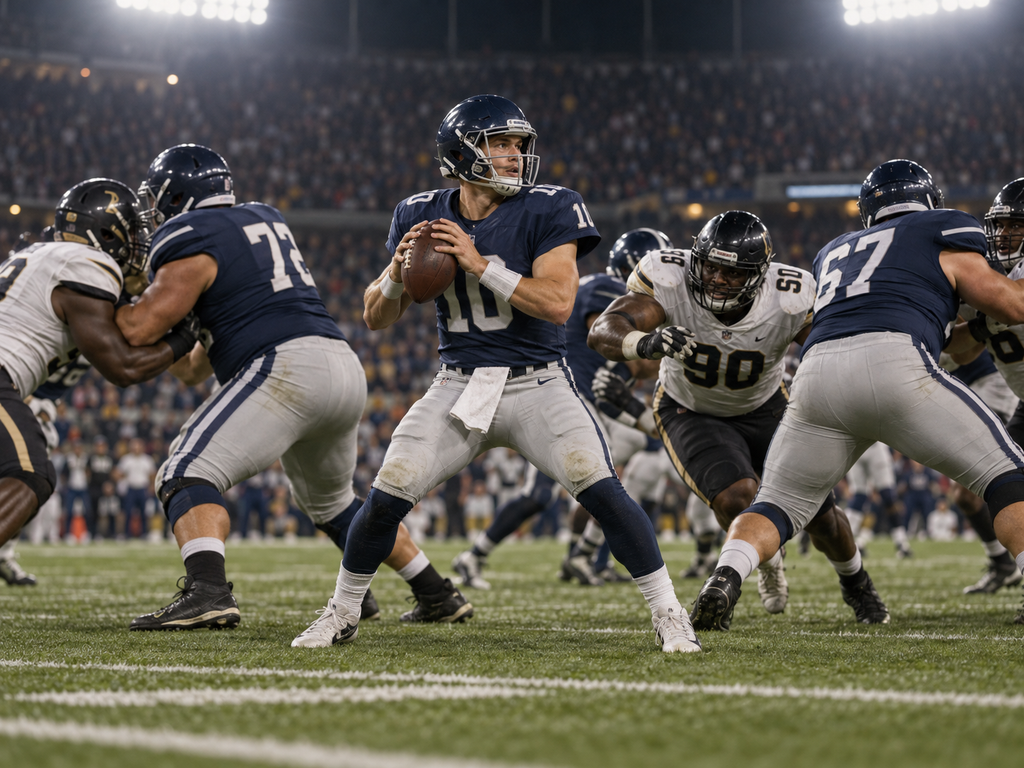
The quarterback drops back to pass on third-and-seven. The offensive line initially provides a clean pocket, and the quarterback begins looking toward the primary receiver.
Suddenly, a defensive lineman breaks through the protection on the right side.
The quarterback has only a moment to respond.
One option is to force a pass toward the intended receiver. Another is to move within the pocket and look for an available target. The quarterback might also need to escape, throw the ball away legally or accept a sack rather than risk a turnover.
Each decision carries a different level of risk.
This is where advanced quarterback development becomes especially important.
Learning to make better quarterback decisions under pressure means recognizing when a passing opportunity remains available, understanding how defensive disruption affects execution and choosing an appropriate response without losing control of the play.
Quarterbacks cannot eliminate defensive pressure. Even excellent offensive lines sometimes allow defenders to reach the passer.
What separates effective decision-making from reckless improvisation is the ability to process changing situations while protecting the football and respecting the offensive system.
This guide explains how experienced quarterbacks can develop better pocket awareness, recognize when a play is breaking down, avoid unnecessary turnovers and practice making decisions when time and space become limited.
Why Defensive Pressure Changes Quarterback Decisions
A quarterback operating from a clean pocket often has more time to maintain throwing mechanics and allow the passing concept to develop.
When pressure arrives, those conditions change.
A defender approaching from the edge may limit the quarterback’s ability to remain in the original throwing position.
Interior pressure can disrupt the space needed to step into a throw.
A collapsing pocket may also affect the quarterback’s visibility and ability to follow the intended progression.
The quarterback must recognize what has changed without assuming the play is automatically over.
Pressure Reduces Available Time
The defense may force the quarterback to act before a receiver completes the intended route.
A route that would become available a moment later may no longer be practical.
This creates an important decision-making challenge: distinguishing a passing window that is developing from one that is actually available.
A quarterback who waits too long may be sacked or lose control of the football.
A quarterback who releases too early without recognizing the defender’s position may create an interception opportunity.
Pressure Changes Throwing Conditions
Defensive pressure can affect throwing balance.
A quarterback may be unable to step forward normally or may need to move before delivering a pass.
Throwing from an unstable position can reduce accuracy, particularly when the quarterback attempts a difficult pass while being contacted.
Advanced quarterbacks learn to recognize when their throwing position is suitable and when the risk has become too high.
Pressure Can Create Emotional Urgency
A defender entering the pocket creates immediate urgency.
That urgency can cause a quarterback to rush through a decision, focus exclusively on the approaching defender or attempt an unnecessarily difficult throw.
The objective is not to ignore pressure.
It is to respond using practiced decisions rather than panic.
Recognize the Difference Between Pressure and Immediate Danger
Not every nearby defender creates the same threat.
A defensive end approaching from outside the tackle may be several steps away from reaching the quarterback.
An interior defender breaking through directly in front of the passer may create a more immediate problem.
The quarterback must learn to distinguish these situations.
Manageable Pressure
Manageable pressure occurs when a defender threatens the pocket but the quarterback still has sufficient space and time to execute the play.
The quarterback may be able to remain in position, make a controlled movement or deliver an available pass.
Moving unnecessarily can sometimes make the situation worse.
For example, drifting toward an edge rusher may shorten the defender’s path to the quarterback.
Immediate Pressure
Immediate pressure occurs when a defender is close enough to threaten the quarterback before the intended play can develop.
The quarterback may need to move, use an available passing option or protect the football.
The response depends on the location of the defender, the passing concept and the surrounding space.
A Collapsing Pocket
A collapsing pocket differs from pressure arriving from one clear direction.
Multiple defenders may reduce the available space around the quarterback.
In that situation, continuing to move backward may increase the distance needed for a successful pass and make an eventual sack more costly.
The quarterback needs to recognize whether a usable escape lane exists or whether protecting possession is the better option.
Develop Better Pocket Awareness
Pocket awareness is the ability to sense the space around the quarterback while maintaining attention on the passing play.
It does not require watching every pass rusher directly.
In fact, a quarterback who constantly looks at the rush may lose track of receivers and coverage defenders.
Maintain Awareness Without Staring at Rushers
The quarterback should begin with knowledge of the protection and the likely location of pressure.
As the play develops, peripheral awareness, practiced timing and the movement of the pocket help indicate whether space is changing.
The goal is to maintain a useful view of the field while responding to nearby threats.
Avoid Unnecessary Backward Movement
A common problem is drifting backward whenever a defender approaches.
Moving deeper can increase the distance to the intended receiver and alter throwing mechanics.
It may also allow edge rushers to continue toward the quarterback.
Depending on the protection and available space, a controlled step forward or sideways may preserve a throwing opportunity.
However, stepping forward is not always safe when interior pressure is present.
The correct movement depends on the actual pocket.
Move With a Purpose
Quarterbacks should avoid moving simply because pressure is visible.
Every movement should serve a purpose, such as preserving a throwing lane, avoiding an approaching defender or reaching an available space.
Excessive movement can disrupt route timing and make it harder for offensive linemen to maintain useful blocking relationships.
Efficient movement is generally more valuable than dramatic movement.
Know When to Deliver the Football
One of the most important advanced skills is recognizing when a pass should be released.
Defensive pressure can make hesitation expensive.
However, releasing the football quickly is useful only when the pass is appropriate for the situation.
Understand the Available Passing Window
A receiver may appear open while the quarterback is still preparing to throw.
By the time the football arrives, a defender may have moved into the intended lane.
Under pressure, the quarterback must account for the timing of the receiver, the defender and the throw itself.
A pass should not be forced simply because the quarterback feels rushed.
Trust the Designed Timing
Many passing concepts depend on coordinated quarterback drops, receiver breaks and release timing.
When the offense executes the concept properly, the quarterback may be able to deliver the ball before pressure reaches the pocket.
This is different from throwing blindly to a predetermined location.
The quarterback must still confirm that the appropriate option is available according to the team’s rules.
Avoid Holding the Ball for a Perfect Opportunity
Some quarterbacks wait for a receiver to become completely uncovered.
At advanced levels, passing windows may be brief.
Waiting for excessive separation can allow pressure to reach the passer.
The quarterback should understand what constitutes an acceptable throwing window within the offense.
That judgment develops through coached repetitions and experience.
Know When Not to Throw
An advanced quarterback must also recognize when the best decision is to avoid a pass.
A pressured throw can create greater risk than losing a few yards.
Avoid Throwing Directly Into Coverage
A quarterback facing pressure may attempt to force the original passing option even after a defender has closed the window.
This can lead to interceptions or tipped passes.
The original route being the primary option does not mean the ball must be thrown there.
The quarterback should follow the team’s progression and decision rules.
Avoid Desperate Off-Balance Throws
Throwing while falling backward or being pulled off balance can make the pass difficult to control.
Although experienced quarterbacks occasionally complete unusual throws, those outcomes should not become the standard technique.
A quarterback needs to recognize when there is insufficient balance or throwing space for an appropriate attempt.
Understand the Value of an Incompletion
An incomplete pass can be preferable to an interception.
However, an incompletion is not always available merely because the quarterback wants to end the play.
Intentional-grounding rules apply to certain throws made to avoid a loss of yardage.
The quarterback must understand when a throwaway is legal under the competition’s rules.
A failed attempt to avoid a sack can become more costly if it produces an intentional-grounding penalty.
Decide Whether to Stay in the Pocket or Escape
Pressure sometimes forces a quarterback to choose between remaining in the pocket and moving outside it.
The best decision depends on the direction of the rush, available space and offensive responsibilities.
Stay When the Pocket Remains Usable
A quarterback may see an edge rusher moving toward the outside of the pocket.
If the interior remains protected, unnecessary movement toward the sideline might create a worse situation.
Remaining in a stable throwing area may provide the better opportunity.
Escape When a Real Lane Exists
If the pocket collapses and a clear path becomes available, moving away from pressure may extend the play.
However, not every apparent opening is safe.
A defender may be positioned outside the quarterback’s immediate view, or the escape path may lead directly toward another rusher.
The quarterback must avoid treating movement as an automatic solution.
Understand the Risks of Reversing Direction
A quarterback who escapes one side of the pocket and suddenly reverses direction may expose the football and lose additional yardage.
Extended scrambling can also disrupt the spacing and timing of the original passing concept.
The decision to continue extending the play should account for the remaining options and the risk of a turnover.
Protect the Football When a Play Breaks Down
Ball security remains one of the most important responsibilities under pressure.
A sack typically results in a loss of yardage, but a fumble or interception can surrender possession.
This does not mean a sack is always acceptable.
Rather, the quarterback must understand the relative risks.
Secure the Ball During Movement
When moving away from pressure, quarterbacks should maintain appropriate control of the football.
Loose carrying positions can increase the risk of a fumble.
The quarterback should avoid unnecessary changes in ball position, especially when defenders are nearby.
Recognize When the Play Is Lost
Some plays do not provide a realistic opportunity for a successful pass or escape.
A quarterback may have to accept that the defense won the play.
Attempting a dangerous last-second throw can create a more damaging outcome.
Coaches should teach quarterbacks to distinguish worthwhile attempts to extend plays from situations where possession protection takes priority.
Avoid Fighting Through Unsafe Contact
Quarterbacks should not expose themselves to unnecessary head or body contact merely to gain a small amount of yardage.
Sliding, getting out of bounds or otherwise ending a run according to the rules may be appropriate when an escape becomes a rushing play.
Protecting the player matters as much as protecting possession.
Evaluate Risk According to Down and Distance
The game situation changes the value of each decision.
A quarterback facing pressure on first-and-ten may have different priorities from one facing fourth-and-long.
First Down
On first down, avoiding a major mistake may preserve several opportunities for the offense.
For example, forcing a covered pass while pressure arrives could produce a turnover when the team still has additional downs available.
A controlled decision that protects possession may be more useful.
Third Down
On third down, gaining the required yardage becomes important.
However, the quarterback should still avoid a reckless throw.
Depending on field position, an incomplete pass may lead to a punt or field-goal attempt.
An interception could give the opponent a much greater advantage.
Fourth Down
On fourth down, the team may lose possession if the offense fails to convert.
That can change the acceptable level of risk.
A quarterback might have stronger reason to attempt a difficult completion rather than accept an unsuccessful play.
However, field position, score and remaining time still affect the decision.
There is no universal rule requiring the same choice on every fourth down.
Recognize When Defensive Pressure Creates a Passing Opportunity
Pressure does not always eliminate offensive opportunities.
When a defense commits additional defenders to the rush, it may change the resources available for coverage.
However, fewer coverage defenders do not automatically mean a receiver is open.
Understand the Trade-Off
A defense sending additional rushers may create more immediate threats near the quarterback.
At the same time, the coverage structure may place greater responsibility on the remaining defenders.
A quick passing concept may be designed to take advantage of that arrangement.
The quarterback must recognize whether the intended passing window is actually available.
Do Not Assume Every Blitz Leaves an Easy Throw
Some pressure schemes maintain substantial coverage behind the rush.
Simulated pressures may bring unexpected rushers while dropping other defenders into passing lanes.
A quarterback who assumes that pressure always creates an uncovered receiver may throw into a defender who was not expected to be there.
This is why pressure recognition and actual decision-making must remain separate skills.
Make Better Decisions When the First Option Is Unavailable
A quarterback may begin a passing play with a preferred read or progression.
Defensive pressure can affect how much time remains to reach subsequent options.
Recognize a Closed Window
If the primary receiver is covered, the quarterback should follow the applicable progression rather than staring at the original target.
However, the pocket may not provide enough time to work through every available option.
The quarterback must recognize the difference between continuing a reasonable progression and holding the football after the play has deteriorated.
Use Available Outlets Correctly
Some passing concepts include a running back, tight end or another receiver as a shorter passing option.
These players may provide opportunities when deeper routes are unavailable.
However, a short outlet is not automatically a safe pass.
A nearby defender could intercept the throw, or the ball carrier might be tackled immediately for a loss.
The quarterback should evaluate the actual option rather than assuming that short passes are risk-free.
Avoid Improvised Progression Rules
Quarterbacks should not invent a new reading sequence whenever pressure appears.
The team’s passing system may already include answers for particular defensive looks.
Learning and applying those rules creates more reliable decisions.
Detailed full-field progression techniques belong to a separate advanced quarterback lesson.
Common Quarterback Mistakes Under Pressure
Mistake 1: Watching the Pass Rush Instead of the Play
The quarterback focuses entirely on approaching defenders and loses awareness of the receiving options.
Improvement: Develop pocket awareness through drills that require attention to both the target area and surrounding movement.
Mistake 2: Moving Backward Automatically
The quarterback retreats even when a usable pocket remains.
Improvement: Practice controlled pocket movement that responds to the direction of the pressure.
Mistake 3: Forcing the Primary Receiver
The original target is covered, but the quarterback throws anyway.
Improvement: Recognize closed passing windows and follow the offense’s decision rules.
Mistake 4: Escaping Without a Clear Path
The quarterback leaves the pocket and runs toward another defender.
Improvement: Learn to identify actual movement space before committing to an escape.
Mistake 5: Holding the Ball Too Long
The quarterback continues waiting after the intended passing opportunity has disappeared.
Improvement: Develop better timing awareness and recognize when the play is no longer progressing productively.
Mistake 6: Attempting an Illegal Throwaway
The quarterback throws the ball into an area that does not satisfy the applicable intentional-grounding rules.
Improvement: Study the competition’s rulebook and practice legal decisions under qualified coaching.
Mistake 7: Treating Every Sack as a Failure of Decision-Making
Sometimes the defense defeats protection before a realistic option develops.
Improvement: Evaluate the quarterback’s decision separately from the play result.
The objective is to reduce avoidable mistakes, not to assume every negative outcome could have been prevented.
Five Drills to Improve Decisions Under Pressure
The following exercises emphasize awareness, recognition and controlled execution. Quarterbacks should practice contact-free pressure situations before adding any realistic defensive contact under qualified supervision.
Drill 1: Pocket Movement and Target Awareness
Purpose: Maintain passing awareness while adjusting position.
Set up a marked pocket using cones or training markers.
A coach or partner indicates a simulated pressure direction.
The quarterback moves to an available area while keeping attention on an assigned receiving target.
The drill ends with a controlled throw.
Review whether the quarterback moved efficiently and maintained balance.
Drill 2: Throw-or-Hold Decision Drill
Purpose: Improve judgment about available passing windows.
A quarterback begins a passing repetition with two possible receiving targets.
A coach presents a visual signal indicating whether the designated passing window is available.
The quarterback must either deliver the appropriate throw or retain the football according to the drill rules.
The objective is to avoid forcing a pass when the assigned target is unavailable.
Drill 3: Escapability Recognition
Purpose: Distinguish usable movement space from blocked escape paths.
Mark several possible escape lanes around a simulated pocket.
A coach indicates which lanes are closed by defenders.
The quarterback identifies whether a clear lane exists.
If one is available, the quarterback moves through it under control.
If none is available, the quarterback demonstrates the coached ball-security response without contact.
Drill 4: Pressure and Outlet Recognition
Purpose: Recognize when a shorter passing option is appropriate.
Run a familiar passing concept against a controlled defensive look.
A coach signals simulated pressure and directs the primary option to remain covered.
The quarterback identifies whether the assigned outlet is available.
The decision should follow the team’s passing rules.
Review whether the quarterback recognized both pressure and coverage.
Drill 5: Timed Decision Simulation
Purpose: Improve decision-making with limited time.
The quarterback begins a familiar passing play.
A coach introduces a simulated pressure cue after the snap.
The quarterback must decide whether to throw, move or end the repetition according to predefined conditions.
Start without contact and gradually increase the complexity of the defensive presentation.
The objective is to build accurate decisions before increasing speed.
Use Film Study to Evaluate Quarterback Decisions
Film study allows quarterbacks to examine how pressure affected a play without the urgency of live competition.
However, the review should focus on the information available to the quarterback at the time.
Watching a play afterward can make a better option appear obvious, even when that option was not visible or realistic during the actual snap.
Review the Pocket at the Decision Point
Pause the film shortly before the quarterback releases the football, escapes or is contacted.
Ask:
- Where is the pressure coming from?
- Does the quarterback still have usable throwing space?
- Which passing windows are actually available?
- Is there a realistic escape lane?
- What are the risks of continuing the play?
- Does the decision follow the offensive system?
These questions help separate decision-making from the final result.
Compare Similar Pressure Situations
Review several plays in which pressure arrives from the same general direction.
For example, compare instances of right-edge pressure.
Observe whether the quarterback repeatedly drifts backward, moves into pressure or overlooks available space.
Recurring tendencies often reveal more than one unusual play.
Record the Decision, Not Just the Outcome
A simple review table can help organize observations.
| Review area | What to evaluate |
|---|---|
| Pressure recognition | Did the quarterback notice the developing threat? |
| Pocket movement | Was the movement controlled and purposeful? |
| Passing decision | Was the intended target appropriately available? |
| Ball security | Did the quarterback protect possession? |
| Offensive execution | Did the decision follow the team’s rules? |
| Result | What happened after the decision? |
An incomplete pass may result from an appropriate decision and poor ball placement.
A completed pass may result from a dangerous throw that happened to succeed.
Advanced analysis should recognize those distinctions.
Train Decision-Making Under Realistic Mental Pressure
Physical pass-rush drills are not the only way to develop decision-making.
Coaches can introduce constraints that simulate the mental demands of a game without requiring unnecessary contact.
Limit Available Decision Time
Start with a familiar passing concept.
Allow the quarterback a reasonable period to identify the correct option.
Gradually reduce the available decision time as recognition improves.
The objective is not to encourage random quick throws.
It is to improve the ability to reach an appropriate decision efficiently.
Introduce Unpredictable Defensive Movement
A quarterback who always knows where the simulated pressure will originate is not practicing full recognition.
A coach can vary the location and timing of pressure cues.
The quarterback must respond to what actually happens.
Begin with simple situations before introducing multiple possible pressure locations.
Combine Pressure With Game Context
Present scenarios involving down, distance, score and remaining time.
For example, a quarterback facing pressure on first-and-ten may prioritize a different outcome from one facing fourth-and-goal late in the game.
The decision exercise should reflect the team’s objectives.
Detailed clock management and broader situational strategy can be developed separately.
Measure Improvement in Quarterback Decisions
Improvement should not be judged solely by completion percentage or the number of sacks taken.
These outcomes depend on protection, receiver execution and defensive performance.
A more useful evaluation includes behaviors the quarterback can influence.
| Skill | Evidence of improvement |
|---|---|
| Pressure awareness | Recognizes developing threats earlier |
| Pocket discipline | Makes fewer unnecessary movements |
| Passing judgment | Avoids forcing covered or unrealistic throws |
| Ball security | Reduces avoidable fumbles and reckless releases |
| Escape decisions | Identifies usable movement space more accurately |
| Assignment discipline | Follows the offensive system consistently |
Coaches can evaluate these areas across several practices and games.
The goal is gradual improvement in decision quality rather than achieving perfect outcomes.
Build a Weekly Pressure Decision-Making Routine
A structured approach helps connect recognition drills, throwing practice and film analysis.
| Training focus | Suggested activity |
|---|---|
| Pocket awareness | Controlled movement and passing drills |
| Passing judgment | Open-versus-closed window recognition |
| Escape decisions | Simulated pressure-lane exercises |
| Ball security | Non-contact possession-control practice |
| Game situations | Down-and-distance decision scenarios |
| Film review | Evaluate actual decisions and recurring errors |
These activities can be integrated into regular quarterback practice.
Training volume should reflect the player’s experience, conditioning and team schedule.
Contact-based practice should be directed by qualified coaches using appropriate safety standards.
When Should a Quarterback Accept a Sack?
One of the most difficult decisions is recognizing when avoiding a sack would create greater risk.
Accepting a sack may be reasonable when:
- No appropriate passing window is available.
- The quarterback cannot legally throw the ball away.
- There is no safe or realistic escape path.
- Attempting a pass would create an unacceptable turnover risk.
However, taking a sack is not always the correct choice.
A sack can move the offense out of field-goal range, create a difficult next down or consume critical game time.
The quarterback must evaluate the situation rather than apply one universal rule.
Sometimes the best decision is an accurate pass.
Sometimes it is a legal throwaway or controlled escape.
And sometimes protecting the football while accepting a negative play is the least damaging option.
Advanced judgment means understanding the difference.
Final Thoughts: Make the Best Available Decision
Improving quarterback decisions under pressure does not mean eliminating every sack or completing every pass when the pocket collapses.
It means recognizing how defensive disruption changes the play and responding with an appropriate level of control.
Advanced quarterbacks develop awareness of the pocket without losing focus on receivers. They understand when a passing window is available, when movement can preserve the play and when protecting possession becomes the priority.
They also recognize that a spectacular improvisation is not automatically a good decision.
Consistent execution, disciplined movement and sound judgment often provide more dependable results than unnecessary risks.
Practice pressure situations through controlled drills, review actual decisions on film and apply the principles of your team’s offensive system.
As your recognition and decision-making improve, you can become more dependable when the defense forces the play away from its original plan.
Continue developing your skills through our Advanced American Football Guides, or explore the American Football Learning Path for structured football training and tactical development.