
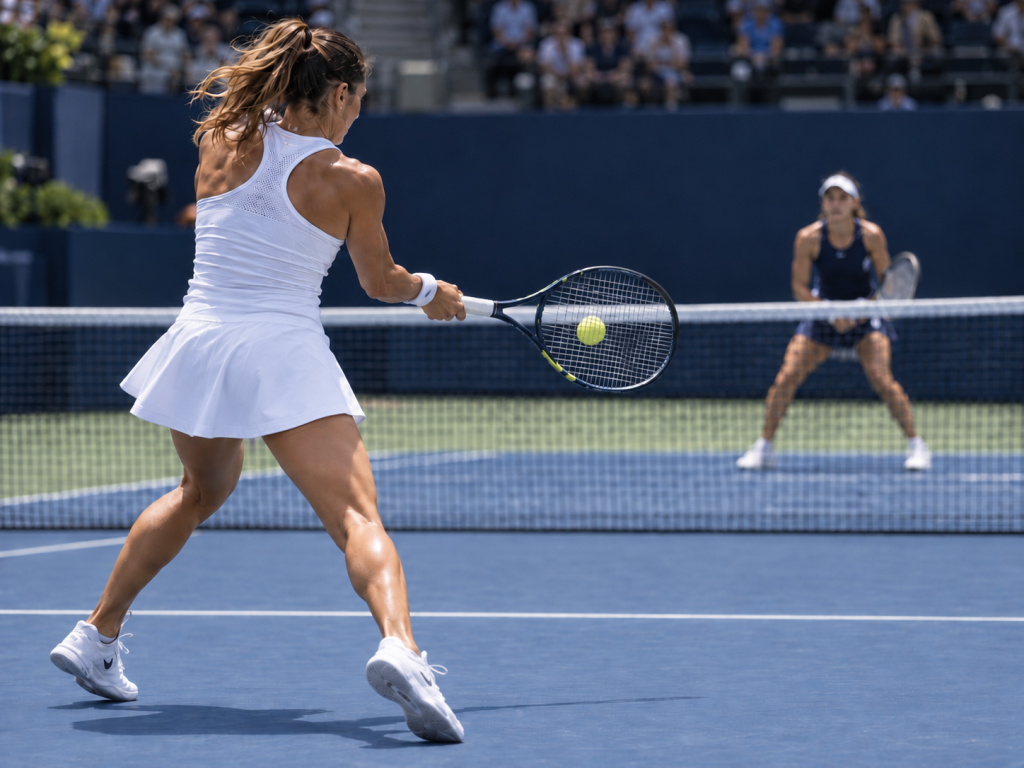
Rallying is the ability to exchange several shots with another player without the point immediately ending.
For beginners, that does not mean hitting hard, aiming for the corners or trying to win every ball. The first goal is much simpler: keep the ball in play.
A productive rally is built on three habits:
- Controlling the ball instead of overpowering it
- Moving into position before each shot
- Recovering after every swing so you are ready for the next ball
When those habits begin working together, tennis starts to feel less like a series of isolated swings and more like a continuous exchange.
What Is a Rally in Tennis?
A rally begins after the serve and return when players continue hitting the ball back and forth across the net.
During a rally, each player tries to reach the incoming ball, strike it after no more than one bounce and send it back inside the opponent’s court.
Beginners often focus heavily on the actual swing. But keeping a rally going depends just as much on what happens before and after contact.
A simple rallying sequence looks like this:
- Watch the opponent hit.
- Read where the ball is traveling.
- Move toward the expected contact area.
- Set up with enough balance to swing.
- Make a controlled shot.
- Recover toward a useful court position.
- Prepare for the next ball.
Then the process repeats.
The better you become at repeating that sequence, the easier it becomes to exchange several shots.
Your First Rallying Goal
Do not measure early rallying success by how fast you hit the ball.
Measure it by how many controlled shots you and your partner can exchange.
For example, try working toward:
- 3 consecutive shots
- 5 consecutive shots
- 10 consecutive shots
- 20 consecutive shots
This changes your mindset.
Instead of thinking, “How do I hit a better winner?” you begin thinking, “How do I make this next ball playable?”
That is a much better foundation for beginner tennis.
Prioritize Control Over Power
One of the fastest ways to end a rally is to swing harder than your current control allows.
Extra racket speed can send the ball long, into the net or far away from the intended target.
During beginner rallies, use a comfortable swing that allows you to:
- Meet the ball cleanly
- Direct it over the net
- Control its general depth
- Recover without losing balance
You do not need to push the ball timidly. You still want a normal forehand or backhand motion.
The difference is that your priority is consistency rather than maximum speed.
Think about sending a controlled ball your partner can reasonably return.
Give Yourself Margin Over the Net
The net is one of the most obvious ways a rally ends.
Beginners often aim too close to it.
Instead of trying to skim every ball just above the net cord, give yourself a comfortable amount of clearance.
A ball traveling several feet above the net can still be an effective rally ball.
More height gives the ball additional time and distance to clear the net before dropping into the court.
During cooperative rallying, that margin is valuable.
You are trying to build consistency, not hit the lowest possible trajectory.
Use a Large Target
Small targets create unnecessary pressure.
Rather than aiming for sidelines or corners, direct most beginner rally balls toward a large central area of the opposite court.
Crosscourt or middle-of-the-court targets are often easier to manage than extremely precise placements.
A useful target might simply be:
- Several feet inside the baseline
- Several feet away from the sideline
- Somewhere your partner can comfortably reach
Giving yourself more room reduces errors and makes longer rallies possible.
Watch the Ball Early
Good movement begins before the ball reaches your side of the court.
Watch your opponent closely as they prepare and hit.
As soon as the ball leaves their racket, begin gathering information:
- Is it going to your forehand or backhand?
- Is it traveling short or deep?
- Is it moving quickly or slowly?
- Will you need to move forward, backward or sideways?
The earlier you recognize the direction of the ball, the more time you have to move.
Beginners often wait until the ball is already close before reacting.
By then, they may have to reach, rush or swing while off balance.
Early recognition creates easier contact.
Move Your Feet Before You Swing
Rallying becomes much harder when you try to hit every ball from wherever you happen to be standing.
Move your body toward the ball so you can create a comfortable hitting position.
That might require:
- Side steps
- Crossover steps
- Small adjustment steps
- Moving forward
- Moving backward
Large movements help you cover distance.
Small adjustment steps help you fine-tune your position as the ball approaches.
Those final small steps are especially important because the bounce may not behave exactly as expected.
Keep moving until you have enough space to swing comfortably.
Avoid Reaching Whenever Possible
Reaching is sometimes unavoidable, but it should not become your normal rallying technique.
If the ball is slightly away from you, try moving your feet rather than simply stretching your racket toward it.
Reaching can cause several problems:
- Poor balance
- Late contact
- Weak racket control
- Reduced recovery speed
Moving closer to the correct hitting position gives you a better chance of making a normal stroke.
Your feet should help put your body where your racket can work comfortably.
Maintain Space Between Your Body and the Ball
Beginners frequently get too close to the incoming ball.
When this happens, the racket becomes cramped against the body and the swing becomes difficult to control.
Try to create enough space so your arm and racket can move naturally through the contact area.
If the ball is coming directly toward you, move away slightly instead of allowing it to crowd you.
Good rallying movement is not only about reaching distant balls.
Sometimes it means creating space from a ball that is coming too close.
Prepare Before the Ball Reaches You
Once you know whether the ball is coming toward your forehand or backhand, begin preparing your body and racket.
You do not want to wait until the bounce before starting your preparation.
Earlier preparation gives you more time to:
- Position your feet
- Track the bounce
- Adjust your spacing
- Make a smoother swing
Late preparation often forces beginners to rush.
A controlled rally stroke should feel organized rather than frantic.
Let the Bounce Help You Judge the Shot
After the ball lands, continue tracking it carefully.
The bounce gives you important information about where contact will occur.
Some balls may rise higher.
Others may stay lower.
Some may bounce closer or farther away than expected.
Stay active with your feet after the bounce.
Small adjustment steps can help you find a more comfortable contact position.
Do not mentally commit to one exact spot too early.
Keep adjusting until the ball reaches your hitting zone.
Make Contact in a Comfortable Position
For most basic groundstroke rallies, you want to contact the ball slightly in front of your body rather than beside or behind you.
Exact positioning varies depending on the stroke and incoming ball, but the general goal is to avoid being late.
Late contact often produces:
- Weak shots
- Poor direction
- Balls that float unpredictably
- Difficulty recovering
Move early enough that you can meet the ball without rushing.
If you regularly contact the ball too late, the problem may begin with your preparation or footwork rather than your swing.
Use a Smooth Swing
A reliable rally stroke does not need to be violent.
Accelerate the racket smoothly through the ball.
Avoid suddenly jerking or chopping at contact.
A smoother motion makes it easier to control:
- Direction
- Height
- Depth
- Balance
You should feel that you are sending the ball toward a target rather than simply striking it as hard as possible.
Finish the Stroke Without Losing Balance
Your swing does not end the moment the racket touches the ball.
Allow the racket to continue naturally through the shot.
At the same time, try to stay balanced enough to begin moving again.
If your swing causes you to spin wildly, fall backward or take several unnecessary recovery steps, you may be using more force than you can currently control.
A good beginner rally stroke should allow you to transition quickly into preparation for the next ball.
Recover After Every Shot
One of the most important rallying habits happens immediately after you hit.
Do not stand and watch your shot.
As soon as your swing finishes, begin recovering.
Recovery means repositioning yourself so you have a reasonable chance of reaching the opponent’s next ball.
Without recovery, every shot pulls you farther out of position.
After several exchanges, you may find yourself standing near a sideline while most of the opposite court is uncovered.
Recover Toward a Useful Position
You do not always need to run directly to the exact center of the baseline after every shot.
Your ideal recovery position depends partly on where you hit the ball and where your opponent is located.
For beginner cooperative rallying, however, returning toward a balanced position around the middle portion of the baseline is a useful starting habit.
The goal is to avoid remaining stranded where you made your previous contact.
Hit.
Recover.
Prepare.
That rhythm should gradually become automatic.
Use Recovery Steps Instead of Relaxing Completely
After hitting, your body may naturally want to stop.
Try to remain active.
Take controlled recovery steps while watching your opponent.
You should be moving back toward position while simultaneously preparing to react.
Avoid turning completely away from the court.
Stay oriented toward your opponent so you can see the next shot developing.
Return to a Ready Position
As your opponent prepares to hit, organize yourself again.
A useful ready position includes:
- Feet comfortably apart
- Knees slightly bent
- Weight balanced
- Racket held in front
- Eyes on the opponent and ball
This puts you in a neutral position from which you can move in different directions.
The ready position is not a frozen pose.
It is a brief moment of preparation between movements.
Use the Split Step to React
As your opponent strikes the ball, use a small split step.
This is a light hop that helps your feet become active just before you need to move toward the next shot.
The timing matters more than the size of the jump.
You want to land around the time your opponent makes contact so you can react to the direction of the ball.
The split step should be small and athletic.
You are not trying to jump high.
You are preparing your body to move.
Keep Returning to the Same Rally Rhythm
Good rallying begins to develop a repeating rhythm:
Prepare → Move → Hit → Recover → Split Step → Move Again
Beginners often concentrate only on the “hit” portion.
But the movement before and after the shot is what allows the next swing to happen.
Try thinking of every stroke as part of a continuous cycle rather than an isolated action.
Do Not Admire Your Shot
One common beginner habit is standing still after hitting and watching where the ball goes.
That may only take a second, but tennis moves quickly.
While you are watching your shot, your opponent may already be preparing to return it.
Train yourself to move immediately after finishing the swing.
You can still track your ball while recovering.
The two actions should happen together.
Avoid Backing Away From Every Ball
Some beginners automatically retreat after every shot.
That can gradually leave them farther and farther behind the baseline.
Instead, react to the actual ball.
If the incoming shot is deep, you may need to move backward.
If it is short, you may need to move forward.
If it is comfortable, you may be able to remain near your existing depth.
Your movement should respond to the ball rather than follow the same pattern every time.
Move Forward for Short Balls
Not every rally ball will reach you near the baseline.
When a ball lands short, move forward early.
Avoid waiting for it to come toward you if doing so would cause the ball to bounce twice or drop too low.
Approach the ball with controlled steps, establish balance and make your shot.
Afterward, your recovery position may change depending on where you are on the court.
For basic rally practice, the important habit is simply recognizing short balls early and moving forward rather than reaching from too far away.
Move Back When the Ball Is Deep
Deep balls can push you backward.
If you recognize that the ball will land close to the baseline, create space early.
Trying to hold your position against every deep ball can cause the ball to crowd your body.
Move back enough to create a comfortable contact point.
Whenever possible, avoid running backward with your back completely turned toward the opponent.
Stay balanced and continue watching the ball.
Use Smaller Steps Near Contact
When the ball is far away, larger steps can help you reach the general area quickly.
As you approach the hitting position, switch to smaller adjustment steps.
These help you fine-tune your distance from the ball.
That combination works well:
Larger steps to cover distance.
Smaller steps to organize contact.
You do not need perfect footwork patterns to begin rallying successfully. You simply need active feet that continue adjusting until you are ready to hit.
Give Yourself Time
Rallying becomes difficult when every ball feels rushed.
One way to create more time is to use controlled shots with comfortable net clearance rather than low, hard drives.
A slightly higher, deeper ball often gives you more time to recover before your opponent hits again.
This can make the rally easier to manage.
Beginners should value time.
More time means more opportunity to move, prepare and recover.
Learn to Handle Different Ball Heights
During real rallies, the ball will not always arrive at the same height.
You may receive:
- Lower balls
- Comfortable waist-height balls
- Higher bouncing balls
Your stance and contact height may need to adjust.
Bend more for lower balls rather than dropping only the racket.
For higher balls, create enough space to avoid being crowded.
The goal is not to force every ball into exactly the same swing.
Adjust your body to the ball you actually receive.
Stay Relaxed Between Shots
Excessive tension can make movement and racket control harder.
Try to keep your grip and upper body reasonably relaxed between shots.
You need enough control to hold the racket securely, but squeezing constantly at maximum pressure can make your swing stiff.
Relaxed preparation allows you to react more naturally.
Think active feet, calm upper body and controlled swing.
Rally Cooperatively Before Rallying Competitively
When learning, it helps to practice rallies where both players are trying to keep the ball going.
This is different from playing a point.
In cooperative rallying, both players intentionally hit manageable balls.
The goal is continuity.
You might even agree to aim primarily toward each other.
This allows you to practice:
- Ball control
- Movement
- Recovery
- Timing
- Repetition
Without the pressure of trying to beat the other player.
Once longer cooperative rallies become comfortable, those habits can carry into regular points.
Start Closer If Full-Court Rallying Is Difficult
If you cannot maintain a rally from the baseline, move closer to the net.
Both players can begin around the service line or even closer.
Use shorter, slower swings and try to exchange several controlled balls.
As consistency improves, gradually move farther apart.
This progression makes it easier to develop touch and timing before dealing with the greater distance of baseline rallies.
The objective remains the same: keep the ball playable.
Practice Forehand-to-Forehand Rallies
One useful rally exercise is to keep most balls on the forehand side.
Both players position themselves so they can exchange controlled forehands.
Rather than changing constantly between forehands and backhands, you can concentrate on repeating:
- Preparation
- Movement
- Contact
- Recovery
Try counting consecutive shots.
When you reach a consistent number, increase the goal.
Practice Backhand-to-Backhand Rallies
You can use the same approach with backhands.
Keep the rally directed toward each player’s backhand side.
The purpose is not to hit difficult angles.
The purpose is to give both players repeated opportunities to organize their movement and make controlled backhand contacts.
Over time, alternate between forehand-focused and backhand-focused rally practice.
Practice Alternating Forehands and Backhands
Once you can maintain rallies on one side, make the movement more realistic.
Have your partner alternate balls between your forehand and backhand areas.
Now you must:
- Read direction
- Move to the correct side
- Adjust your spacing
- Hit
- Recover
- Prepare again
Keep the feeds manageable.
The goal is still continuity rather than speed.
Use Rally Counts
Counting consecutive shots is one of the simplest ways to measure improvement.
Two players might try to reach:
5 shots → 10 shots → 20 shots → 30 shots
If the rally ends, restart.
Do not treat the error as a failure.
Instead, notice what happened.
Did you:
- Hit too hard?
- Arrive late?
- Get too close to the ball?
- Forget to recover?
- Aim too close to the line?
- Stop moving your feet?
The rally itself becomes feedback.
Do Not Rush the Next Shot
Longer rallies can make beginners increasingly excited or tense.
After several successful exchanges, you may suddenly try to do more than necessary.
You might hit harder, aim closer to a line or attempt a difficult change of direction.
During rally practice, resist that temptation.
Treat shot number 10 the same way you treated shot number 2.
Make another controlled ball.
Then recover.
Consistency comes from repeating good decisions.
Keep Your Eyes Active During the Entire Rally
Your visual focus should constantly move between useful information.
Watch:
- Your opponent’s preparation
- Their contact
- The flight of the ball
- The bounce
- Your own contact area
- The ball leaving your racket
- Your opponent preparing again
Avoid staring at one area of the court.
Rallying requires continuous tracking.
The earlier your eyes gather information, the earlier your feet can respond.
Common Rallying Mistakes
Trying to Hit Every Ball Hard
More power creates less margin for error.
Better approach: Use controlled speed and prioritize getting another ball back.
Standing Still After Contact
Watching your shot delays recovery.
Better approach: Begin moving as soon as the swing finishes.
Waiting for the Ball
Beginners sometimes expect the ball to come directly to them.
Better approach: Move toward the ball and create your own hitting position.
Getting Too Close to the Ball
This crowds the swing.
Better approach: Use adjustment steps to maintain comfortable spacing.
Reaching Instead of Moving
Stretching may save one ball but usually produces poor control.
Better approach: Move your feet whenever there is enough time.
Aiming Too Close to the Lines
Precise targets increase errors.
Better approach: Use larger targets with plenty of court margin.
Forgetting the Ready Position
Holding the finish of the previous stroke makes the next shot harder.
Better approach: Recover your balance and bring the racket back into a prepared position.
Recovering Too Late
You may reach your next shot while still moving from the previous one.
Better approach: Make recovery part of every stroke rather than something you remember afterward.
A Simple Beginner Rally Practice
Try this progression with a partner.
Begin inside the service boxes.
Exchange controlled balls and try to reach 10 consecutive shots.
Once you can do that consistently, move backward several steps.
Repeat the exercise.
Continue gradually moving toward the baseline as your control improves.
When rallying from farther away, keep using the same priorities:
- Comfortable targets
- Controlled swing speed
- Active footwork
- Immediate recovery
- Preparation before every shot
Do not move farther back simply because you completed one successful rally.
Stay at each distance until the exchange begins to feel repeatable.
Focus on One More Ball
You do not need to think about maintaining a 20-shot rally while the first ball is approaching.
Your responsibility is simply to make the next controlled shot.
Move.
Set up.
Send the ball back.
Recover.
Then deal with the next ball.
Long rallies are created one manageable shot at a time.
Rallying Becomes Easier Through Repetition
At first, the rally process can feel busy.
You may be trying to remember your preparation, spacing, swing, recovery and ready position all at once.
With repetition, those pieces gradually begin to connect.
You recognize the ball sooner.
Your feet start moving earlier.
Your contact becomes more predictable.
You recover without needing to remind yourself.
That is when rallying starts to feel natural.
For a beginner, the goal is not to dominate the exchange.
It is to become increasingly comfortable staying in it.
Develop enough control to send the ball back, enough movement to reach the next shot and enough recovery discipline to be ready when it arrives.
When those habits become repeatable, longer rallies follow.