
Returning serve is one of the first challenges every tennis beginner faces. Unlike a normal rally ball, the serve can arrive faster, with more spin and from a different angle each time.
The goal of the return is not to hit a spectacular winner. Your first job is simply to get the ball back into the court with enough control to begin the rally.
A good beginner return comes from three things: standing in a sensible position, preparing early and using a compact swing.
What Is a Return of Serve?
A return of serve is the shot you hit immediately after your opponent serves.
The server begins the point by hitting the ball diagonally into the correct service box. Your return is the next shot.
If the serve lands in, you must return it before the ball bounces a second time.
From there, the point becomes a normal rally.
Because the serve may arrive faster than an ordinary groundstroke, your return usually requires less backswing and quicker preparation than your normal forehand or backhand.
Where to Stand When Returning Serve
Your starting position depends partly on how fast and consistently your opponent serves, but beginners should begin from a comfortable, balanced position.
Stand behind the baseline and roughly cover the half of the court where the serve can arrive.
You do not need to stand directly in the middle of the entire court.
When returning from the deuce side, position yourself so you can comfortably cover serves toward both the center and the sideline.
Do the same from the ad side.
Avoid standing so far toward one side that you leave a large open area for the server.
How Far Behind the Baseline Should You Stand?
For many beginners, starting around one or two steps behind the baseline is a good reference point.
This gives you a little more time to react while still keeping you close enough to the court to play a controlled return.
If the server hits slowly, you may be able to stand closer to the baseline.
If the server hits harder, moving slightly farther back can give you additional reaction time.
Try not to move excessively far behind the baseline unless you need the extra time. Standing too far back can make it harder to control shorter serves and may leave you starting the rally from a defensive position.
Start in a Ready Position
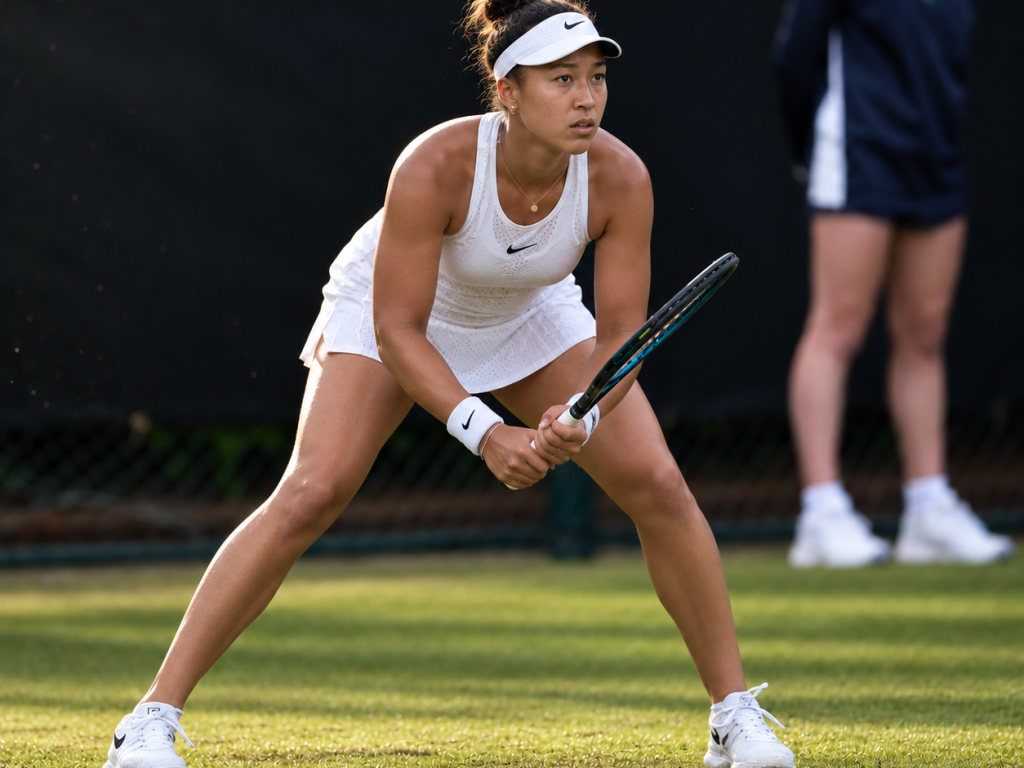
Before the server begins the motion, get into an athletic ready position.
Keep your feet slightly wider than shoulder width, bend your knees gently and lean forward enough that you feel ready to move.
Your weight should be balanced toward the balls of your feet rather than resting heavily on your heels.
Hold the racket comfortably in front of your body.
Avoid letting the racket hang down beside you. Keeping it in front makes it easier to react quickly to either a forehand or backhand return.
Your upper body should remain relaxed.
Tension in the arms and shoulders can make a fast reaction more difficult.
Watch the Server and the Ball
Your attention should be on the server as the service motion begins.
As the racket approaches the ball, focus closely on the contact.
Watching the ball early helps you recognize its direction sooner.
Beginners sometimes watch the server’s body for too long and only begin tracking the ball after it has crossed the net.
Instead, shift your attention toward the ball immediately after the server makes contact.
The sooner you recognize whether the serve is coming toward your forehand, backhand or body, the sooner you can prepare.
Use a Small Split Step
As the server makes contact with the ball, use a small split step.
A split step is a light hop that helps place you in a balanced position so you can move quickly in either direction.
It should not be a large jump.
The movement is small and controlled.
Land with your knees slightly bent and your feet ready to push toward the incoming ball.
Timing matters more than height.
Ideally, you want to be landing and becoming ready to move just as you recognize the direction of the serve.
Decide Forehand or Backhand Quickly
Once you see the direction of the serve, turn toward the appropriate side.
If the ball is moving toward your forehand side, prepare the forehand.
If it is moving toward your backhand side, prepare the backhand.
Serves directed toward your body can be more difficult because you have less space to swing.
When this happens, move your feet quickly to create enough room to choose either a forehand or backhand.
The important thing is to make the decision early.
Waiting until the ball is very close often leads to late contact and rushed swings.
Keep the Backswing Compact
The return of serve usually requires a shorter backswing than a normal rally groundstroke.
This is especially important against faster serves.
You simply do not have as much time.
Instead of taking the racket far behind your body, use a small shoulder turn and bring the racket into position.
Think of the return as receiving and redirecting the incoming ball rather than generating maximum power.
The speed of the serve already provides much of the pace you need.
Your job is to control it.
Turn Your Shoulders Early
As soon as you recognize the side of the incoming serve, turn your shoulders.
For a forehand return, rotate your upper body toward the forehand side.
For a backhand return, rotate toward the backhand side.
This shoulder turn prepares the racket without requiring a large arm movement.
Avoid keeping your chest facing directly toward the net while trying to swing only with your arm.
A small unit turn using the shoulders helps produce a more stable and controlled return.
Move Your Feet Into Position
Even when a serve is close to you, small foot movements can improve your contact.
Do not simply reach for the ball if you can adjust your position.
Move toward the ball enough to create comfortable spacing between your body and the racket.
When the serve is wide, push off quickly and move laterally.
When the serve comes directly toward your body, move slightly to one side so you have room to swing.
You usually will not have time for several large steps.
The movement may only be one quick step or a small adjustment.
That can still make a major difference.
Make Contact in Front
Try to contact the ball slightly in front of your body.
If the ball gets too far beside or behind you, controlling the return becomes more difficult.
Your ideal contact position depends on whether you are hitting a forehand or backhand, but the basic idea remains the same.
Prepare early enough that the racket meets the ball rather than chasing it after it has already passed your best contact position.
Against faster serves, this often means shortening the swing even more.
Keep the Racket Stable Through Contact
At contact, aim for a firm but relaxed racket.
You do not need to squeeze the handle as hard as possible.
Instead, maintain enough stability that the racket face does not twist excessively when it meets the ball.
Guide the racket through the contact zone with a controlled motion.
Avoid flicking suddenly with the wrist.
A stable racket face gives you a better chance of directing the ball where you want it to go.
Use the Serve’s Pace
One of the biggest mistakes beginners make is trying to swing harder because the serve is coming quickly.
Usually the opposite approach works better.
A fast serve already carries plenty of energy.
You can use that pace by meeting the ball with a short, controlled swing.
Think about blocking or redirecting the ball rather than overpowering it.
The faster the incoming serve, the more compact your return often needs to become.
Aim for a Large Target
When learning to return serve, give yourself a generous target.
The middle portion of the court is usually safer than trying to hit close to a sideline.
Returning toward the center also reduces the chance of missing wide and gives you more room for error.
You are trying to start the rally.
Once your returns become more consistent, you can begin directing them more intentionally.
At first, depth and control matter more than hitting precise angles.
Return Deep When You Can
A return that lands deeper in the court can make it harder for the server to immediately attack the next ball.
You do not need to hit the return hard to achieve this.
A controlled shot with good height over the net can travel deep enough to give you time to recover.
Avoid trying to hit extremely low over the net.
Giving yourself some margin can improve consistency.
Recover After the Return
Your job does not end when you make contact.
After the return, regain your balance and prepare for the next shot.
Do not stand and watch your return travel across the net.
Begin moving into a sensible rally position.
Where you recover depends on where your return goes, but the basic goal is to avoid being stuck near the sideline or off balance when your opponent hits the next ball.
Returning a Slow Serve
A slower serve gives you more time, but beginners often create problems by trying to attack it too aggressively.
You may be able to use a slightly fuller swing than you would against a fast serve, but control should still come first.
Move into position, prepare early and hit a normal controlled groundstroke.
Do not assume that every slow serve needs to be hit for a winner.
A reliable return that starts the rally is already a successful shot.
Returning a Fast Serve
Against a faster serve, simplify everything.
Shorten your backswing.
Turn your shoulders early.
Keep your racket in front of you.
Make a compact swing and use the incoming pace.
You may feel as though you are simply blocking the ball back.
That is completely acceptable.
You do not need to produce your own power on every return.
Returning a Serve Toward Your Body
Body serves can feel uncomfortable because the ball does not give you much space to swing.
The key is recognizing the direction early and moving your feet.
Create room by shifting slightly to one side.
Choose either a forehand or backhand and commit to it.
Avoid staying completely still and trying to swing while the ball is coming directly toward you.
Even a small adjustment can create enough space for a cleaner return.
Returning a Wide Serve
When the serve pulls you toward the sideline, move quickly but stay balanced.
Take a short swing and prioritize getting the ball back into the court.
Do not feel that you must hit a difficult angle simply because you have been pulled wide.
A controlled crosscourt or central return can give you time to recover.
After hitting the ball, begin moving back toward a better position for the next shot.
Common Return-of-Serve Mistakes
Standing Flat-Footed
If your weight is on your heels, reacting quickly becomes difficult.
Stay light on your feet and use a small split step as the server contacts the ball.
Taking Too Large a Backswing
A big backswing takes time.
Against a serve, especially a faster one, that extra movement often makes you late.
Keep the preparation compact.
Swinging Too Hard
Trying to overpower the serve can reduce control.
Use the server’s pace and focus on clean contact.
Preparing Too Late
Waiting until the ball is almost beside you leaves very little time to swing.
Recognize the direction early and begin your shoulder turn immediately.
Watching the Serve Instead of the Ball
Once the server makes contact, your attention should follow the ball.
Tracking it early helps you recognize direction and prepare sooner.
Reaching Instead of Moving
Stretching the racket toward the ball can produce weak or inconsistent contact.
Whenever possible, use your feet to improve your spacing.
Trying to Hit a Winner
A return does not need to end the point.
For beginners, getting the serve back under control is far more valuable than attempting a low-percentage attacking shot.
A Simple Beginner Return Sequence
You can simplify the return into a short routine:
- Start balanced behind the baseline.
- Hold the racket in front of your body.
- Watch the server and the ball.
- Make a small split step near the server’s contact.
- Recognize forehand, backhand or body serve.
- Turn your shoulders early.
- Move your feet to create space.
- Use a short backswing.
- Contact the ball in front.
- Aim for a large target.
- Recover and prepare for the next shot.
Following the same sequence repeatedly makes returning serve feel less rushed over time.
Practice Returning Without Trying to Win the Point
A useful beginner practice is to remove the pressure of playing full points.
Have a partner serve at a comfortable pace while you focus only on making controlled returns.
Choose a large target in the middle of the court and count how many returns you can put into play.
Do not worry about hitting hard.
Once you can consistently return slower serves, gradually increase the serving pace.
You can also practice separately from the forehand and backhand sides.
This helps you become comfortable preparing quickly for either shot.
Keep the Goal Simple
Returning serve can feel difficult because every point begins with the ball coming toward you on your opponent’s terms.
You cannot control the speed, direction or placement of the serve.
You can control your preparation.
Start from a balanced position, stay alert, prepare early and keep your swing compact.
Instead of trying to produce a powerful return, concentrate on getting the ball back into the court with control.
When you can consistently return the serve, you give yourself something every beginner needs: a chance to actually start the rally.