
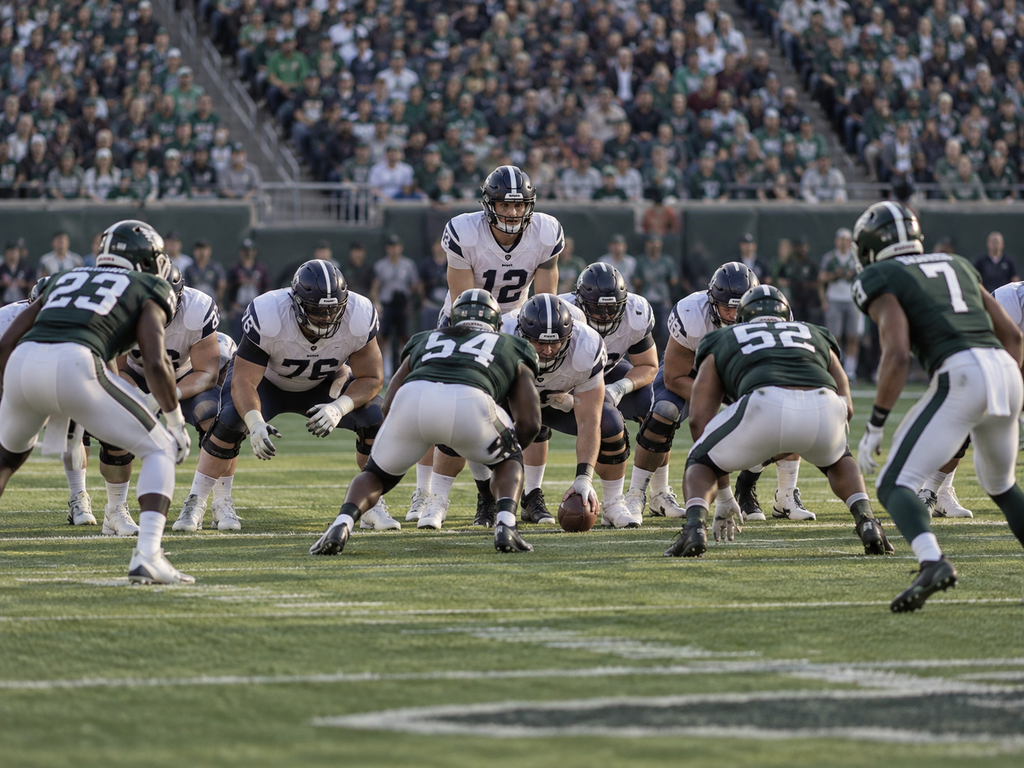
The quarterback approaches the line of scrimmage on third-and-eight. Two linebackers move into the gaps on either side of the center, while a defensive back edges closer to the line of scrimmage. Six defenders appear capable of rushing the passer.
The offense prepares for additional pressure.
When the ball is snapped, however, both linebackers retreat into coverage. Four other defenders rush, including one from an unexpected position. The defensive alignment created the appearance of a heavy blitz, but the actual rush was different.
On the next drive, the defense presents a similar formation. This time, an additional linebacker attacks through an interior gap, forcing the quarterback to release the football earlier than planned.
Recognizing the difference between these situations is an important advanced football skill.
Learning how to recognize defensive blitzes requires more than counting defenders near the line of scrimmage. Offensive players must understand potential rush threats, defensive disguises, protection responsibilities and the difference between what a defense shows and what it actually does.
A quarterback might correctly identify six potential rushers but still face only four. An offensive lineman might initially expect an outside defender to rush, only to see that player drop into coverage.
The objective is not to predict every defender’s movement perfectly. It is to recognize credible pressure threats, communicate within the team’s protection system and confirm how the rush develops.
This guide explains common blitz indicators, pressure structures, defensive disguises and practical methods for improving pressure recognition.
What Is a Defensive Blitz?
A defensive blitz generally involves sending an additional or unexpected defender to rush the quarterback.
In a conventional four-man defensive front, four defensive linemen may provide the primary pass rush while the remaining defenders handle coverage responsibilities.
A defense can increase pressure by sending a linebacker, defensive back or another player who would otherwise have a coverage or support responsibility.
However, the exact definition of a blitz varies among coaching systems.
Some teams classify pressure according to the number of rushers. Others use terms describing the origin of the rush, coverage structure or defensive call.
For offensive recognition, the important questions are practical:
- Which defenders could rush?
- Where could the pressure originate?
- How many players are likely to rush?
- Which offensive players are responsible for potential threats?
- What happens if an apparent rusher drops into coverage?
Understanding these questions helps explain why some defensive formations are difficult to protect against.
Understand the Difference Between a Blitz and Defensive Pressure
Blitz and pressure are related terms, but they do not mean exactly the same thing.
A blitz describes a defensive tactic. Pressure describes the disruption created around the quarterback.
A defense can generate pressure without blitzing.
For example, four defensive linemen may defeat their blockers and force the quarterback to move before the passing play develops.
Likewise, a defense can send six rushers without successfully pressuring the quarterback if the offense protects effectively or releases the ball quickly.
This distinction matters because the number of defenders rushing does not automatically determine the outcome.
Four-Man Pressure
A four-man rush can create pressure through individual pass-rushing ability, blocking mismatches or coordinated defensive movement.
Even when only four defenders rush, the offense must identify where those players originate.
In a simulated-pressure design, the defense may send four players from unexpected positions rather than relying exclusively on conventional defensive linemen.
Five-Man Pressure
A five-man rush can challenge the offense by creating an additional blocking responsibility.
For example, four defensive linemen and a linebacker may rush.
Depending on the offensive protection, the line and eligible blockers must account for the additional threat.
Five-man pressure can also originate from defensive packages that initially appear to contain fewer conventional rushers.
Six-Man or Heavier Pressure
Sending six or more defenders places additional emphasis on overwhelming the offense’s blocking resources or forcing a rapid decision.
However, allocating more defenders to the rush generally leaves fewer players available for coverage.
The exact coverage behind the pressure depends on the defensive system.
A heavy blitz does not automatically guarantee an open receiver, and the quarterback must still consider the actual defensive responsibilities.
Recognize the Defensive Front Before the Snap
The defensive front provides the first important pressure clues.
An advanced quarterback or offensive lineman should identify which defenders are positioned near the line of scrimmage and which gaps they might threaten.
Identify the Down Linemen
Begin by locating the defenders positioned directly across from the offensive line.
These players commonly form the foundation of the pass rush.
Pay attention to their alignment relative to the center, guards and tackles.
A defensive lineman positioned on the outside shoulder of a guard may threaten a different path than one aligned outside an offensive tackle.
However, defensive linemen do not always rush directly forward.
They may twist, loop or exchange responsibilities with other rushers.
Their starting position establishes a possible threat, not a guaranteed rush path.
Look for Standing Edge Defenders
Outside linebackers and edge defenders often align in a two-point stance near the offensive tackles.
Depending on the system, these players may be regular pass rushers, coverage defenders or both.
A standing defender outside the tackle should be included in the offense’s potential-rusher assessment.
Do not assume that a standing position makes the player less likely to rush.
Count Potential Rushers
Consider a defense with three defensive linemen, two outside linebackers and an inside linebacker close to the line.
Six players appear capable of rushing.
That does not mean six defenders will necessarily attack.
The count tells the offense how many credible threats exist within the presented alignment.
Identifying them helps the offense apply its assigned protection rules.
Recognize A-Gap Pressure Looks
The A-gaps are the spaces between the center and the offensive guards.
Defenses sometimes position linebackers near these gaps to threaten interior pressure.
What Is a Double-A-Gap Mug Look?
A double-A-gap mug alignment generally features two defenders, often inside linebackers, positioned near the gaps on opposite sides of the center.
This can create the appearance of immediate interior pressure.
The offensive line must account for the possibility that either or both defenders will rush.
However, the defense may use the same alignment for several different calls.
Both linebackers might rush, one might rush or both might retreat into coverage.
Why the Alignment Creates Uncertainty
The center and guards must recognize potential interior threats.
Depending on the protection scheme, the offense may need to determine how blocking responsibilities are distributed.
If the defense presents several possible rushers, it can make those decisions more difficult.
Even when a linebacker eventually drops into coverage, the initial alignment may influence how the offense prepares.
Example: Two Linebackers Showing Pressure
Imagine a defense with four down linemen and two linebackers standing near the A-gaps.
Before the snap, six defenders appear capable of rushing.
The quarterback recognizes the pressure presentation.
After the snap, one linebacker attacks through an interior gap while the other drops into coverage.
The correct pre-snap observation was that both linebackers presented credible threats.
The actual pressure became clear only after the snap.
This is why recognizing a blitz look is different from knowing exactly which defenders will rush.
Identify Overloaded Defensive Alignments
An overloaded pressure look places multiple potential rushers toward one area or side of the offensive formation.
For example, a defense may position several players outside and near the right side of the offensive line.
Look for Uneven Distribution
A quarterback should notice when the defense has more potential rushers concentrated on one side.
That alignment could create a protection concern depending on the offensive blocking system.
A defense might present three credible threats against two nearby blockers.
However, the offense may have additional protection resources, such as a running back or tight end, depending on the play.
The alignment alone does not establish that a defender will be unblocked.
Recognize Edge Overloads
An edge overload involves multiple potential rushers threatening the same side of the formation.
A defensive end might align outside the tackle while a linebacker or defensive back positions nearby.
These players could attack different paths to place stress on protection assignments.
They might also be disguising another coverage or pressure call.
Avoid Assuming the Overload Is Real
Defenses can show an overloaded alignment and then rush from a different location.
The offense should recognize the possible overload while remaining prepared for post-snap movement.
The correct response depends on the team’s established protection rules.
Watch for Defensive Back Pressure
Not every pass rusher begins near the offensive line.
Cornerbacks, safeties and nickel defenders can become rushers in certain defensive calls.
Their positioning may provide early clues.
Nickel Pressure
A nickel defender is commonly the fifth defensive back in a defensive personnel package.
This player may align near an inside receiver or close to the edge of the offensive formation.
In some schemes, the nickel defender rushes from the outside or through an available path.
A nickel defender moving closer to the line may therefore represent a possible pressure threat.
However, the player could also be adjusting a coverage responsibility.
Safety Pressure
Safeties sometimes move closer to the formation before becoming rushers.
A safety approaching from depth can create a different blocking challenge from a defender already positioned near the line.
But moving toward the line does not automatically indicate a blitz.
The safety may be rotating into underneath coverage or run support.
Cornerback Pressure
A cornerback may also rush from the edge.
This is sometimes associated with defensive calls designed to surprise the quarterback or attack a protection weakness.
Because cornerbacks often begin farther from the ball, their timing and starting position matter.
The offense should notice unusual movement without assuming every cornerback adjustment signals pressure.
Understand Delayed Blitzes
Not all rushers attack immediately when the ball is snapped.
A delayed blitz occurs when a defender begins rushing after an initial pause or other movement.
Why Defenses Use Delayed Pressure
The delay may allow blockers to commit to another defender before the additional rusher enters the play.
A linebacker might initially appear to remain in an underneath position before attacking an interior lane.
Some delayed rushes are designed calls. Others depend on a particular offensive or defensive trigger.
What Offensive Players Should Observe
The key is recognizing that a defender who does not rush immediately may still become a threat.
Offensive linemen and other protection players need to maintain awareness according to their assigned responsibilities.
A defender remaining near the line should not automatically be ignored simply because they did not attack at the snap.
Example: Late Interior Rusher
The offense faces a four-man rush.
A linebacker initially remains a few yards behind the defensive line.
As the pass protection develops, the linebacker attacks an interior opening.
The pressure arrives later than the initial rush.
From a recognition standpoint, the linebacker was a possible second-level threat before the snap, but the delayed rush could only be confirmed as the play developed.
Understand Simulated Pressure
Simulated pressure is one of the most important concepts for advanced offensive players to recognize.
A simulated pressure commonly involves rushing four defenders while changing which players actually rush.
For example, a linebacker may attack the quarterback while a defensive end drops into coverage.
The defense still rushes four players, but the rush originates from unexpected positions.
Why Simulated Pressure Works
Offensive protection is designed around identifying and accounting for rushing threats.
When the defense sends players from unusual positions, blockers may need to respond to movement that differs from the expected rush.
The defense can also maintain seven players in coverage while presenting the appearance of a heavier blitz.
Example: Linebacker Rush and Defensive End Drop
The defense begins with four linemen and two linebackers positioned near the line.
The offense identifies several possible rushers.
After the snap, a linebacker rushes while one defensive end retreats into underneath coverage.
The final rush contains four players.
This is a simulated-pressure concept rather than a conventional five-man blitz.
Why It Can Confuse the Quarterback
A quarterback may anticipate that additional rushers will leave fewer defenders in coverage.
Instead, a defensive lineman drops into a passing area.
A throw that initially appears available may be challenged by the unexpected coverage defender.
This is why recognizing the difference between actual blitz pressure and simulated pressure matters.
USA Football’s coaching material identifies this combination of unexpected second-level rushers and defensive-line droppers as a common simulated-pressure approach.
What Are Creeper Pressures?
A creeper is a term used in many defensive systems for a pressure concept involving an unexpected rusher while maintaining a relatively conventional number of pass rushers.
It is frequently associated with four-man pressures that bring a second-level or defensive-back rusher while another player drops into coverage.
Terminology varies by coaching system, and creeper and simulated pressure are sometimes used interchangeably.
For offensive players, the distinction is less important than recognizing the underlying movement.
A defense may present a conventional formation but rush from a different position than the offense expects.
The offense must account for the actual threats while understanding that a player normally associated with rushing may instead become a coverage defender.
Distinguish Blitz Disguise From Actual Pressure
A defense may deliberately present a threatening alignment without sending additional rushers.
For example, two linebackers could walk toward the center before the snap.
The offensive line sees potential interior pressure.
At the snap, both linebackers retreat into coverage while the defensive line rushes normally.
The defense has created a blitz appearance without executing that blitz.
Why Defenses Bluff Pressure
A threatening alignment may influence offensive communication, protection preparation or the quarterback’s expectations.
It can also conceal the coverage structure that will develop after the snap.
Look for Confirmation After the Snap
A defensive player standing near a gap is not proof of a blitz.
Watch whether that player actually attacks the line.
Also observe whether another defender drops into coverage.
These movements help distinguish among a conventional rush, additional pressure and simulated pressure.
Do Not React to Every Bluff
Advanced offensive recognition requires discipline.
If the quarterback treats every threatening movement as a guaranteed blitz, the defense may successfully create confusion without sending extra rushers.
Pre-snap observations should inform preparation rather than trigger unsupported adjustments.
How Blitz Recognition Relates to Pass Protection
Recognizing pressure is useful because offensive players must understand who is responsible for potential rushers.
However, pass protection is governed by the offensive system.
Different teams use different protection rules.
Understand Protection Numbers
An offense with five offensive linemen may face more than five potential rushers.
Additional blockers, protection adjustments or designed passing timing may influence how the offense handles those threats.
The quarterback must recognize the situation without assuming that every visible defender requires a separate blocker.
Identify the Protection Point
Many offensive systems use a designated point or identification to organize protection assignments.
A center or quarterback may identify a particular defender according to the team’s rules.
The exact terminology and responsibilities vary.
Advanced players should understand how their team’s protection calls account for the defensive structure.
Communication Must Be Consistent
A correct observation is not useful if teammates misunderstand the resulting call.
Quarterbacks, centers, running backs and other protection players must use agreed terminology.
Improvised communication can create more confusion than the original defensive disguise.
This article focuses on recognizing pressure, not installing or changing pass-protection schemes.
Three Game Situations Involving Defensive Pressure
Situation 1: Double-A-Gap Threat
The offense faces third-and-six.
Two linebackers stand near the A-gaps.
Four defensive linemen are also positioned to rush.
Pre-snap observation: Six potential rushers are visible, including two interior threats.
Post-snap movement: One linebacker rushes while the other retreats.
Recognition lesson: A threatening alignment does not mean every potential rusher will attack.
Situation 2: Edge Overload With a Defensive Back
The defense places a defensive end, linebacker and nickel defender near one edge.
The offense recognizes a possible overload.
Pre-snap observation: Several defenders threaten the same side.
Post-snap movement: The nickel defender rushes while another player rotates into coverage.
Recognition lesson: Identify the actual rushers and their paths rather than relying solely on the original count.
Situation 3: Simulated Pressure
The defense shows four defensive linemen and a linebacker near the line.
Pre-snap observation: The linebacker could become an additional rusher.
Post-snap movement: The linebacker rushes, but a defensive end drops into coverage.
Recognition lesson: Unexpected pressure does not always mean more than four defenders are rushing.
Common Mistakes When Recognizing Blitzes
Assuming Every Linebacker Near the Line Will Rush
Defenses frequently present pressure looks without sending every threatening defender.
Better approach: Identify credible threats while recognizing that some players may drop into coverage.
Counting Only Defensive Linemen
A quarterback who focuses exclusively on down linemen may overlook linebackers or defensive backs positioned to rush.
Better approach: Observe all defenders capable of threatening the protection.
Ignoring Defender Movement After the Snap
Pre-snap alignment is only an initial picture.
Better approach: Confirm whether defenders rush, drop or exchange responsibilities once the play begins.
Assuming Four Rushers Means Conventional Pressure
Simulated pressure can involve four rushers originating from unexpected positions.
Better approach: Recognize who rushes, not only how many.
Treating Every Blitz as an Automatic Passing Opportunity
A defense may rush additional players while maintaining coverage near the intended throwing area.
Better approach: Follow the offensive system and evaluate the actual passing situation.
Confusing Pressure Recognition With Improvisation
Correctly identifying a possible blitz does not authorize every offensive player to change assignments independently.
Better approach: Communicate through the team’s established protection and adjustment rules.
Five Drills to Improve Blitz Recognition
Pressure recognition can be practiced without player contact.
Drill 1: Potential Rusher Identification
Purpose: Improve recognition of defenders who could rush.
A coach displays a paused defensive formation.
Identify the down linemen, standing edge players, linebackers and defensive backs positioned as possible threats.
Record which areas of the offensive line they could attack.
Resume the clip and compare the potential threats with the actual rush.
Drill 2: A-Gap Pressure Recognition
Purpose: Recognize interior linebacker pressure presentations.
Review clips showing linebackers positioned near the A-gaps.
Before the snap, identify the possible rushers.
After the snap, record whether each linebacker rushed or dropped into coverage.
Compare several plays from similar alignments.
Drill 3: Overload Recognition
Purpose: Identify uneven distributions of potential rushers.
A coach presents formations with multiple defenders concentrated near one side of the offensive line.
Identify the threatened side and possible pressure paths.
Discuss how the team’s established protection system accounts for the look.
Do not invent new blocking calls during the drill.
Drill 4: Simulated Pressure Identification
Purpose: Distinguish between extra rushers and exchanged rush responsibilities.
Watch a play in which a linebacker or defensive back rushes.
Identify whether another defender drops into coverage.
Count the final rushers.
Determine whether the play involved a conventional blitz or simulated pressure under the terminology used by the team.
Drill 5: Timed Pressure Recognition
Purpose: Improve recognition under limited preparation time.
A coach displays a defensive alignment for a short period.
The player identifies:
- The number of credible potential rushers.
- The most obvious interior or edge pressure threats.
- Whether a simulated-pressure possibility exists.
The coach then reveals the actual defensive call and reviews the observations.
Accuracy should come before speed.
Use Film Study to Recognize Defensive Pressure Patterns
Film review is especially useful because it allows players to examine complex pressure looks repeatedly.
Begin by grouping plays according to similar defensive alignments.
For example, study several snaps featuring two linebackers near the A-gaps.
Record how often the defenders rush, drop or exchange responsibilities.
Then compare the outcomes.
| Observation | What to record |
|---|---|
| Defensive personnel | Number and types of defenders |
| Front alignment | Position of down linemen and edge players |
| Linebacker positioning | Interior or outside pressure threats |
| Defensive back movement | Possible nickel, corner or safety pressure |
| Rush count | Number of actual pass rushers |
| Rush origin | Which players attacked the quarterback |
| Coverage drops | Which apparent rushers dropped into coverage |
| Result | How the protection and passing play developed |
Avoid drawing conclusions from one play.
A defense may use the same pre-snap presentation for several different calls.
The objective is to recognize the range of possibilities associated with an alignment.
How to Measure Improvement in Blitz Recognition
Improvement should not be judged solely by whether the quarterback correctly predicts every blitz.
A more useful evaluation considers several recognition skills.
| Skill | Evidence of improvement |
|---|---|
| Potential-rusher identification | Recognizes credible threats more consistently |
| Interior pressure awareness | Notices linebackers threatening A- and B-gaps |
| Edge pressure awareness | Identifies possible outside rushers |
| Simulated-pressure recognition | Notices unexpected rushers and coverage droppers |
| Communication | Uses correct team protection terminology |
| Discipline | Avoids unsupported assumptions and unnecessary adjustments |
A quarterback may correctly identify a pressure possibility even when the defense ultimately chooses another call.
That observation can still be valuable.
The goal is informed preparation, not perfect prediction.
Build a Weekly Pressure Recognition Routine
Advanced players can develop pressure awareness through short, focused sessions.
| Session | Focus |
|---|---|
| Day 1 | Review potential rushers and defensive fronts |
| Day 2 | Study interior and edge pressure looks |
| Day 3 | Compare blitzes with simulated pressures |
| Day 4 | Review defensive disguises and late movement |
| Day 5 | Practice timed recognition and communication |
Use film clips, diagrams and coach-led walkthroughs.
Physical contact is not necessary for these recognition exercises.
Whenever possible, practice with the actual terminology and protection rules used by the player’s team.
This makes the learning directly applicable to competition.
When to Move Beyond Blitz Recognition
Recognizing pressure is only one part of advanced quarterback development.
Once a player can identify credible threats and understand the difference between conventional blitzes and simulated pressure, they can progress toward more specialized skills.
These include executing assigned protection adjustments, understanding passing concepts against pressure and making decisions when the pocket begins to collapse.
Those subjects require their own instruction.
For now, the priority is developing a disciplined process for recognizing where pressure might originate and confirming what happens after the snap.
Final Thoughts: Recognize the Threat, Not Just the Formation
Learning how to recognize defensive blitzes requires understanding the relationship between defensive alignment, potential rushers and actual post-snap movement.
Linebackers near the A-gaps may threaten interior pressure. Overloaded fronts may place several rushers near one side of the offensive line. Defensive backs can attack from unexpected positions, while simulated pressures can create confusion without increasing the total number of rushers.
No single alignment guarantees a blitz.
Advanced offensive players learn to identify possibilities, communicate through their protection system and avoid reacting to defensive disguises as though they were confirmed calls.
Through film study, controlled recognition drills and coaching feedback, players can become more prepared to identify pressure and execute their responsibilities.
Continue exploring our Advanced American Football Guides, or visit the American Football Learning Path for structured courses covering tactical awareness and advanced football concepts.