
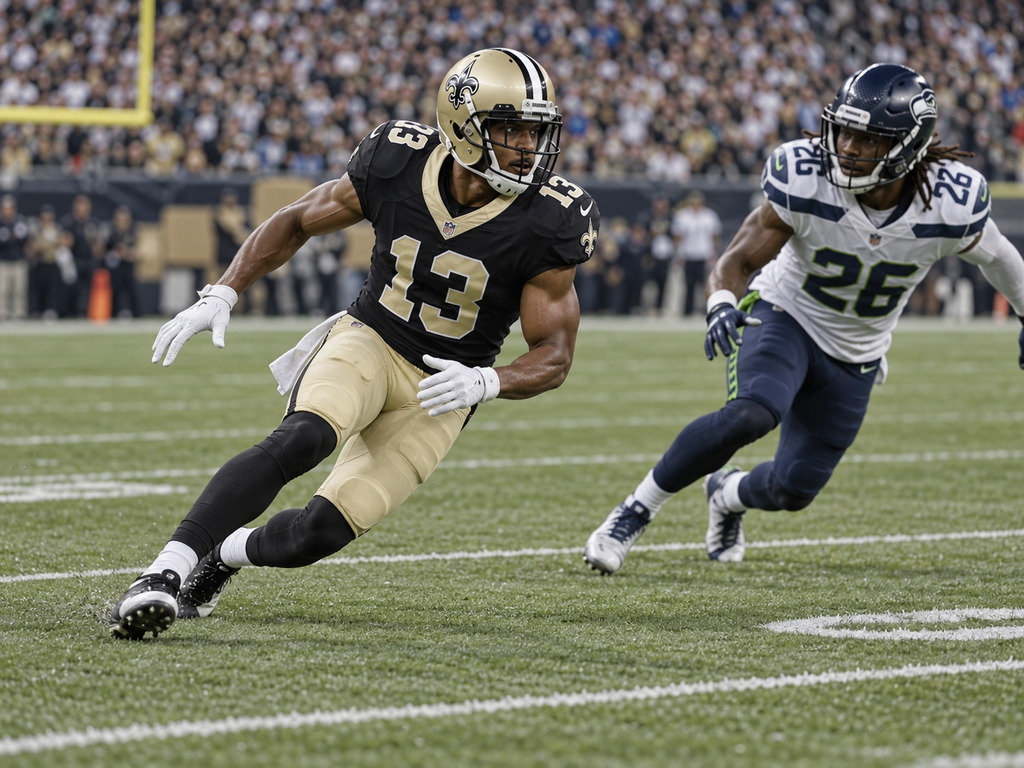
A wide receiver lines up outside the numbers, facing a cornerback positioned several yards away. The defender has inside leverage, leaving more space toward the sideline. The receiver recognizes the alignment, but instead of immediately running outside, he begins with a controlled vertical stem that forces the defender to protect the deeper part of the field.
When the receiver reaches his assigned break point, he changes direction toward the sideline. The quarterback delivers the pass as the receiver enters the intended window.
On the next play, the defense presents a similar alignment, but the cornerback reacts differently and a safety moves toward the outside passing area. The same route no longer creates the same opportunity.
Situations like these demonstrate why advanced receiver development requires more than speed and precise cuts.
Advanced football route running involves understanding how defender leverage, coverage structure, route stems, timing and spacing influence the execution of a passing play.
A receiver who understands these relationships can execute routes more effectively while maintaining the responsibilities of the offensive system.
However, advanced route running does not mean changing every route whenever a defender moves. Adjustments must follow the team’s play design and the quarterback’s expectations.
This guide explains how experienced receivers can refine their releases, manipulate defensive leverage, maintain route timing and recognize how different coverage structures influence passing opportunities.
What Makes Route Running Advanced?
Basic route running focuses on executing a planned movement pattern accurately.
A developing receiver learns to accelerate, reach the correct depth, make efficient cuts and arrive at the intended receiving area.
Advanced route running builds on these abilities by accounting for how defenders are positioned and how they respond.
Two receivers might run the same out route using slightly different approaches because they face different defensive alignments.
One may need to maintain outside space against an inside-leverage cornerback. Another may need to work through a tighter release before reaching the assigned route stem.
Both must still arrive at the correct location with the timing expected by the quarterback.
Advanced execution involves four interconnected skills:
- Leverage recognition: Understanding where the defender is positioned relative to the receiver and intended route.
- Release selection: Using an appropriate opening movement to enter the route.
- Route-stem control: Influencing defender positioning while maintaining the required path and depth.
- Coverage awareness: Understanding how different defensive responsibilities affect available space.
These skills become effective only when the receiver already possesses reliable footwork, acceleration and route discipline.
Understand Defender Leverage Before the Snap
Defender leverage is one of the most useful pieces of information available to a receiver before a play begins.
Leverage describes the defender’s position relative to the receiver and the field.
A cornerback may position themselves inside, outside or directly across from the receiver.
Each alignment can influence the receiver’s available movement.
Recognize Inside Leverage
Inside leverage means the defender begins closer to the middle of the field than the receiver.
This positioning can help the defender contest inside releases or routes.
Imagine a receiver assigned a short in-breaking route against an inside-leverage cornerback.
The defender’s starting position may make the intended path more difficult to access directly.
The receiver may need to use the release and route stem prescribed by the play to create a suitable entry into the route.
That does not mean automatically running outside. Doing so could interfere with the route’s timing or spacing.
Recognize Outside Leverage
Outside leverage places the defender closer to the sideline.
This may help the defender challenge outside-breaking routes or prevent an easy outside release.
A receiver running an out route against outside leverage may face a defender already positioned near the intended break direction.
The receiver must understand how the assigned route is designed to address that positioning.
Some passing concepts create opportunities through complementary routes rather than expecting one receiver to defeat the defender independently.
Understand Head-Up Alignment
A cornerback aligned directly across from the receiver may present a more balanced starting position.
The receiver should observe the defender’s cushion, stance and possible safety support.
A head-up alignment does not necessarily indicate man coverage.
It is simply one element of the defensive picture.
Leverage Is Not the Entire Coverage
Defenders may intentionally use particular leverage because they expect help from other players.
An inside-leverage cornerback might have deep support from a safety. An outside-leverage defender might be protecting a boundary while expecting inside help.
Advanced receivers consider both the immediate defender and the surrounding coverage structure.
Develop More Effective Releases Against Press Coverage
Press coverage places a defender close to the receiver near the line of scrimmage.
This can challenge the receiver’s ability to enter the intended route on time.
An effective release should help the receiver avoid unnecessary delay while preserving the route’s required alignment.
Use a Release That Supports the Route
Receivers may use different release techniques depending on their assignment, available space and coaching system.
A speed release emphasizes accelerating into the route with minimal unnecessary movement.
A hesitation release may briefly alter the defender’s timing before the receiver accelerates.
A split or foot-fire release uses quick foot movement to influence the defender’s reaction.
These terms and their exact execution can vary by coaching system.
The objective is not to perform the most elaborate movement.
A release is successful when it allows the receiver to enter the assigned route efficiently.
Avoid Unnecessary Movement at the Line
Developing receivers sometimes assume that more footwork creates better separation.
In reality, excessive movement can delay the route.
A receiver who spends too much time attempting to deceive the cornerback may disrupt the quarterback’s timing.
Use the simplest effective release permitted by the offensive system.
Preserve Route Timing
Imagine a passing concept designed for the receiver to break after a particular number of steps.
If the receiver becomes delayed at the line, the quarterback may reach the intended throwing point before the receiver is ready.
Advanced receivers must balance defeating an initial challenge with maintaining the play’s rhythm.
When press coverage significantly disrupts timing, the receiver should respond according to the team’s coached rules rather than improvising an entirely different route.
Use Route Stems to Influence Defenders
The route stem is the initial portion of the route before the receiver makes the primary break.
For many routes, the stem provides an opportunity to influence how the defender moves.
Attack the Defender’s Position
Imagine a receiver running an out route against a cornerback using inside leverage.
The receiver may begin with a vertical stem that encourages the defender to maintain depth before the outside break.
Against a different alignment, the coached stem may vary.
The purpose is to create a useful relationship between the receiver, defender and intended break point.
Maintain Vertical Pressure
A receiver who clearly signals an upcoming cut may allow the defender to react early.
Maintaining an effective vertical threat can make it harder for the defender to commit to a shorter route too soon.
This does not mean every route should be run at maximum speed.
The receiver needs appropriate acceleration and tempo for the assigned concept.
Understand the Risk of Excessive Manipulation
A receiver may attempt to move a defender too far in one direction before making the planned break.
If that movement changes the route depth or timing, the receiver may no longer be where the quarterback expects.
Advanced route running requires restraint.
The goal is to influence the defender while preserving the integrity of the play.
Control Route Tempo Without Telegraphing the Break
Tempo refers to how a receiver controls speed throughout the route.
Changes in tempo can affect how a defender responds.
However, poorly timed changes may reveal the receiver’s intentions.
Use Controlled Acceleration
A receiver may accelerate during the initial stem to encourage the defender to respect a deeper route.
The receiver then decelerates according to the demands of the assigned break.
The transition should be efficient and consistent.
Avoid Early Deceleration
Imagine a curl route that requires a break at approximately twelve yards.
If the receiver begins visibly slowing several yards before reaching the assigned depth, the defender may anticipate the turn.
A better approach is to learn the appropriate deceleration pattern that allows the receiver to reach the break point under control.
The exact steps depend on running speed, route design and coaching technique.
Maintain Similar Stems for Related Routes
When several routes begin with comparable stems, receivers benefit from avoiding unnecessary differences that reveal the intended break.
For example, a vertical route and an intermediate-breaking route may initially look similar.
A receiver who changes posture dramatically before one route may unintentionally provide the defender with an early clue.
Consistent movement patterns help preserve uncertainty.
Running Routes Against Man Coverage
In man coverage, defenders generally have responsibilities tied to particular eligible receivers.
This often makes individual positioning, route execution and separation especially important.
However, modern man systems may include safety help, switches and other adjustments.
Understand the Defender’s Leverage
A receiver should identify whether the assigned defender begins inside or outside.
That alignment affects the available route space.
For example, an inside-leverage defender may make a direct inside break more difficult.
An outside-leverage defender may be positioned to contest a route toward the boundary.
The receiver should execute the release and stem taught for the offensive concept.
Create Separation Through Efficient Movement
Against man coverage, sharp changes in direction can force the defender to redirect momentum.
A receiver who decelerates and breaks efficiently may create a temporary opening.
The important factor is not always the total distance between players.
A small window can be useful if the quarterback’s timing and ball placement match the route.
Recognize Safety Help
A receiver may defeat the immediate cornerback but still enter an area protected by a safety.
For example, a receiver running a deep post may move inside the cornerback but encounter deep-middle coverage.
This is why defeating an individual defender does not guarantee an open passing window.
The receiver must understand the assigned route’s role within the larger concept.
Running Routes Against Zone Coverage
Zone coverage creates a different challenge.
Defenders generally protect assigned areas or apply route-matching rules based on the offensive formation and receiver distribution.
Receivers must understand how their routes interact with available space.
Find the Intended Receiving Window
In many zone-beating passing concepts, the objective is to place receivers in areas that challenge the positioning of nearby defenders.
A receiver may need to settle within an available window rather than continue running directly toward a covered area.
However, stopping or adjusting a route must follow the team’s rules.
A receiver should never assume that an improvised stop is acceptable simply because an open area appears.
Understand Spacing
Imagine two receivers entering the same small area of the field.
Their movement may allow one defender to influence both potential targets.
Well-designed passing concepts use spacing to distribute receivers across appropriate areas.
An advanced receiver understands why maintaining the assigned width and depth matters.
Good spacing helps the offense create distinct passing opportunities.
Recognize Zone Defender Movement
A defender may react to a receiver entering an assigned area before shifting attention toward another receiving threat.
This movement can create temporary openings.
However, pattern-match defenses may follow receivers more aggressively than traditional spot-drop zones.
Receivers should avoid assuming every zone defender will remain stationary.
Understand Pattern-Match Coverage
Pattern-match coverage combines zone structures with responsibilities that change according to receiver routes.
It can resemble man coverage after the snap because defenders may follow particular receivers based on route distribution.
For advanced receivers, this means simple rules such as “find an open zone” are not always sufficient.
Imagine a defense presenting a two-high structure.
After the snap, an outside cornerback carries a vertical receiver while a safety reacts to an inside route.
The defenders may be following match rules rather than playing conventional man coverage.
The receiver must understand how the assigned route fits within the offensive concept.
Detailed coverage adjustments should be coached within the team’s system.
The important lesson is that defensive coverage cannot always be classified by whether a defender follows a receiver.
Apply Advanced Route Running to Common Routes
Several familiar routes offer opportunities to apply advanced technique.
Slant Against Inside Leverage
A slant breaks toward the middle of the field.
Against a defender already positioned inside, the receiver may face a difficult direct entry into the route.
The coached release may seek to influence the defender’s position before the break.
However, the receiver must preserve the route’s required depth and timing.
The goal is not to force a slant into a covered area.
Out Route Against Outside Leverage
An outside-leverage cornerback may already be positioned near the route’s intended destination.
The receiver needs to understand how the stem and complementary offensive concept create the intended opportunity.
In some situations, the route helps influence another defender rather than becoming the primary passing target.
This illustrates why route execution must support the entire play.
Curl Against Off Coverage
A cornerback providing significant cushion may react differently to a curl than a defender aligned close to the line.
The receiver should maintain a credible vertical stem before decelerating at the designated depth.
Breaking too early can allow the defender to anticipate the route.
Post Against Deep Safety Help
A post route attacks an inside deep area.
The receiver may create separation from the cornerback but still face a safety positioned to challenge the throw.
The route must be executed according to the intended spacing and timing.
Simply winning against the cornerback does not guarantee a safe passing opportunity.
Crossing Routes Against Match Coverage
Crossing routes can challenge defenders who must communicate or exchange responsibilities.
However, advanced match defenses may track receivers across the formation.
The receiver must maintain the route’s assigned depth and movement rather than assume the defender will stop following.
Understand Route Adjustments and Sight Adjustments
Some offensive systems allow receivers to adjust routes according to predefined defensive indicators.
These adjustments may be called option routes, choice routes or sight adjustments, depending on the system.
The details vary considerably.
What Is an Option Route?
An option route provides more than one possible route outcome based on defined conditions.
For example, a receiver may have instructions to break in one direction against a particular leverage and another direction against a different look.
Both the quarterback and receiver must understand the same rules.
What Is a Sight Adjustment?
A sight adjustment is a predetermined response to a defensive look, often associated with certain pressure situations.
The receiver and quarterback must recognize the same indicator.
If only one player makes the adjustment, the pass may go to an unexpected location.
Why Communication Matters
Route adjustments depend on shared expectations.
A receiver should not independently change direction because a different route appears more attractive.
A seemingly open area may conflict with another receiver’s assignment or the quarterback’s progression.
Advanced execution requires disciplined communication and familiarity with the offensive system.
Practical Drills for Advanced Route Running
Advanced training should introduce defensive reactions while preserving correct route execution.
Drill 1: Leverage Recognition
Purpose: Improve the ability to identify inside, outside and head-up alignment.
A defender lines up in different positions across from the receiver.
Before the snap, the receiver identifies the leverage.
The coach then assigns the appropriate release or route execution according to the team’s system.
Begin at a controlled speed without contact.
Review whether the receiver recognized the alignment correctly.
Drill 2: Release and Timing
Purpose: Improve release efficiency against press alignment.
A defender presents a press look without initiating contact.
The receiver practices an assigned release and enters the route.
A coach observes whether the movement preserves the intended timing.
Gradually introduce realistic defensive movement under supervision.
Drill 3: Route-Stem Control
Purpose: Improve the ability to influence defenders while maintaining route depth.
Set a cone at the intended break point.
The receiver runs the assigned stem against a defender who reacts to the movement.
The coach evaluates whether the receiver reached the correct depth and maintained the planned route path.
Drill 4: Man and Zone Recognition
Purpose: Recognize how different defensive responsibilities affect the route.
Run a familiar passing concept against two controlled defensive looks.
In one repetition, the defender follows the receiver according to a man assignment.
In another, defenders operate according to a simple zone or match rule.
The receiver executes only the adjustments permitted by the offensive system.
Drill 5: Quarterback-Receiver Adjustment Drill
Purpose: Improve coordination on predefined option routes.
The coach presents a defensive indicator that determines the authorized route outcome.
The quarterback and receiver independently identify the correct adjustment.
The receiver executes the route while the quarterback delivers the pass.
Review whether both players interpreted the indicator consistently.
Common Advanced Route Running Mistakes
Overcomplicating the Release
A receiver uses excessive foot movement against press coverage.
This delays entry into the route.
Correction: Choose efficient releases that preserve timing.
Ignoring Defender Leverage
A receiver runs the assigned route without recognizing how the defender is positioned.
Correction: Learn the team’s leverage-based execution rules while maintaining route discipline.
Manipulating the Defender Too Long
A receiver attempts to influence the defender but reaches the break point late.
Correction: Prioritize route depth and timing over unnecessary deception.
Treating Zone Coverage as Empty Space
A receiver assumes that a gap between defenders will remain open.
Correction: Understand how defenders react to route distribution and how the passing window develops.
Changing Routes Without Authorization
A receiver adjusts the route independently.
Correction: Follow established option-route and sight-adjustment rules.
Losing Quarterback Timing
The receiver creates separation but arrives after the expected throwing window.
Correction: Evaluate whether the release, stem and break fit the quarterback’s timing.
How to Evaluate Advanced Route Running Performance
Advanced receivers should evaluate more than catches and yards.
Several important skills can be measured during controlled practice.
| Skill | What to Evaluate |
|---|---|
| Leverage recognition | Correct identification of defender positioning |
| Release efficiency | Ability to enter the route without unnecessary delay |
| Route depth | Consistency with assigned break points |
| Stem control | Ability to influence a defender without changing the route |
| Timing | Arrival within the expected throwing window |
| Adjustment recognition | Correct execution of predefined route options |
| Spacing | Maintaining proper relationships with other receivers |
Video review can help identify recurring technical errors.
For example, a receiver may consistently win against press alignment but reach the break point late.
The problem may not be the release itself but the time spent completing it.
Tracking these details helps separate successful individual movement from successful execution of the offensive play.
Build a Focused Advanced Receiver Practice Session
Advanced receivers benefit from structured sessions that combine technique, recognition and team coordination.
| Practice Phase | Activity | Suggested Time |
|---|---|---|
| Warm-up | Dynamic movement and progressive acceleration | 5–10 minutes |
| Leverage recognition | Identify defensive positioning | 5 minutes |
| Release techniques | Practice assigned releases | 10 minutes |
| Route stems | Controlled defender-influence drills | 10 minutes |
| Coverage scenarios | Execute routes against different looks | 10 minutes |
| Quarterback timing | Practice prescribed adjustments | 10 minutes |
| Review | Evaluate video and coach feedback | 5 minutes |
These durations are illustrative.
Adjust training volume to the athlete’s conditioning, overall practice schedule and recovery needs.
High-speed cutting places demands on the lower body. Progress gradually and avoid continuing through pain.
Final Thoughts: Route Running Is About Precision and Awareness
Developing advanced football route running requires combining physical execution with a deeper understanding of defensive positioning.
Receivers must recognize leverage, select efficient releases, manipulate defenders through controlled stems and maintain the timing required by the passing concept.
Against man coverage, individual positioning and separation often become important.
Against zone and match coverage, spacing, route distribution and defensive responsibilities influence where passing opportunities develop.
The most effective receivers do not abandon their assignments whenever they recognize a different defensive look.
They understand how their routes contribute to the offense and apply approved adjustments when appropriate.
Continue refining your releases, stems and coverage recognition through coached repetitions and film review.
As these skills become more consistent, you can create useful passing opportunities while remaining a dependable part of the offensive system.
Explore more Advanced American Football Guides for deeper offensive and defensive concepts, or visit the American Football Learning Path to continue progressing through structured courses.