
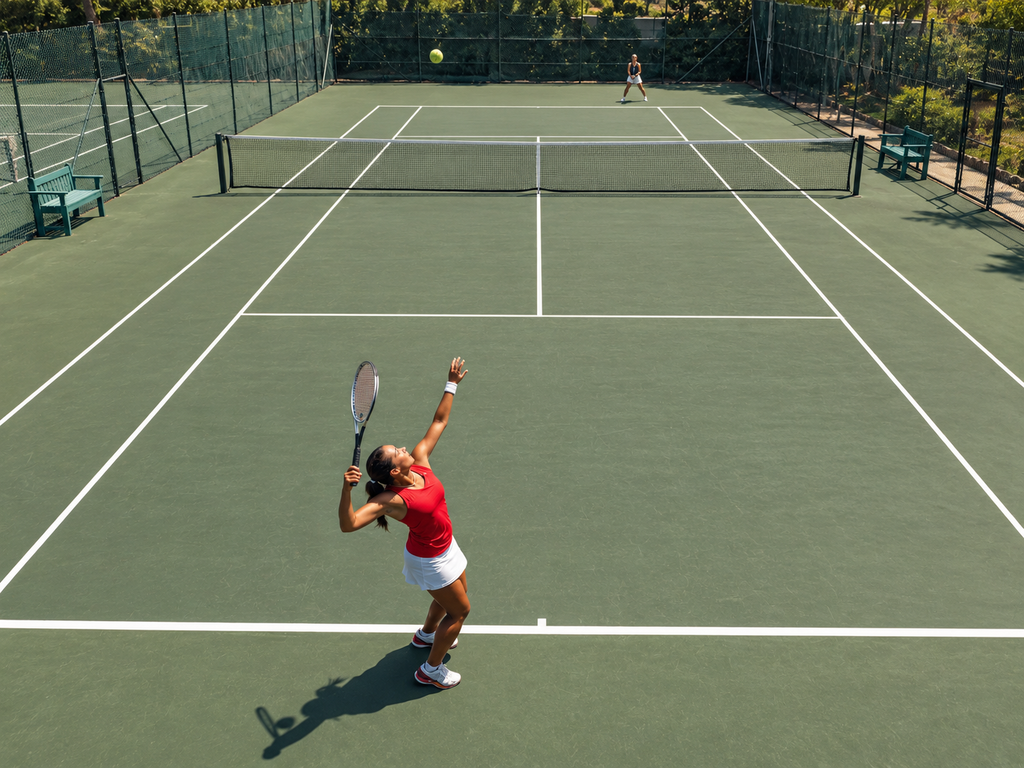
A powerful tennis serve can put an opponent under pressure, but speed alone does not make a serve effective. Players who struggle to direct the ball into specific areas of the service box often lose opportunities to start points confidently. They may also commit unnecessary double faults when trying to serve harder than they can consistently control.
Learning how to improve your tennis serve accuracy helps intermediate players develop more dependable serves, direct the ball toward useful targets, and reduce errors. By focusing on repeatable technique, controlled acceleration, and structured target practice, you can improve your ability to place serves without relying entirely on power.
Why Serve Accuracy Matters in Tennis
Serve accuracy refers to your ability to direct the ball into a chosen area of the correct service box. It involves more than simply getting the serve in.
An accurate serve allows you to choose where your opponent receives the ball. This can influence their return position, the type of return they can produce, and how the point develops.
For intermediate players, improved accuracy offers several advantages:
- Fewer double faults: More reliable service execution reduces the chances of losing points without a rally.
- Better control of point starts: Serving toward a chosen target allows you to begin points more deliberately.
- Greater variety: You can change placement without needing to dramatically increase power.
- Improved confidence: Reliable targeting makes it easier to maintain your normal serving motion during important points.
- More effective use of serve speed: Well-placed serves can be difficult to return even when they are not exceptionally fast.
Accuracy and consistency are related, but they are not identical.
A player may consistently land serves in the middle of the service box without being able to direct them toward a specific target. Developing placement means improving control over where successful serves land.
Understand the Three Main Serve Placement Targets
The service box provides several useful target areas. For intermediate players, three general locations are especially important.
Wide Serve
A wide serve is directed toward the outer portion of the service box, closer to the singles sideline.
Its purpose is often to move the receiver away from the center of the court.
A successful wide serve may force the receiver to stretch or move laterally before making contact.
However, serving wide can also create a return angle if your opponent reaches the ball comfortably.
Use the wide serve as a controlled placement option rather than assuming it will automatically produce a weak return.
Body Serve
A body serve is directed toward the receiver’s position, making it more difficult to establish comfortable spacing for the return.
The exact target depends on where the receiver stands and how they react.
For example, a serve traveling toward the receiver’s hitting hip or central body area may require a quick adjustment before they can make contact.
Body serves can be useful against opponents who return effectively when given room to extend their arms.
The goal is controlled placement, not deliberately hitting the opponent.
T Serve
A T serve is directed toward the center service line, near the point where it meets the service line.
This target creates a different return angle from a wide serve.
Depending on the receiver’s position, a well-placed T serve may require a quick movement toward the center.
It can also reduce the lateral angle available for certain returns.
When practicing T serves, remember that aiming directly at the line leaves very little margin for error.
Initially, choose a target area comfortably inside the service box, then gradually improve your precision.
Develop a More Consistent Ball Toss
An inconsistent ball toss is one of the common reasons intermediate players struggle with serve placement.
When the ball travels to different positions on successive serves, the player must repeatedly adjust their contact point and racket path.
This makes accuracy harder to reproduce.
Keep the Toss Repeatable
Use a smooth tossing motion and a consistent release.
Avoid adding unnecessary wrist movement that makes the ball travel unpredictably.
The toss should reach a location appropriate to your serving technique, allowing you to extend comfortably into contact.
Understand Toss Position
The ideal toss position depends on the player’s stance, serving motion, and type of serve.
For a typical flat first serve, a right-handed player may contact the ball somewhat in front of the body and toward the hitting side. The exact location varies between players.
The objective is not to force everyone into one toss position.
Instead, develop a repeatable toss that supports your intended racket path and target.
Practice Without Hitting
A simple toss drill can reveal inconsistencies before they affect the full serve.
- Assume your normal serving stance.
- Toss the ball using your usual motion.
- Allow the ball to fall without swinging.
- Observe its landing position.
- Repeat ten times.
Look for a consistent landing area rather than expecting every toss to fall on one exact spot.
A toss-only drill does not perfectly reproduce the toss used during a complete serving motion, but it can help identify major inconsistencies.
Maintain Reliable Serving Mechanics
Accuracy becomes more difficult when the serving motion changes significantly between attempts.
Intermediate players should focus on repeatable coordination rather than constantly rebuilding their technique.
Establish a Consistent Starting Position
Choose a stance that feels balanced and supports your established serving motion.
Position yourself behind the baseline on the appropriate side of the center mark.
Your stance should allow comfortable shoulder rotation, weight transfer, and upward movement toward the ball.
Avoid changing your foot placement with every serve unless you are deliberately practicing a specific adjustment.
Coordinate the Toss and Racket Movement
The tossing arm and racket arm should work together through a coordinated serving motion.
If the toss is rushed or the racket preparation is delayed, contact becomes less predictable.
Practice a smooth rhythm that allows you to reach the ball at an appropriate height without feeling hurried.
Maintain a Suitable Contact Point
The ball should be contacted at a height and position that allow an effective serving motion.
Contacting too far behind the body can affect balance and racket orientation.
Contacting too far in front may force the player to reach or alter the swing unexpectedly.
Review your contact position when serves consistently miss in the same direction.
Avoid Steering the Racket at Contact
Players sometimes try to control serve placement by abruptly changing the racket face or slowing the swing immediately before contact.
This often produces a less natural motion and unpredictable results.
Instead, develop direction through coordinated body alignment, racket path, contact position, and a suitable racket-face orientation.
Placement should result from a repeatable serving motion, not a last-second wrist adjustment.
How to Aim Your Tennis Serve More Accurately
Serving toward a target requires more than looking at a particular spot.
You need to coordinate your intended direction with the serving motion.
Begin With Larger Targets
Divide the correct service box into three general target zones: wide, body, and T.
Initially, aim toward the middle of each zone rather than the boundaries.
Larger targets provide useful margins and allow you to develop directional control before demanding precision.
Once you can repeatedly land serves in a broad zone, gradually make the target smaller.
Practice One Target at a Time
Changing your target after every serve makes it more difficult to identify patterns.
Start by attempting several serves toward the same area.
For example, serve ten balls toward a wide target and record how many land successfully in that zone.
Repeat with the body and T targets.
This allows you to compare performance across different placements.
Adjust Your Aim Gradually
If your serves consistently miss toward one side, review your starting alignment, toss, contact, and racket path.
Avoid making large technical changes after a single miss.
Observe several serves to identify a pattern before making an adjustment.
Use a Controlled Serving Speed
When learning accurate placement, start at a speed that allows you to reproduce your normal technique.
You do not need to serve slowly or interrupt your natural motion.
Instead, choose a manageable level of effort and gradually increase pace while maintaining target accuracy.
Balance Serve Power and Placement
An effective serve combines speed, placement, spin, and reliability.
The balance between these elements changes according to the player’s ability and the match situation.
A faster serve offers less reaction time, but it may also become less accurate when a player exceeds their controllable serving speed.
A moderately paced serve directed to a difficult location may be more effective than a powerful serve that lands in a comfortable returning position.
Find Your Reliable Serving Speed
Begin with a serve speed that allows you to maintain natural mechanics and reasonable accuracy.
During practice, compare the results of different effort levels.
For example, you might attempt ten serves at a comfortable pace and another ten at a moderately higher intensity.
Record both the total serves that land in and the serves that reach your intended target.
If accuracy declines sharply as effort increases, you may need additional practice before relying on that pace during matches.
Avoid Sacrificing Technique for Speed
Trying to generate maximum power can cause players to rush their motion, lose balance, or contact the ball inconsistently.
Develop your serving rhythm and accuracy first.
Then introduce greater acceleration while preserving the same fundamental coordination.
Four Practical Tennis Serve Accuracy Drills
The following drills help intermediate players improve targeting, consistency, and placement under progressively more demanding conditions.
Drill 1: Three-Zone Target Practice
Objective: Improve control over wide, body, and T serve placement.
Equipment: Tennis balls and cones or flat markers.
Setup: Identify three broad target areas inside the appropriate diagonal service box.
Instructions:
- Begin from the deuce side.
- Attempt ten serves toward the wide target.
- Record successful serves that land within the designated area.
- Repeat with the body and T targets.
- Move to the ad side and complete the same sequence.
Practice focus: Maintain a repeatable serving motion while changing intended placement.
Record overall service-box accuracy separately from target accuracy.
Drill 2: Consecutive Serve Challenge
Objective: Develop reliable service execution without unnecessary technical adjustments.
Setup: Serve from the baseline using a broad target inside the correct service box.
Instructions:
- Attempt to land three consecutive serves inside the box.
- Increase the target to five consecutive serves.
- Progress toward eight or ten successful serves.
- Restart the count after a fault.
- Repeat from both the deuce and ad sides.
Practice focus: Maintain consistent rhythm, toss quality, and contact position.
Do not increase serve speed simply because you have completed a successful sequence.
Drill 3: Target Accuracy With Controlled Pace
Objective: Improve accuracy while gradually introducing greater serving speed.
Setup: Choose one target zone and prepare a set of tennis balls.
Instructions:
- Hit ten serves at a comfortable effort level.
- Record the number reaching the intended target.
- Hit another ten serves using moderately greater effort.
- Record the results again.
- Compare your accuracy at the two effort levels.
Practice focus: Identify the serving intensity at which you can maintain reliable target control.
Use similar conditions when comparing results.
Drill 4: First-Serve and Second-Serve Simulation
Objective: Apply serve placement skills under realistic scoring pressure.
Setup: Play simulated service points without requiring a returner.
Instructions:
- Select a target for your first serve.
- Attempt the serve using your normal first-serve motion.
- If it is a fault, prepare a second serve aimed at a larger, safer target area.
- Count a double fault if both serves miss the correct service box.
- Complete twenty simulated service points.
- Record first-serve percentage, second-serve success, and double faults.
Practice focus: Maintain a dependable routine while adjusting the level of placement risk.
This drill is intended to develop accuracy and decision-making, not to teach advanced spin-based second serves.
Common Tennis Serve Placement Mistakes
Intermediate players may develop habits that reduce accuracy even when they understand the intended technique.
Aiming Too Close to the Lines
Trying to hit the corners of the service box leaves little margin for minor errors.
Correction: Begin with larger target zones and gradually increase precision.
Changing the Toss for Every Target
Deliberately altering the toss too dramatically between placements can reduce consistency and reveal your intentions.
Correction: Develop a repeatable toss appropriate to the serve being practiced. Small technical variations may be necessary, but avoid unnecessary changes.
Slowing the Racket Abruptly
Trying to guide the serve by decelerating at contact can disrupt the serving motion.
Correction: Maintain a smooth, coordinated swing at a controllable effort level.
Practicing Only From One Side
Accuracy developed exclusively from the deuce court may not transfer automatically to the ad court.
Correction: Practice each target from both service positions.
Focusing Only on Successful Serves
Counting serves that land in the box provides useful information, but it does not measure precise placement.
Correction: Track both service-box success and intended-target accuracy.
Making Technical Changes After Every Miss
One missed serve does not necessarily indicate a mechanical problem.
Correction: Look for repeated patterns before adjusting your toss, alignment, or swing.
How to Measure Your Serve Accuracy
Tracking a few simple measurements can help you evaluate improvement over multiple practice sessions.
Serve-In Percentage
Calculate the percentage of serves that land inside the correct service box.
For example, if 32 out of 40 serves land successfully, your serve-in percentage is 80%.
This measures general reliability but does not indicate whether you reached your intended target.
Target Accuracy Percentage
Record how many serves land in the selected target zone.
If 12 out of 20 serves reach your chosen area, your target accuracy is 60%.
Keep the target size consistent when comparing sessions.
First-Serve Percentage
During practice points or simulated service games, track the proportion of first serves that land in.
This helps you evaluate whether your first-serve pace and placement are reliable enough for match play.
Double-Fault Frequency
Record the number of double faults over a consistent number of simulated service points or actual service games.
A reduction in double faults may indicate improved second-serve reliability, although you should also consider how effectively those serves are placed.
Accuracy Under Pressure
Compare your serve performance during relaxed target practice with your results during simulated games or match play.
Some players serve accurately during isolated drills but struggle when keeping score.
Practicing with consequences and a normal between-point routine can help bridge that difference.
Build a Practical Serve Accuracy Routine
Serve placement improves through repeated, purposeful practice.
A simple training session might follow this structure:
| Practice Activity | Duration |
|---|---|
| Dynamic warm-up and progressive serves | 5 minutes |
| Toss consistency practice | 5 minutes |
| Three-zone target practice | 10 minutes |
| Controlled-pace accuracy practice | 5 minutes |
| First- and second-serve simulation | 10 minutes |
This 35-minute routine can be adjusted according to your experience, available time, and physical readiness.
Allow adequate rest between serving sets, particularly when practicing at higher effort levels. Stop or reduce intensity if shoulder or elbow discomfort develops.
Focus on the quality of each attempt rather than simply hitting as many serves as possible.
Improve Your Serve One Target at a Time
Learning how to improve tennis serve accuracy requires a combination of repeatable mechanics, purposeful target selection, and regular practice.
Start by developing a consistent toss and serving rhythm. Practice directing the ball toward broad wide, body, and T zones before attempting smaller targets.
As your placement becomes more dependable, gradually increase serving pace and introduce match-like pressure.
A reliable serve does not need to be the fastest shot on the court. By improving accuracy and selecting appropriate targets, intermediate players can start more points with control and become more confident during service games.