
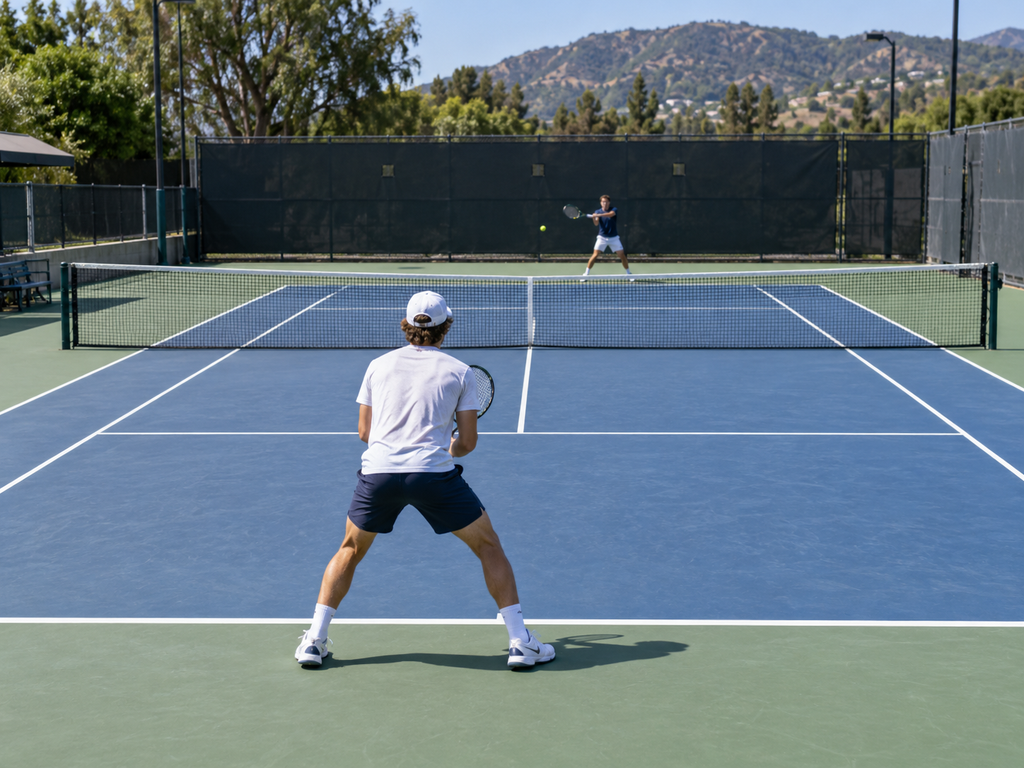
Good tennis court positioning helps players reach more shots, reduce unnecessary movement, and prepare for the next ball. While technique and footwork are essential, knowing where to stand during a rally can make just as much difference to your ability to stay competitive.
At the intermediate level, players need to move beyond simply returning to the middle of the court after every shot. Effective positioning depends on where you hit the ball, where your opponent is located, and which return angles are available. Understanding these relationships allows you to cover the court more efficiently and respond to changing rally situations.
Why Tennis Court Positioning Matters
Tennis court positioning refers to where you place yourself in relation to the ball, your opponent, and the available playing space.
A well-positioned player is better prepared to reach the next shot without making unnecessary movements. Poor positioning, on the other hand, can leave large areas of the court exposed or force you to chase balls that would otherwise be manageable.
Effective positioning can help you:
- Cover likely return angles more efficiently.
- Reduce the distance required to reach the next ball.
- Maintain a balanced position before your opponent strikes.
- Recognize opportunities to move forward or defend.
- Avoid leaving unnecessary openings on the court.
- Respond more effectively when the direction of a rally changes.
The most important principle is that court positioning is dynamic. There is no single location that works for every rally or every shot.
As an intermediate player, your goal is to recognize how your position should change as a point develops.
Understanding the Basic Positions on a Tennis Court
Several general court positions provide useful reference points during singles play.
Behind the Baseline
During a neutral baseline rally, players typically position themselves around or behind the baseline.
The exact distance depends on the incoming ball’s depth, speed, spin, and the player’s preferred contact position.
Standing farther behind the baseline provides more reaction time against deep or powerful groundstrokes. However, it also increases the distance required to reach short balls and may allow the opponent to control more of the court.
Moving closer to the baseline can help you take time away from your opponent, but it requires earlier preparation and more precise timing.
Neither position is automatically correct. Choose a depth that allows you to handle the incoming ball effectively.
Inside the Baseline
Moving inside the baseline is often appropriate when an opponent hits a shorter or weaker ball.
This position allows you to contact the ball earlier, play a more aggressive shot, or continue moving toward the net.
However, stepping forward without a suitable opportunity can leave you vulnerable to deeper replies.
Recognize whether the incoming ball gives you enough time and control to move forward confidently.
Near the Service Line
The area around the service line is commonly crossed when approaching the net.
It can also become a temporary hitting position when responding to a short ball.
This is not usually an ideal place to remain during a neutral singles rally. From this area, you may be vulnerable to balls directed toward your feet, passing shots, or lobs.
If you decide to approach the net, continue toward an appropriate volleying position when the situation permits.
Near the Net
Moving toward the net allows you to intercept the ball earlier and finish suitable attacking opportunities.
Your position should depend on the opponent’s location, the quality of your approach shot, and the likelihood of a passing shot or lob.
Do not move so close to the net that you cannot react to an opponent’s reply.
For intermediate players, understanding when to advance is more important than trying to play every point near the net.
Where Should You Stand During a Baseline Rally?
During a neutral singles rally, a useful starting position is near the baseline and around the center of the likely return angles.
However, this does not mean standing directly on the center mark throughout every exchange.
Your position should change in response to the opponent’s location and the direction of your previous shot.
When the Ball Is Near the Center
If you hit a neutral groundstroke toward the middle of your opponent’s court, recovering toward the central baseline area is often appropriate.
From this position, you have a reasonable opportunity to cover replies toward either sideline.
Your exact depth should reflect the pace and depth of the incoming rally.
When Your Opponent Is Pulled Wide
A shot that forces your opponent toward a sideline changes the angles available for the next reply.
For example, an opponent contacting a ball near the deuce-court sideline may have different crosscourt and down-the-line options than an opponent hitting from the center.
Your recovery position should reflect those possibilities.
Rather than automatically returning to the exact center mark, position yourself to cover the most realistic replies.
When You Are Under Pressure
If an opponent hits a deep, powerful shot that pushes you backward, your priority may be to establish a position where you can make controlled contact.
You may need to remain farther behind the baseline temporarily.
Avoid forcing yourself forward before you have enough time to prepare.
Once you return a manageable shot and regain a neutral rally position, you can adjust your depth accordingly.
How to Recover After a Crosscourt Shot
Crosscourt shots are common during baseline rallies because the diagonal court provides useful space and generally allows a safer trajectory.
When you hit crosscourt, the opponent will often receive the ball on the same general side of the court as your starting hitting position, viewed across the net.
This affects how you should recover.
Example: Crosscourt Forehand Rally
Imagine you are a right-handed player hitting a forehand from the deuce side.
You send a controlled crosscourt forehand toward your opponent’s deuce side.
If your opponent remains in that area, a crosscourt reply may bring the ball back toward the side you just played from.
Instead of recovering completely past the center mark, you may benefit from remaining slightly toward that side.
This reduces the distance required to reach a likely crosscourt return.
However, you still need to respect the possibility of a down-the-line shot.
Practical Recovery Principle
After hitting crosscourt:
- Recognize where your shot is likely to land.
- Observe whether your opponent reaches the ball comfortably.
- Move toward a position that covers the available return angles.
- Avoid recovering excessively toward one sideline.
- Prepare to react as your opponent makes contact.
The objective is not to predict the next shot perfectly. It is to establish a position that gives you a reasonable chance of responding to multiple possibilities.
How to Recover After a Down-the-Line Shot
Down-the-line shots change the geometry of a rally.
When you hit down the line, the ball travels toward the opponent’s court on the same side of the net as your hitting position.
From there, the opponent may have a crosscourt angle that directs the ball toward the opposite side of your court.
As a result, your recovery position often needs to shift farther across the center than it would after a crosscourt shot.
Example: Down-the-Line Backhand
Imagine hitting a backhand down the line from your ad side.
The ball travels toward your opponent’s deuce side.
If the opponent can make a comfortable return, a crosscourt reply could send you toward your deuce side.
Remaining close to your original backhand sideline would leave considerable court space exposed.
Instead, recover toward or somewhat beyond the center mark, depending on your shot’s quality and the opponent’s available angles.
When Not to Over-Recover
Not every down-the-line shot requires a large recovery movement.
If your shot is especially deep or forces the opponent to stretch, they may have fewer realistic options for a sharp crosscourt reply.
Recovering excessively could then leave you unnecessarily exposed to another direction.
Assess the opponent’s balance and contact position before committing too far.
The important lesson is to recover according to the opponent’s likely response, not simply according to a fixed rule.
How Shot Depth Affects Your Court Position
Shot direction is only one part of court positioning. Depth also influences how much time and space each player has.
After Hitting a Deep Shot
A deep groundstroke can push an opponent farther behind the baseline.
If the opponent has difficulty attacking from that position, you may have time to maintain a relatively stable baseline position or move slightly forward.
However, depth alone does not guarantee a weak reply. A well-balanced opponent may still produce a strong return.
Continue evaluating the opponent’s preparation.
After Hitting a Short Ball
If your shot lands short and allows the opponent to step inside the baseline, you may need to prepare for a more aggressive reply.
The opponent may have opportunities to hit wider angles or direct a faster ball toward an open area.
Your position should acknowledge this increased pressure.
Instead of rushing forward, establish a balanced location from which you can respond to the opponent’s attacking options.
When Receiving a Short Ball
If the opponent sends you a short ball, move forward to establish an appropriate contact position.
After hitting, decide whether you should continue approaching the net or recover to a baseline-oriented position.
That decision depends on the quality of your shot and whether moving forward creates a useful attacking opportunity.
Avoid automatically retreating behind the baseline after every shorter ball.
How to Position Yourself When Your Opponent Approaches the Net
An opponent moving toward the net changes the available targets and the time you have to respond.
Your normal baseline recovery position may no longer be the most important consideration.
Instead, focus on creating enough space and balance to play a suitable passing shot, lob, or controlled return.
Maintain a Useful Hitting Distance
Depending on the depth of the incoming ball, you may need to remain near or behind the baseline to create enough room for your stroke.
Avoid moving forward without a clear purpose when the opponent is already established at the net.
Recognize Open Passing-Shot Areas
The opponent’s position affects which part of the court is available.
Observe whether they are covering the center, favoring one side, or moving toward the anticipated shot.
Do not assume that a particular sideline is always open.
Consider the Lob
If the opponent is very close to the net, a well-executed lob may be a useful option.
However, attempting a difficult lob from poor balance can produce a short ball that is easy to overhead.
Select the shot according to your contact position and the opponent’s coverage.
Four Practical Tennis Court Positioning Drills
These drills help intermediate players develop better recovery decisions during singles rallies.
Drill 1: Crosscourt Recovery Practice
Objective: Learn to recover toward an appropriate position after crosscourt groundstrokes.
Setup: Two players rally crosscourt from the baseline.
Instructions:
- Begin a controlled crosscourt rally.
- After each shot, move toward a suitable recovery position.
- Remain aware of the opponent’s location.
- Use a split step as the opponent prepares to strike.
- Continue for ten to fifteen controlled exchanges.
Practice focus: Avoid automatically returning to the exact center mark when the rally geometry suggests a slightly different recovery position.
Drill 2: Crosscourt and Down-the-Line Recovery
Objective: Recognize how shot direction changes the next recovery position.
Setup: One player follows a predetermined pattern of crosscourt and down-the-line shots while a partner provides cooperative returns.
Instructions:
- Begin with a crosscourt groundstroke.
- Recover to cover the likely reply.
- On the next suitable ball, hit down the line.
- Adjust your recovery toward the new available return angles.
- Repeat the pattern while maintaining controlled shot execution.
Practice focus: Understand how changing direction affects the part of the court you need to protect.
Drill 3: Deep and Short Ball Positioning
Objective: Improve positional decisions when the depth of the incoming ball changes.
Setup: Have a partner feed alternating deep and short balls.
Instructions:
- Begin in a neutral baseline position.
- Respond to a deep ball from an appropriate distance behind or near the baseline.
- Recover according to the shot you played.
- Move forward when your partner feeds a shorter ball.
- Decide whether to continue forward or recover after making contact.
Practice focus: Adjust your court depth based on the incoming ball rather than remaining at one fixed distance from the baseline.
Drill 4: Live-Rally Recovery Decisions
Objective: Apply court positioning principles in realistic exchanges.
Setup: Play cooperative singles rallies in which either player may change direction.
Instructions:
- Begin each rally at a controlled pace.
- After each shot, identify where the opponent will likely contact the ball.
- Adjust your recovery position accordingly.
- Use a split step around the opponent’s contact.
- Continue the rally while avoiding unnecessary movement toward fixed court landmarks.
After several rallies, discuss whether your positioning helped you reach the next ball efficiently.
Practice focus: Develop the habit of making positioning decisions based on the actual rally situation.
Common Tennis Court Positioning Mistakes
Intermediate players often lose court coverage because of predictable positioning habits.
Always Returning to the Exact Center
The center mark is a useful reference, but it is not the correct destination after every shot.
Correction: Adjust your position according to the opponent’s location and likely return angles.
Standing Too Far Behind the Baseline
Remaining excessively deep can make it difficult to respond to short balls and take advantage of weaker returns.
Correction: Choose your depth according to the pace, depth, and difficulty of the rally.
Moving Forward Without an Opportunity
Advancing after a weak or poorly placed shot may leave you exposed to passing shots or deep returns.
Correction: Recognize when your previous shot gives you enough time and control to move forward.
Watching Your Shot Instead of Recovering
Players sometimes admire a well-hit groundstroke and delay preparing for the next exchange.
Correction: Begin evaluating the opponent’s likely reply immediately after contact.
Overcommitting to One Side
Trying to cover the most obvious return may leave the opposite side unnecessarily open.
Correction: Maintain a balanced position that accounts for more than one realistic response.
How to Measure Improvement in Court Positioning
Good court positioning is not measured simply by how much distance you cover.
In fact, improved positioning may allow you to reach the same balls with less movement.
Useful indicators include:
Recovery readiness: Are you balanced and prepared when your opponent makes contact?
Court coverage: Can you reach both crosscourt and down-the-line replies without repeatedly being caught out of position?
Reduced unnecessary movement: Do you avoid returning to positions that do not match the rally situation?
Better positional awareness: Can you explain why you recovered to a particular location after a shot?
Improved responses to changes in direction: Are you better prepared when an opponent redirects a rally?
Recording short sections of practice matches can help you evaluate your location after each stroke.
Pay attention to the moments immediately before your opponent hits. Your position at that instant often provides more useful information than where you began the point.
Make Court Positioning Part of Every Rally
Improving tennis court positioning requires a shift from following fixed recovery rules to making decisions based on the developing point.
Start by recognizing how crosscourt and down-the-line shots affect available return angles. Then consider your opponent’s position, the depth of your previous shot, and whether you should maintain a baseline position or move forward.
Practice recovering toward the areas that give you the best opportunity to handle the next realistic reply, rather than automatically returning to the center mark.
As your positional awareness develops, you can cover the court more efficiently, respond to changes in direction, and maintain better control throughout singles rallies.