
Moving from the baseline to the kitchen is one of the most important transitions beginners learn in pickleball.
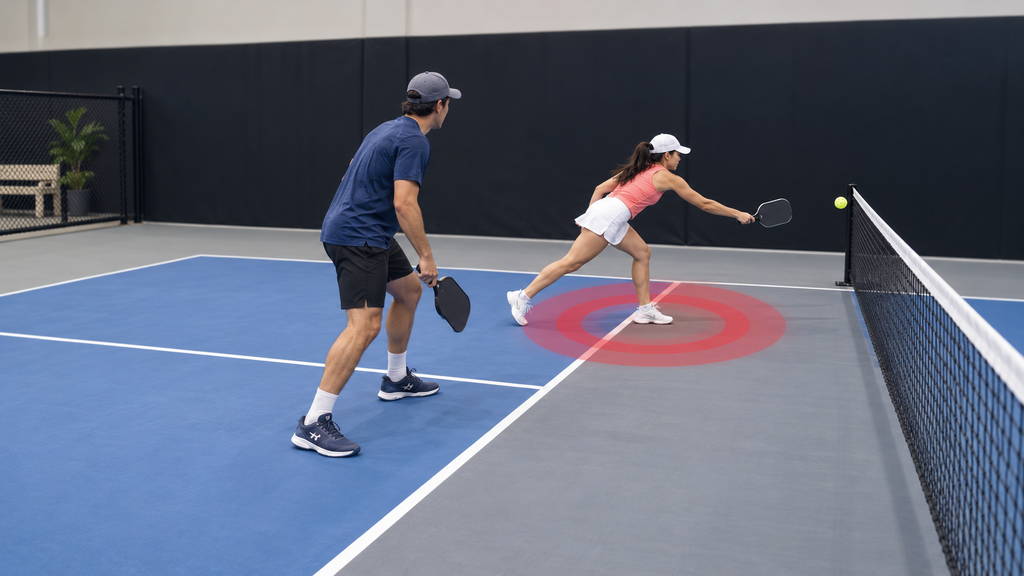
At the start of many points, you will be positioned near the baseline. As the rally develops, however, your goal is often to move forward toward the non-volley zone line, commonly called the kitchen line.
That movement sounds simple, but many beginners either rush forward too quickly, stay back too long or continue moving while the opponent is hitting the ball. Each of those habits can make the next shot much harder.
Learning how to advance under control helps you reach a stronger court position while staying balanced and ready for whatever comes next.
Why Players Move Toward the Kitchen
The kitchen line is an important position because it places you closer to the net.
From there, you can:
- Take time away from your opponents
- Reach shorter balls more easily
- Apply pressure with controlled volleys
- Participate in dink exchanges
- Cover more of the court without giving opponents large open spaces
Players who remain near the baseline for too long often give their opponents more time to react and more room to place the ball.
That does not mean you should charge forward after every shot.
The goal is to move toward the kitchen when the rally allows it while remaining balanced enough to respond to the next ball.
Understanding the Starting Position
When receiving serve, the receiving team typically begins near the baseline because the serve must bounce before it can be returned.
Under the two-bounce rule, the serving team must also allow the return of serve to bounce before playing it.
This creates a natural opportunity for the receiving team to begin moving forward after the return.
The serving team usually has to be more patient because it must first deal with that bouncing return before trying to advance.
For this reason, the path from the baseline to the kitchen is not identical for both teams.
The Receiving Team Can Often Advance First
After returning serve, the receiver and their partner should usually look for an opportunity to move toward the kitchen line.
A common beginner sequence is:
- Return the serve.
- Begin moving forward.
- Watch the opponent preparing to hit.
- Stop and get balanced before the opponent makes contact.
- Respond to the next ball.
- Continue forward when the opportunity appears.
You may not reach the kitchen line immediately.
That is completely normal.
Good movement is often a series of controlled advances rather than one long sprint.
The Serving Team Usually Has to Work Forward
The serving team starts the point at a positional disadvantage because the return of serve must bounce before it can be played.
After that bounce, the serving team can begin looking for opportunities to advance.
The problem is that the receiving team may already be close to the kitchen line.
Simply hitting the ball hard and running forward can leave the serving team vulnerable.
Instead, the serving team often needs to hit a shot that gives them enough time to move.
That may mean:
- Driving the ball and advancing when the opponent is under pressure
- Playing a softer shot that lands near the opponent’s kitchen
- Moving forward in stages
- Stopping to defend when necessary
The key is not to reach the kitchen as quickly as possible.
The key is to reach it without giving away control of the rally.
Do Not Run Forward Blindly
One of the most common beginner mistakes is sprinting from the baseline toward the net immediately after hitting the ball.
This can create several problems.
While you are running:
- Your body is less balanced
- Changing direction becomes harder
- Your paddle may drop
- Balls hit at your feet become difficult to handle
- You may run directly into a fast shot
Instead of thinking, “I need to get to the kitchen now,” think:
Hit, move, stop, play, move again.
That rhythm is much easier to control.
Use the Split Step Before Your Opponent Hits
One of the most useful movement habits in pickleball is the split step.
A split step is a small athletic stop that helps you become balanced and ready to move in any direction.
As your opponent prepares to hit:
- Slow your forward movement.
- Make a small hop or light adjustment with your feet.
- Land with your feet comfortably apart.
- Keep your knees slightly bent.
- Hold your paddle in front of your body.
You do not need a dramatic jump.
The purpose is simply to stop moving forward long enough to react properly.
Trying to hit while still running is much more difficult.
Move Forward in Stages
Beginners sometimes believe they must go directly from the baseline to the kitchen line.
In reality, you may need several shots to get there.
Imagine the court divided into three areas:
- Baseline area
- Transition area
- Kitchen line
You may hit from the baseline, move several steps forward, stop in the transition area, play another ball and then continue toward the kitchen.
This staged movement is especially important when your opponents are already positioned near the net.
Trying to force your way forward too quickly can make you an easy target.
What Is the Transition Zone?
The space between the baseline and the kitchen line is often called the transition zone.
Players sometimes refer to it as “no man’s land” because staying there for too long can be difficult.
That description can be misleading, though.
The transition zone is not automatically a bad place to be.
It is simply a temporary position.
You may need to stop there because your opponent is about to hit the ball.
The mistake is not being in the transition zone.
The mistake is continuing to move while the opponent is striking the ball or remaining there without trying to improve your position.
Use the transition zone as part of your journey forward.
Keep Your Paddle Ready While Moving
Your paddle should stay in a useful ready position as you advance.
Avoid allowing it to hang beside your leg.
A simple ready position includes:
- Paddle in front of your body
- Elbows relaxed
- Knees slightly bent
- Weight balanced
- Eyes on the ball
Keeping your paddle in front reduces the distance it must travel when the next shot arrives.
This becomes especially important as you move closer to the kitchen where rallies can speed up quickly.
Stay Low and Balanced
Forward movement in pickleball should be athletic rather than upright and stiff.
Keep a slight bend in your knees while moving.
This helps you:
- Change direction
- Reach low balls
- Handle shots near your feet
- Stop more quickly
- Maintain balance
Avoid leaning heavily forward while running.
Your upper body should remain relatively controlled while your feet do the movement.
Watch the Ball Before Watching Your Destination
Beginners sometimes become so focused on reaching the kitchen line that they stop paying attention to what their opponents are doing.
Your first responsibility is always to stay ready for the next ball.
Do not stare at the kitchen line while moving toward it.
Instead, watch:
- The ball
- Your opponent’s paddle
- Their body position
- The direction of the next shot
Your movement should be based on what is happening in the rally.
Know When to Stop Advancing
Moving forward is usually valuable, but there are times when you should stop.
Pause your advance when:
- Your opponent is preparing to hit
- You are off balance
- The ball is likely to land near your feet
- Your shot has left your opponent in a strong attacking position
- You need time to defend
You may even need to move backward slightly if a lob or deep shot forces you away from the net.
Forward movement should never be automatic.
Good players adjust based on the situation.
Do Not Move Forward After a Poor Shot
The quality of your previous shot affects whether you should advance.
Suppose you hit a high ball that your opponent can attack aggressively.
Charging toward the kitchen behind that shot may expose you to a fast ball before you are ready.
Instead, recognize when you have given your opponent an attacking opportunity.
Get balanced and prepare to defend.
Advance again when you regain control.
This leads to an important rule of thumb:
Move forward behind a ball that gives you time.
Move With Your Partner in Doubles
In doubles pickleball, both partners should generally move forward together.
A common mistake is having one player reach the kitchen while the other remains near the baseline.
That creates a large gap between the partners.
Opponents can attack that space by hitting:
- Between the two players
- Behind the player at the net
- In front of the player staying deep
Instead, try to maintain roughly the same depth as your partner.
If your partner moves forward, look for an opportunity to move forward as well.
If your partner must stop, you may need to stop too.
Think of the team as moving together rather than as two independent players.
Maintain Side-to-Side Positioning While Advancing
You should not only move forward.
You also need to stay connected to your partner horizontally.
If the ball moves toward one side of the court, both partners may shift slightly in that direction while advancing.
This helps reduce open gaps.
You do not need to mirror every step exactly, but both players should generally respond to the same movement of the ball.
Avoid Crossing Your Feet
When moving only a few steps, controlled shuffle steps can help you remain balanced.
Crossing your feet while trying to react to a fast ball can make changing direction more difficult.
Use:
- Small forward steps
- Shuffle steps
- Controlled adjustment steps
For longer distances, such as moving from the baseline after a deep return, normal running steps may be necessary.
The important part is to slow down and regain balance before the opponent hits.
What to Do With Balls at Your Feet
One of the hardest situations in the transition zone is receiving a ball near your feet.
Because you are between the baseline and kitchen line, opponents may deliberately place the ball low in front of you.
Your goal is usually not to attack these balls aggressively.
Instead:
- Bend your knees.
- Keep the paddle face controlled.
- Play the ball back with enough height to clear the net.
- Try to keep the return low.
- Regain balance.
- Continue advancing when possible.
Trying to hit a powerful shot from an awkward low position often creates unnecessary errors.
Do Not Force Every Ball
There will be times when you are halfway to the kitchen and the opponent hits a difficult shot.
You do not need to win the point immediately.
Sometimes the correct goal is simply to stay in the rally.
A controlled defensive shot can buy enough time to:
- Recover your balance
- Take another step forward
- Reconnect with your partner
- Prepare for the next ball
Patience is a major part of successful transition play.
A Simple Movement Pattern for Beginners
Use this pattern during practice:
Hit → Move → Stop → Play → Move Again
For example:
- Hit a deep return.
- Move several steps forward.
- Stop as your opponent prepares to hit.
- Play the next ball.
- Move forward again.
- Repeat until you reach the kitchen line.
This simple rhythm teaches you to avoid hitting while running.
Drill 1: Return and Advance
This drill teaches the receiving team’s basic movement.
Setup
One player serves while another returns.
How to Practice
- Start near the baseline.
- Return the serve.
- Move toward the kitchen line.
- Stop before the server hits the next ball.
- Play the ball.
- Continue advancing.
The goal is not speed.
Focus on balance and timing.
Drill 2: Three-Stop Transition
This drill teaches staged movement.
Place imaginary checkpoints at:
- Baseline
- Middle of the transition zone
- Near the kitchen line
After every shot:
- Move toward the next checkpoint.
- Stop before your partner hits.
- Play the next ball.
- Continue forward.
This helps eliminate the habit of sprinting continuously toward the net.
Drill 3: Partner Movement
Practice moving forward with a doubles partner.
Start with both players near the baseline.
One player feeds balls while the pair:
- Hits the ball.
- Moves several steps forward together.
- Stops together.
- Plays the next ball.
- Continues until both reach the kitchen.
The goal is to keep both players at approximately the same depth.
Common Beginner Mistakes
Sprinting all the way to the kitchen
Running continuously makes it difficult to react when the opponent hits.
Fix: Stop and get balanced before your opponent makes contact.
Staying at the baseline
Some beginners become comfortable hitting groundstrokes and never move forward.
Fix: Look for opportunities to advance after a good shot.
Moving after every shot regardless of quality
Not every shot gives you permission to move forward.
Fix: Advance when your shot gives you enough time or places the opponent under pressure.
Reaching the kitchen alone
One partner moves forward while the other stays deep.
Fix: Communicate and move as a team.
Paddle hanging down while moving
A low paddle creates slower reactions.
Fix: Keep the paddle in front while advancing.
Standing upright
An upright position makes low shots harder to handle.
Fix: Bend your knees slightly and stay athletic.
Hitting while still running
This often leads to poor contact and loss of control.
Fix: Use a split step and become balanced before hitting.
When You Reach the Kitchen Line
Once you arrive at the kitchen line, stop your forward movement and establish a balanced ready position.
Remember that you may not volley the ball while standing inside the non-volley zone or while your momentum carries you into it after a volley.
Position yourself close enough to the line to control the space in front of you without stepping illegally into the kitchen during a volley.
From this position, the style of the rally may change.
You may begin dealing with:
- Dinks
- Volleys
- Speed-ups
- Balls directed at your body
- Lobs over your head
Those situations require their own skills, but reaching the kitchen under control gives you a much better chance of handling them.
Safety Tips When Moving Forward
Controlled movement is safer as well as more effective.
Keep these habits in mind:
- Avoid sprinting blindly toward the net.
- Watch for your partner when moving side to side.
- Do not step on loose balls near the court.
- Wear court shoes with good lateral support.
- Maintain balance before changing direction.
- Avoid backing up quickly when possible.
- Give yourself enough space around the kitchen line.
If a lob forces you backward, turning and moving safely is usually better than running backward for several steps.
How to Know You Are Improving
You are making progress when you begin to notice that:
- You stop before opponents strike the ball.
- You reach the kitchen without feeling rushed.
- You make fewer errors from the transition zone.
- Your paddle stays ready while you move.
- You and your partner reach the kitchen together more often.
- You recognize when a shot is too weak to advance behind.
- You remain balanced even when opponents hit toward your feet.
Do not judge improvement only by whether you reach the kitchen quickly.
Better movement is about arriving under control.
Final Thoughts
Moving from the baseline to the kitchen is not a race.
Strong pickleball movement is based on timing, balance and awareness.
Start from the baseline, hit a controlled shot and move forward when the rally gives you the opportunity. As your opponent prepares to hit, stop and regain balance. Play the next ball, then continue advancing when it is safe to do so.
In doubles, move with your partner and avoid leaving large gaps between you.
The more comfortable you become with this rhythm, the easier it will be to transition from defensive baseline play into a stronger position near the kitchen.
Remember the simple sequence:
Hit. Move. Stop. Play. Move again.
That habit will help you reach the kitchen with much more control and confidence.