
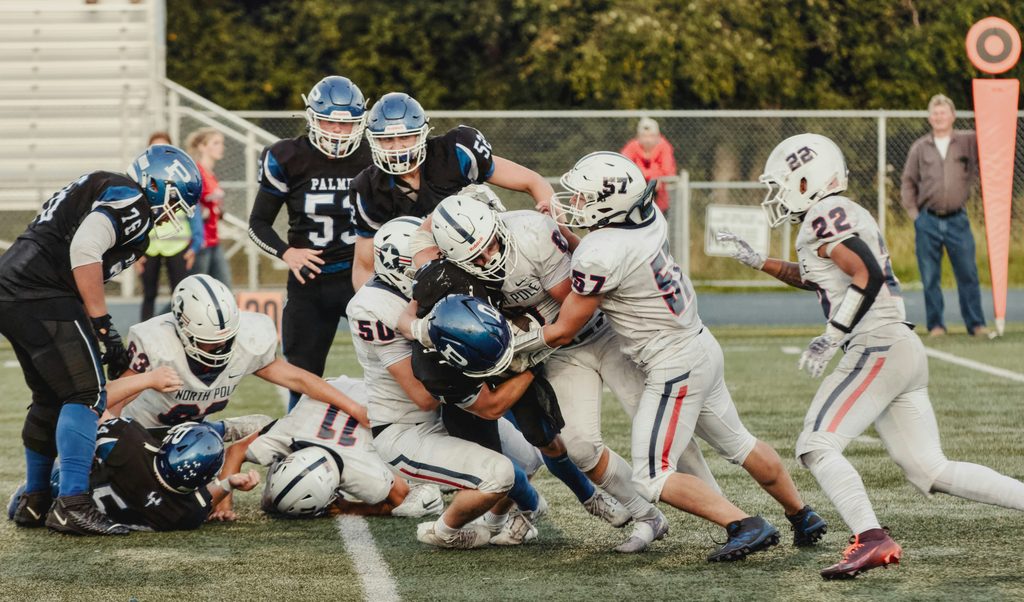
Understanding offense vs defense in football is one of the first steps toward making sense of an American football game. On almost every normal play, one team has possession of the football and tries to move it down the field, while the other team tries to stop that progress.
The team with the ball is the offense. Its main goal is to advance the football and ultimately score points. The opposing team is the defense. Its job is to prevent the offense from advancing, stop scoring opportunities, and, when possible, take possession of the ball.
These roles are not permanent. When possession changes, the teams switch responsibilities. The team that was playing offense sends out its defense, while the team that was defending gets an opportunity to use its offense.
This basic relationship between the two sides is central to understanding how football works.
What Is Offense in Football?
The offense is the group of players representing the team that currently controls the football.
Before most offensive plays, the ball is placed at the line of scrimmage, an imaginary line running across the field through the location of the ball. The offensive team lines up on one side of that line, while the defense lines up on the other.
The offense then runs a planned play designed to move the ball toward the opponent’s end zone.
An offense can advance the ball in several ways, but the two most important are:
- Running with the football
- Throwing a forward pass
Although offensive strategies can become extremely complicated, the basic objective is simple: gain yards, keep possession, and create opportunities to score.
What Is Defense in Football?
The defense is the group of players trying to stop the team with possession of the football.
Unlike the offense, the defense does not normally begin the play controlling the ball. Instead, defenders react to what the offense does while following their own assignments.
The defense may try to:
- Tackle the ball carrier
- Stop running plays
- Defend receivers against passes
- Pressure the quarterback
- Prevent the offense from earning a first down
- Force the offense backward
- Create a turnover and gain possession
A successful defense does not necessarily have to take the football away on every series. Simply preventing the offense from gaining enough yards can eventually force it to give up possession.
Which Team Is on Offense?
The simplest way to identify the offense is to look for the team that has possession of the ball.
At the start of a typical play, the offense controls the football and determines when the play begins through the snap.
The snap is the action that starts the play. Usually, a center sends the ball backward between the legs to the quarterback. Once the ball is snapped, the offense attempts to execute its planned play.
If you are watching a game and are unsure which team is playing offense, look for the quarterback positioned behind or near the center. That team’s unit is usually the easiest way for a beginner to identify the offense before the snap.
Possession is what determines the roles. A team is not permanently an offensive or defensive team.
When it has the ball, its offensive unit plays.
When the opponent has the ball, its defensive unit plays.
What Is the Main Goal of the Offense?
The offense’s ultimate goal is to score points.
Usually, that means moving the football toward the opponent’s end zone and trying to score a touchdown. However, an offense does not need to score on every individual play.
Football is built around a series of shorter objectives.
The offense normally receives a limited number of plays, called downs, to gain the required yardage for a new first down. By continuing to earn first downs, the offense can keep possession and move farther down the field.
For example, suppose an offense begins a series of downs at its own 30-yard line.
On the first play, the running back gains 5 yards.
On the next play, the quarterback completes a pass for 8 yards.
The offense has gained 13 yards over those two plays. If it reached the required line to gain, it receives a new first down and can continue its drive.
A drive is a series of offensive plays during one continuous period of possession.
Good offensive play therefore involves more than trying to score immediately. The offense must consistently gain yards while protecting the football.
Running the Football
A running play occurs when an offensive player carries the ball forward rather than relying primarily on a forward pass.
A common example begins with the quarterback receiving the snap and handing the football to a running back.
The running back then searches for an opening and tries to advance before being tackled.
Other offensive players help by blocking, which means legally getting in the way of defenders to create space for the ball carrier.
Running plays can serve many purposes. They may gain short, reliable yardage, attack openings in the defense, or help the offense control possession.
From a beginner’s perspective, the key point is simple: when an offensive player takes the football and runs with it, the defense tries to tackle that player and end the play.
Passing the Football
The other major way an offense advances is through passing.
On a typical passing play, the quarterback receives the snap and looks for an eligible teammate, often a wide receiver or tight end.
The quarterback throws the ball forward, and the receiver attempts to catch it.
If a legal forward pass is caught, the receiver can continue running until the player is tackled, goes out of bounds, scores, or the play otherwise ends.
If the pass hits the ground without being legally caught, it is normally an incomplete pass. The offense does not gain possession farther down the field simply because the quarterback threw the ball there.
Passing can produce large gains, but it also gives the defense opportunities to make plays on the football.
What Is the Main Goal of the Defense?
The defense wants to prevent the offense from scoring and make it as difficult as possible for the offense to continue its possession.
Defenders accomplish this in several ways.
They can stop a ball carrier for a small gain, defend a pass so it falls incomplete, tackle a quarterback behind the line of scrimmage, or force the offense into difficult down-and-distance situations.
For example, imagine the offense needs 10 yards for a new first down.
If the defense limits the offense to 2 yards on first down and stops the next play for no gain, the offense now faces a much more difficult situation because it still needs most of the required yardage.
A defense therefore does not need a spectacular play every time. Consistently limiting offensive gains can be extremely effective.
Tackling the Ball Carrier
One of the defense’s most basic responsibilities is tackling.
A tackle occurs when a defender legally brings the player carrying the football down or otherwise causes the play to end under the applicable rules.
Suppose a running back receives a handoff and runs for 4 yards before a linebacker tackles the player.
The play ends at approximately the spot where the runner’s forward progress ends. The offense keeps possession, but the defense has limited the gain.
Several defenders may participate in stopping the ball carrier, particularly when the offense runs into a crowded area.
Players must follow tackling rules. Certain forms of dangerous contact can result in penalties, and exact rules vary somewhat between leagues.
Preventing First Downs
A major defensive goal is preventing the offense from earning new first downs.
An offense cannot continue indefinitely without gaining the required yardage. If it fails to reach the line to gain within its available downs, possession can eventually change.
That gives the defense a clear short-term objective: keep the offense from reaching the required distance.
Imagine the offense faces third down and needs 7 yards for a first down.
The quarterback completes a pass, but the receiver is tackled after gaining only 4 yards.
The defense has allowed a completed pass, but it has still achieved an important result because the offense remains short of the first-down marker.
Depending on the situation, the offense may then punt, attempt a field goal, or try another offensive play on fourth down.
How the Defense Can Create Turnovers
Stopping the offense is useful, but taking the football away can be even more important.
An unexpected change of possession is commonly called a turnover.
Two of the most familiar turnovers are interceptions and lost fumbles.
An interception happens when a defensive player catches a forward pass thrown by the offense. Instead of the intended offensive receiver catching the ball, the defender gains possession.
A fumble occurs when a player who has possession loses control of the football while the ball is still live. If the defense legally recovers it, possession changes.
After many turnovers, the defender who gains possession may be able to run with the football before being tackled or scoring.
Once that play ends, the team that gained possession can send its offense onto the field.
How Possession Changes Offensive and Defensive Roles
The easiest way to understand offense vs defense in football is to remember that possession controls the roles.
Consider a game between Team A and Team B.
Team A begins with the football, so Team A’s offense takes the field. Team B’s defense lines up against it.
Team A’s quarterback throws a pass.
A Team B defender intercepts it.
At that moment, Team B has gained possession. During the interception return, that defender can attempt to advance the ball.
When the play ends, the teams change units.
Team B sends out its offense because Team B now possesses the ball. Team A sends out its defense because Team A must now try to stop Team B.
The teams themselves have not changed. Their roles have changed because possession has changed.
Other Ways Possession Can Change
An interception or lost fumble is not the only way one team can give the football to the other.
Possession can also change after situations such as:
- A punt
- A kickoff
- A failed fourth-down attempt
- Certain scoring plays followed by the appropriate restart
- The end of a half or game period under applicable procedures
One common example is a punt.
If an offense reaches fourth down and does not want to risk failing to gain the required yardage, it may kick the ball to the other team. Once the receiving team legally gains possession and the play ends, its offensive unit can take over.
The important point for understanding offense and defense is that every possession change eventually reverses the teams’ normal roles.
Why Most Players Specialize on Offense or Defense
American football has highly specialized positions. At major competitive levels, most players normally spend their regular snaps on either offense or defense rather than playing both sides throughout the game.
Offensive players develop skills suited to moving and protecting the football.
Quarterbacks practice throwing passes and directing offensive plays. Running backs specialize in carrying the football. Receivers focus on running routes and catching passes. Offensive linemen concentrate heavily on blocking.
Defensive players develop a different set of responsibilities.
Defensive linemen work to defeat blocks and disrupt plays near the line of scrimmage. Linebackers may help against both runs and passes. Defensive backs commonly defend receivers and passes farther from the line.
Because these responsibilities are so different, specialization allows players to concentrate on the techniques required for their positions.
Teams can substitute players between plays, which makes it practical to use separate offensive and defensive groups.
There are exceptions, especially at levels where teams have smaller rosters. Some high school or youth players, for example, may play both offense and defense.
Offense and Defense Work as Units
Football is not simply a series of individual matchups. Both the offense and defense must work together as coordinated units.
On offense, a successful pass might require several players to do their jobs correctly.
The offensive line must protect the quarterback. Receivers must run their assigned routes. The quarterback must read the defense and make an accurate throw. The intended receiver must complete the catch.
One mistake can disrupt the entire play.
Defense also requires coordination.
Some defenders may rush toward the quarterback while others cover receivers. Against a running play, defenders must maintain their responsibilities so that the ball carrier cannot easily find an open path.
This team structure is one reason football can appear complicated at first. Eleven players on each side may have different assignments on the same play.
Beginners do not need to understand every assignment to follow the action. Start with the larger question: What is the offense trying to accomplish, and how is the defense trying to stop it?
A Simple Offense vs Defense Example
Imagine the offense starts with the football at its own 25-yard line.
On first down, the quarterback hands the ball to a running back. The offensive line blocks while the defense tries to close the running lanes. The running back gains 4 yards before being tackled.
On the next play, the offense chooses to pass. The quarterback throws to a receiver who catches the ball for another 8 yards.
The offense has successfully moved down the field and may have earned a new first down.
Several plays later, the quarterback attempts another pass.
This time, a defensive back anticipates the throw and catches it.
That is an interception.
The defender runs several yards before being tackled.
Now possession belongs to the other team. The former defense leaves the field, and that team’s offensive unit enters. The team that just lost the ball sends out its defense.
Within a single play, the relationship between the two teams has completely reversed.
Offense vs Defense in Football: The Basic Difference
The basic difference between offense and defense comes down to possession and purpose.
The offense has the football and tries to advance it, earn first downs, maintain possession, and score.
The defense does not begin with possession and tries to stop the offense, prevent first downs and scoring, and create opportunities to take the football away.
Once possession changes, the teams switch roles.
Understanding that simple pattern makes many other parts of football easier to follow. Instead of seeing 22 players moving at once, you can begin by identifying which side has the ball and what the opposing side is trying to prevent.
Frequently Asked Questions
Does the Offense Always Have the Football?
The offensive team is the team with possession, although individual offensive players obviously do not all physically hold the ball. The football may be snapped, handed off, thrown, or carried during a play while the team remains on offense.
Can a Defensive Player Score?
Yes. A defender who gains possession through a play such as an interception or fumble recovery may be able to advance the football and score a touchdown.
Does a Team Use the Same Players on Offense and Defense?
Usually not at major competitive levels. Most players specialize in offensive or defensive positions, and teams substitute different groups when possession changes. At some youth or high school levels, players may participate on both sides.
What Happens When the Defense Gets the Ball?
If the defense gains legal possession, the play continues according to the situation until it ends. Afterward, the team that gained possession normally sends its offensive unit onto the field, while the other team sends out its defense.
What Is the Biggest Difference Between Football Offense and Defense?
The biggest difference is their immediate objective. The offense controls the ball and tries to advance and score. The defense tries to stop that progress and, when possible, gain possession.
Key Takeaways
- The offense is the team with possession of the football.
- The offense tries to gain yards, earn first downs, maintain possession, and score.
- Running and passing are the two main ways an offense advances the ball.
- The defense tries to stop the offense from advancing and scoring.
- Defenders tackle ball carriers, defend passes, prevent first downs, and try to create turnovers.
- Interceptions and recovered fumbles can give the defense possession.
- When possession changes, the teams switch offensive and defensive roles.
- Most players specialize on one side of the ball because offensive and defensive positions require different responsibilities and skills.
- Understanding possession is the easiest way for a beginner to recognize offense vs defense in football.