
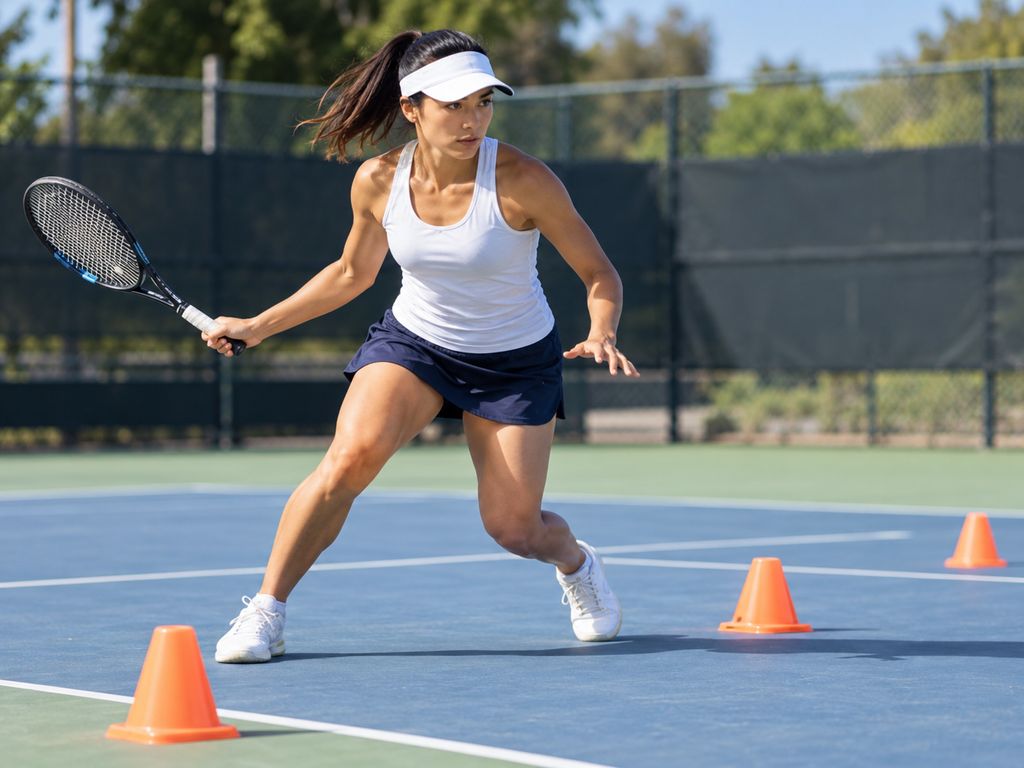
Good tennis footwork allows players to reach the ball efficiently, establish a balanced hitting position, and prepare for the next shot. Even players with reliable forehands and backhands can struggle during rallies when their movement is late, their positioning is awkward, or their recovery is too slow.
Practicing tennis footwork drills can help intermediate players improve their first step, movement efficiency, balance, and ability to change direction. By developing these skills, you can reach more balls in a comfortable hitting position and maintain better control during increasingly demanding rallies.
Why Footwork Matters in Tennis
Footwork connects your movement to your stroke execution. It determines how quickly you respond to an incoming ball, whether you arrive in a useful hitting position, and how efficiently you prepare for the next exchange.
At the intermediate level, many players already understand the basic mechanics of groundstrokes and volleys. However, their performance may become inconsistent when opponents change the direction, depth, or speed of the ball.
Effective footwork helps players:
- React more quickly to incoming shots.
- Cover short and wide balls efficiently.
- Maintain balance while hitting on the move.
- Adjust their distance from the ball before contact.
- Recover after each stroke without wasting movement.
- Change direction with greater control.
Improving these abilities requires more than running faster. Tennis movement involves short bursts of acceleration, controlled deceleration, small adjustment steps, and repeated changes of direction.
The goal is to move with purpose rather than take as many steps as possible.
Understanding the Essential Tennis Footwork Patterns
Before practicing specific drills, it helps to understand the movement patterns used throughout a tennis rally.
The Split Step
The split step is a small, timed hop or adjustment that prepares your body to move in either direction.
Players typically initiate the split step as the opponent is about to strike the ball, aiming to land around the opponent’s contact so they can react to the outgoing shot.
To perform it:
- Maintain a comfortable athletic stance with your knees slightly bent.
- Make a small hop or light adjustment off the ground.
- Land on the balls of your feet with your weight balanced.
- Push toward the direction of the incoming ball.
The movement should be compact and responsive. Jumping too high wastes time and can delay your first step.
Lateral Movement
Side-to-side movement is essential for reaching groundstrokes during baseline rallies.
Depending on the distance involved, players may use sidesteps, crossover steps, or a combination of movements.
Shorter adjustments often require small lateral steps, while wider balls may require a crossover or running movement to cover more distance.
The best choice depends on how far you need to travel and how much time you have before the ball arrives.
Forward and Backward Movement
Not every incoming shot stays near the baseline.
Short balls require players to accelerate forward, while deeper shots may force them to move backward or create additional space behind the ball.
Forward movement should be controlled so you can slow down before contact when possible.
When retreating, turning and moving with crossover or running steps is generally more efficient and stable than taking several long backward steps.
Adjustment Steps
Once you approach the incoming ball, smaller steps allow you to fine-tune your hitting position.
These final adjustments are particularly important when the ball bounces higher, lower, faster, or slower than expected.
Without adjustment steps, players may arrive near the ball but still make contact while cramped, stretched, or off balance.
Recovery Steps
Recovery begins immediately after completing a stroke.
A player hitting from a wide position may use a crossover step to begin moving back toward an appropriate recovery area, then transition into smaller steps as the opponent prepares to hit.
Recovery should respond to the shot you have played and the opponent’s likely return options rather than follow a fixed movement pattern every time.
Drill 1: Split-Step Reaction Drill
Objective: Improve reaction timing and the ability to initiate movement in either direction.
Equipment: Tennis court, two cones, and a practice partner.
Setup: Place one cone a few steps to the left of a central starting point and another an equal distance to the right.
Instructions:
- Stand between the cones in a ready position.
- Ask your partner to give a left or right signal.
- Perform a compact split step timed to the signal.
- Push immediately toward the indicated cone.
- Touch or approach the cone under control.
- Return to the starting position and repeat.
Perform two or three sets of six to eight reactions, allowing enough rest to maintain quick and controlled movement.
Key coaching point: Focus on timing the split step and making an efficient first move. Avoid jumping excessively or moving before the direction is indicated.
Progression: Have your partner feed a ball instead of giving a verbal signal. Respond to the actual ball direction and prepare for a controlled groundstroke.
Drill 2: Lateral Cone Shuffle
Objective: Develop more efficient side-to-side movement and controlled changes of direction.
Equipment: Three cones.
Setup: Place one cone at the center of the baseline and two additional cones several steps to either side.
Instructions:
- Begin in an athletic stance behind the center cone.
- Move laterally toward the right cone using controlled sidesteps.
- Lower your center of gravity slightly as you approach the cone.
- Push off your outside leg to change direction.
- Return through the middle and continue to the left cone.
- Repeat the sequence at a manageable pace.
Complete three rounds of approximately 20 seconds, with recovery time between rounds.
Key coaching point: Maintain stable posture and avoid allowing your feet to become tangled during the movement.
For larger distances, practice transitioning from sidesteps to crossover steps rather than relying exclusively on shuffling.
Progression: Ask a partner to vary the direction so you must react instead of following a predictable sequence.
Drill 3: Crossover Step and Wide-Ball Recovery
Objective: Improve movement toward wide groundstrokes and the transition back into recovery.
Equipment: Tennis balls and a practice partner or coach.
Setup: Start near the middle of the baseline. Your partner stands on the opposite side of the court with a supply of balls.
Instructions:
- Begin in a ready position and perform a split step as your partner feeds.
- Move toward a wide ball using an appropriate crossover or running step.
- Make additional small adjustments as you approach the hitting position.
- Hit a controlled crosscourt groundstroke.
- Push off to begin recovering toward an appropriate position.
- Prepare for the next feed.
Complete eight to ten repetitions on one side before alternating directions.
Key coaching point: Do not treat contact as the end of the movement. The recovery transition is part of the repetition.
Progression: Alternate feeds between the forehand and backhand sides to increase the demand on movement and recovery.
Drill 4: Forward and Backward Movement Drill
Objective: Improve the ability to adjust to shorter and deeper balls.
Equipment: Tennis balls, a court, and a feeder.
Setup: Begin near the baseline while your partner prepares to feed balls with different depths.
Instructions:
- Start in a balanced ready position.
- React to a shorter feed by moving forward.
- Use adjustment steps to establish a suitable hitting position.
- Play a controlled shot and recover.
- Respond to a deeper feed by turning and moving backward to create space.
- Prepare and hit the next ball.
Complete two or three sets of six to eight alternating feeds.
Key coaching point: Learn to accelerate toward the ball and decelerate when time permits. Avoid rushing into contact or retreating while leaning backward excessively.
Progression: Randomize the feed depth so that movement direction cannot be predicted in advance.
Drill 5: Adjustment-Step Accuracy Drill
Objective: Improve fine movement and spacing immediately before ball contact.
Equipment: Tennis balls and a practice partner.
Setup: Have your partner feed moderately paced balls to slightly different positions near your normal groundstroke contact area.
Instructions:
- Begin each repetition from a ready position.
- Identify the general direction of the incoming ball.
- Move toward the anticipated hitting area.
- Use short adjustment steps to refine your distance from the ball.
- Execute a controlled forehand or backhand.
- Return to the starting position before the next feed.
Perform ten repetitions on each side.
Key coaching point: Concentrate on achieving comfortable spacing rather than arriving at the ball as quickly as possible.
Watch for signs that your movement needs adjustment, such as contact occurring too close to the body, excessive reaching, or loss of balance.
Progression: Increase the variation in ball height, speed, and depth while maintaining a controlled feeding pace.
Drill 6: Figure-Eight Tennis Footwork Drill
Objective: Improve coordination, directional changes, and control during continuous movement.
Equipment: Two cones.
Setup: Place two cones approximately three to four meters apart in an open section of the court.
Instructions:
- Begin midway between the cones.
- Move around the first cone using short, controlled steps.
- Cross toward the second cone.
- Circle the second cone in the opposite direction.
- Continue following a figure-eight movement pattern.
- Maintain stable posture as you accelerate and decelerate around each cone.
Perform three sets of 20–30 seconds, resting between sets.
Key coaching point: Do not prioritize maximum speed at the expense of balance. Smooth changes of direction are more valuable than completing the pattern while stumbling or losing control.
Progression: Add an external directional signal or a split step at the midpoint to make the drill less predictable.
Drill 7: Live-Ball Movement and Recovery Drill
Objective: Apply footwork skills during realistic tennis exchanges.
Equipment: Tennis court, tennis balls, and a partner.
Setup: Both players begin near the baseline.
Instructions:
- Begin a cooperative rally at a moderate pace.
- One player varies the direction of each shot within an agreed target area.
- The other player focuses on split-step timing, movement, adjustment steps, and recovery.
- Continue for a series of manageable exchanges.
- Switch roles after a set period.
Begin with 60-second rounds, adjusting the duration to the players’ fitness and control.
Key coaching point: Maintain a consistent movement routine without rushing. Prepare before every incoming shot, not only when the previous ball has forced you to move.
Progression: Introduce additional depth variation or increase rally speed gradually.
This drill is especially useful because it connects isolated movement practice with actual ball recognition and stroke execution.
Common Tennis Footwork Mistakes to Avoid
Footwork problems often come from inefficient movement patterns rather than a lack of effort.
Skipping the Split Step
Players who remain flat-footed while their opponent strikes the ball may react late and struggle to initiate movement.
Practice using a compact split step with appropriate timing, rather than jumping automatically at fixed intervals.
Taking Large Steps Near Contact
Long strides can be useful when covering distance, but they often make precise final positioning difficult.
Transition to smaller adjustment steps as you approach the ball whenever time allows.
Moving Too Quickly Without Control
Running at maximum speed toward every incoming ball can result in poor balance and excessive momentum.
Learn to accelerate when necessary, then decelerate before contact when the situation permits.
Recovering Before Completing the Shot
Some players become so focused on returning to the center of the court that they move away before completing a balanced stroke.
Finish the required hitting movement and transition into recovery smoothly.
Practicing Without Reacting to the Ball
Cone drills develop coordination, but predictable movements cannot fully reproduce the demands of a tennis rally.
Combine planned footwork patterns with random feeds and live-ball practice to develop more transferable movement skills.
How to Structure an Intermediate Tennis Footwork Session
Footwork training can fit into a regular tennis practice without replacing technical or match-play work.
Here is a sample 30-minute session.
| Activity | Duration |
|---|---|
| Dynamic warm-up and light movement | 5 minutes |
| Split-step reaction drill | 5 minutes |
| Lateral movement and crossover drills | 5 minutes |
| Adjustment-step and forward/backward drills | 7 minutes |
| Live-ball movement and recovery | 6 minutes |
| Light movement and cool-down | 2 minutes |
Treat these durations as a flexible template, not a requirement to move continuously. Include short rest periods and adjust repetitions to maintain movement quality.
Players new to dedicated footwork training should start at a manageable intensity. Increase demands gradually, especially during drills involving repeated acceleration and directional changes.
How to Measure Improvement in Tennis Footwork
Tracking progress helps determine whether your movement training is becoming more effective.
Useful indicators include:
Reaction timing: Observe whether you initiate movement more promptly after recognizing the opponent’s shot.
Balanced contact: Track how often you reach a comfortable hitting position instead of stretching or leaning excessively.
Recovery readiness: Notice whether you are prepared for the next ball rather than still moving back from the previous shot.
Movement efficiency: Assess whether you can cover the same distance with fewer unnecessary steps while maintaining control.
Performance during live rallies: Compare your ability to reach wide and short balls during similar practice situations over time.
Use short practice videos when possible to review your split-step timing, first movement, adjustment steps, and recovery.
Avoid judging progress solely by how quickly you complete cone drills. Movement speed matters, but efficient positioning and balance are equally important.
Improve Your Movement One Step at a Time
Developing better tennis footwork requires a combination of reaction training, efficient movement patterns, balance, and realistic on-court practice.
Start with basic split-step and lateral movement drills, then introduce crossover movements, adjustment steps, and directional changes. Once these patterns become more comfortable, practice applying them to unpredictable ball feeds and live rallies.
The most effective tennis footwork drills are those that improve your ability to respond to the ball, arrive in a suitable hitting position, and prepare for the next shot.
By practicing regularly and concentrating on movement quality, intermediate players can develop more reliable court coverage and greater confidence during demanding rallies.