
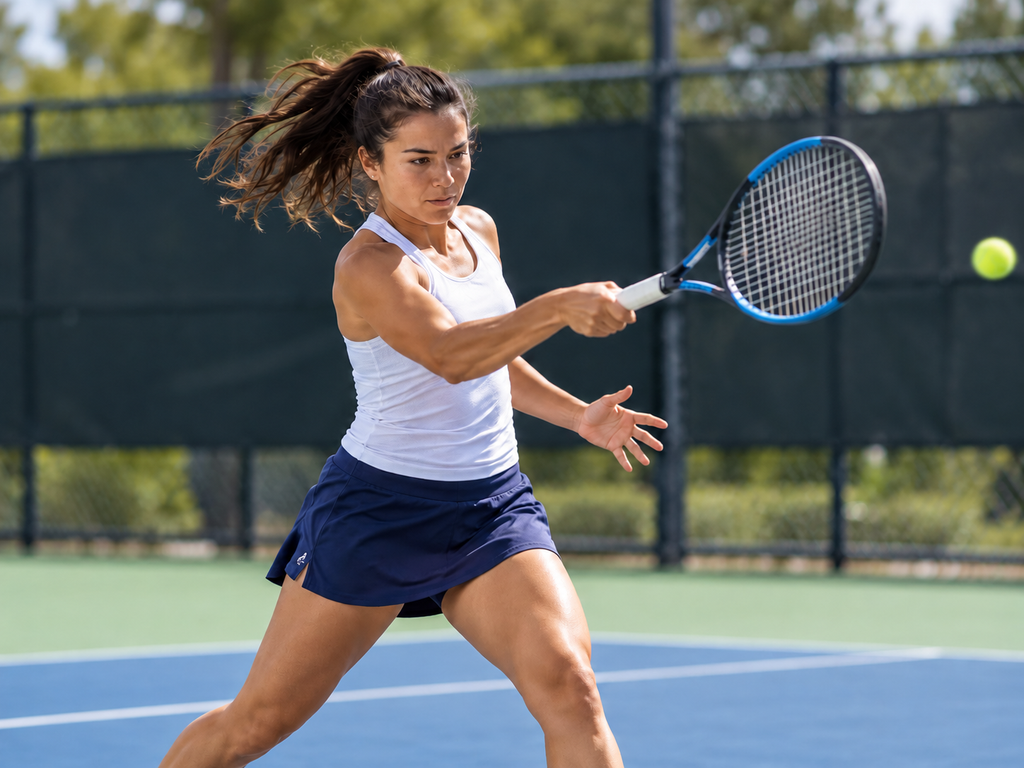
Learning how to hit topspin in tennis is an important step for intermediate players who want greater control over their groundstrokes. Topspin allows players to send the ball over the net with useful clearance while helping it dip toward the court. This makes it possible to combine reliable shot placement with increasing racket speed.
Although many players understand that topspin involves brushing upward on the ball, generating effective spin requires more than a simple upward racket movement. The racket path, contact position, racket-face angle, and timing must work together. Understanding these elements can help you develop more consistent topspin forehands and backhands without sacrificing depth or control.
What Is Topspin in Tennis?
Topspin is the forward rotation of a tennis ball as it travels through the air. From the perspective of a player hitting a standard forward-moving groundstroke, the upper surface of the ball rotates in the direction of travel.
This rotation affects the ball’s flight and bounce.
As a topspin shot travels forward, aerodynamic forces contribute to a downward-curving trajectory. This allows players to strike the ball with a relatively high trajectory and still bring it down inside the baseline.
After bouncing, a topspin ball often rises higher and moves forward aggressively compared with a flatter shot struck under otherwise similar conditions.
The exact result depends on the amount of spin, ball speed, incoming trajectory, and court surface.
Why Topspin Matters for Intermediate Players
Topspin provides several practical advantages.
- Greater net clearance: Players can use a higher trajectory without automatically sending the ball long.
- Improved shot control: Forward rotation helps bring the ball down into the court.
- More reliable depth: Players can develop groundstrokes that travel deep while maintaining reasonable margins.
- More challenging bounces: Heavy topspin can produce higher or more difficult contact points for opponents.
- Better stroke versatility: Players can adjust the balance between spin, speed, and trajectory depending on the incoming ball.
Topspin does not guarantee accuracy. A poorly timed or excessively upward swing can still produce a short ball, a mishit, or an error.
Effective topspin comes from combining appropriate technique with controlled execution.
How Topspin Is Created
The central principle of topspin is that the racket moves upward across the back of the ball during contact.
However, the racket also needs a forward component to send the ball toward the intended target.
A stroke that moves almost entirely upward may produce substantial spin but insufficient depth or forward speed.
Three factors are especially important.
1. Low-to-High Racket Path
For a typical topspin groundstroke, the racket approaches contact from below the intended contact height and travels upward and forward through the hitting zone.
The upward component helps generate forward rotation.
The precise racket path varies depending on the ball’s height, incoming speed, the player’s grip, and the intended shot.
2. Racket-Face Angle
The racket face should be appropriately oriented at contact.
Players sometimes assume they must dramatically close the racket face to create topspin. In practice, excessive closing can drive the ball into the net.
An effective racket-face angle works together with the upward-and-forward swing path.
3. Racket Speed and Contact Quality
Spin depends partly on the relative motion between the strings and the ball.
A faster racket movement can increase spin potential, but speed alone does not produce a reliable topspin shot.
The player must also maintain suitable timing, spacing, and contact quality.
The objective is to produce repeatable spin rather than swing as fast as possible.
How to Hit a Topspin Forehand
The forehand is often the first groundstroke on which intermediate players learn to increase topspin.
Players typically have greater freedom to accelerate the racket on the forehand side, although the technique still requires appropriate preparation and coordination.
Step 1: Prepare Early
As you recognize an incoming ball to your forehand side, turn your shoulders and begin preparing the racket.
Allow the racket to move into a backswing suitable for your established forehand technique.
Avoid exaggerating the backswing simply because you want more spin.
Early preparation gives you time to adjust your position and establish comfortable spacing.
Step 2: Position Yourself for Contact
Move so that the ball will reach a suitable contact area, generally in front of the body.
The exact spacing and contact position depend on your grip, stance, and the height of the incoming shot.
Maintain enough room to swing without crowding the ball or reaching excessively.
Use small adjustment steps when necessary.
Step 3: Establish a Low-to-High Swing Path
During the forward swing, allow the racket head to approach the ball from below the contact height.
Accelerate upward and forward through contact.
The racket should not stop moving toward the target simply because you are trying to generate spin.
The balance between upward and forward movement determines much of the resulting trajectory.
Step 4: Maintain a Suitable Racket Face
Keep the racket face appropriately oriented through the contact zone.
Avoid deliberately rolling your wrist over the ball at the instant of contact.
Topspin comes primarily from the racket’s movement and orientation during the extremely brief contact period, not from a last-second wrist flick.
Step 5: Follow Through Naturally
Allow the racket to continue along its swing path after contact.
Depending on the shot, grip, and technique, the follow-through may finish across the body or in another comfortable position.
Do not force an exaggerated finish simply to imitate a particular player’s technique.
The important factors are the quality of contact and the movement of the racket through the hitting zone.
How to Hit a Topspin Backhand
Backhand topspin uses the same underlying principle as forehand topspin: an upward-and-forward racket path produces forward rotation.
However, the mechanics differ between one-handed and two-handed backhands.
Two-Handed Topspin Backhand
The two-handed backhand provides additional support through the involvement of both arms.
To develop topspin:
- Turn your shoulders early and prepare the racket.
- Position yourself with enough space to swing comfortably.
- Allow the racket head to approach contact from below the ball.
- Accelerate upward and forward through contact.
- Maintain a stable racket-face orientation.
- Complete a natural follow-through as your body rotates.
The non-dominant arm makes an important contribution to racket acceleration and control, although the exact coordination depends on the player’s technique.
Avoid pulling the racket sharply upward with the arms while neglecting body rotation and forward movement.
One-Handed Topspin Backhand
A one-handed backhand requires a different combination of spacing, shoulder rotation, and arm movement.
To produce topspin:
- Turn sideways early and prepare the racket.
- Establish sufficient distance between your body and the ball.
- Position the racket below the intended contact point during the forward swing.
- Extend the hitting arm through a controlled upward-and-forward movement.
- Maintain a stable hitting position through contact.
- Allow the racket to finish naturally.
One-handed backhand players often benefit from paying particular attention to spacing and contact timing.
Trying to compensate for late contact by lifting the racket abruptly can produce weak or inconsistent shots.
Forehand vs. Backhand Topspin: Key Differences
Both strokes rely on similar spin principles, but their mechanics are not identical.
| Element | Topspin Forehand | Topspin Backhand |
|---|---|---|
| Preparation | Forehand shoulder turn and racket preparation | Backhand-specific shoulder turn and preparation |
| Contact | Generally in front of the body, depending on grip | In front of the body, with spacing depending on one- or two-handed technique |
| Swing Path | Upward and forward | Upward and forward |
| Arm Coordination | Usually led by the hitting arm with body rotation | One-handed extension or coordinated two-handed swing |
| Common Challenge | Excessive wrist manipulation or poor spacing | Late contact or insufficient room to swing |
The objective is not to make both strokes look identical.
Instead, develop the appropriate movement pattern for each stroke while maintaining the common principles of spin generation.
How to Control Topspin, Depth, and Net Clearance
One of the most useful intermediate skills is learning to adjust topspin without losing control of the ball’s landing position.
Balance Upward and Forward Racket Movement
An excessively upward swing may produce a high, short ball with limited forward pace.
A very flat swing may produce insufficient spin for the intended trajectory.
During practice, experiment with small adjustments to the upward and forward components of your swing.
Your goal is to produce a ball that clears the net comfortably and lands at a useful depth.
Adjust for Different Ball Heights
A low incoming ball often requires more upward movement and an appropriate trajectory to clear the net.
A higher incoming ball may allow a more forward swing path, depending on the intended shot.
Do not use exactly the same racket path for every contact height.
Learn to adapt while maintaining the fundamental mechanics of your stroke.
Avoid Sacrificing Depth for Spin
Players sometimes become so focused on generating rotation that their shots consistently land near the service line.
These short balls may allow opponents to move forward and attack.
To develop more effective topspin, use a reasonable amount of forward racket acceleration and practice aiming for deeper areas of the court.
Good topspin should support the intended shot rather than become the only objective.
Four Practical Topspin Tennis Drills
These exercises help intermediate players develop spin production, contact quality, and trajectory control.
Drill 1: Controlled Topspin Forehand Rally
Objective: Develop a repeatable topspin forehand.
Setup: Rally cooperatively with a partner from the baseline.
Instructions:
- Begin with moderately paced forehand rallies.
- Focus on an upward-and-forward swing path.
- Aim for comfortable net clearance.
- Maintain a controlled racket-face orientation.
- Attempt ten consecutive forehands without an avoidable error.
Start with manageable ball speed and gradually increase the pace as contact becomes more reliable.
Practice focus: Repeatable racket movement and reliable trajectory.
Drill 2: Topspin Backhand Repetitions
Objective: Improve backhand spin and contact control.
Setup: Have a partner feed comfortable balls toward your backhand side.
Instructions:
- Prepare your backhand before the ball arrives.
- Establish suitable spacing and balance.
- Swing upward and forward through contact.
- Aim for a consistent target area.
- Complete two sets of ten controlled backhands.
Use your established one-handed or two-handed backhand technique.
Practice focus: Timing, contact quality, and an appropriate swing path.
Drill 3: Net Clearance and Depth Drill
Objective: Learn to produce topspin while maintaining useful shot depth.
Setup: Place markers to identify a broad target area beyond the service line and comfortably inside the baseline.
Instructions:
- Begin a controlled baseline rally.
- Hit with a topspin trajectory that provides comfortable net clearance.
- Aim to land the ball inside the designated deep target area.
- Record the number of successful attempts out of twenty.
- Adjust your trajectory and forward swing component based on the results.
Practice focus: Balancing spin, height, and forward pace.
Do not assume that higher net clearance always produces a better shot. The goal is a trajectory that matches the intended landing area.
Drill 4: Alternating Forehand and Backhand Topspin
Objective: Transfer topspin technique between both groundstroke sides.
Setup: Have a partner alternate moderate feeds between your forehand and backhand.
Instructions:
- Prepare early for the incoming shot.
- Move into a comfortable hitting position.
- Execute a controlled topspin forehand.
- Recover and prepare for the next feed.
- Execute a controlled topspin backhand.
- Continue alternating for ten to twenty shots.
Practice focus: Consistent preparation, spacing, and topspin execution across both strokes.
Increase the variation in ball placement only after you can maintain reliable contact.
Common Topspin Mistakes and How to Correct Them
Brushing Too Steeply Upward
Players sometimes attempt to maximize spin by lifting the racket almost vertically.
This may produce excessively short shots or unreliable contact.
Correction: Maintain an upward component while allowing the racket to continue moving forward through the ball.
Closing the Racket Face Too Much
An excessively closed racket face can cause the ball to travel directly into the net.
Correction: Use a racket-face orientation suited to your grip, contact height, and swing path rather than forcing the strings downward.
Using Excessive Wrist Action
Trying to create topspin with a sudden wrist flick can disrupt racket control.
Correction: Develop spin through coordinated racket acceleration and an appropriate swing path. Allow natural wrist movement without deliberately manipulating it at contact.
Contacting the Ball Too Late
Late contact can make it difficult to establish the desired racket path and direction.
Correction: Prepare earlier, improve spacing, and recognize the ball’s trajectory sooner.
Generating Spin Without Useful Depth
A heavily spinning ball that repeatedly lands short may not be effective in a match.
Correction: Practice combining spin with suitable forward acceleration and depth targets.
Swinging Too Fast Before Developing Control
Increasing racket speed before achieving reliable timing often creates inconsistent results.
Correction: Begin at a manageable tempo and add acceleration gradually as contact quality improves.
When Should You Use Topspin During a Match?
Topspin is useful in many match situations, but it should be selected according to the incoming ball and your intended result.
During Baseline Rallies
Topspin groundstrokes can help you maintain rally depth with a reasonable margin over the net.
They are particularly useful when you want to exchange controlled shots while waiting for a better attacking opportunity.
When Hitting Crosscourt
Crosscourt topspin shots can provide a practical combination of court geometry, net clearance, and controlled depth.
The longer diagonal court distance generally provides more room than a comparable down-the-line target.
However, the effectiveness of the shot still depends on your position and the opponent’s court coverage.
Against Higher-Bouncing Balls
Topspin can help you manage a higher contact point and maintain an aggressive trajectory.
Adjust the swing path to suit the ball’s height rather than automatically exaggerating the upward movement.
When You Need Additional Net Clearance
If the incoming ball is low or you are in a difficult position, a controlled topspin trajectory may provide a useful margin over the net.
The correct response also depends on your balance and whether you can create enough racket speed and height to return the ball effectively.
The important skill is choosing when topspin supports your shot rather than attempting to maximize rotation on every stroke.
How to Measure Your Topspin Improvement
You do not need advanced tracking equipment to evaluate basic progress.
Start by observing how consistently you can produce the intended ball trajectory.
Useful measurements include:
Successful target shots: Record how many topspin groundstrokes land inside a designated area.
Net clearance: Observe whether your shots consistently clear the net with a suitable margin instead of frequently clipping the tape.
Shot depth: Monitor whether the ball lands at the intended depth rather than repeatedly falling short.
Stroke reliability: Track how many consecutive topspin shots you can execute during a controlled rally.
Performance against different feeds: Evaluate whether you can maintain topspin against variations in ball speed, height, and depth.
A practice partner or short video recording can help you examine your swing path and shot trajectory.
Remember that the appearance of a high follow-through does not, by itself, prove that you have generated effective topspin.
Focus on the ball’s flight, bounce, and landing position.
Build a More Reliable Topspin Technique
Understanding how to hit topspin in tennis gives intermediate players another way to control groundstroke trajectory, depth, and pace.
The most important principles are early preparation, appropriate spacing, an upward-and-forward racket path, a suitable racket-face angle, and reliable contact.
Begin by developing a repeatable topspin forehand and backhand at a comfortable pace. Use structured drills to monitor clearance and depth before introducing greater speed and more demanding ball feeds.
As your control improves, topspin can become a dependable part of your baseline game, helping you maintain effective rallies and select more purposeful shots during matches.