
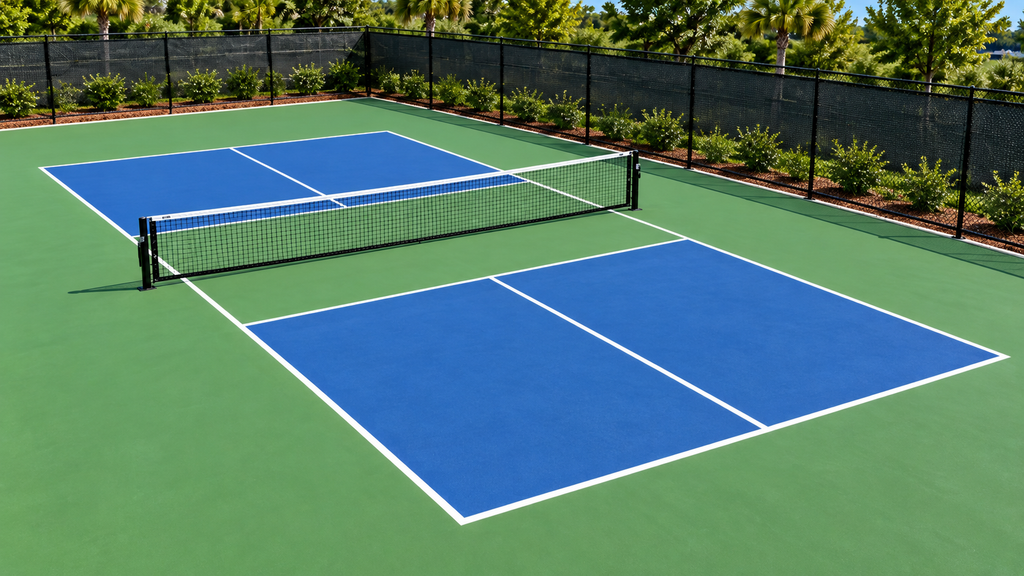
Before learning how to serve, rally or move during a point, you need to Understand the Pickleball Court and Its Boundaries. A pickleball court has a simple rectangular layout, but several different lines and areas divide that rectangle into useful sections. Knowing where those features are will make later instructions much easier to follow because terms such as baseline, sideline, service court, centerline and non-volley zone will already have a clear physical meaning.
In this lesson, the goal is not to learn strategy or decide where you should stand during different situations. Instead, you will learn how to look at a pickleball court and identify its major parts confidently from either side of the net.
How to Understand the Pickleball Court and Its Boundaries
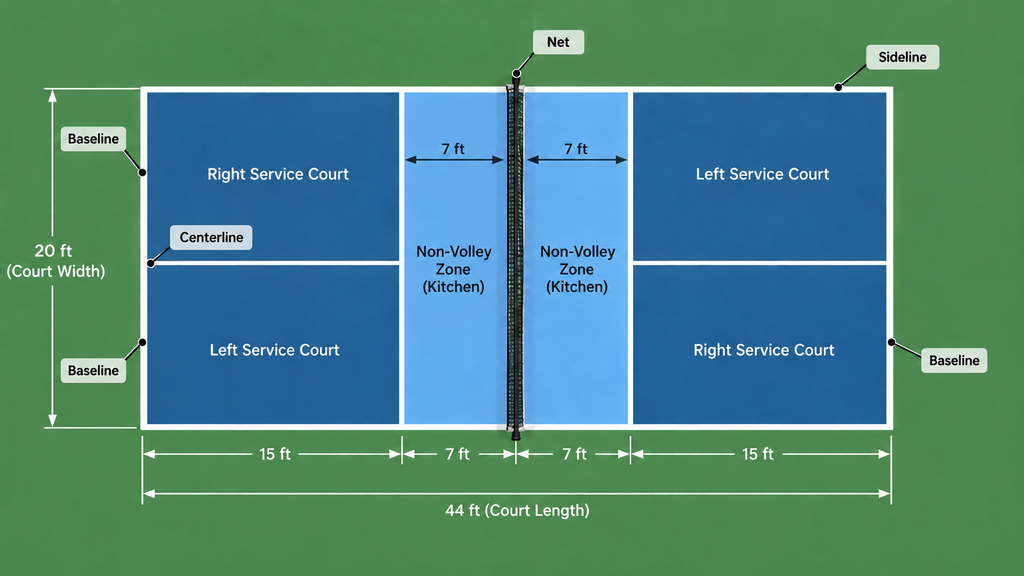
A regulation pickleball court is a rectangle measuring 20 feet wide by 44 feet long. The same basic playing-court dimensions are used for both singles and doubles. USA Pickleball continues to list these dimensions in its current court guidance and identifies its 2026 Official Rulebook as the current governing rulebook.
The easiest way to begin understanding the pickleball court layout is to use the net as your main reference point.
The net stretches across the middle of the court and divides the 44-foot length into two opposing ends. When you stand on one end and face the net, you are looking across at the other end of the court.
Each end contains the same basic features:
- • one baseline at the back;
- • one sideline on the left;
- • one sideline on the right;
- • two service courts;
- • a centerline separating those service courts; and
- • a non-volley zone next to the net.
Because the two ends mirror each other, learning the layout from one side gives you the basic pattern you need to recognize it from the other.
Do not worry yet about where you should stand to serve, how score affects serving position or what tactical position is best. At this stage, concentrate only on recognizing the physical court.
Find the Baseline and Sidelines
Start with the outside edges of the marked court.
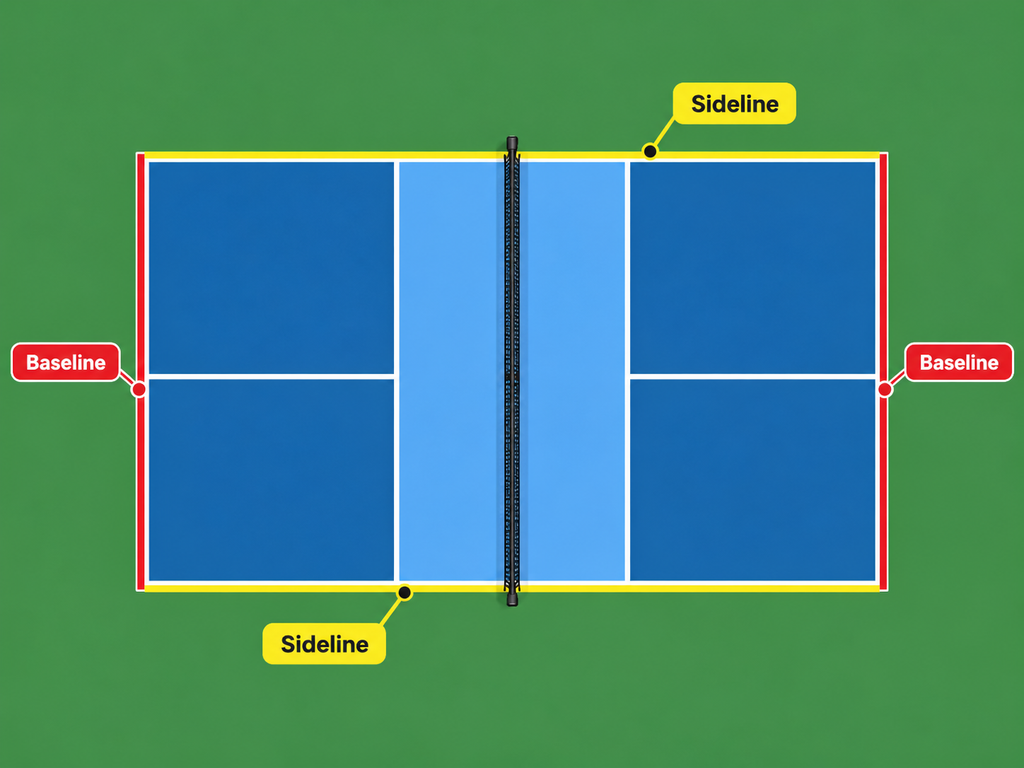
The baseline is the line at the back of each end of the court. It runs parallel to the net. If you are standing behind one end of the court and facing the net, the baseline is the boundary line immediately in front of you.
There are two baselines in total—one at each end.
The sidelines are the long outer lines running along the left and right sides of the court. They extend from one baseline to the other and run perpendicular to the net. USA Pickleball’s current court guidance describes the baselines as parallel to the net and the sidelines as running the length of the court.
Together, the two baselines and two sidelines form the outer rectangular shape of the marked playing court.
A simple way to recognize them is to imagine standing at the center of one baseline and looking toward the net:
- • the baseline is behind the playing area on your end;
- • one sideline is on your left;
- • the other sideline is on your right.
Turn around and view the court from the opposite end. The same pattern appears again.
For now, your job is simply to recognize these lines as the outer boundaries of the marked pickleball court. Detailed line-call procedures are not needed to understand the court’s geography.
Identify the Centerline and Service Courts
Once you recognize the outer rectangle, look at the area between the baseline and the non-volley zone.
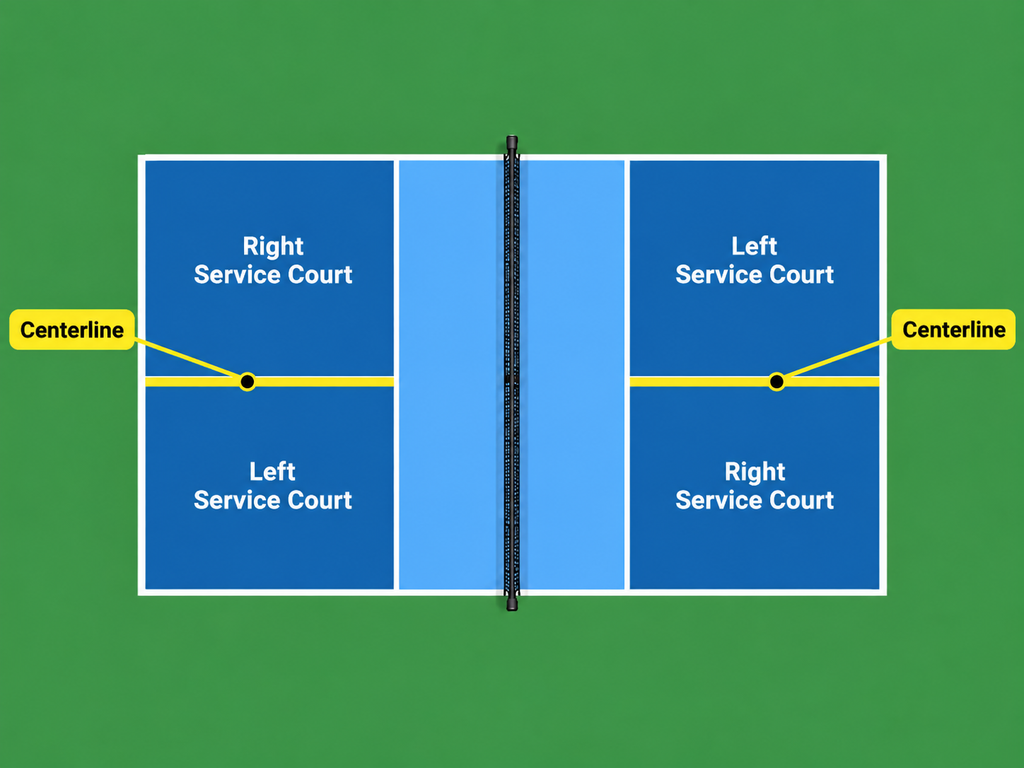
You will see a centerline dividing this part of the court into two sections. The centerline runs from the baseline toward the non-volley-zone line. USA Pickleball identifies the centerline as the line dividing the right and left service areas.
This creates two service courts on each end of the court:
- • the right service court;
- • the left service court.
The words right and left are understood from the perspective of a player standing on that end of the court and facing the net.
Stand behind one baseline and face forward. One service court is on your right and one is on your left. Walk around the net to the opposite baseline, turn to face the net again, and identify your right and left service courts from that new viewpoint.
Notice that the centerline does not simply divide the entire 44-foot court into two long strips. On a standard court, it separates the service courts in the areas behind the non-volley zone.
At this stage, you do not need to decide which service court should be used during a particular score. Simply learn to look at either end and identify the two service courts correctly.
Locate the Non-Volley Zone
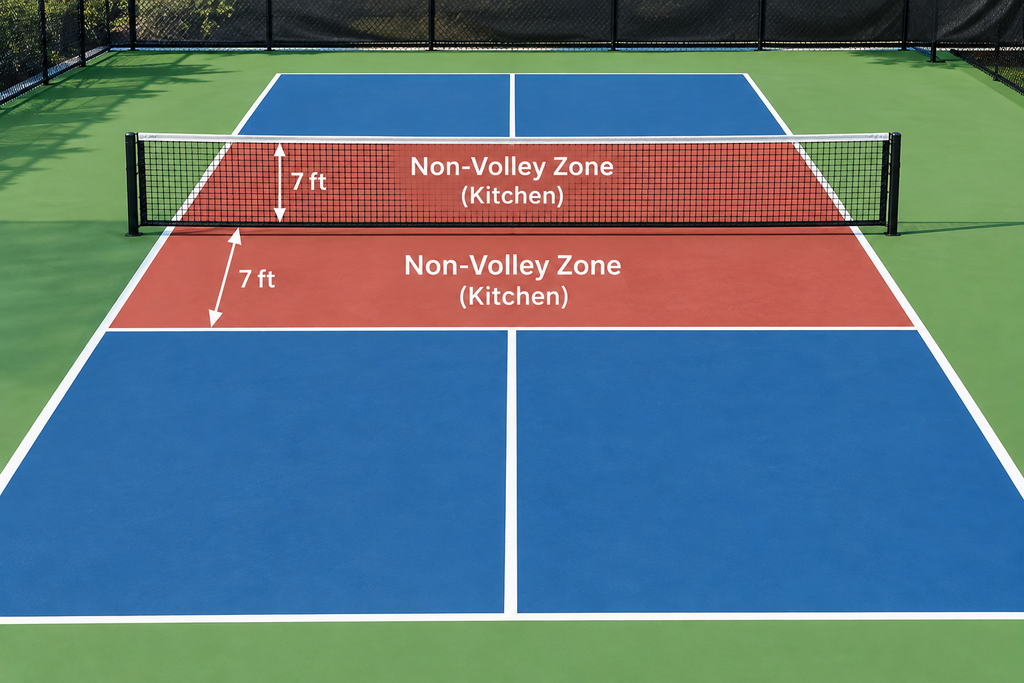
The area closest to the net on each side is officially called the non-volley zone, usually abbreviated NVZ. It is commonly called the kitchen.
On each side of the court, the non-volley zone extends 7 feet from the net. Together, the two non-volley zones create a 14-foot area centered around the net. USA Pickleball’s current instructional and court information confirms the seven-foot depth on each side.
A line running parallel to the net marks the back edge of the non-volley zone on each end. This is commonly called the non-volley-zone line or, informally, the kitchen line.
It is important to distinguish the area from the line.
The kitchen is not simply the line painted across the court. The term refers to the entire non-volley-zone area between that line and the net on that end of the court.
For this lesson, concentrate on locating and recognizing the area. There are specific rules governing volleys in and around the non-volley zone, but those restrictions are separate from the basic court geography you are learning here.
A useful visual sequence from one baseline toward the opposite baseline is:
baseline → service courts → non-volley zone → net → non-volley zone → service courts → baseline
Once that sequence becomes familiar, the court becomes much easier to read.
Read the Court from Either Side of the Net
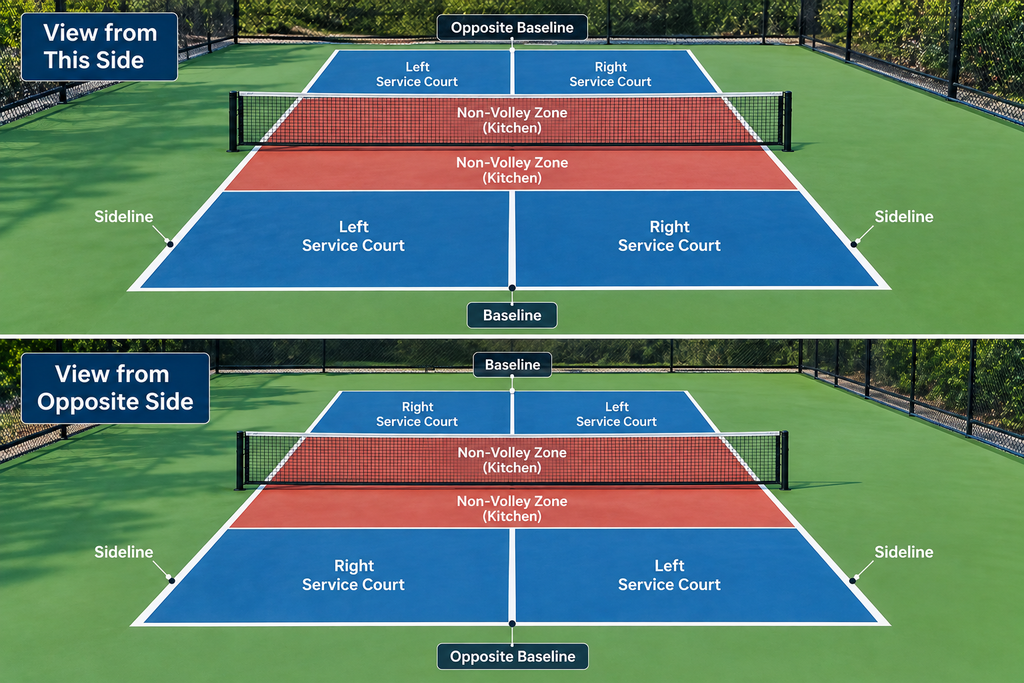
Beginners sometimes learn the court while always standing in the same place. Then, after changing ends, the layout can briefly feel reversed.
Avoid that problem by deliberately viewing the court from several locations.
Stand behind one baseline and face the net. Identify:
- • the baseline;
- • both sidelines;
- • the right service court;
- • the left service court;
- • the centerline;
- • the non-volley zone;
- • the net.
Now walk safely around the net to the opposite end. Turn around and repeat the same identification process.
The markings have not changed, but your viewpoint has.
Your right service court is now on your current right. Your left service court is on your current left. The baseline behind you is a different physical line from the baseline you were standing near before, but it performs the same role on this end.
Next, stand near a sideline rather than directly behind the baseline. Look across the court and locate the same features again.
This practice teaches you to recognize the court by the relationship among its markings instead of memorizing the view from a single spot.
Separate the Marked Court from the Surrounding Playing Space
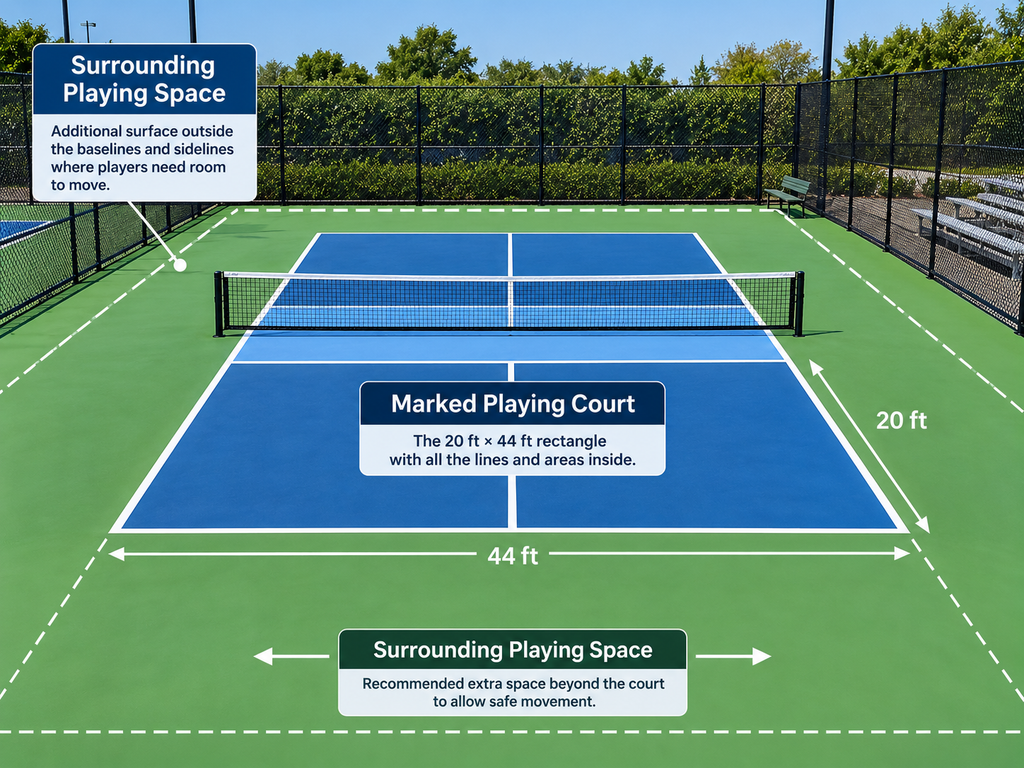
The painted or taped rectangle is the marked playing court, but players often need space outside those lines while moving.
This distinction is important.
A ball can send a player beyond a baseline or outside a sideline during normal movement. Therefore, the physical surface available around the marked court matters even though it is not part of the 20-by-44-foot playing rectangle.
USA Pickleball’s facility guidance illustrates this difference clearly: the actual playing lines measure 20 by 44 feet, while a larger surrounding surface is recommended to provide usable space around them.
When looking at a facility, mentally separate two ideas:
The court: the marked rectangle and the lines and areas inside it.
The surrounding playing space: the additional surface outside the baselines and sidelines where a player may need room to move.
Do not assume that everything inside a fence is part of the marked pickleball court. A large fenced area may contain one or several courts plus considerable surrounding space.
Similarly, do not assume that the baseline or sideline acts like a wall that players never move beyond. Those markings identify the edge of the court, not the edge of all possible player movement.
This is particularly important at facilities where courts are positioned close together or where fences, walls, benches or other objects are near the playing area.
Understand How the Major Court Markings Fit Together
Once you can identify each individual feature, connect them into one complete picture.
Begin at one baseline.
The baseline forms the back edge of your end of the marked court. The sidelines form the left and right outer edges.
Moving toward the net, the centerline separates the right and left service courts.
The service courts stop at the non-volley-zone line. Beyond that line is the seven-foot non-volley zone.
The net then divides your end from the opponent’s end.
Across the net, the pattern is mirrored: another non-volley zone, another pair of service courts divided by a centerline, and another baseline at the far end.
This relationship is more useful than memorizing the names independently. If someone points to the centerline, for example, you should gradually be able to recognize not only its name but also what lies on either side of it and where it sits in relation to the baseline and non-volley zone.
The same basic court remains in use whether two people are playing singles or four people are playing doubles. The regulation playing rectangle does not become narrower or wider when the number of players changes.
Common Beginner Confusion
Several court features are easy to mix up when you are new to pickleball.
Baseline versus non-volley-zone line: Both run parallel to the net. The baseline is at the back of an end of the court. The non-volley-zone line is much closer to the net and marks the rear edge of the kitchen.
Centerline location: The centerline separates the right and left service courts. Do not imagine it as a line that must divide every part of the court, including the kitchen.
Kitchen versus kitchen line: The kitchen is an area. The line across the court helps mark that area, but the line and the entire area are not the same thing.
Marked court versus surrounding surface: The 20-by-44-foot rectangle is the regulation playing court. The playable facility surface can extend farther behind the baselines and outside the sidelines.
Right and left service courts: Your orientation changes when you change ends. Face the net from your current end before identifying right and left.
Shared facility markings: Some facilities place pickleball lines on surfaces that also contain tennis, basketball or other markings. Do not automatically follow every painted line you see. First identify the rectangle belonging to the pickleball court, then locate its baselines, sidelines, non-volley-zone lines and centerlines.
When several colors are present, trace one court slowly rather than trying to understand all of the markings at once.
Practice: Walk and Identify the Court
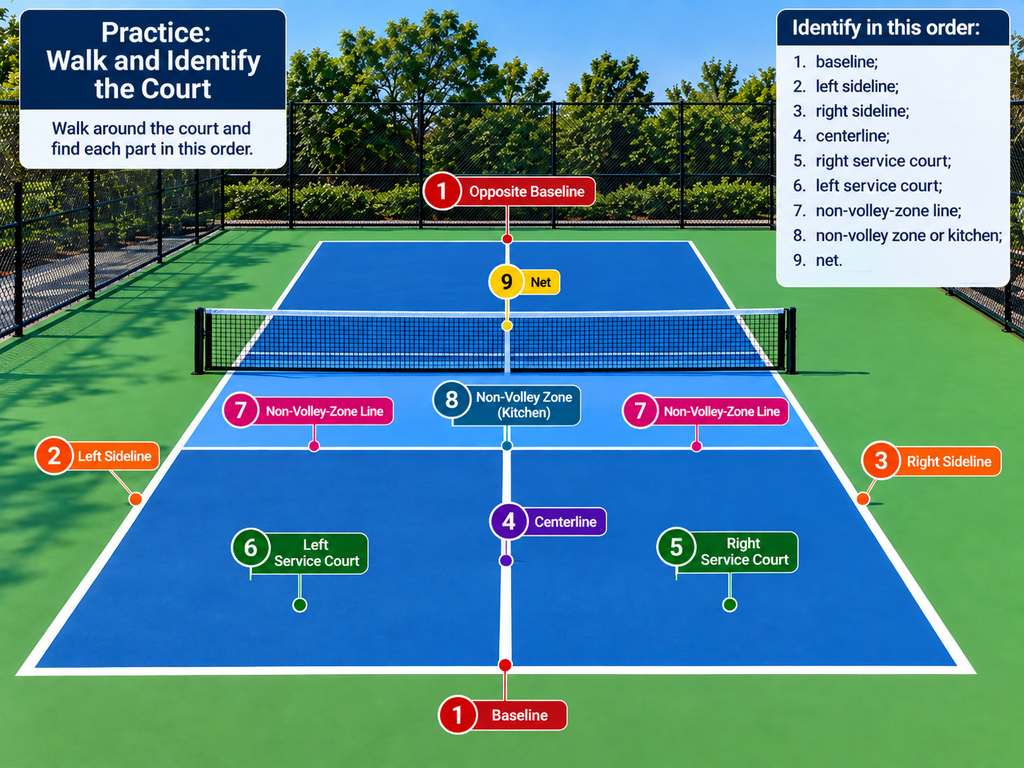
This activity requires an empty pickleball court. No paddle, ball or active hitting is necessary.
Begin outside the playing area and take a moment to look at the entire court.
First, find one baseline. Stand behind it facing the net.
Point to or touch each feature in this sequence:
- baseline;
- left sideline;
- right sideline;
- centerline;
- right service court;
- left service court;
- non-volley-zone line;
- non-volley zone or kitchen;
- net.
Next, walk around the net to the opposite end rather than crossing underneath or over it. Face the net again and repeat the sequence.
Then change your starting position. Try beginning near a sideline, near a corner or several steps behind the baseline. From each location, identify the same features.
Finally, walk around the outside perimeter of the marked court. As you move, distinguish between the boundary lines themselves and the surrounding surface available beyond them.
Do not perform this exercise while other players are actively using the court. Use an empty court so you can concentrate on recognition without interfering with play.
Progression
Once you can identify the features in a fixed order, make the activity less predictable.
Have another person call out features randomly:
“Baseline.”
“Right service court.”
“Kitchen.”
“Centerline.”
“Left sideline.”
Point to each one without first returning to your original starting position.
If you are practicing alone, create your own random sequence or move to a different location after every identification.
You can also stand outside the court and describe the layout aloud. For example:
“The net divides the two ends. The kitchen is next to the net. Behind the kitchen are the right and left service courts. The centerline separates those service courts. The baseline is at the back.”
The objective is not speed. Correct recognition matters more than responding quickly.
Success Standard
You have completed the activity successfully when you can walk around an empty court and, without assistance, identify:
- • both baselines;
- • both sidelines;
- • the centerline on each end;
- • the right and left service courts;
- • the net;
- • both non-volley zones; and
- • the difference between the marked court and its surrounding playing space.
Repeat the exercise from both ends of the court and from several different starting locations. When those features remain recognizable despite the change in viewpoint, you have developed the basic spatial understanding needed to read a pickleball court confidently.
Does Better Pickleball Equipment Make a Difference?

Gear for Improvement
As your skills develop, it is natural to wonder whether better equipment could help you improve faster. New gear can sometimes make a meaningful difference, but improvement does not automatically…
Summary
A regulation pickleball court is 20 feet wide and 44 feet long, with the same playing-court dimensions used for singles and doubles. The net divides the court into two opposing ends.
The baselines form the back boundaries, while the sidelines form the long outer boundaries. Each end has right and left service courts separated by a centerline.
The non-volley zone, commonly called the kitchen, occupies the area next to the net and extends 7 feet from the net on each side.
Learning the court means more than memorizing line names. You should be able to recognize how the lines and areas relate to one another, orient yourself after changing ends, and distinguish the marked court from the surrounding space available for player movement.
Previous: Course Overview
Next: Know the Basic Pickleball Equipment