
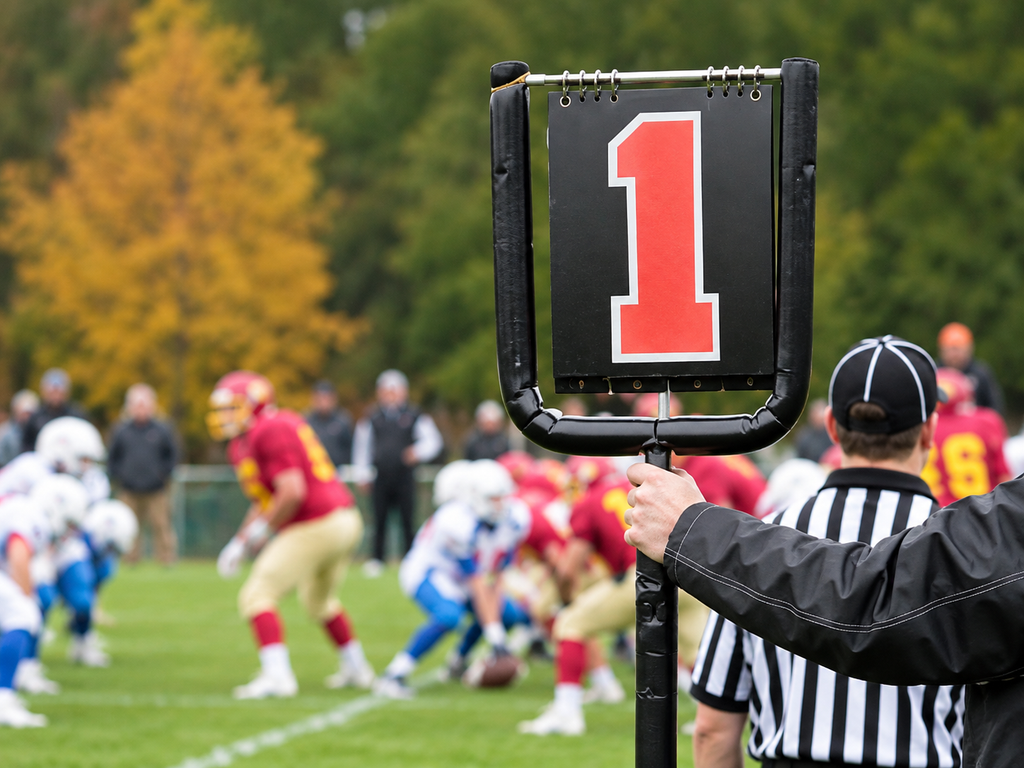
A first down is one of the most important concepts to understand in American football. If you are new to the sport, knowing how first downs work makes it much easier to follow what the offense is trying to accomplish on every play.
So, what is a first down in football? A first down means the offense has earned a new set of downs, usually by advancing the ball at least 10 yards from where its previous set of downs began.
The offense normally gets four downs, or attempts, to gain those 10 yards. If it reaches the required distance, it earns another first down and receives a fresh set of four downs.
First downs are therefore a major part of how an offense keeps possession of the ball and continues moving toward the opponent’s end zone.
What Does a First Down Mean?
A down is one offensive play.
When an offense begins a new series of downs, it normally has four attempts to gain at least 10 yards. The first play in that series is called first down.
For example, imagine the offense starts with the ball at its own 30-yard line. It needs to reach the 40-yard line to gain 10 yards.
If it reaches or passes the 40-yard line within four downs, it earns another first down.
The offense then receives another set of downs and usually needs to gain another 10 yards.
This process can continue throughout an offensive possession, allowing a team to move down the field a few plays at a time.
What Does “1st and 10” Mean?
One of the most common phrases you will hear during a football game is “1st and 10.”
The first number tells you which down the offense is playing.
The second number tells you approximately how many yards the offense must gain to earn another first down.
So:
1st and 10 means it is first down and the offense needs 10 yards for another first down.
Suppose the offense gains four yards on that play. The next situation would normally be:
2nd and 6
It is now second down, and six yards remain before the offense reaches the required distance.
If the offense gains those remaining six yards or more on the next play, it earns a new first down.
The next play will usually begin another 1st and 10 situation.
What Is the Line to Gain?
The point the offense must reach to earn another first down is called the line to gain.
For a normal new series of downs, the line to gain is 10 yards ahead of the spot where that series began.
On television broadcasts, you may see a colored line digitally placed across the field to help viewers identify this point. That television graphic is not physically painted on the field.
At the stadium, the sideline crew uses equipment to identify the required distance.
The offense does not need to move a player completely beyond the line to gain. What matters is the position of the football.
If the ball reaches the required point while the player legally possesses it, the offense has gained enough yardage for a first down.
How Does a Team Earn a First Down?
The most common way to earn a first down is simply to gain enough yards.
An offense may do this on one play or over several plays.
For example:
- First down: gain 3 yards.
- Second down: gain 2 yards.
- Third down: gain 6 yards.
The offense gained 11 total yards during those three plays. Because it reached the line to gain before using all four downs, it earns another first down.
The new set of downs begins from the spot where the previous play ended.
An offense can earn a first down in several different ways, including running the ball, completing a pass, or benefiting from certain defensive penalties.
First Downs by Running the Ball
A team can earn a first down with a running play.
A running play usually involves the quarterback handing or pitching the football to another offensive player, such as a running back, although the quarterback can also run with the ball.
Suppose it is 2nd and 5.
The running back takes the ball and runs seven yards before being tackled.
Only five yards were needed, so the seven-yard gain moves the ball beyond the line to gain.
The offense earns a first down.
The next play will normally be first down with a new distance to gain.
A run does not need to gain all 10 yards at once. Yardage gained on earlier downs counts toward reaching the same line to gain.
First Downs by Passing the Ball
A completed forward pass can also produce a first down.
Imagine the offense faces 3rd and 8.
The quarterback throws the football to a receiver, who catches it and advances 12 yards before the play ends.
Because the offense needed eight yards and gained 12, it earns a first down.
The catch itself does not automatically create the first down. The offense must gain enough total yardage on the play to reach the line to gain.
For example, a four-yard completion on 3rd and 8 would leave the offense short of the required distance.
First Downs Awarded by Penalty
Certain penalties against the defense can also give the offense a first down.
Sometimes the penalty yardage itself moves the ball far enough to reach the line to gain.
Other defensive penalties can carry an automatic first down under the rules being used. In those situations, the offense receives a first down as part of the penalty enforcement.
The exact penalty rules and enforcement procedures can vary depending on the league and the type of foul.
For a beginner, the important point is that first downs are not earned only through rushing and passing plays. A defensive penalty can also result in a new first down.
What Happens After a First Down?
After the offense earns a first down, its previous down count is essentially reset.
Instead of continuing to second, third, or fourth down, the offense begins a new series.
In a normal situation, that new series starts with 1st and 10.
Suppose a team has 3rd and 4 and gains seven yards.
It has gained enough for a first down.
The offense does not move on to fourth down. It receives a completely new set of downs.
That reset is what makes earning first downs so valuable.
As long as an offense keeps reaching the line to gain, it can continue possessing the football and moving down the field.
What Happens If the Offense Does Not Get a First Down?
The offense normally has four downs to reach the line to gain.
If it does not gain enough yards on first, second, and third down, it reaches fourth down.
At that point, the team has an important decision to make.
It may attempt another offensive play and try to gain the remaining yards. If it succeeds, it earns a first down and continues its possession.
If it attempts the play and fails to reach the line to gain, possession generally goes to the opposing team. This is called a turnover on downs.
Teams may also choose to punt on fourth down rather than risk giving the opponent the ball at the current field position. In some situations, they may attempt a field goal instead.
For understanding first downs, the central idea is simple: failing to reach the required distance within the available downs can bring the offensive possession to an end.
Why Are First Downs So Important?
First downs allow the offense to keep its drive alive.
A drive is a series of offensive plays during one continuous possession.
An offense does not normally need to reach the end zone in only four plays. Instead, it can repeatedly earn first downs as it moves down the field.
Consider a team starting deep in its own territory.
It might:
- Gain a first down with two running plays.
- Gain another first down with a completed pass.
- Gain another after three shorter plays.
- Continue advancing until it reaches scoring territory.
Each first down gives the offense another opportunity to continue the drive.
Without first downs, the offense would quickly use all four of its attempts and risk losing possession.
First downs also affect strategy. An offense facing 2nd and 2 has much more flexibility than an offense facing 3rd and 15 because the first team needs only a short gain to earn another set of downs.
First Down vs. Touchdown
A first down and a touchdown are very different.
A first down allows the offense to continue its drive with a new set of downs.
A touchdown is a scoring play.
Earning a first down does not give the team any points.
For example, an offense might complete a pass that moves the ball from the 40-yard line to the 28-yard line. If that gain reaches the line to gain, the team earns a first down, but it has not scored.
The offense simply continues playing from its new position.
A team may earn several first downs during one possession before eventually scoring a touchdown, attempting a field goal, or losing possession.
Can a Team Gain More Than 10 Yards on a First Down?
Yes.
Ten yards is normally the minimum distance required to earn another first down when a standard series begins with 1st and 10. There is no requirement to stop after exactly 10 yards.
If it is 1st and 10 and a running back gains 25 yards, the entire 25-yard gain counts.
The offense gets a new first down from the spot where the play ends.
The same applies to passing plays.
A receiver could catch a pass and run 40 yards. If the play ends before a touchdown is scored, the offense normally begins a new set of downs from that new field position.
Does the Offense Always Need Exactly 10 Yards?
Not always.
Although 1st and 10 is the normal starting situation, penalties and field position can change the required distance.
A penalty may create situations such as 1st and 15 or 1st and 20, meaning the offense needs more than 10 yards to reach the line to gain.
Other situations can produce shorter distances.
The offense can also be close enough to the opponent’s goal line that fewer than 10 yards remain before the end zone. In that case, you may hear a situation such as 1st and goal instead of 1st and 10.
The basic concept remains the same: the down-and-distance information tells you the offense’s current situation and what it needs to accomplish next.
A Simple First Down Example
Imagine the offense starts at its own 25-yard line.
The line to gain is the 35-yard line.
The series might look like this:
1st and 10: The running back gains three yards.
The ball is now at the 28-yard line. Seven yards remain.
2nd and 7: The quarterback completes a pass for four yards.
The ball reaches the 32-yard line. Three yards remain.
3rd and 3: The offense runs the ball for five yards.
The ball reaches the 37-yard line.
Because the offense reached and passed the 35-yard line, it earned a first down.
The offense now starts a new series at the 37-yard line, normally with 1st and 10.
The new line to gain would be 10 yards farther down the field.
This cycle can continue for as long as the offense keeps earning new first downs and maintains possession.
How to Recognize a First Down While Watching Football
Once you understand the basic system, first downs are easy to follow during a game.
Look at the down-and-distance information shown on the television scoreboard or stadium display.
If you see:
1st & 10
the offense has just started a new set of downs or is beginning its possession in a normal situation.
If you see:
3rd & 2
the offense is on its third down and needs two more yards for a first down.
After the play, watch where the ball is spotted compared with the line to gain.
If the ball reaches the required distance, the down display will reset to first down.
Broadcasters may also say that a player “moved the chains,” an expression associated with gaining enough yardage for a new first down.
Frequently Asked Questions
How Many Yards Is a First Down?
An offense normally needs to gain 10 yards from the start of a new series to earn another first down.
Penalties and certain field situations can change the distance required.
How Many Chances Does a Team Get to Make a First Down?
The offense normally receives four downs to reach the line to gain.
If it earns the necessary yardage, it receives a new set of downs.
Does a First Down Score Points?
No. A first down does not score any points.
It simply gives the offense a new set of downs and allows the drive to continue.
Can a Penalty Give a Team a First Down?
Yes. Penalty enforcement can sometimes move the football far enough to reach the line to gain, and certain defensive penalties can include an automatic first down.
Exact penalty rules vary by league and situation.
What Happens If a Team Does Not Get a First Down on Fourth Down?
If the offense runs a normal fourth-down play and fails to reach the line to gain, possession generally changes to the opposing team.
Teams often punt or attempt a field goal instead of trying to convert a difficult fourth down.
Key Takeaways
A first down gives the offense a new set of downs and helps it continue moving the football down the field.
In a normal series, the offense has four downs to gain at least 10 yards. The point it must reach is called the line to gain.
“1st and 10” means the offense is on first down and normally needs 10 yards for another first down.
Teams can earn first downs by running, passing, or through certain defensive penalties.
If an offense keeps earning first downs, it can keep its drive alive and maintain possession. If it fails to reach the line to gain within four downs, it risks giving the ball to the opposing team.
Understanding what is a first down in football makes the entire flow of an American football game much easier to follow.