
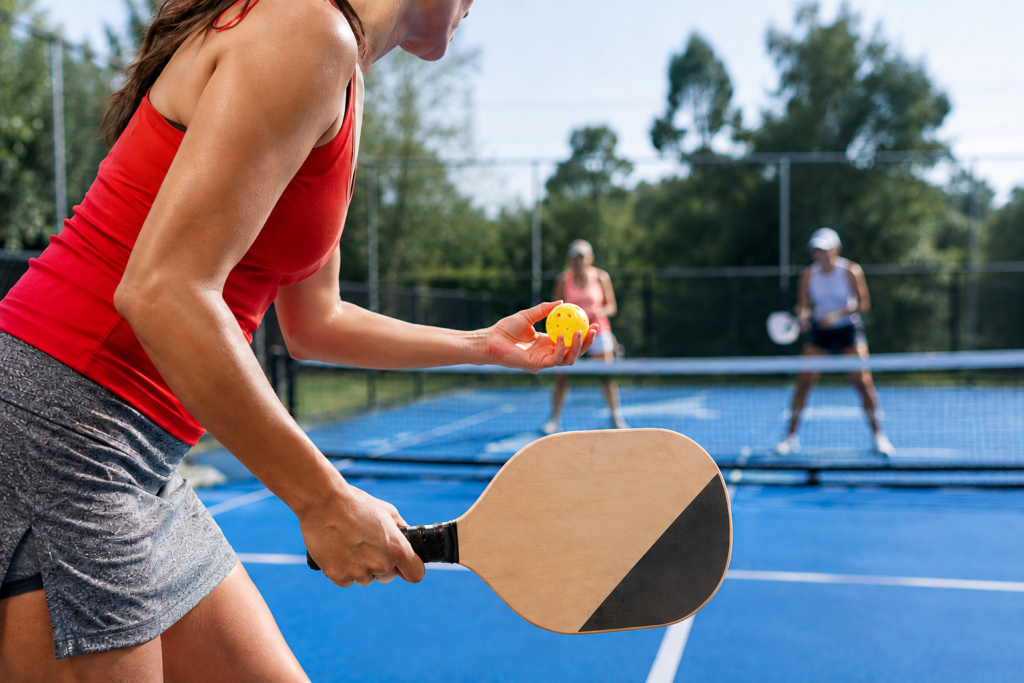
Every pickleball rally begins with a serve. For a beginner, that makes the serve one of the most important shots to learn.
Fortunately, you do not need a powerful or complicated serve to play effective pickleball. A good beginner serve has a much simpler job: start the rally legally, clear the net and land deep in the correct service court as consistently as possible.
Once you can do that reliably, you can begin working on placement, pace and spin.
This guide explains how to serve in pickleball step by step, including the serving rules, the difference between a volley serve and a drop serve, where to aim and how to avoid the mistakes that cause beginners to lose unnecessary rallies.
What Is a Pickleball Serve?
The serve is the shot that starts each rally.
The server stands behind the baseline and sends the ball diagonally across the net into the opponent’s correct service court.
Under standard pickleball rules, the served ball must clear the opponent’s non-volley zone, often called the kitchen, and land in the diagonally opposite service court.
Unlike a tennis serve, a traditional pickleball volley serve uses an upward serving motion rather than an overhead motion.
Pickleball also allows a second serving method called the drop serve, where the player releases the ball, lets it bounce and then strikes it.
Both are useful. You only need to become comfortable with one to start playing.
The Main Goal of a Beginner Serve
When beginners start practicing their serve, it is tempting to think about speed.
That should not be your first priority.
Your first goal should be:
Get the serve in consistently.
A serve that travels at moderate speed and lands deep in the service court is usually much more useful than a hard serve that frequently goes into the net or out of bounds.
A good progression is:
- Legality
- Consistency
- Depth
- Placement
- Pace
- Spin
Build those qualities in that order.
Pickleball Serving Rules Beginners Need to Know
Before working on technique, understand the basic rules that make a serve legal.
USA Pickleball’s 2026 rules place the serving requirements primarily in Section 7 of the official rulebook.
You Must Serve From Behind the Baseline
When you strike the serve, at least one foot must be touching the correct serving area behind the baseline.
Your feet cannot be touching the court itself, and they cannot be touching the playing surface outside the correct serving area at the moment you strike the ball.
A simple beginner habit is to stand several inches behind the baseline rather than directly on it.
That gives you a small safety margin and makes accidental foot faults less likely.
The Serve Goes Diagonally Across the Court
You do not serve straight ahead.
The ball must travel diagonally into the opponent’s opposite service court.
If you serve from the right side, you aim toward the receiver’s right service court from their perspective—the court diagonally across from you.
The Serve Must Clear the Kitchen
The ball must completely clear the non-volley zone before landing.
This includes the non-volley zone line itself.
A serve that lands on the kitchen line is out, while a serve that lands on the centerline, sideline or baseline of the correct service court is considered in.
This is one reason beginners should avoid aiming too close to the kitchen line.
Give yourself more margin.
A Serve Can Touch the Net
A serve does not automatically become a fault simply because it clips the net.
If it touches the net, crosses over and still lands legally in the correct service court, play continues.
The Ball Release Must Be Visible
The ball must be released using one hand or the paddle, and the release must be visible to the receiver.
You also cannot deliberately manipulate the ball to add spin before striking it. Spin may be applied when the paddle contacts the ball.
For a beginner, the easiest solution is simple:
Hold the ball normally, release it naturally and concentrate on clean contact.
The Two Types of Pickleball Serve
There are two main legal serving methods:
- the volley serve
- the drop serve
Understanding the difference will help you decide which feels more natural.
1. The Volley Serve
The volley serve is made by striking the ball before it bounces.
Under the 2026 USA Pickleball rules, a legal volley serve must meet several requirements:
- The paddle must be moving in a clear upward arc when it contacts the ball.
- The highest point of the paddle head must clearly not be above the highest part of your wrist joint at contact.
- The ball must clearly be no higher than your waist when you strike it.
- The serve may be hit with a forehand or backhand motion.
For most beginners, a simple forehand volley serve is the easiest version to learn.
Think of it as a smooth low-to-high swing, not an overhead hit.
2. The Drop Serve
With a drop serve, you release the ball, allow it to bounce and then hit it.
The ball must be released from a natural, unaided height and cannot be thrown, tossed or otherwise propelled before the bounce.
There is no restriction on how many times it may bounce or exactly where on the playing surface it bounces before you hit it.
The drop serve can be especially useful for beginners who struggle with timing the release and swing of a volley serve.
Because the ball bounces first, some players find it easier to judge the contact point.
Which Serve Should a Beginner Use?
Try both.
If the volley serve feels natural, there is no reason to avoid it.
If coordinating the ball release with your paddle swing feels awkward, experiment with the drop serve.
Neither serve is automatically better.
The better serve is the one you can make legally, comfortably and consistently.
For the rest of this guide, we will focus mainly on the traditional forehand volley serve because it teaches a simple motion that most beginners can use immediately.
How to Serve in Pickleball Step by Step
Step 1: Start Behind the Baseline
Stand behind the baseline on the correct side of the court.
Do not crowd the line.
Starting about 6 to 12 inches behind it gives you room to transfer your weight forward without worrying about stepping onto the court too early.
Position yourself comfortably rather than forcing an exaggerated stance.
Step 2: Turn Slightly Sideways
You do not need to face the net completely square.
For a right-handed player, placing the left foot slightly forward and the right foot slightly behind often creates a natural serving position.
Left-handed players can reverse this setup.
Your shoulders can be slightly turned toward the sideline.
This position gives your arm room to swing forward naturally.
Step 3: Relax Your Grip
Hold the paddle securely but do not squeeze it as hard as possible.
Too much grip pressure makes the wrist, forearm and shoulder tense.
That often results in a stiff, jerky swing.
Use enough pressure to control the paddle while allowing your arm to move freely.
A good serve should feel smooth rather than forced.
Step 4: Hold the Ball in Front of Your Body
Hold the pickleball with your non-paddle hand slightly in front of you.
Keep the setup simple.
Avoid tossing the ball high into the air like a tennis serve.
For a volley serve, you are trying to create a predictable contact point around or below waist level.
The less unnecessary movement you introduce, the easier the serve becomes to repeat.
Step 5: Begin With the Paddle Low
Let the paddle begin below the ball.
Remember that a legal volley serve requires the paddle to be moving upward when it contacts the ball.
Think:
low to high
rather than:
straight across
or:
high to low.
Step 6: Release the Ball Naturally
Release the ball rather than trying to manipulate it.
Your goal is simply to place the ball where your paddle can meet it comfortably.
For beginners, consistency in the release is extremely important.
If one release is close to your body, the next is far away and another is too high, your swing will constantly need to adjust.
Try to make every setup look and feel similar.
Step 7: Swing Forward and Up
Bring the paddle forward using a smooth underhand motion.
Let your shoulder and arm do most of the work.
You do not need a large wrist snap.
Think about swinging through the ball rather than hitting suddenly at it.
Your motion should feel similar to gently tossing something forward underhand.
Step 8: Contact the Ball in Front of You
Try to make contact slightly in front of your body instead of beside or behind you.
This gives you more control over direction.
For a volley serve, remember that contact must clearly occur no higher than your waist.
Keep your eyes on the ball through contact.
A surprisingly large number of serving errors happen simply because players look toward their target too early.
Step 9: Aim High Enough to Clear the Net
Beginners often hit serves into the net because they try to keep the ball too low.
You do not need to barely clear the net.
Give yourself some margin.
A slightly higher serve that lands deep in the court is much better than repeatedly hitting the tape.
Your target is not the net.
Your target is the service court beyond it.
Step 10: Follow Through Toward Your Target
After contact, allow the paddle to continue forward naturally.
Do not stop the paddle immediately after hitting the ball.
A smooth follow-through helps with both direction and depth.
Your body weight can also move gently forward as you finish.
You should remain balanced and ready for the next shot.
Where Should You Aim Your Pickleball Serve?
When you are first learning, aim toward the large middle area of the service court.
Do not immediately try to paint the sidelines.
Your margin for error is much larger when you aim several feet inside the boundaries.
Once your serve becomes reliable, start working on depth.
Why Deep Serves Are Useful
A deep serve lands closer to the opponent’s baseline.
This can make the receiver hit their return from farther back instead of allowing them to comfortably move forward before hitting.
That can give the serving side more time to prepare for the return.
However, do not confuse “deep” with “as close to the baseline as physically possible.”
A serve that repeatedly misses long is not helping you.
For beginners, aim roughly toward the back third of the service court while still giving yourself room inside the baseline.
Three Useful Serving Targets
Once you can consistently put the ball in play, practice three basic targets.
Deep Middle
This is an excellent default target.
You have plenty of court available, and you avoid taking unnecessary risks near the sideline.
Deep Toward the Sideline
Serving wider can force the receiver to move farther away from the center of the court.
This can create space elsewhere, but it also gives you less margin for error.
Use it after you have developed good control.
Toward the Receiver’s Body
A serve directed toward the receiver can sometimes make it harder for them to decide whether to use a forehand or backhand.
You do not need extreme precision.
Simply learning to vary your location makes you less predictable.
Consistency Comes Before Power
One of the biggest beginner mistakes is trying to hit a “winning” serve.
You generally do not need one.
A serve that goes out gives the opponent exactly what they want: the rally ends before you even have a chance to play.
Instead, find a serving speed at which you can make roughly eight or nine serves out of ten.
Once you reach that level, gradually increase the pace.
If your accuracy suddenly disappears, reduce the speed again.
This approach builds a serve you can actually trust during games.
How Much Spin Should You Use?
Spin can eventually make your serve more difficult to return, but it is not a beginner priority.
Learning spin too early often creates three problems:
- inconsistent contact
- excessive wrist movement
- reduced accuracy
First learn to strike the center of the paddle face consistently.
Once the basic serve is reliable, you can experiment with controlled topspin by brushing slightly upward across the back of the ball during paddle contact.
Remember that while spin may be generated through paddle contact, the 2026 rules prohibit intentionally manipulating the ball to create spin during the release itself.
What Should You Do After Serving?
Do not admire your serve.
Your job is not finished.
After the serve lands, the receiver must allow it to bounce before returning it. Then, under pickleball’s two-bounce rule, the serving side must also allow the return to bounce before hitting its next shot.
That means you generally should not sprint directly toward the kitchen immediately after serving.
Serve, recover your balance and prepare for the return.
The next shot is coming.
Common Pickleball Serving Mistakes
Trying to Hit Too Hard
More power usually means less control when your technique is still developing.
Fix: Reduce your swing speed until you can consistently land the ball in the service court.
Hitting Into the Net
This often happens because the player swings too flat or tries to keep the serve unnecessarily low.
Fix: Use a clearer low-to-high motion and give yourself more net clearance.
Serving Long
You may be swinging too hard or sending the ball too high without enough control.
Fix: Reduce your effort slightly and aim several feet inside the baseline.
Serving Into the Kitchen
A serve landing in the non-volley zone or on its line is a fault.
Fix: Stop aiming close to the kitchen. Pick a target farther toward the middle or back of the service court.
Stepping on the Baseline
Standing too close to the baseline creates unnecessary foot faults.
Fix: Begin several inches farther back.
Using an Overhead Motion
A traditional volley serve is not a tennis serve.
Fix: Start the paddle low and swing upward through the ball.
Contacting the Volley Serve Too High
A volley serve must be contacted no higher than waist level.
Fix: Keep the ball release and contact point comfortably low.
Overusing the Wrist
Trying to create power by snapping the wrist can make the paddle face difficult to control.
Fix: Focus on a relaxed shoulder-and-arm swing with a stable paddle face.
Looking Up Before Contact
Beginners often look toward the service box before they have actually struck the ball.
Fix: Keep your attention on the ball until contact, then follow the flight.
Changing Your Technique After Every Miss
One serve goes long, so you completely change your swing. The next goes into the net, so you change it again.
That makes improvement almost impossible.
Fix: Make small adjustments while keeping the basic motion consistent.
Beginner Pickleball Serving Drills
You do not need another player to practice serving.
A court, several balls and a target are enough.
Drill 1: 20-Serve Consistency Test
Serve 20 balls into the correct service court.
Count how many land legally.
Do not worry about speed.
Your first target might be:
15 out of 20.
Then try to reach:
18 out of 20.
This gives you a measurable way to track improvement.
Drill 2: Deep Serve Practice
Create an imaginary target area in the back third of the service court.
Try to land 10 serves there.
Once you can do it consistently, repeat from the other serving side.
Drill 3: Three-Target Serving
Choose three targets:
- middle
- wide
- body
Hit five serves toward each.
This teaches directional control rather than simply getting the ball across the net.
Drill 4: Alternate Serving Sides
Serve one ball from the right side.
Then serve one from the left.
Continue alternating.
This helps you become comfortable serving from both positions instead of becoming dependent on one angle.
Drill 5: Pressure Serving
After warming up, give yourself only one serve.
Imagine the score is tied late in a game.
Choose your safest target and serve.
Repeat this 10 times.
The purpose is to practice committing to a reliable serve when you do not have unlimited practice attempts.
A Simple Beginner Serving Routine
A repeatable routine can make your serve more consistent.
Try this:
- Check that you are on the correct serving side.
- Set your feet behind the baseline.
- Choose your target.
- Relax your grip.
- Hold the ball in your normal starting position.
- Look at your target.
- Return your eyes to the ball.
- Release.
- Swing smoothly.
- Recover for the next shot.
Use roughly the same routine before every serve.
The goal is to remove unnecessary decisions and make your serving motion familiar.
Volley Serve or Drop Serve: Which Is Easier?
There is no universal answer.
The volley serve can feel smooth and natural once you learn the release and upward motion.
The drop serve can simplify timing because the ball bounces before you strike it.
If you are repeatedly struggling with the volley serve, try the drop serve rather than becoming frustrated.
The objective is not to use the most impressive technique.
It is to develop a legal serve that you can trust.
How to Improve Your Pickleball Serve Over Time
Your serve can evolve as your game improves.
A beginner may simply focus on getting the ball into play.
Later, you can begin adding:
Depth: Keep opponents farther behind the baseline.
Placement: Move the serve toward different areas of the service box.
Pace: Give the receiver less time to prepare.
Topspin: Help the ball dip while allowing you to swing faster.
Variation: Prevent opponents from anticipating the same serve every time.
Do not try to master everything at once.
A consistent serve with good depth is already a strong foundation for recreational pickleball.
Pickleball Serve FAQ
Do you get two serves in pickleball?
No. Standard pickleball does not give you a second attempt after a service fault in the way tennis does.
That makes consistency especially important.
Does a pickleball serve have to bounce before you hit it?
Not always.
With a volley serve, you strike the ball before it bounces.
With a drop serve, you release the ball and hit it after a bounce.
Can a pickleball serve hit the net?
Yes. If the serve touches the net but continues over it and lands legally in the correct service court, the ball remains in play.
Can a pickleball serve land on the line?
Most service court boundary lines count as in.
However, the non-volley zone or kitchen line is different. A serve landing on that line is out because the serve must completely clear the non-volley zone.
Can you serve overhand in pickleball?
A standard volley serve must satisfy the required upward-arc, paddle-position and contact-height requirements, which prevents it from being performed like a conventional overhead tennis serve.
Can you put spin on a pickleball serve?
You may generate spin when the paddle contacts the ball. However, deliberately manipulating the ball to add spin during its release is prohibited under the 2026 USA Pickleball rules.
Where should beginners aim their serve?
Start by aiming safely toward the middle of the correct service court.
As your accuracy improves, work on serving deeper toward the baseline before attempting more aggressive angles.
Keep the Serve Simple
The pickleball serve does not need to be complicated.
For a beginner, the most useful serve is one you can repeat under pressure.
Stand safely behind the baseline. Use a relaxed setup. Make a smooth swing. Send the ball diagonally over the kitchen and into the correct service court. Then recover and prepare for the return.
Do that consistently before worrying about speed or spin.
As your control improves, start experimenting with deeper placement, different targets and additional pace.
A reliable serve may not always be the most spectacular shot on the court, but it does something essential every time:
It gives you the opportunity to play the rally.