
A Simple Beginner’s Guide
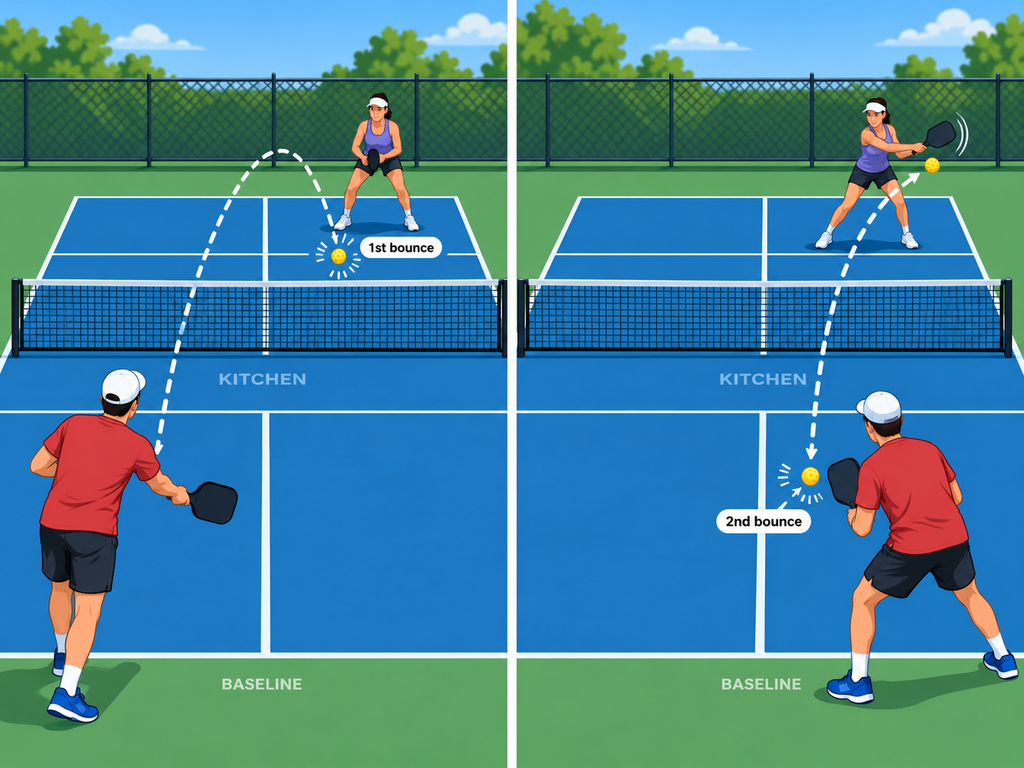
The two-bounce rule is one of the most important rules to understand when learning pickleball. It affects the beginning of every rally and has a major influence on where players stand, when they move forward and when they are allowed to volley the ball.
Fortunately, the rule itself is simple:
After the serve, the receiving team must let the ball bounce once before returning it. The serving team must then let the return bounce once before hitting it.
After those two required bounces—one on each side of the court—players may hit the ball either after a bounce or out of the air as a volley.
USA Pickleball describes the same basic sequence: the serve must bounce on the receiving side and the return of serve must then bounce on the serving side before either team can begin volleying.
Understanding this rule will make the opening few shots of a pickleball rally much easier to follow.
What Is the Two-Bounce Rule in Pickleball?
The two-bounce rule requires the ball to bounce once on each team’s side of the court at the beginning of every rally.
The sequence looks like this:
- The serve crosses the net.
- The receiving team lets the serve bounce once.
- The receiver returns the ball.
- The serving team lets that return bounce once.
- The serving team hits the next shot.
- From this point forward, either team may volley the ball or let it bounce before hitting it.
That is the entire rule.
The two required bounces are therefore:
Bounce #1: The serve bounces in the receiver’s court.
Bounce #2: The return of serve bounces in the server’s court.
Once both have happened, the two-bounce requirement has been satisfied.
Why Is It Called the Two-Bounce Rule?
The name sometimes causes confusion because beginners may think the ball has to bounce twice on the same side.
It does not.
The rule refers to two separate bounces during the opening of the rally:
- one bounce on the receiving team’s side
- one bounce on the serving team’s side
Players should not wait for the ball to bounce twice before hitting it. Under normal play, allowing the ball to bounce twice on your side before returning it means you have lost the rally.
A simple way to remember the rule is:
Serve bounces. Return bounces. Then play normally.
Step-by-Step Example of the Two-Bounce Rule
Imagine Player A is serving to Player B.
Step 1: Player A Serves
Player A serves diagonally into Player B’s service court.
Player B cannot hit the serve out of the air.
Step 2: Player B Lets the Serve Bounce
The ball lands legally in Player B’s service court.
This is the first required bounce.
Player B can now hit the return.
Step 3: Player B Returns the Serve
Player B sends the ball back across the net toward Player A.
Player A cannot immediately volley this return.
Step 4: Player A Lets the Return Bounce
The return lands on Player A’s side.
This is the second required bounce.
The two-bounce rule has now been completed.
Step 5: Player A Hits the Third Shot
Player A hits the ball after the bounce.
This shot is commonly called the third shot because it is the third hit of the rally:
- Serve
- Return
- Third shot
Step 6: Normal Rally Play Begins
After the third shot, players are no longer required to let the ball bounce because of the two-bounce rule.
They may:
- volley the ball
- hit a groundstroke after a bounce
- hit a dink after a bounce
- drive the ball
- play a drop shot
Other pickleball rules, particularly the non-volley zone or kitchen rules, still apply.
Can You Volley the Serve in Pickleball?
No.
A player receiving the serve must allow the ball to bounce before hitting it.
For example, imagine the serve is traveling toward you at chest height and you could easily hit it before it lands.
You still have to wait.
The ball must make its first required bounce before the return can be played.
Hitting the serve out of the air violates the two-bounce rule.
Can the Serving Team Volley the Return?
No.
This is one of the most common mistakes made by new pickleball players.
After serving, the serving team must allow the receiver’s return to bounce before hitting the third shot.
Suppose you serve and your opponent returns a high ball toward you. Even if it looks like an easy volley, you cannot hit it out of the air.
You must let it bounce first.
This requirement is one reason serving players usually remain near the baseline after serving instead of immediately rushing toward the net.
USA Pickleball specifically advises serving teams to stay back initially because they are required to let the return of serve bounce before playing the next shot.
What Happens After the Two Required Bounces?
Once the serve has bounced on the receiving side and the return has bounced on the serving side, the special requirement is finished for that rally.
From then on, players can choose whether to:
Volley the ball
Hit it before it touches the court.
or
Play it after a bounce
Allow it to bounce once and then hit it.
This creates the faster exchanges, dinks, drives, drops and volleys commonly seen during pickleball rallies.
Remember, however, that being allowed to volley does not mean you can volley from anywhere.
The non-volley zone rule still prevents players from volleying while standing in or contacting the kitchen.
The two-bounce rule and kitchen rule are separate rules.
Two-Bounce Rule vs. Double Bounce
These two terms sound similar but describe very different situations.
Two-Bounce Rule
The two-bounce rule is a legal requirement at the beginning of every rally.
The ball must bounce:
- once after the serve
- once after the return
Those bounces occur on opposite sides of the net.
Double Bounce
A double bounce happens when the ball bounces twice on one team’s side before that team returns it.
Under standard play, that means the rally is over.
For example:
Your opponent hits the ball toward you.
The ball bounces once.
You run toward it but cannot reach it in time.
The ball bounces again.
You cannot continue the rally by hitting the ball after that second bounce.
So remember:
Two-bounce rule = one required bounce on each side.
Double bounce = two bounces on the same side before a return.
They are not the same thing.
Why Does Pickleball Have the Two-Bounce Rule?
The two-bounce rule helps prevent the serving team from gaining an immediate serve-and-volley advantage.
Without the rule, a player could potentially:
- serve
- rush straight toward the net
- intercept the return in the air
- immediately pressure the receiving team
Requiring the serving team to allow the return to bounce changes that dynamic.
It gives the receiving team an opportunity to move forward while forcing the serving team to remain farther back for at least the opening part of the rally.
USA Pickleball notes that the rule helps eliminate the serve-and-volley advantage and encourages longer rallies.
That seemingly simple rule has a major influence on pickleball strategy.
How the Two-Bounce Rule Affects Court Positioning
Understanding the two-bounce rule explains why experienced pickleball players position themselves differently depending on whether they are serving or receiving.
Positioning for the Receiving Team
The player receiving the serve generally starts near or behind the baseline.
This gives the receiver enough room to allow the serve to bounce before hitting the return.
In doubles, the receiver’s partner can usually begin closer to the kitchen line because that player is not required to receive the serve.
After making the return, the receiver will often move forward toward the non-volley zone line.
That can put both members of the receiving team near the kitchen while the serving team is still dealing with the required bounce of the return.
Positioning for the Serving Team
The serving team should usually be more patient.
After the serve, the server cannot simply charge forward expecting to volley the next ball.
The return must bounce.
For that reason, the server generally stays at or near the baseline.
In doubles, the server’s partner should also avoid moving too far forward too early.
If the return comes deep, someone standing too close to the net may have difficulty backing up far enough to let the required bounce occur.
This is one of the first positioning habits beginners should learn.
Why a Deep Return of Serve Is Useful
The two-bounce rule helps explain why players often try to hit their return of serve deep into the opponent’s court.
Remember that the serving team must let the return bounce.
A deep return landing close to the baseline can keep the serving team farther away from the kitchen.
A short return may make it easier for the serving team to:
- let the ball bounce
- step forward
- hit their third shot
- begin advancing toward the kitchen
A deeper return usually makes that transition more difficult.
For beginners, the main priority should still be getting the return safely into the court. But as your consistency improves, depth becomes an important strategic goal.
Why Serving Players Should Not Rush Forward
A common beginner habit looks like this:
Serve → immediately run toward the kitchen.
That movement feels natural because being closer to the net can be advantageous in pickleball.
But immediately rushing forward after serving can put you in trouble.
The opponent may send a deep return toward your feet or behind you.
Because the ball is required to bounce before you hit it, you may suddenly have to:
- stop moving forward
- backpedal
- wait for the bounce
- hit while moving backward
That is a difficult shot.
Instead, serve and remain balanced near the baseline until you know where the return is going.
Allow it to bounce.
Hit your third shot.
Then decide when to move forward.
Does the Two-Bounce Rule Apply in Doubles?
Yes.
The two-bounce rule applies in both singles and doubles pickleball.
In doubles, it applies to the teams rather than requiring a particular individual player to make each shot.
For example:
Team A serves.
A player on Team B receives the serve after it bounces.
Team B returns the ball.
The ball must then bounce on Team A’s side before either member of Team A hits it.
Once that bounce occurs and the next shot is made, normal rally play continues.
The serving player’s partner cannot avoid the rule by volleying the return.
The requirement applies to the entire serving team.
Does the Two-Bounce Rule Apply in Singles?
Yes.
The sequence is exactly the same.
The server serves.
The receiver lets the ball bounce and returns it.
The server lets the return bounce before playing the next shot.
After those two required bounces, either player may volley when otherwise permitted by the rules.
The biggest difference is simply that each player must cover the entire court alone.
Does the Ball Have to Bounce Before Every Shot?
No.
The two-bounce rule applies only at the beginning of each rally.
Once the serve and return have each produced their required bounce, you do not have to alternate between volleys and bouncing shots.
For example, a rally could continue like this:
Serve → bounce → return → bounce → third shot → volley → volley → volley → dink → volley.
Or:
Serve → bounce → return → bounce → groundstroke → groundstroke → groundstroke.
Both sequences can be perfectly legal.
Players decide whether to volley or play the ball after a bounce depending on the situation.
Common Two-Bounce Rule Mistakes
Most beginners understand the rule quickly, but remembering it during an actual game can take practice.
Mistake 1: Volleying the Serve
A beginner sees the serve coming toward them and instinctively hits it before it lands.
Fix: Remind yourself before every serve:
“Let the serve bounce.”
Start far enough behind the baseline that you are not tempted to take the ball out of the air.
Mistake 2: Volleying the Return of Serve
The serving team forgets that the receiver’s return must also bounce.
This often happens when the return is high and looks easy to hit.
Fix: After serving, tell yourself:
“Stay back. Let it bounce.”
Mistake 3: Running to the Kitchen Immediately After Serving
The server moves forward before seeing where the return is going.
A deep return then forces the player backward.
Fix: Stay balanced near the baseline until the required second bounce occurs and you have played the third shot.
Mistake 4: Thinking the Ball Must Bounce Twice on One Side
This is a misunderstanding of the name “two-bounce rule.”
Fix: Remember:
One bounce on their side. One bounce on your side.
Mistake 5: Confusing the Two-Bounce Rule With the Kitchen Rule
Some players assume that once the two-bounce rule is completed they can volley while standing anywhere on the court.
That is incorrect.
Fix: Treat the rules separately:
The two-bounce rule determines when volleys may begin during the rally.
The kitchen rule determines where you may stand when volleying.
A Simple Way to Remember the Rule
For beginners, there is no need to memorize complicated terminology.
Just remember this sequence:
Serve → Bounce → Return → Bounce → Play
Or even more simply:
Serve bounces. Return bounces. Then anything goes—subject to the other rules of pickleball.
If you remember those two required bounces, you will avoid one of the most common rule violations among new players.
Practice Drill for Learning the Two-Bounce Rule
You can learn the rule quickly with a simple cooperative drill.
You need two players.
Step 1
Player A serves normally.
Step 2
Player B deliberately waits for the ball to bounce before returning it.
Step 3
Player A waits for the return to bounce before hitting the third shot.
Step 4
Continue the rally normally.
Play 10 to 20 rallies this way.
Before each hit during the opening sequence, say the sequence aloud:
“Serve.”
“Bounce.”
“Return.”
“Bounce.”
“Play.”
This may feel unnecessary at first, but repetition helps make the rule automatic.
Once it becomes a habit, you will stop consciously thinking about it during games.
How the Rule Shapes the First Three Shots
The two-bounce rule is one reason the first three shots of a pickleball rally have distinct strategic roles.
Shot 1: The Serve
The server’s first goal is to start the rally with a legal serve.
Because the receiver must let the ball bounce, the serving team knows the serve cannot immediately be volleyed back.
Shot 2: The Return
The receiver lets the serve bounce and hits the return.
A deep return can be particularly effective because the serving team must also let this ball bounce.
Shot 3: The Third Shot
The serving team lets the return bounce and then plays the third shot.
This is an important transition point in the rally.
Depending on the situation, the player may use:
- a third-shot drop
- a drive
- a controlled groundstroke
- another placement shot
After this shot, the two-bounce requirement is complete and the rally becomes much more open.
The Two-Bounce Rule and the Kitchen
The two-bounce rule is closely connected to how pickleball rallies develop, but it does not change the rules of the non-volley zone.
Once both required bounces have happened, a player can legally volley—but not while standing in the kitchen.
The non-volley zone extends seven feet from the net on each side, and players cannot volley while contacting that zone or its boundary line.
However, players are allowed to enter the kitchen to hit a ball after it has bounced.
This distinction is important.
The kitchen is not an area players are forbidden from entering.
It is a non-volley zone.
Frequently Asked Questions About the Two-Bounce Rule
What is the two-bounce rule in pickleball?
The two-bounce rule requires the receiving team to let the serve bounce once before returning it and requires the serving team to let that return bounce once before playing the next shot.
Does the ball bounce twice on each side?
No.
There are two required bounces total: one on the receiving team’s side after the serve and one on the serving team’s side after the return.
Can you hit a pickleball serve before it bounces?
No.
The receiving player must allow the serve to bounce before returning it.
Can you volley the return of serve?
No.
The serving team must allow the return of serve to bounce before hitting the third shot.
When can you start volleying in pickleball?
Once the serve has bounced on the receiving side and the return has bounced on the serving side, players may begin volleying when otherwise permitted.
Does the two-bounce rule apply to doubles?
Yes.
The rule applies in both singles and doubles.
Does the two-bounce rule apply throughout the entire rally?
No.
It applies only to the opening sequence of the rally.
Is the two-bounce rule the same as a double bounce?
No.
The two-bounce rule requires one bounce on each team’s side during the opening of the rally. A double bounce occurs when the ball bounces twice on one team’s side before being returned.
Can you step into the kitchen after the two-bounce rule is completed?
Yes.
Players may enter the kitchen at any time, but they may not volley while contacting the kitchen or its lines.
Final Thoughts
The two-bounce rule may seem like a small part of pickleball, but it shapes the opening of every rally.
Remember the basic sequence:
The serve must bounce.
The return must bounce.
Then normal rally play begins.
The rule prevents players from immediately attacking the net after the serve and gives both teams an opportunity to establish the rally. It also explains why receivers often move forward after returning serve while servers tend to remain near the baseline until they have played their third shot.
For a beginner, the easiest way to remember everything is:
Serve → Bounce → Return → Bounce → Play.
Once that sequence becomes automatic, you can focus less on remembering the rule and more on positioning, shot selection and controlling the rally.