
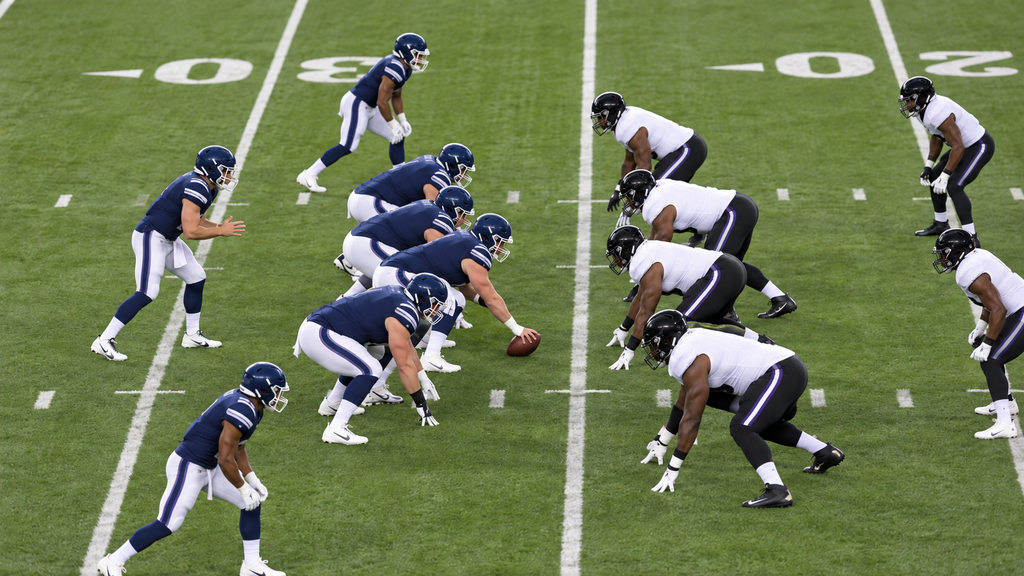
American football can look complicated when you first watch it. Players constantly change, the action stops and starts, and the announcers use phrases such as “third and four” or “first and goal” without explaining what they mean.
The good news is that the basic structure of the game is much simpler than it first appears.
The most important American football basics are understanding which team has possession, how the offense moves the ball, how downs work, and how teams score points. Once those ideas make sense, following a game becomes much easier.
What Is the Basic Objective of American Football?
The basic objective is to score more points than the opposing team.
Teams score mainly by moving the football into the opponent’s end zone for a touchdown or by kicking the ball through the opponent’s goalposts for a field goal.
One team controls the ball and tries to advance toward the opponent’s end zone. The other team tries to stop that advance and regain possession.
Football is therefore a game of both scoring points and controlling field position.
The team with the most points at the end of the game wins.
Offense vs Defense
The two main sides of a football team are the offense and defense.
The offense is the unit that has possession of the football. Its job is to move the ball down the field and score.
The defense is the unit trying to stop the offense. Defenders attempt to tackle ball carriers, prevent completed passes, stop first downs and sometimes take the ball away.
The roles depend on possession.
When Team A has the football, Team A’s offense plays against Team B’s defense. When Team B gains possession, Team B sends out its offense while Team A switches to defense.
Special teams are also used for plays such as punts, field goals and kickoffs, but understanding offense and defense is the best place for a beginner to start.
How Possession Works
Possession simply means control of the football.
An offensive possession usually consists of a series of plays called a drive. The offense tries to keep the drive going by earning first downs until it either scores or loses possession.
Possession can change in several ways.
For example, the offensive team may:
- Score and then kick the ball to the opponent.
- Punt the ball away.
- Fail to gain the required yardage on fourth down.
- Throw an interception.
- Lose a fumble that the defense recovers.
After possession changes, the teams switch offensive and defensive roles.
This back-and-forth movement between possessions forms the basic flow of an American football game.
What Is a Down in Football?
A down is one offensive play.
A down begins when the ball is snapped to start the play and ends when the play is ruled over.
For example, a play normally ends when a ball carrier is tackled, a runner goes out of bounds, a forward pass falls incomplete, or a scoring play occurs.
The offense normally receives up to four downs to move the ball at least 10 yards.
Those downs are called:
- First down
- Second down
- Third down
- Fourth down
If the offense gains enough yardage, it earns another first down and receives a new set of downs.
This system is one of the most important American Football Basics to understand.
What Does First and 10 Mean?
You will frequently hear expressions such as “1st and 10,” “2nd and 6,” or “3rd and 2.”
The first number tells you which down the offense is playing.
The second number tells you how many yards the offense needs to gain to earn a new first down.
Suppose an offense begins with first and 10.
On first down, the running back gains four yards.
The offense has now used one down and still needs six yards.
The next situation is:
2nd and 6
If the offense then gains three yards, the situation becomes:
3rd and 3
If the next play gains five yards, the offense has passed the line it needed to reach. It earns a new first down.
The next play will usually begin as another first and 10.
Near the opponent’s goal line, the wording can change. If there are fewer than 10 yards remaining to the goal line, you may hear “1st and goal.” In that situation, the offense is trying to reach the end zone rather than another first-down marker.
Why Does the Offense Need 10 Yards?
The 10-yard requirement prevents the offense from keeping the ball indefinitely without making meaningful progress.
The offense gets four opportunities to gain those 10 yards.
It does not need to gain all 10 yards on one play.
A team might gain:
- Four yards on first down.
- Three yards on second down.
- Four yards on third down.
That would produce 11 total yards, so the offense earns another first down.
The down count resets, and the offense receives another set of downs.
As long as the offense continues earning first downs, the drive can continue.
What Happens on Fourth Down?
Fourth down is important because it is normally the offense’s final chance to gain the required yardage.
A team generally has three main choices.
Go for the First Down
The offense can run another normal play.
If it gains enough yards, it earns a new first down and keeps possession.
If it fails, possession changes to the other team. This is commonly called a turnover on downs.
Punt
A team can deliberately kick the ball downfield to the opponent.
This is called a punt.
Punting gives up possession, but it can force the opponent to begin its next drive much farther from the scoring end zone.
Teams commonly punt when they are too far away to attempt a field goal and do not want to risk failing on fourth down.
Attempt a Field Goal
If the offense is close enough to the opponent’s goalposts, it may attempt a field goal.
A successful field goal scores three points.
Choosing between these options depends on the score, distance required, field position, time remaining and the team’s strategy.
How Teams Move the Ball Down the Field
The offense has two basic ways to advance the football: running and passing.
On a running play, a player carries the football forward.
The quarterback may hand the ball to a running back, keep it himself or use another designed running play.
On a passing play, the quarterback usually throws the ball forward to an eligible receiver.
If the receiver catches the pass legally, the offense gains the yards reached before the play ends.
If a forward pass falls incomplete, the play normally gains no yardage and the offense moves to the next down.
Teams mix runs and passes as they attempt to gain yards, earn first downs and eventually reach scoring position.
How Touchdowns Work
A touchdown is worth six points.
Touchdowns are the main scoring objective of the offense.
A team can score a touchdown in several ways, including:
- Carrying the football across the opponent’s goal line.
- Catching a legal pass in the opponent’s end zone.
- Returning an interception or recovered fumble into the opponent’s end zone.
After scoring a touchdown, the scoring team receives an opportunity to add more points with an extra-point kick or a two-point conversion attempt.
Extra Points and Two-Point Conversions
After a touchdown, the scoring team can normally choose between attempting one additional point or two additional points.
An extra point is a kick through the goalposts.
If the kick is successful, one point is added to the six points from the touchdown.
That creates a total of seven points from the touchdown and extra point.
A two-point conversion is an offensive play in which the team tries to get the football into the end zone again from a short distance away.
A successful attempt adds two points, producing eight total points from the touchdown and conversion.
Teams may choose a two-point attempt when the game situation makes two points more valuable than one.
The exact placement and procedures for conversion attempts can differ between leagues, but the basic scoring values remain easy for beginners to recognize.
How Field Goals Work
A field goal is worth three points.
On a field goal attempt, the ball is snapped to a holder, who places it for the kicker. The kicker then tries to send the ball between the uprights and above the crossbar of the goalposts.
Teams frequently attempt field goals on fourth down when they are close enough to the goalposts but do not believe going for a first down is the best option.
A field goal scores fewer points than a touchdown, but three points can still be extremely valuable.
If the kick is unsuccessful, the opposing team gains possession according to the rules used by that league.
What Is a Safety?
A safety is a scoring play worth two points.
One common example occurs when the offense has possession near its own goal line and the ball carrier is tackled in the offense’s own end zone.
The defensive team receives two points.
Safeties are much less common than touchdowns and field goals, but they are an important part of football scoring.
The term should not be confused with a defensive player position that is also called a safety.
Basic Turnovers
A turnover occurs when possession changes from one team to the other unexpectedly during an offensive possession.
Two of the most common turnovers are interceptions and fumbles.
Interception
An interception happens when a defensive player catches a forward pass intended for an offensive player.
The defender’s team immediately gains possession and may usually return the ball until the play ends.
Fumble
A fumble occurs when a player who has possession loses control of the football before the play is over.
Either team may be able to recover the loose ball.
If the defense recovers it, possession changes.
Turnover on Downs
If an offense reaches fourth down, runs a play and fails to gain the required yardage, the other team takes possession.
This is called a turnover on downs.
Although it is different from an interception or recovered fumble statistically, the result is similar: the offense loses possession.
A Simple Example of a Drive
Putting the American Football Basics together is easier with a simple example.
Suppose Team A starts a drive at its own 25-yard line.
The situation is:
1st and 10
On first down, the running back carries the ball for four yards.
Team A now has:
2nd and 6
On second down, the quarterback completes a pass for eight yards.
Because the offense needed only six yards, Team A earns a first down.
The down count resets:
1st and 10
The offense then gains five yards on a running play.
That makes it:
2nd and 5
The next pass is incomplete.
It is now:
3rd and 5
The quarterback completes a seven-yard pass. Team A earns another first down.
Several plays later, the offense reaches the opponent’s 8-yard line.
Because the goal line is now less than 10 yards away, the situation may be:
1st and goal
On the next play, the running back gains three yards.
Team A has:
2nd and goal from the 5-yard line
The quarterback then throws a completed pass into the end zone.
Touchdown.
Team A receives six points.
The team then successfully kicks the extra point, increasing the scoring total from that possession to seven points.
The scoring team will then give possession back to the opponent through the appropriate restart, normally a kickoff under standard game conditions.
That sequence—from gaining possession until scoring—is one complete offensive drive.
Understanding the Basic Flow of a Football Game
When watching football as a beginner, try not to follow every position, formation or strategy immediately.
Instead, focus on four questions:
- Which team has the ball?
- What down is it?
- How many yards are needed for a first down?
- Where is the offense trying to reach?
Once you can answer those questions, most plays become much easier to understand.
You can then begin recognizing why a team runs or passes, why third down feels important, why teams often punt on fourth down and why field position affects scoring decisions.
Frequently Asked Questions
How Many Downs Does an Offense Get?
An offense normally gets four downs to gain at least 10 yards. If it succeeds, it earns a new first down and another set of downs.
What Does 3rd and 5 Mean?
It means the offense is on its third down and needs five more yards to earn a new first down.
What Happens If a Team Fails on Fourth Down?
If the offense attempts a normal play on fourth down and does not gain the required yardage, the opposing team takes possession. This is called a turnover on downs.
How Many Points Is a Touchdown Worth?
A touchdown is worth six points. The scoring team can then attempt an extra point worth one point or a two-point conversion worth two points.
How Many Points Is a Field Goal Worth?
A successful field goal is worth three points.
How Many Points Is a Safety Worth?
A scoring safety is worth two points.
Can a Team Keep the Ball for an Entire Drive?
Yes. As long as the offense continues earning first downs and does not score or lose possession, its drive can continue.
Key Takeaways
The most important American Football Basics begin with possession, downs and scoring.
The offense controls the football and tries to move toward the opponent’s end zone. The defense tries to stop that progress and regain possession.
The offense normally receives four downs to gain at least 10 yards. Reaching the required distance earns another first down and allows the drive to continue.
Teams can move the ball by running or passing. On fourth down, they may attempt to gain the remaining yards, punt the ball away or attempt a field goal.
Touchdowns are worth six points, field goals are worth three, safeties are worth two, and teams can add one or two points after a touchdown.
Once you understand possession, first downs and the basic scoring system, the overall structure of American football becomes much easier to follow.