
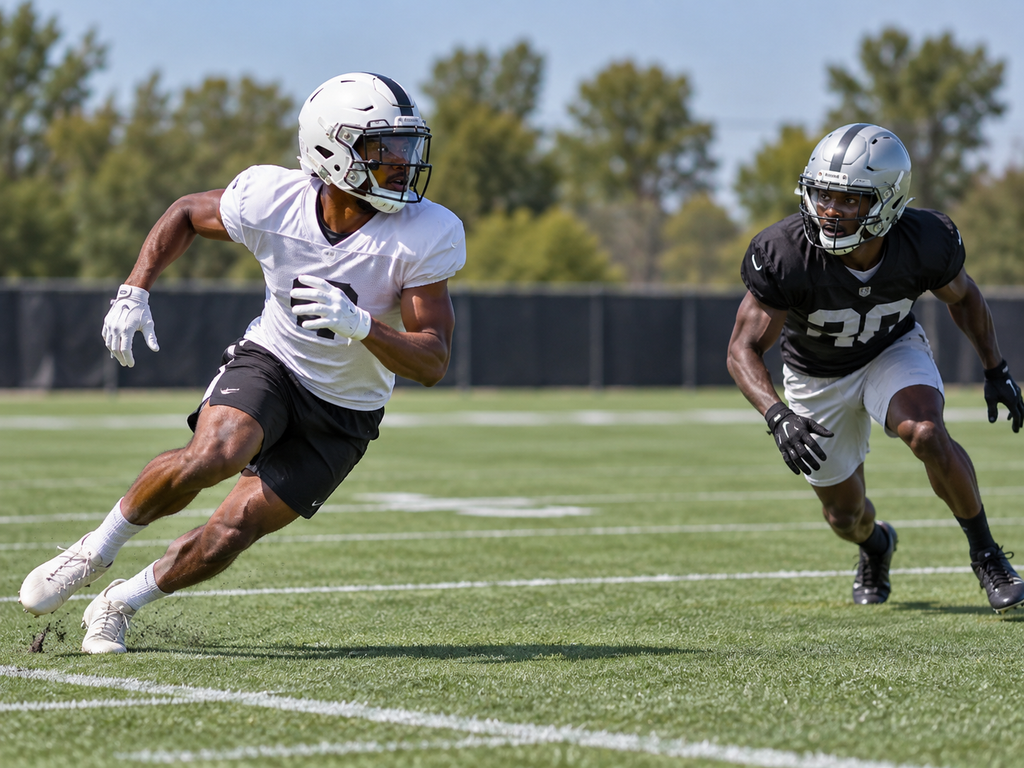
A wide receiver lines up across from a defender, accelerates downfield and makes a sharp cut toward the sideline. For a brief moment, the defender continues moving in the original direction. That small opening gives the quarterback enough space to deliver a completed pass.
Creating separation like this is one of the most important skills a receiver can develop. While speed helps, running faster than a defender is not the only way to get open. Precise footwork, controlled acceleration, body positioning and well-timed directional changes can make a receiver much harder to cover.
Learning effective football route running techniques helps developing receivers become more consistent, create better passing opportunities and work more effectively with their quarterbacks.
This guide explains how to improve route execution, make sharper cuts, control your running speed and practice common receiving routes. It focuses on the individual techniques that help receivers create separation, rather than advanced coverage adjustments or complex offensive strategy.
What Is Route Running in American Football?
Route running is the process of following a planned movement pattern during a passing play. A receiver begins from an assigned position, moves into a designated area and attempts to become available for a pass.
Different routes require different movements.
A slant involves an angled break toward the middle of the field. An out route takes the receiver toward the sideline. A curl sends the receiver downfield before stopping and turning back toward the quarterback.
Although these routes may look simple on a diagram, executing them consistently takes practice.
A receiver must control their acceleration, maintain the correct route depth, change direction efficiently and arrive at the intended area at the appropriate time.
Good route running also requires understanding that the quarterback expects the receiver to follow the designed pattern.
If a receiver runs a route too shallow, makes a rounded turn or takes longer than expected to complete a break, the quarterback’s throw may no longer match the receiver’s position.
The purpose of route running is not simply to move around the field. It is to create a dependable passing opportunity within the offensive play.
Why Separation Matters for Wide Receivers
Separation describes the space a receiver creates between themselves and a defender.
When a receiver creates enough space, the quarterback may have a clearer passing window. The receiver also has more room to adjust to the ball and complete the catch.
However, separation is not measured only by the physical distance between players.
A receiver might have limited space but still offer a useful throwing window because of their body position and the defender’s location.
For example, a receiver running an out route may position their body between the defender and the football’s intended arrival point. Even without several yards of separation, the positioning can help protect the catching opportunity.
Three elements contribute to effective separation:
- Movement: Accelerating, slowing and changing direction efficiently.
- Positioning: Placing the body in a useful location relative to the defender.
- Timing: Arriving at the intended receiving area when the quarterback expects it.
These elements work together. A receiver who runs quickly but arrives late may be less useful than one who creates a smaller opening at precisely the right moment.
Start With a Consistent Receiver Stance
Effective route running begins before the receiver takes the first step.
A balanced stance helps produce a controlled release, efficient acceleration and better movement throughout the route.
Establish an Athletic Position
Begin with your feet in a comfortable staggered or balanced stance, depending on the alignment and coaching instructions.
Keep your knees slightly bent and your weight positioned so you can accelerate without first shifting awkwardly.
Your upper body should remain relaxed enough for natural running movement.
Avoid standing too upright or leaning so far forward that maintaining balance becomes difficult.
Your stance should allow you to take an efficient first step in the direction required by the play.
Practice Your First Three Steps
The first few steps establish the early rhythm of the route.
Receivers who hesitate, stand up abruptly or take unnecessarily long first steps may lose valuable time before reaching their intended route depth.
During practice, mark a starting line and accelerate forward for approximately five yards.
Focus on controlled forward movement rather than taking the longest possible strides.
Repeat the exercise while keeping the starting stance and initial movement reasonably consistent.
A reliable release from the line provides a foundation for the rest of the route.
Use Acceleration to Create Opportunities
Speed is useful in football, but receivers also need to control how they accelerate.
Running every route at maximum speed can make breaks harder to execute and reduce consistency.
The objective is to accelerate when the route demands it while maintaining enough control to change direction efficiently.
Build Speed Gradually and Purposefully
During a vertical portion of a route, accelerate using natural running mechanics.
Keep your head aligned with your movement and allow your arms to contribute to the running rhythm.
Avoid unnecessary upper-body movement that makes maintaining a straight path difficult.
As you approach a planned break, prepare to adjust your speed according to the demands of the route.
Some routes require a firm deceleration before a directional change. Others involve maintaining speed through a gradual angle.
Recognizing that difference is an important part of intermediate receiver development.
Avoid Telegraphing Your Break
A receiver can unintentionally reveal an upcoming directional change by slowing excessively, turning the head too soon or making an obvious body movement.
For example, imagine running a curl route.
If you begin slowing several yards before the intended stopping point, a defender may recognize that you are about to turn back toward the quarterback.
Instead, practice approaching the planned break with controlled speed and executing the turn at the correct depth.
The goal is not to disguise every movement with unnecessary tricks. It is to avoid giving away your intentions through poor technique.
Improve Footwork for Sharper Route Breaks
Footwork is central to effective route execution.
A sharp break allows a receiver to redirect movement efficiently while maintaining balance and preparing to receive the football.
Poor footwork often produces rounded cuts, extra steps and delays.
Understand Deceleration
Before making a significant directional change, your body needs to manage its forward momentum.
Trying to turn sharply without controlling speed can cause slipping, overstriding or losing balance.
Practice lowering your center of gravity slightly as you approach the break.
Bend naturally through your hips and knees while keeping your feet underneath you as much as the movement allows.
Use controlled steps to reduce speed before redirecting your body.
The number of steps required depends on your speed, the route and the playing surface.
Plant and Redirect
During many sharp routes, a receiver uses a strong plant step to help redirect momentum.
For an out route, the receiver typically needs to change from running downfield to moving toward the sideline.
The outside or inside plant foot used depends on the route, direction and taught technique.
Rather than memorizing one universal planting rule, practice the exact footwork assigned to each route.
Focus on maintaining balance, avoiding excessive reaching and accelerating smoothly out of the break.
Eliminate Unnecessary Steps
A common problem among developing receivers is taking several adjustment steps before completing a cut.
These extra movements delay the route and may allow the defender to recover.
Set up a drill with a cone marking the break point.
Approach the cone, decelerate appropriately, plant and accelerate in the new direction.
Repeat while observing whether you take unnecessary steps before moving away from the break.
Quality matters more than completing the drill at maximum speed.
Run Routes at the Correct Depth
Route depth is the distance a receiver travels downfield before making a planned break.
For example, a coach may assign a particular out route with a break at approximately ten yards.
If the receiver turns at six yards instead, the play may not develop as intended.
Incorrect route depth can also interfere with spacing between receivers.
Use Field Markings During Practice
Mark the intended break point with a cone or field marker.
Start from the designated alignment and run toward the marker.
Complete the planned directional change at the correct depth.
After several repetitions, remove the marker and attempt the route again.
Ask a partner or coach to check whether you consistently reach the intended location.
This exercise develops a better sense of distance and helps make routes more repeatable.
Understand Why Consistency Matters
The quarterback and receiver depend on shared expectations.
The quarterback may begin the throwing motion before the receiver completes the route.
If the receiver consistently reaches the intended position at the expected time, the passing connection becomes more reliable.
This is why disciplined route running can be more valuable than improvising a different movement on every repetition.
Five Common Routes to Practice
Developing receivers benefit from practicing a manageable selection of routes before adding more demanding variations.
Each of the following patterns introduces a useful movement skill.
1. Slant Route
A slant involves an angled break toward the middle of the field after an initial release.
The receiver needs to transition efficiently from forward acceleration into the diagonal path.
Practice focus: Maintain balance through the break and accelerate toward the intended receiving window.
Common mistake: Drifting gradually inward rather than making a purposeful directional change.
2. Out Route
An out route begins with a vertical movement before the receiver breaks toward the sideline.
It requires controlled deceleration and a relatively sharp change of direction.
Practice focus: Reach the correct depth, plant efficiently and accelerate toward the sideline.
Common mistake: Rounding the turn, which lengthens the route and gives the defender time to react.
3. Curl Route
A curl sends the receiver downfield before stopping and turning back toward the quarterback.
The receiver needs to manage forward momentum so they can turn without drifting far beyond the intended spot.
Practice focus: Decelerate under control and present a clear receiving target.
Common mistake: Beginning the turn too early or drifting after the break.
4. Post Route
A post route begins vertically before angling toward the middle of the field.
Unlike a sharp out route, the post often involves preserving considerable speed through the directional change.
Practice focus: Maintain a consistent angle and avoid unnecessary slowing.
Common mistake: Making an overly wide turn that changes the planned route timing.
5. Go Route
A go route is a primarily vertical route intended to challenge the defense downfield.
Although its movement pattern is straightforward, consistent execution still matters.
Practice focus: Accelerate efficiently, maintain the assigned path and track the ball when appropriate.
Common mistake: Wandering sideways or looking back too early and unnecessarily reducing running speed.
Practicing these routes regularly provides experience with different forms of acceleration, deceleration and directional control.
Use Body Positioning to Improve Separation
Effective route running involves more than footwork.
The receiver’s position relative to the defender can influence the quality of the passing opportunity.
A defender may attempt to remain between the receiver and the expected destination.
The receiver, in turn, tries to execute the designed route while making efficient use of available space.
Maintain a Useful Running Path
Imagine a receiver running vertically with a defender positioned nearby.
Unnecessary lateral movement may shorten the defender’s path or reduce space for the receiver’s planned break.
Following the intended route line helps preserve spacing and timing.
Receivers should use their assigned path rather than drifting unpredictably around the field.
Use Controlled Body Movement
A receiver may use natural changes in running tempo, shoulder position and route direction to influence how a defender reacts.
However, exaggerated movements can slow the receiver or make balance more difficult.
The goal is to create an efficient movement that the defender must respond to.
Advanced techniques involving specific defensive leverage and coverage adjustments can be developed later. At this stage, prioritize route discipline and controlled movement.
Build Better Timing With Your Quarterback
A well-executed route does not automatically produce a completed pass.
The receiver and quarterback must coordinate the timing of the play.
For example, on a short out route, the quarterback may anticipate the break and begin releasing the ball as the receiver changes direction.
If the receiver reaches the break late, the ball may arrive before the receiver reaches the intended area.
If the receiver breaks too early, the quarterback’s expected throwing location may no longer be correct.
Practice Routes Without Defenders
Begin with a quarterback and receiver running a planned route at a comfortable practice speed.
Agree on the route depth, alignment and expected timing.
Run several repetitions and observe whether the football consistently arrives in an appropriate catching area.
If timing is inconsistent, identify whether the problem comes from route depth, receiver speed, footwork or throwing timing.
Change one factor at a time rather than making multiple adjustments simultaneously.
Add Realistic Movement Gradually
Once the route becomes repeatable, increase the practice speed.
You can also begin each repetition from a different assigned alignment or use a coach to signal when the play starts.
When working with qualified coaches, controlled defensive repetitions can be introduced.
The receiver should preserve the taught route while learning to maintain timing in a more realistic environment.
Practical Drills for Better Route Running
A useful practice routine includes drills that isolate movement skills before combining them into complete routes.
Drill 1: Cone Break Drill
Purpose: Improve directional changes and eliminate rounded cuts.
Place one cone at the starting position and another at the intended route depth.
Accelerate toward the second cone, decelerate appropriately and perform the planned break.
Repeat the drill using different directions.
Begin at a controlled speed and increase intensity only when your movement stays balanced.
Drill 2: Route Depth Consistency
Purpose: Improve distance awareness.
Set markers at several assigned route depths.
Run a designated route and complete the break at the correct marker.
After several repetitions, remove the marker and attempt to reproduce the same depth.
Have a partner evaluate the result.
This helps develop route consistency without requiring constant visual reminders.
Drill 3: Break and Accelerate
Purpose: Improve movement immediately after a directional change.
Start several yards before a marked break point.
Approach under control, execute the cut and accelerate for another five yards.
Focus on transitioning smoothly from deceleration to acceleration.
Avoid standing upright or pausing unnecessarily after changing direction.
Drill 4: Quarterback Timing Drill
Purpose: Improve passing coordination.
Work with a quarterback on a selected route.
Complete five to ten repetitions while maintaining the same alignment and assigned depth.
Record whether the ball arrives before, during or after the intended receiving window.
Discuss adjustments with the quarterback or coach before repeating.
Drill 5: Route Combination Practice
Purpose: Build consistency across several routes.
Choose three familiar routes, such as a slant, curl and out.
Have a partner call one of the routes before each repetition.
Execute the correct route while preserving its intended depth and movement pattern.
This tests your ability to transition between route types without changing their fundamental mechanics.
Common Route Running Mistakes
Recognizing recurring mistakes can help receivers make meaningful improvements.
Rounding Every Cut
Rounded cuts often increase the distance traveled and reduce the sudden directional change needed for certain routes.
Correction: Practice controlled deceleration and sharper breaks where the route requires them.
Running Every Route at the Same Speed
Different routes place different demands on acceleration and deceleration.
Correction: Learn where the route requires maintained speed and where a controlled reduction is necessary.
Breaking at Inconsistent Depths
Changing the break point from one repetition to another affects timing with the quarterback.
Correction: Use marked depths during practice until the route becomes repeatable.
Taking Too Many Steps During Breaks
Unnecessary steps delay the receiver’s movement out of the cut.
Correction: Practice the taught footwork pattern slowly before increasing speed.
Looking for the Football Too Early
Turning the head prematurely can interfere with running posture and route execution.
Correction: Learn the appropriate moment to locate the football within the specific route and passing concept.
Practicing Only at Full Speed
Maximum-speed repetitions can reinforce mistakes when the movement pattern is not yet reliable.
Correction: Begin at controlled speeds, improve consistency and progressively increase intensity.
How to Measure Route Running Improvement
Route running improvement can be evaluated through repeatable movement and coordination rather than relying only on catches.
A completed pass depends on many factors, including quarterback accuracy and defensive positioning.
Instead, monitor aspects of performance you can directly influence.
Useful measurements include:
| Skill | What to Evaluate |
|---|---|
| Route depth | Consistency of break location |
| Direction changes | Balance and efficiency through cuts |
| Acceleration | Ability to regain speed after breaks |
| Timing | Arrival at the intended receiving window |
| Route accuracy | Consistency with the assigned route |
| Body control | Stability when turning or decelerating |
Video review can be useful when available.
Record several repetitions from a safe sideline position and compare your route depth, break mechanics and acceleration.
Avoid judging improvement based on one impressive repetition. Look for consistent execution across several practice sessions.
Build a Weekly Route Running Practice Routine
A developing receiver can improve by practicing regularly with a clear purpose.
The following is an example of a focused session rather than a mandatory training schedule.
| Practice Phase | Activity | Approximate Time |
|---|---|---|
| Warm-up | Dynamic movement and progressive acceleration | 5–10 minutes |
| Footwork | Planting, deceleration and controlled breaks | 5–10 minutes |
| Route execution | Slants, outs, curls and posts | 10 minutes |
| Timing | Passing repetitions with a quarterback | 10 minutes |
| Review | Feedback and technique corrections | 5 minutes |
Adjust the volume based on experience, conditioning, coaching and recovery needs.
Practicing at high intensity while fatigued can reduce movement quality. Take appropriate rest between demanding repetitions and stop if you experience pain.
Choose one main technical goal for each session.
For example, one practice might emphasize breaking at the correct depth. Another might focus on maintaining balance during out routes.
This keeps training organized and makes progress easier to evaluate.
When Are You Ready for More Advanced Route Running?
Intermediate receivers should first become comfortable executing their assigned routes consistently.
You may be ready for more advanced concepts when you can:
- Run familiar routes at the intended depths without relying on cones.
- Maintain balance through directional changes.
- Accelerate efficiently after route breaks.
- Coordinate route timing with the quarterback.
- Execute the team’s assigned route patterns reliably.
- Recognize and correct recurring technique mistakes.
Advanced receiver development introduces more detailed coverage recognition, defensive leverage, release variations and adjustments within specific offensive systems.
Those skills build on the foundation of disciplined route execution.
Trying to learn complicated adjustments before mastering the route itself can make performance less consistent.
Final Thoughts: Better Routes Create Better Opportunities
Improving football route running techniques is not simply about becoming faster.
A reliable receiver understands how to accelerate, control momentum, execute precise breaks and reach the intended catching area at the right time.
Developing better footwork helps create sharper directional changes. Consistent route depth improves timing with the quarterback. Controlled body movement helps the receiver take advantage of available space without sacrificing balance or route discipline.
Start with a small set of routes and practice them carefully. Use cones, partner feedback and passing repetitions to identify where your technique can improve.
As your movement becomes more efficient and repeatable, you can gradually introduce more realistic practice situations.
The goal is to become a receiver the quarterback can trust to run the correct route and arrive in the right place.
Explore more Intermediate American Football Guides for additional receiving and movement skills, or visit the American Football Learning Path to continue developing through structured courses.