
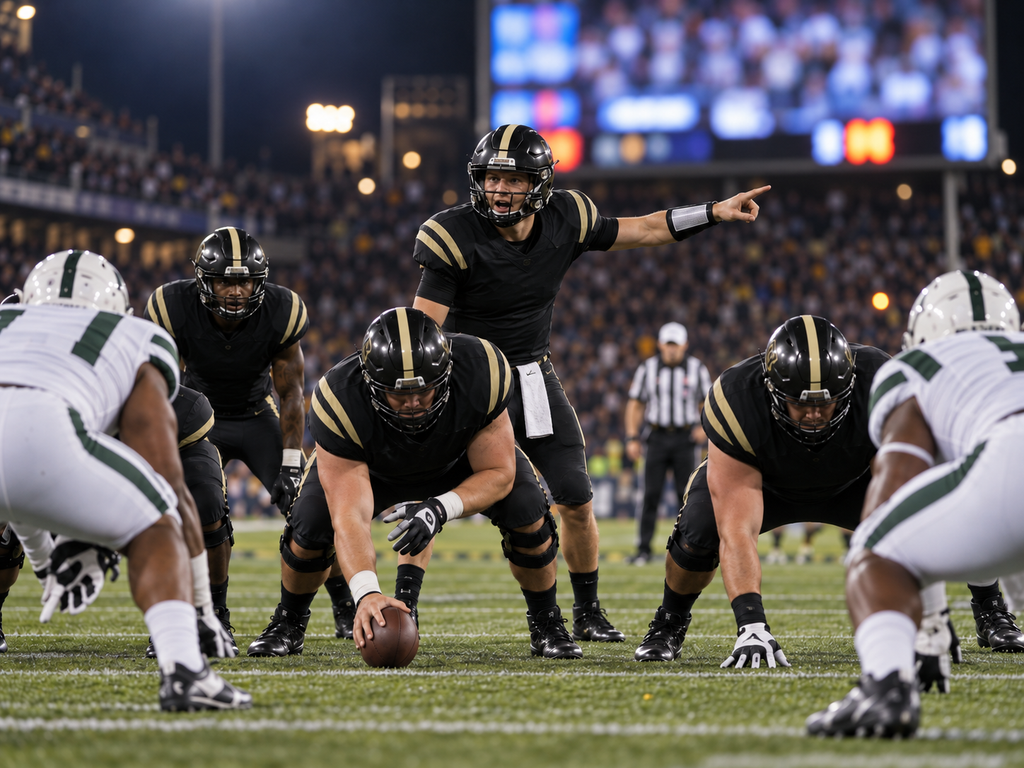
The offense trails by three points with 1:42 remaining in the fourth quarter. The team has the football near midfield and two timeouts available.
The quarterback completes a pass for 14 yards, but the receiver is tackled inbounds. The game clock continues running. The offense now faces a decision: hurry to the next snap, use a timeout or organize another play while the clock runs.
Every second matters, but using a timeout immediately is not necessarily the best decision.
A few minutes earlier, the team may have been comfortable using most of the play clock before snapping the football. Now, the same delay could reduce its opportunity to score.
This is the challenge of football clock management.
Advanced clock management involves understanding how time, possession, play selection and remaining timeouts influence a team’s options. It requires knowing when to preserve seconds, when to allow the clock to run and how to prepare players for situations where there is little time to communicate.
A well-managed drive can give an offense additional opportunities. Poor timing decisions can leave a team without enough time to complete its next play, even when it has moved into scoring position.
This guide explores practical clock-management strategies used during competitive American football, with particular attention to end-of-half drives, late-game possessions and protecting a lead.
What Is Clock Management in American Football?
Clock management is the strategic use of available game time to improve a team’s chances of achieving its objectives.
Those objectives change throughout a game.
A team that is trailing may need to preserve enough time to complete several plays and score. A team protecting a lead may benefit from keeping the game clock running and limiting the opponent’s remaining possessions.
Clock management also involves understanding the difference between the game clock and the play clock.
The game clock measures the time remaining in a period, while the play clock limits how long the offense may take to put the ball into play.
These clocks interact, but they serve different purposes.
For example, an offense protecting a lead may allow much of the play clock to expire before snapping the ball, provided it avoids a delay-of-game penalty.
An offense attempting a late comeback may choose to snap the ball much sooner to preserve game time.
Effective management requires selecting the appropriate pace for the situation rather than always playing quickly or slowly.
Understand How the Game Clock Starts and Stops
Advanced strategy depends on knowing the timing rules governing each play.
In the NFL, a completed play ending with a tackle inbounds generally allows the game clock to continue running.
An incomplete forward pass normally stops the game clock until the next snap.
A charged team timeout also normally stops the clock until the next snap.
Out-of-bounds plays require greater attention because the restart rules change during different stages of the game.
The NFL Out-of-Bounds Rule
When a runner goes out of bounds on a scrimmage play, the NFL game clock stops.
Outside certain late-half situations, it generally restarts when the officials make the ball ready for play.
However, the game clock starts on the next snap after a runner goes out of bounds during:
- The final two minutes of the first half.
- The final five minutes of the second half.
This distinction is particularly important for teams attempting late-game drives.
A receiver stepping out of bounds with eight minutes remaining in the fourth quarter does not necessarily preserve time until the next snap.
The same play with less than five minutes remaining ordinarily does.
The applicable clock rule should always be checked for the specific competition.
Understand the Two-Minute Warning
The NFL has a two-minute warning near the end of each half.
This provides an automatic clock stoppage under the applicable rules.
Teams can plan around the warning because it may allow them to preserve a charged timeout.
For example, a defense facing an opponent attempting to run down the clock near the end of a half may consider how the next play relates to the upcoming two-minute warning.
The warning itself does not mean every team should use the same strategy.
Its value depends on possession, score, down and remaining time.
Know When the Clock Restarts
A stoppage is only part of the calculation.
Players must also understand whether the clock will resume on the referee’s ready-for-play signal or on the next snap.
Failing to recognize the restart can lead to unexpected time loss.
This is especially important following administrative stoppages, penalties and unusual officiating situations.
Use the Play Clock as a Strategic Resource
The play clock prevents an offense from delaying indefinitely between plays.
In ordinary NFL situations, a 40-second play clock commonly follows the end of a play. Certain administrative situations use a 25-second clock, with other exceptions specified by rule.
An offense does not always need to snap the ball immediately.
When Protecting a Lead
Imagine a team leading by six points with four minutes remaining.
The offense has possession and wants to reduce the time available for an opponent’s comeback.
If the game clock is running, using much of the available play clock before each snap can consume valuable seconds.
Suppose the offense can legally wait approximately 30 additional seconds before snapping.
Across several plays, those decisions may significantly reduce the opponent’s remaining time.
However, the offense must still execute its plays properly.
A delay-of-game penalty, negative play or turnover can eliminate the benefit of careful timing.
When Trailing
A team attempting a comeback usually values the remaining game time differently.
Waiting until the play clock nearly expires may reduce the number of plays it can run.
The offense may prefer to organize quickly, get aligned and snap sooner.
The objective is not simply to rush.
Players must still understand the play call, substitutions and formation.
An incorrectly executed hurried play may cost more time than a brief, organized preparation.
Make Better Decisions About Timeouts
Timeouts are limited resources.
In NFL regulation play, each team receives three charged timeouts per half.
Because unused first-half timeouts do not carry into the second half, their strategic value changes throughout the game.
Preserve Timeouts for High-Value Situations
A timeout can be valuable when the clock is running and a team urgently needs to prepare another play.
It may also be useful for stopping an opponent’s clock-draining drive.
However, spending a timeout unnecessarily can leave the team without a way to stop the clock later.
Imagine a team trailing by four points with 2:30 remaining.
The offense completes a short pass inbounds.
It could use a timeout immediately, but if the next play is already prepared, getting to the line quickly might preserve the timeout for a more difficult situation.
The correct choice depends on how much time would be lost organizing the next snap.
Understand the Value of a Timeout on Defense
Timeout decisions are not limited to the team possessing the football.
A defense protecting its opportunity for another possession may use timeouts to stop an opponent from consuming the remaining clock.
Suppose the opponent leads by three points with two minutes remaining and has the football.
If the defense can force a punt, preserving enough time for a final offensive drive becomes important.
Using a timeout after an inbounds play may be worthwhile.
However, the defense should also consider the next down and the two-minute warning.
A timeout used before an automatic stoppage may provide less value than one saved for later.
Avoid Spending Timeouts to Correct Preventable Confusion
Teams sometimes use timeouts because players are not aligned or the play call is unclear.
Occasionally, preventing a serious assignment error justifies the stoppage.
But repeated confusion can leave a team without enough timeouts in critical moments.
Improved communication, practiced substitution procedures and clear sideline responsibilities can reduce unnecessary timeout use.
Manage a Two-Minute Offensive Drive
A two-minute drive requires coordinated execution under time pressure.
The offense may need to travel a considerable distance while conserving enough time for a scoring attempt.
The exact strategy depends on the score and available resources.
A team needing a touchdown approaches the drive differently from a team needing only a field goal to tie.
Establish the Objective Before the Drive
The offense should understand what it needs to accomplish.
Consider a team trailing by three points with 1:30 remaining.
A field goal could tie the game, while a touchdown could take the lead.
The offense must balance field position, scoring opportunities and time.
Players should know the approximate target area for a possible field-goal attempt without assuming every kick from that distance will succeed.
Use the Sidelines When Appropriate
During the final five minutes of the NFL’s second half, a runner going out of bounds on a scrimmage play generally keeps the clock stopped until the next snap.
This makes sideline passing opportunities valuable during late drives.
However, forcing a throw toward a covered sideline can lead to an interception or incompletion.
A shorter completion inbounds may sometimes be a better choice, particularly when the offense has enough time or a timeout available.
The clock benefit must be considered alongside the play’s likelihood of success.
Prepare the Next Play in Advance
Hurry-up offenses benefit from having several calls or predetermined alternatives ready.
The quarterback and offensive players need to know how the team will respond after a completion, incompletion or significant gain.
Prepared communication reduces the time spent waiting for new instructions.
This does not mean eliminating coaching input.
It means designing procedures that allow the team to operate efficiently when time is limited.
Understand Hurry-Up and No-Huddle Offense
A hurry-up offense attempts to reduce the time between plays.
A no-huddle approach allows the offense to organize without gathering in a conventional huddle.
These methods are related but not identical.
A team can operate without a huddle while deliberately allowing the clock to run.
Similarly, an offense might use a quick huddle and still snap promptly.
Advantages of Faster Tempo
When executed properly, faster tempo may allow the offense to:
- Run more plays before time expires.
- Limit time lost between completed plays.
- Maintain a familiar personnel group.
- Reduce the opponent’s opportunity to substitute in certain situations.
However, faster tempo also places demands on communication and execution.
Risks of Excessive Speed
An offense that moves too quickly may create penalties, missed assignments or poor passing decisions.
Substitution rules still apply.
Officials may hold the snap to allow the defense a reasonable opportunity to substitute following an offensive substitution, which can affect the intended tempo.
Teams should practice hurry-up situations rather than improvising them only during competition.
Manage the Clock When Protecting a Lead
A team protecting a late lead generally wants to reduce the opponent’s remaining opportunities.
However, managing the clock is not identical to refusing to advance the football.
An offense that fails to gain first downs may return possession too quickly.
Understand the Value of a First Down
Suppose a team leads by four points with 3:20 remaining.
The opponent has one timeout.
A first down may allow the leading team to consume substantially more time.
For that reason, gaining the necessary yardage may be more important than selecting the play that merely appears to keep the clock running.
A completed pass ending inbounds can support both objectives.
The best choice depends on the expected gain, risk of turnover, likelihood of an incompletion and remaining clock.
Avoid Unnecessary Out-of-Bounds Plays
Near the end of an NFL game, a runner going out of bounds may stop the clock until the next snap.
A team trying to protect a lead may prefer for the ball carrier to remain inbounds when doing so is safe and appropriate.
However, players should not risk injury or sacrifice an important first down solely to avoid the boundary.
Situational judgment matters.
Protect Possession
A turnover can be devastating when protecting a late lead.
Ball security becomes especially important.
The offense should avoid unnecessary risks while continuing to execute the chosen play effectively.
Clock management works only if the team maintains possession long enough to benefit from it.
When Can a Team Run Out the Clock?
A team may be able to end a game without running another conventional offensive play when the remaining time, play clock and opponent’s timeouts make further possession unnecessary.
Quarterback kneel-downs are commonly used for this purpose.
Understand Kneel-Down Strategy
A kneel-down allows the quarterback to intentionally end the play while maintaining possession and generally keeping the game clock running.
It typically sacrifices a small amount of yardage.
The tactic can help a leading team avoid unnecessary plays once it has enough remaining downs and clock control.
However, kneeling is not automatically appropriate whenever a team is ahead.
The offense must consider remaining time, down, available timeouts and field position.
Example: Forty Seconds Remaining
Imagine a team leads by four points, has first down and possesses the football with 40 seconds remaining.
The opponent has no timeouts.
Under ordinary NFL conditions, a properly executed kneel-down can allow the remaining game clock to expire without another meaningful play.
But if the opponent still has timeouts, the offense may need additional snaps.
Teams should calculate the remaining clock carefully rather than assuming every late kneel-down will end the game.
Avoid Common Late-Game Clock Mistakes
Some of the most costly clock-management errors involve incorrect assumptions rather than complicated strategy.
Using a Timeout Before an Automatic Stoppage
A team may spend a timeout just before the two-minute warning when allowing the next play to reach the warning would have preserved it.
The correct decision depends on the game situation and likely clock movement.
Snapping Too Early While Protecting a Lead
An offense may repeatedly snap the ball with substantial time remaining on the play clock.
When trying to end the game, those unused seconds can benefit the opponent.
Waiting Too Long During a Comeback
A trailing team may complete several passes but take too long to organize the next snap.
Even a successful drive can fail if the offense leaves insufficient time for the final scoring attempt.
Forgetting the Out-of-Bounds Restart Rule
Assuming every out-of-bounds play preserves time until the next snap can create poor planning.
The NFL’s late-half exceptions are especially important to understand.
Losing Track of Remaining Timeouts
Players and coaches must understand which team has timeouts and how many remain.
Timeout availability changes whether a team can stop the clock, force additional snaps or preserve time for another possession.
Failing to Account for Clock Runoffs
Certain fouls and other specified events can trigger a 10-second runoff late in an NFL half.
Such situations are governed by detailed rules and may include timeout options or exceptions.
A team should not assume that deliberately committing a foul, throwing an illegal pass or exploiting an injury stoppage provides a free way to preserve time.
Practical Late-Game Clock Management Scenarios
The following hypothetical situations demonstrate how strategic decisions change with the game.
Scenario 1: Trailing by Three With 1:15 Remaining
The offense has the football at its own 45-yard line with one timeout.
A completed pass gains 12 yards, and the receiver is tackled inbounds.
The game clock continues running.
Strategic considerations:
The offense must determine whether it can organize another play quickly enough to preserve the timeout.
If the next call is ready and players can align efficiently, continuing without a timeout may be reasonable.
If the team is disorganized or approaching a critical decision, the timeout may become more valuable.
The goal is to preserve both scoring opportunities and enough time to use them.
Scenario 2: Leading by Five With 2:40 Remaining
The offense has first-and-ten.
The opponent has two timeouts.
The leading team wants to maintain possession and prevent a final drive.
Strategic considerations:
Using the play clock deliberately may help reduce remaining time.
However, gaining another first down could be more valuable than merely taking time off the clock.
The opponent may use timeouts after inbounds plays, so the offense cannot assume the clock will run continuously.
The team should balance clock consumption with the need to keep possession.
Scenario 3: Trailing by Seven With 0:48 Remaining
The offense has second-and-six at the opponent’s 20-yard line and no timeouts.
A completed pass ends inbounds near the 10-yard line.
Strategic considerations:
The offense must organize another play quickly.
A legal clock-stopping spike may be available if the team can line up correctly and meet the applicable requirements.
Alternatively, a prepared hurry-up play may provide a scoring opportunity.
The choice depends on the remaining time, down and offensive readiness.
Scenario 4: Leading by Three With 1:05 Remaining
The offense has first-and-ten, and the opponent has no timeouts.
Strategic considerations:
If the game clock is running and the offense can legally consume the remaining time through kneel-downs, unnecessary passing or rushing plays would introduce avoidable risk.
The team should verify the timing calculation and maintain possession.
This is a situation where ending the game safely can take priority over gaining additional yardage.
Understand Clock Management Near Halftime
Clock management is not only an end-of-game skill.
The final minutes of the first half also create opportunities to influence possessions.
Preserve Time for a Scoring Attempt
An offense approaching halftime may want enough time to reach scoring position.
If it waits too long to increase its tempo, an otherwise promising drive may end without an attempt.
Teams should consider field position, timeouts and the type of scoring opportunity realistically available.
Consider Who Receives the Second-Half Kickoff
Possession order matters.
A team that scores late in the first half and receives the opening kickoff of the second half has the opportunity to score on consecutive possessions without the opponent running an offensive play between them.
This is sometimes called a double-dip opportunity.
The possibility can influence late-half strategy, but it does not justify reckless decision-making.
A turnover or failed possession could eliminate the advantage.
Avoid Giving Away Unnecessary Possession Time
An offense that scores very quickly may leave the opponent enough time for another drive.
However, deliberately delaying a scoring opportunity can also be costly.
The offense should consider the likelihood of scoring, its remaining timeouts and the opponent’s potential response.
There is no universal rule that a team should always score as quickly or slowly as possible.
Practice Clock Management Before Game Day
Successful clock management depends on players understanding the team’s procedures before a critical situation occurs.
Practice should reproduce realistic time, score and timeout constraints.
Two-Minute Drive Simulation
Set a hypothetical score and remaining time.
Have the offense begin at a specified field position.
Require players to organize and execute plays while managing the clock according to the competition’s rules.
Coaches can stop the exercise to correct communication problems or timing errors.
Four-Minute Offense Practice
A four-minute offense generally refers to an approach designed to protect a late lead and consume game time.
Coaches can present a situation in which the offense leads and the opponent has limited timeouts.
Players practice controlled tempo, ball security and the responsibilities associated with maintaining possession.
Timeout Decision Exercises
Present several hypothetical situations.
Ask players to identify whether an immediate timeout, continued hurry-up play or deliberate clock consumption would be appropriate.
Explain how the choice changes with the number of remaining timeouts.
Clock Restart Recognition
Use film clips or game scenarios to identify when the game clock starts on the snap versus the ready-for-play signal.
Include out-of-bounds situations, incomplete passes and official stoppages.
Because timing rules vary by competition, exercises should use the applicable rulebook.
Evaluate Clock Management Decisions Correctly
Not every unsuccessful drive results from poor clock management.
A team may manage time appropriately but fail to execute an important pass.
Likewise, an offense may score despite wasting valuable seconds earlier.
Review the decisions separately from the outcome.
Useful evaluation questions include:
- Did the team understand the remaining time and score?
- Were timeouts used deliberately?
- Did players recognize clock stoppages and restarts?
- Was the play clock used appropriately?
- Did the offense maintain enough time for its intended objective?
- Did communication delays create avoidable time loss?
- Did the team preserve possession when protecting a lead?
These questions make postgame evaluation more constructive.
A coach can identify whether the problem involved strategic planning, rule knowledge or execution.
Final Thoughts: Every Second Should Have a Purpose
Effective football clock management is not simply about stopping the clock whenever possible or running it down whenever a team has the lead.
It involves recognizing how time affects the remaining opportunities for both teams.
When trailing, the offense must balance gaining yards with preserving enough time to finish the drive. When protecting a lead, maintaining possession and controlling the tempo can limit the opponent’s opportunities.
Advanced players should understand game-clock restart rules, recognize when timeouts are most valuable and know how their team’s hurry-up or clock-draining procedures work.
Practice realistic game scenarios, review timing decisions and coordinate closely with coaches and teammates.
The best clock-management decisions are those that serve the team’s immediate objective while accounting for the remaining time, possession and available resources.
Continue exploring our Advanced American Football Guides, or visit the American Football Learning Path for structured instruction in game strategy and advanced football concepts.