
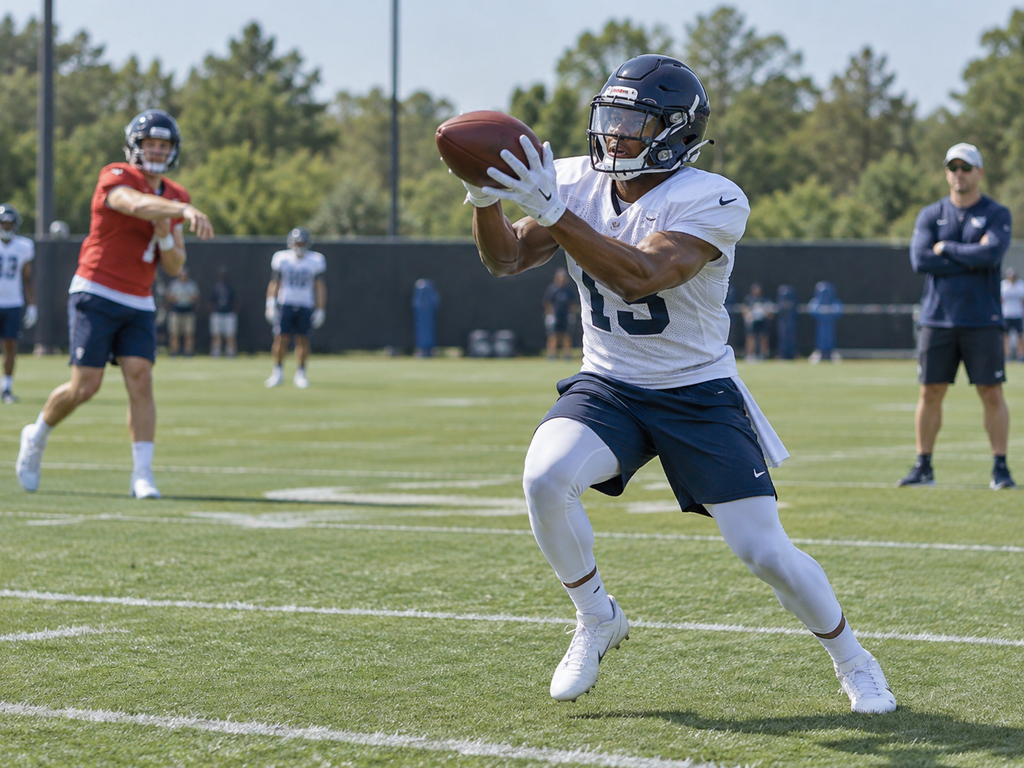
A wide receiver runs across the middle of the field as the quarterback releases a pass. The ball arrives slightly ahead of the receiver, forcing a small adjustment while running.
The receiver reaches forward, gets both hands on the football and briefly appears to secure it. But before completing the catch, the ball slips through the fingers and falls to the ground.
The receiver was in the right place. The route was timed well, and the throw was catchable. The problem was finishing the reception.
Situations like this show why catching is a skill that requires deliberate practice rather than simply repeating passing drills.
Learning to improve football catching skills involves developing reliable hand positioning, tracking the ball throughout its flight, adjusting to different throws and securing possession before transitioning into the next movement.
Catching consistently is not just about having strong hands. It requires coordination between the eyes, hands, body and feet.
A player who catches accurately while standing still may struggle when accelerating across the field or receiving a pass at an unfamiliar angle.
This guide explains practical techniques and training methods that help developing receivers become more consistent. It focuses on individual receiving mechanics and controlled practice rather than advanced contested-catch situations or complicated defensive adjustments.
What Makes a Reliable Football Catch?
A reliable catch involves several actions occurring in the correct sequence.
The receiver must identify the incoming ball, position the body appropriately, place the hands to receive it and establish control.
These actions often happen quickly, particularly when the receiver is moving.
Seeing the Football
The receiver should visually track the football as it approaches.
This helps the player judge the ball’s speed, direction and arrival point.
Losing sight of the ball can make even a routine catch difficult.
Positioning the Hands
The hands must be ready to receive the football rather than react at the last moment.
Appropriate hand positioning depends on the height and angle of the incoming pass.
Controlling the Ball
Contacting the football is not the same as securing it.
The receiver must establish control and prevent the ball from slipping away.
Completing the Reception
A receiver should understand the rules for completing a catch in the applicable league.
Under NFL rules, a completed catch generally requires control, the necessary inbounds contact and satisfying the requirements for performing an act common to the game or maintaining control long enough to do so.
The rules include details and exceptions, particularly near boundaries and when a player goes to the ground.
Training should emphasize establishing control and maintaining possession rather than assuming that touching the ball with both hands completes a catch.
Use Proper Hand Positioning
Hand positioning is one of the first technical areas to develop.
A football has an elongated shape, and its orientation can change as it travels.
The receiver should learn to present the hands appropriately for the incoming pass.
Catching Passes Above the Waist
For many passes arriving near chest height or above, receivers can use a hands-first catching position.
The thumbs are generally positioned closer together, with the fingers spread naturally around the approaching ball.
Coaches sometimes call this a diamond or triangle hand position.
The exact shape should remain comfortable rather than forcing the hands into a rigid formation.
The goal is to receive the ball with the hands rather than allowing it to strike the chest before attempting to control it.
Catching Passes Below the Waist
For low passes, the hand position often changes.
The receiver may turn the hands so the little fingers are closer together and the palms are oriented to receive the ball from below.
This allows the hands to form a more suitable receiving surface for low throws.
However, receivers should adapt to the actual ball angle instead of relying on one fixed hand position.
Keep the Fingers Relaxed
Excessive tension can make catching movements less natural.
Spread the fingers comfortably and prepare to cushion the incoming football.
As the ball arrives, the hands and arms should work together to absorb its momentum.
The receiver should avoid stiff, uncontrolled contact that causes the ball to bounce away.
Catch the Football With Your Hands
Developing receivers sometimes rely too heavily on trapping the football against their bodies.
A body catch can be appropriate in certain situations, particularly when protecting control of a difficult pass.
However, practicing hands-first catching helps expand the receiver’s ability to handle different ball locations.
Why Hands-First Technique Matters
A pass may arrive slightly outside the receiver’s body.
The player might need to reach forward, upward or toward one side.
A receiver who can control the football with the hands has more flexibility than one who depends exclusively on the ball reaching the chest.
Avoid Letting the Ball Hit Your Body First
Imagine a pass arriving at chest level.
The receiver waits until the football contacts the chest before attempting to secure it.
The impact may cause the ball to bounce away.
A better training objective is to meet the ball with the hands when the pass and situation allow.
After establishing control, bring the ball into a secure carrying position.
Understand When Body Position Helps
The receiver’s body can still support the catch.
For example, after catching a ball near the chest, the player may use the torso to help secure possession.
The key is establishing control rather than allowing an uncontrolled rebound.
Improve Your Ability to Track the Football
Ball tracking involves following the football’s flight and judging where it will arrive.
This skill becomes especially important when the ball travels farther or follows a higher trajectory.
Watch the Ball From Release to Arrival
During practice, begin observing the football as it leaves the thrower’s hand.
Follow its movement rather than looking away to anticipate the next action.
This provides information about the throw’s speed, direction and trajectory.
Judge the Arrival Point
A receiver may need to adjust speed or position to meet the football.
For example, a pass traveling slightly ahead of the receiver may require continued acceleration.
A pass thrown behind the receiver may require slowing or adjusting the upper body.
These decisions should occur early enough for the receiver to maintain balance.
Avoid Reaching Too Early
Some developing receivers extend their arms long before the ball arrives.
Holding the arms out unnecessarily can interfere with running mechanics and make the catch less coordinated.
Instead, track the ball and prepare the hands as the reception approaches.
The timing of the reach depends on the trajectory and catching situation.
Practice Different Throwing Arcs
A short, direct pass provides a different visual challenge from a high, looping throw.
Receivers should practice tracking both.
Gradually increase variation after becoming comfortable with simple throws.
The goal is to improve adaptability rather than memorize one predictable ball path.
Improve Eye-Hand Coordination
Eye-hand coordination is the ability to use visual information to guide hand movement.
Catching requires the eyes and hands to work together accurately.
Begin With Predictable Throws
Start with short passes from a partner.
Use a comfortable distance and consistent throwing speed.
Focus on watching the football into the hands and establishing control.
Avoid increasing the difficulty until the technique becomes repeatable.
Introduce Changes in Ball Location
Once basic catches become reliable, ask a partner to vary the throw slightly.
The ball might arrive at chest height, near one shoulder or slightly lower.
The receiver should adjust hand position and body alignment while remaining balanced.
Avoid intentionally throwing dangerously high, low or beyond the receiver’s safe reach.
Add Movement Gradually
Stationary catches establish the foundation.
Next, introduce walking receptions, light jogging and eventually controlled running.
The receiver should maintain visual tracking while coordinating the feet and hands.
Increasing speed too quickly may cause technical errors to become habitual.
Learn to Catch While Moving
Catching while running requires more coordination than catching while standing still.
The receiver must manage body movement while tracking the incoming football.
Catching a Pass While Running Forward
Imagine a receiver moving downfield with the quarterback delivering a pass slightly ahead.
The receiver must maintain enough speed to reach the ball’s arrival point.
Looking back too early or making abrupt movements may reduce running efficiency.
The receiver should locate the football at the appropriate moment, adjust smoothly and complete the catch without unnecessary changes in direction.
Catching Across the Field
Crossing routes create a different challenge because the receiver is moving sideways relative to the quarterback.
The player must track the ball while continuing across the field.
Practice with a partner by jogging along a marked path while receiving a short pass.
Begin at moderate speed before progressing.
Catching After a Directional Change
Some routes require a receiver to change direction shortly before the pass arrives.
The player may still be regaining balance when the football reaches the catching area.
This makes efficient footwork and coordinated hand positioning important.
Practice a simple directional change, establish balance and receive a controlled pass.
The emphasis should remain on completing the reception rather than developing advanced route-running techniques.
Adjust to High, Low and Off-Target Passes
Quarterbacks do not deliver every pass to the receiver’s preferred catching position.
Developing receivers benefit from practicing reasonable adjustments.
High Passes
A high pass may require the receiver to extend upward.
The player should judge whether the football can be reached safely.
When appropriate, extend the hands toward the ball while maintaining body control.
Avoid uncontrolled jumping or dangerous contact situations during practice.
Low Passes
A low pass may require bending through the knees and hips while positioning the hands beneath the ball.
The receiver should try to maintain balance rather than folding awkwardly at the waist.
Practice low catches using controlled throws that remain safely within reach.
Passes Behind the Receiver
A ball thrown slightly behind the receiver may require slowing down or rotating the upper body.
The receiver should avoid twisting so abruptly that balance is lost.
Begin with small adjustments before practicing more demanding variations.
Passes Outside the Body
Some throws require reaching toward the left or right.
The receiver should move the hands toward the football while maintaining control of the body.
Training both directions helps reduce reliance on a preferred side.
Secure the Football After the Catch
Catching does not end when the football reaches the hands.
The receiver must secure possession before moving into the next action.
Bring the Ball Into a Secure Position
After establishing control, the receiver should move the football into an appropriate carrying position.
Common ball-security coaching emphasizes keeping the ball close to the body with firm control.
The precise carrying technique should follow the team’s coaching system.
Avoid Rushing Into the Next Movement
A receiver may begin turning upfield before establishing control.
This can cause the ball to slip away.
During drills, emphasize completing the catch before transitioning into a running movement.
As the sequence becomes more reliable, practice making the transition more fluid.
Protect the Ball During Movement
The receiver should maintain possession while changing direction or preparing for contact.
Actual ball-security technique during contested situations should be practiced under qualified supervision.
This guide focuses on clean receptions and controlled movements, not contact-based catching techniques.
Common Football Catching Mistakes
Recognizing mistakes makes practice more productive.
Looking Away Before Securing the Ball
A receiver begins watching the next running lane before completing the catch.
Correction: Track the ball through its arrival and establish possession before shifting attention.
Catching With Stiff Hands
Rigid hands can cause the football to rebound.
Correction: Use a controlled receiving motion that helps absorb the ball’s momentum.
Relying Only on Body Catches
A player struggles whenever the ball arrives outside the chest.
Correction: Practice hands-first receptions from several safe catching positions.
Using the Wrong Hand Position
A player attempts to receive a low throw with the same orientation used for a high pass.
Correction: Adapt hand positioning to the ball’s height and angle.
Reaching Too Early
The receiver extends both arms long before the ball arrives.
Correction: Improve visual tracking and coordinate the reach with the arrival of the football.
Practicing Only Stationary Catches
A receiver performs well while standing still but struggles during running routes.
Correction: Gradually introduce movement after developing consistent stationary technique.
Increasing Difficulty Too Quickly
A player practices difficult one-handed catches before mastering routine receptions.
Correction: Prioritize repeatable fundamentals and increase difficulty progressively.
Seven Practical Drills to Improve Football Catching Skills
These exercises develop different aspects of receiving. Most require only a football, a partner and a safe practice area.
Drill 1: Stationary Hand-Catching Drill
Purpose: Improve hand positioning and clean receptions.
Stand several yards from a partner.
Have the partner throw comfortable chest-level passes.
Focus on receiving the ball with the hands, cushioning the catch and establishing control.
Complete 10 repetitions before reviewing the technique.
Once consistent, gradually vary the throwing location.
Drill 2: High-and-Low Catch Drill
Purpose: Practice adapting hand position.
A partner alternates between comfortably high and low passes.
The receiver adjusts the hands and body to match the throw.
Use a controlled pace and avoid throws that force awkward or unsafe reaches.
The goal is accuracy of movement rather than speed.
Drill 3: Left-and-Right Adjustment Drill
Purpose: Improve catches outside the body’s centerline.
A partner throws the football slightly to either side.
The receiver adjusts the hands and upper body while remaining balanced.
Begin with small variations.
Increase the range only when the receiver can maintain control.
Drill 4: Walking Catch Drill
Purpose: Introduce coordination between movement and receiving.
The receiver walks along a marked path.
A partner delivers short passes while the receiver continues moving.
Focus on tracking the ball, coordinating the hands and completing the catch.
Progress to light jogging when consistent.
Drill 5: Crossing Catch Drill
Purpose: Improve catches while moving laterally.
Mark a short route across an open field.
The receiver jogs along the path while a quarterback or partner throws a controlled pass.
The receiver maintains the path, tracks the ball and establishes control.
Repeat in both directions.
Drill 6: Over-the-Shoulder Tracking Drill
Purpose: Develop awareness of deeper passes.
A receiver begins with a controlled run downfield.
A partner delivers a comfortable pass along the receiver’s path.
The receiver locates the football, adjusts speed if needed and attempts the catch.
Begin with short distances and moderate throwing arcs.
A trained coach should oversee progression to more demanding deep-ball repetitions.
Drill 7: Catch-and-Secure Drill
Purpose: Improve possession after the reception.
A partner delivers a short pass.
The receiver catches the football, brings it into a secure carrying position and takes several controlled steps.
Pause and confirm possession before beginning the next repetition.
Gradually introduce light directional changes without contact.
Build a Progressive Catching Practice Routine
A productive session should introduce difficulty in a controlled sequence.
The following is an example of a focused catching workout.
| Practice Phase | Activity | Suggested Time |
|---|---|---|
| Warm-up | Dynamic movement and easy catches | 5 minutes |
| Fundamentals | Stationary hands-first receptions | 5–10 minutes |
| Ball adjustment | High, low and side catches | 10 minutes |
| Moving catches | Walking, jogging and crossing passes | 10 minutes |
| Ball tracking | Controlled deeper throws | 5–10 minutes |
| Review | Feedback and technique corrections | 5 minutes |
Practice volume should reflect the player’s age, experience and conditioning.
Rest when technique deteriorates or fatigue interferes with coordination.
The objective is consistent execution, not completing the maximum possible number of repetitions.
Measure Your Catching Improvement
Tracking progress helps determine whether training is producing better consistency.
However, practice statistics should be interpreted carefully.
A receiver completing ten easy stationary catches is not necessarily more advanced than one completing eight difficult moving catches.
Different drills test different abilities.
Track Catches by Difficulty
Record results separately for stationary, moving and adjustment catches.
For example:
| Drill type | Successful catches | Attempts |
|---|---|---|
| Stationary chest passes | 18 | 20 |
| Moving crossing passes | 14 | 20 |
| Low-pass adjustments | 12 | 20 |
| Deep-ball tracking | 11 | 20 |
These hypothetical numbers demonstrate how separate categories reveal different weaknesses.
The receiver may already have strong stationary technique but need more practice adjusting to low throws.
Observe the Quality of the Catch
Completion count is only part of the evaluation.
Coaches and players can also observe:
- Whether the receiver watches the ball through arrival.
- Whether the hands are positioned appropriately.
- Whether the body remains balanced.
- Whether the ball is controlled cleanly.
- Whether the receiver transitions into ball security effectively.
Compare Similar Practice Conditions
To measure improvement fairly, compare drills using reasonably similar throwing distances, speeds and difficulty.
Changing every condition at once makes progress harder to interpret.
A player should look for consistent improvement across several sessions rather than one unusually good day.
How to Practice When You Don’t Have a Quarterback
Not every receiver has regular access to a quarterback or throwing partner.
Some catching fundamentals can still be developed individually.
Use Safe Self-Toss Exercises
A player can gently toss the football upward and practice receiving it cleanly.
Vary the catching height within a safe range.
Focus on hand positioning, visual tracking and control.
This is useful for basic coordination, although it does not reproduce the speed or spin of a quarterback’s pass.
Practice Ball Tracking
Toss the football upward at different comfortable angles.
Follow its flight and establish control.
Avoid attempting dangerous diving catches or throwing the ball into crowded areas.
Use a Rebound Surface Carefully
A suitable training rebounder can provide repeated catching opportunities.
However, not every wall or surface is appropriate for throwing a football.
Avoid hard rebounds at close range, particularly toward the face.
Use equipment intended for the exercise and follow its safety instructions.
Whenever possible, combine individual practice with partner throws to develop realistic receiving timing.
Develop Confidence Through Consistency
Catching confidence develops when players repeatedly experience successful, controlled receptions.
A receiver who struggles with routine passes may become tense when another throw arrives.
That tension can interfere with hand movement.
Instead of responding by practicing increasingly difficult catches, return to a manageable exercise.
Complete several clean repetitions and identify the specific technique that needs attention.
Then gradually increase the challenge.
Focus on the Process
Avoid evaluating every repetition only as a catch or drop.
A receiver may make a catch using poor technique.
Another player may perform the correct movement but fail to secure a difficult throw.
The objective is to develop repeatable mechanics that support long-term improvement.
Use Specific Feedback
General instructions such as “catch better” provide little guidance.
More useful feedback identifies a particular issue.
For example:
“You started looking upfield before securing the ball.”
Or:
“Your hands were too rigid when the pass arrived.”
Specific corrections help players understand what to change on the next repetition.
When Are You Ready for More Advanced Catching Skills?
Intermediate receivers should first become consistent with routine receptions under increasingly realistic practice conditions.
Useful signs of readiness include:
- Reliable hand positioning for different pass heights.
- Consistent visual tracking.
- Clean receptions while jogging and running.
- Controlled adjustment to moderately off-target throws.
- Secure possession after the catch.
- Ability to identify and correct recurring mistakes.
More advanced receiving work may include contested catches, high-point timing, sideline body control and catching through legal defensive contact.
These situations require additional coaching and appropriate safety precautions.
Developing strong fundamentals first makes later skill progression more effective.
Final Thoughts: Consistent Catching Comes From Repeatable Technique
Learning to improve football catching skills requires coordinated work between the eyes, hands, body and feet.
Reliable receivers track the football, use appropriate hand positioning and establish control before transitioning into the next movement.
They also develop the ability to handle different ball heights, angles and throwing speeds.
Start with routine hands-first catches and gradually introduce movement.
Practice receiving while crossing the field, adjusting to slightly off-target passes and securing possession after the catch.
Use feedback and simple performance records to identify the areas that need improvement.
The goal is not to make every reception spectacular.
It is to become dependable when the quarterback delivers a catchable football.
Explore more Intermediate American Football Guides to develop your receiving and movement skills, or visit the American Football Learning Path for structured lessons that build football fundamentals and practical playing ability.