
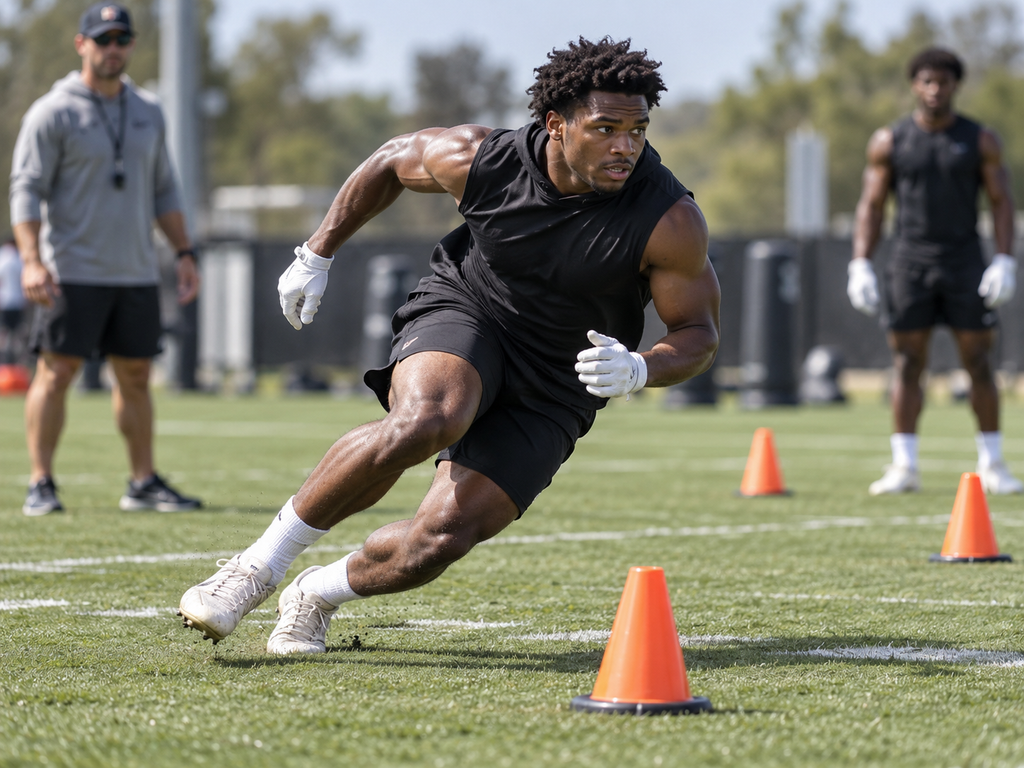
A running back receives a handoff and approaches an opening between two offensive linemen. A defender steps into the running lane, forcing the ball carrier to change direction.
Instead of continuing straight into the defender, the running back slows slightly, plants a foot and moves toward another opening.
A few yards away, a linebacker must react to the same movement. The defender changes direction, regains balance and accelerates toward the ball carrier.
Both players rely on footwork and agility, but they use those abilities differently.
The running back must control movement while carrying the football. The linebacker must react to another player’s actions without losing balance.
Learning to improve football footwork and agility helps players accelerate, stop, move laterally and change direction more efficiently during a game.
These skills are useful across nearly every position. Wide receivers need controlled movements when changing direction, defensive backs must react to opponents, and linemen benefit from efficient steps within their assignments.
However, being agile does not simply mean moving your feet as quickly as possible. Effective agility involves making the right movement at the right moment.
This guide explains how intermediate players can develop better balance, foot placement, acceleration and reactive movement through practical football training.
What Is Footwork in American Football?
Footwork refers to how a player positions and moves the feet to perform a football action.
It includes the placement, timing and direction of steps.
A player’s footwork influences balance, acceleration and the ability to respond when a play changes.
For example, a defensive back may need to move backward before turning and accelerating.
A running back may need to shorten steps before changing direction.
An offensive lineman may need to move laterally while maintaining a stable blocking position.
These movements are different, but each depends on controlled foot placement.
Why Footwork Matters
Poor footwork can make an athlete slower even when they have strong running ability.
A player who takes unnecessary steps during a change of direction may need more time to move toward the intended area.
A player who loses balance after planting a foot may struggle to accelerate again.
Effective footwork helps athletes use their existing strength and speed more efficiently.
Footwork Versus Foot Speed
Foot speed describes how quickly the feet move.
Footwork describes how those movements are organized.
A player can move the feet rapidly without making meaningful progress.
For example, taking several quick steps in place does not necessarily improve the ability to evade a defender.
The objective is controlled movement that supports football performance.
What Is Agility in Football?
Agility is the ability to change speed or direction rapidly in response to a stimulus while maintaining control.
That stimulus might be an opponent’s movement, a coach’s signal or the development of a play.
This distinguishes agility from a planned change-of-direction exercise.
Change of Direction
Change-of-direction ability involves accelerating, slowing and moving in a new direction.
When an athlete knows the movement pattern before beginning, the exercise primarily trains planned change of direction.
For example, running to a cone, cutting right and accelerating toward another cone is a planned drill.
It can still be valuable for developing movement technique.
Reactive Agility
Reactive agility adds an unpredictable decision.
Imagine a linebacker facing a ball carrier who may cut left or right.
The linebacker must recognize the movement and respond.
This requires perception, decision-making and physical movement.
A reactive drill might use a partner’s movement or a visual signal to determine the direction of the cut.
Why Both Matter
Planned exercises help players practice efficient mechanics.
Reactive exercises help players apply those mechanics to changing situations.
A complete training approach uses both rather than assuming that memorizing a fast cone pattern automatically improves every game reaction.
Build a Balanced Athletic Stance
Efficient footwork begins with a body position that allows controlled movement.
The exact stance depends on the position and assignment, but several principles apply broadly.
Maintain a Stable Base
The feet should provide enough separation for balance without making movement unnecessarily difficult.
A stance that is too narrow may reduce stability.
A stance that is excessively wide may interfere with quick steps.
Players should use the position taught for the movement they are performing.
Bend Through the Hips and Knees
A comfortable athletic position usually involves some bending at the hips and knees.
This helps prepare the body to accelerate or change direction.
The player should avoid collapsing the chest forward or forcing the knees into awkward positions.
Keep the Head and Torso Controlled
Large, uncontrolled upper-body movements can interfere with balance.
For example, leaning too far to one side before cutting may make the movement difficult to recover from.
The torso should move naturally with the intended direction while remaining coordinated with the lower body.
Avoid Staying Low All the Time
A lower stance can help prepare for some directional changes, but remaining excessively crouched during every movement may reduce running efficiency.
Players should learn to adjust posture according to the task.
Acceleration, sprinting and lateral defensive movement do not require identical body positions.
Improve Your First-Step Acceleration
The first few steps are important because many football plays require players to move rapidly from a relatively stationary position.
A running back may accelerate after receiving a handoff.
A receiver may begin moving when the ball is snapped.
A defender may react to the first meaningful movement of an opponent.
Push Into the Intended Direction
Acceleration begins by applying force against the ground.
The player should move the body in the intended direction rather than taking unnecessary preparation steps.
For a forward start, an appropriate forward body angle helps support acceleration.
The exact technique depends on the player’s stance and role.
Avoid Standing Upright Too Early
Some players become fully upright almost immediately after starting.
This may make early acceleration less efficient.
Players should allow the body position to rise naturally as speed increases rather than forcing an exaggerated lean or staying low for too long.
Coordinate the Arms
Arm movement contributes to running coordination.
During acceleration, the arms should move in a controlled pattern appropriate for the task.
Avoid excessive sideways swinging that interferes with balance.
Practice Short Accelerations
A simple exercise is to accelerate over five to ten yards from a comfortable starting stance.
Focus on purposeful first steps and controlled movement.
Walk back between repetitions and allow enough recovery to maintain quality.
A small number of technically sound accelerations is more useful than performing many rushed repetitions.
Learn to Decelerate Before Changing Direction
Many football movements require slowing before accelerating in another direction.
Players sometimes focus entirely on the cut and overlook the importance of deceleration.
Why Stopping Ability Matters
Imagine a receiver running toward a marked break point.
If the player cannot reduce speed under control, the body may continue moving beyond the intended direction.
The athlete then needs additional steps to recover.
Effective deceleration helps prepare the body for the next movement.
Use Progressive Braking Steps
As a player approaches a planned change of direction, shortening steps can help reduce speed.
The exact pattern depends on approach speed and intended cutting angle.
The athlete should avoid reaching too far forward with one leg or attempting an abrupt stop that exceeds their current ability.
Maintain Balance During Braking
The hips and knees help absorb the forces involved in slowing down.
The player should maintain control of the trunk and avoid excessive knee collapse or awkward twisting.
A coach can provide feedback on body position.
Practice Deceleration Separately
Begin with a short, moderate-speed run.
Decelerate gradually within a marked area.
Progress to faster approaches only when stopping remains controlled.
This establishes a foundation before introducing sharper cuts.
Improve Lateral Movement
Lateral movement is important when players need to move sideways without immediately turning into a full sprint.
Defensive backs, linebackers and offensive linemen often use different forms of lateral footwork.
Practice the Lateral Shuffle
Begin in an athletic position.
Move sideways using controlled steps.
Avoid allowing the feet to collide or crossing them during a drill intended to practice shuffling.
The purpose is to maintain balance while moving in either direction.
Keep the Movement Smooth
Some athletes bounce vertically during lateral exercises.
Excessive upward movement can waste energy and interfere with quick changes of direction.
Focus on moving across the ground efficiently.
Understand When to Turn and Run
Shuffling is useful over limited distances.
However, a player may need to turn and accelerate when the required movement becomes longer or faster.
For example, a defensive back may initially move laterally before opening the hips and running.
The transition should follow the specific position technique taught by the coach.
Improve Your Ability to Cut and Change Direction
Cutting involves redirecting movement from one path to another.
Different angles require different amounts of braking and force.
A gentle directional change differs from a sharp cut after a fast approach.
Prepare for the Cut
A player should recognize the intended direction and organize the body before planting.
In a planned drill, the athlete knows the direction.
In a reactive drill, the athlete must first interpret the stimulus.
Use an Appropriate Plant
The planting foot helps redirect force into the new movement.
Its position depends on the cutting angle and approach speed.
Avoid reaching the foot excessively far from the body or forcing a rigid movement pattern.
For many directional changes, controlled knee and hip alignment helps maintain stability.
Accelerate Out of the Cut
A successful cut is not complete when the athlete changes direction.
The player must regain acceleration toward the next objective.
Practice the plant and the first few steps afterward as one coordinated movement.
Avoid Cutting at Maximum Speed Too Soon
High-speed cuts place substantial demands on muscles, tendons and joints.
Begin with manageable speeds and gradually increase intensity.
Players who are new to agility training should prioritize technique before competitive reaction drills.
Improve Balance and Single-Leg Control
Football players frequently support most of their body weight on one leg during running, cutting and directional transitions.
Single-leg strength and balance can support more controlled movement.
Single-Leg Balance
Stand on one leg with a slight bend in the supporting knee.
Maintain a stable position for a short period.
Repeat on the opposite leg.
The goal is controlled balance rather than holding an awkward posture for as long as possible.
Controlled Single-Leg Reach
Stand on one leg and reach the other foot lightly toward a nearby marker.
Return to the starting position.
Keep the movement within a comfortable range.
This can help develop coordination while the supporting leg maintains stability.
Lateral Step-and-Hold
Step sideways and establish a balanced position on the landing leg.
Pause briefly before returning.
Begin with a small distance.
Progress only when the landing remains controlled.
These exercises can prepare athletes for more demanding directional movements.
How Footwork and Agility Differ by Football Position
The most useful movement patterns depend on what the player is required to do during a game.
| Position | Important movement demands |
|---|---|
| Running back | Accelerating through openings, cutting and redirecting movement |
| Wide receiver | Controlled directional changes and acceleration after breaks |
| Defensive back | Backpedaling, transitions, lateral movement and reactive pursuit |
| Linebacker | Short accelerations, lateral movement and reacting to ball carriers |
| Quarterback | Balanced pocket movements and controlled repositioning |
| Offensive lineman | Short, powerful steps and lateral positioning |
| Defensive lineman | Explosive starts and coordinated movements around blockers |
A single agility drill cannot develop every position equally.
For example, a receiver may benefit from directional changes after forward acceleration.
A defensive back may need additional practice transitioning from backward movement to forward pursuit.
An offensive lineman usually needs different movement distances and body positions.
Players should include drills that reflect their actual game responsibilities.
Seven Practical Football Footwork and Agility Drills
The following drills progress from basic control to more reactive movement.
Use a flat, safe training surface with adequate space.
Drill 1: Five-Yard Acceleration
Purpose: Improve first-step efficiency.
Set two markers five yards apart.
Begin in an appropriate athletic stance.
Accelerate toward the second marker.
Slow down gradually after passing it.
Walk back and recover before repeating.
Focus: Strong first steps, coordinated arms and controlled acceleration.
Drill 2: Lateral Shuffle Between Cones
Purpose: Develop lateral movement and balance.
Place two cones approximately three to five yards apart.
Begin facing forward.
Shuffle toward one cone and then return.
Maintain controlled foot placement without unnecessary bouncing.
Focus: Smooth lateral movement and consistent body control.
Drill 3: Sprint-to-Stop
Purpose: Improve deceleration.
Mark a short acceleration area followed by a stopping zone.
Accelerate at a manageable speed.
Reduce speed and stop within the designated zone.
As control improves, gradually increase approach speed.
Focus: Balanced braking without awkward steps or uncontrolled forward movement.
Drill 4: Three-Cone Change of Direction
Purpose: Practice acceleration and directional changes.
Arrange three cones in an L-shaped pattern with suitable spacing.
Move from the first cone toward the second.
Change direction and continue toward the third.
Begin with a planned path.
Focus: Controlled cuts, purposeful foot placement and acceleration after the turn.
The L-drill has many versions. Use one appropriate for the athlete’s experience.
Drill 5: Backpedal-to-Sprint Transition
Purpose: Develop defensive movement transitions.
Begin in a comfortable defensive stance.
Backpedal for a short distance under control.
At a marked point, turn and accelerate forward.
Practice turning in both directions.
Focus: Smooth transition without crossing into an unstable position.
Drill 6: Mirror Drill
Purpose: Improve reactive agility.
Two athletes face each other several yards apart.
One acts as the leader and moves laterally within a defined area.
The second athlete mirrors the movement.
Keep the drill brief and controlled.
Focus: Reading a partner’s movement, reacting appropriately and maintaining balance.
Begin without contact and avoid sudden changes that exceed the participants’ current ability.
Drill 7: Reactive Cone Drill
Purpose: Combine movement mechanics with decision-making.
Place three cones in different directions from a central starting point.
A coach or partner provides a visual signal indicating which cone to approach.
The athlete reacts, moves toward the designated cone and returns under control.
Vary the signals so the direction is not known in advance.
Focus: Accurate recognition and efficient movement rather than guessing.
Do Agility Ladders Improve Football Performance?
Agility ladders are popular because they allow athletes to practice organized foot-placement patterns.
They can be useful for coordination, rhythm and controlled stepping.
However, completing a ladder pattern quickly does not automatically improve reactive agility during a game.
What Ladders Can Develop
A ladder exercise can help athletes practice:
- Coordinated stepping.
- Movement rhythm.
- Awareness of foot placement.
- Controlled transitions between predefined patterns.
These are useful components of movement training.
What Ladders Do Not Fully Reproduce
Football agility involves responding to opponents, accelerating into open space and changing direction under unpredictable conditions.
A ladder typically provides a known pattern.
Therefore, ladder drills should supplement rather than replace sprinting, deceleration, change-of-direction and reactive training.
The best training program connects controlled movement exercises to realistic football demands.
Combine Speed Training With Agility Work
Speed and agility are related but should not be treated as identical.
Straight-line speed involves accelerating and maintaining running velocity.
Agility involves changing movement in response to a stimulus.
A player may sprint quickly but struggle to stop or redirect efficiently.
Another player may change direction well but lack strong acceleration.
Train Each Ability Deliberately
A complete movement program can include:
- Short accelerations.
- Controlled deceleration.
- Planned changes of direction.
- Lateral movement.
- Reactive agility exercises.
The training should reflect the player’s position and current needs.
Prioritize Quality Over Fatigue
High-quality speed and agility practice usually requires adequate recovery.
Repeatedly performing demanding drills while exhausted can reduce movement precision.
Conditioning and agility training serve different purposes.
An athlete should not assume that becoming extremely tired during a drill means the drill improved agility.
Progress One Variable at a Time
Increase difficulty gradually.
For example, first improve technique at moderate speed.
Then introduce faster approaches.
After movement remains controlled, add unpredictable signals or an opponent’s movement.
Changing speed, direction, decision complexity and resistance simultaneously makes technique harder to evaluate.
Common Footwork and Agility Mistakes
Taking Too Many Steps
A player uses several unnecessary steps before changing direction.
Improvement: Practice efficient stopping and redirection rather than rapid foot movement alone.
Standing Too Upright During a Cut
The athlete struggles to redirect the body under control.
Improvement: Learn appropriate hip and knee movement during deceleration and planting.
Leaning Excessively
The upper body moves far ahead of the feet, causing a loss of balance.
Improvement: Maintain coordinated posture and progress cutting speed gradually.
Watching the Ground Constantly
The athlete focuses only on the feet and misses information about the surrounding movement.
Improvement: After learning the pattern, practice maintaining awareness of the environment.
Using Only Predetermined Drills
The athlete becomes quick at a familiar cone pattern but struggles to react during a game.
Improvement: Add drills with unpredictable, meaningful visual cues.
Ignoring Position Requirements
A player trains only general footwork exercises without practicing movements used in their position.
Improvement: Include role-specific transitions and movement distances.
Training Through Poor Technique
A tired player continues performing sharp cuts despite losing balance and control.
Improvement: Rest, reduce intensity or end the drill when movement quality deteriorates.
Build a Weekly Football Agility Training Routine
Intermediate players can benefit from two or three focused footwork and agility sessions per week, depending on their team practices, conditioning and recovery.
The following is an illustrative schedule rather than a universal prescription.
| Session | Focus | Main Activities |
|---|---|---|
| Session 1 | Acceleration and deceleration | Short starts, sprint-to-stop, controlled cutting |
| Session 2 | Lateral movement and transitions | Shuffle drills, backpedal-to-sprint, single-leg control |
| Session 3 | Reactive agility | Mirror drill, reactive cones, position-specific movement |
Allow adequate recovery between demanding sessions.
Players already participating in intense team practices may need less additional training.
Training load should be adjusted with the guidance of a qualified coach.
How to Measure Footwork and Agility Improvement
Progress should be evaluated using more than one timed cone drill.
A faster time is useful only when the athlete maintains proper movement quality.
Compare Similar Conditions
Use the same distances, surface and drill instructions when comparing results.
For example, time a short planned change-of-direction drill over several sessions.
Record whether the athlete completed the movement without slipping, losing balance or missing the intended route.
Track Movement Quality
A coach can observe:
- Efficiency of the first steps.
- Ability to slow under control.
- Balance during cuts.
- Smoothness of directional transitions.
- Acceleration after changing direction.
- Accuracy of responses during reactive drills.
Separate Planned and Reactive Performance
An athlete might improve in a predetermined cone drill without becoming faster at responding to an opponent.
Track these abilities separately.
For reactive agility, include response accuracy as well as movement efficiency.
A player who guesses the direction before the signal may produce a fast time without demonstrating better decision-making.
Use Video Review to Improve Movement Technique
Recording short drill repetitions can help athletes identify movements that are difficult to notice in real time.
For example, a player might believe a cut is efficient but discover that several unnecessary steps occur before the plant.
Video can also reveal excessive torso movement or inconsistent braking.
Review One Skill at a Time
Choose a specific question before watching.
For example:
“Did I slow down under control before changing direction?”
Avoid attempting to correct every technical detail simultaneously.
Compare Similar Repetitions
Record the same drill at a consistent camera angle.
Compare the athlete’s movement across several sessions.
Look for more efficient steps, improved balance and better control.
Use Qualified Feedback
Video does not always reveal the cause of a technical issue.
A coach or qualified strength-and-conditioning professional can help identify appropriate corrections.
This is particularly important when a player repeatedly experiences pain or difficulty controlling a movement.
Apply Agility Skills to Real Football Situations
Agility training becomes more valuable when movement skills transfer into game-related actions.
Running Back Example
A running back approaches a running lane during a controlled team drill.
A defender moves into the original path.
The running back recognizes the movement and redirects toward the available space.
The goal is not to perform an elaborate cut.
It is to make an efficient football decision while maintaining balance and ball security.
Defensive Back Example
A defensive back begins in a backpedal.
A receiver accelerates downfield.
The defender transitions into a forward running position according to the coverage assignment.
Efficient footwork helps the defender respond without wasting unnecessary movement.
Linebacker Example
A linebacker reads a developing running play.
The ball carrier changes direction.
The linebacker must adjust pursuit while maintaining the assigned responsibility.
Reactive movement is important because the player’s path depends on the offense.
Offensive Lineman Example
An offensive lineman faces a defender who moves laterally after the snap.
The blocker uses coached footwork to maintain appropriate positioning.
The movement may be short, but balance and timing remain essential.
These examples show why football agility is not a single universal movement pattern.
Final Thoughts: Train Movement That Matters
Improving football footwork and agility requires more than performing fast steps through cones or ladders.
Effective movement depends on balance, acceleration, deceleration, controlled cutting and the ability to react to changing situations.
Intermediate players should develop reliable movement mechanics before adding demanding speed or unpredictable defensive reactions.
Practice short accelerations, lateral shuffles, controlled stops and directional transitions. Then introduce reactive drills that require meaningful decisions.
Choose exercises that reflect the movement demands of your football position, and evaluate both speed and control.
The objective is not simply to move faster during training.
It is to become more efficient, balanced and responsive when a football play changes direction.
Continue exploring our Intermediate American Football Guides to develop position-specific skills, or visit the American Football Learning Path for structured football instruction and progressive training.