
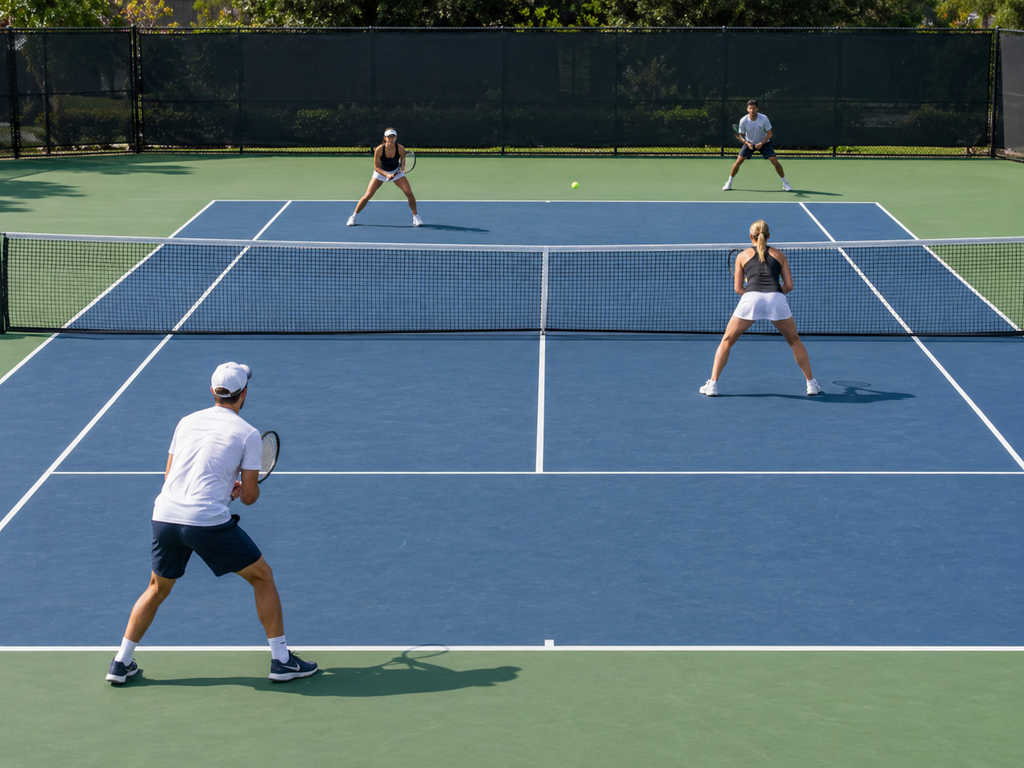
Playing doubles tennis requires more than combining the skills of two singles players. With four players sharing the court, successful teams must coordinate their positioning, communicate clearly, and understand how each partner’s decisions affect the next shot. Even players with reliable groundstrokes and volleys can struggle when they leave gaps, hesitate over shared balls, or move independently of their partner.
Developing an effective doubles tennis strategy helps intermediate players work together to cover the court, create attacking opportunities, and reduce avoidable errors. By understanding basic formations, partner responsibilities, and practical communication habits, you can become a more dependable doubles partner and make better decisions during matches.
How Doubles Tennis Strategy Differs From Singles
In singles tennis, one player is responsible for covering the court and choosing the best position for the opponent’s next shot. In doubles, those responsibilities are shared between two teammates.
The doubles court is wider than the singles court because the doubles alleys are included during rallies. However, having a partner means that you do not need to cover every available angle alone.
Effective doubles play depends on coordinating that shared coverage.
Three principles are especially important:
- Positioning: Each partner should occupy a useful area without leaving unnecessary openings.
- Communication: Players need clear signals and consistent expectations about who will take particular balls.
- Teamwork: Partners should respond to the same rally situation rather than make conflicting decisions.
For example, when one player moves forward to intercept a ball, their partner may need to adjust position to cover the space left behind.
A strong doubles team functions as a coordinated unit rather than two players competing independently on the same side.
Understand the Basic Doubles Formations
Intermediate players should become comfortable with the two most common positional arrangements: one player at the baseline with one at the net, and both players at the net.
There are also situations when both players defend from the baseline.
One Up, One Back
In the one-up, one-back formation, one partner plays near the baseline while the other plays closer to the net.
This is common during serving and returning situations.
The baseline player handles many deeper groundstrokes, while the net player looks for opportunities to intercept manageable balls.
A major advantage is that each player has a relatively clear role.
However, the formation can create gaps if the players become too far apart or fail to adjust their positions when the ball changes direction.
The net player should stay attentive rather than assume the baseline partner will handle the entire rally.
Both Players at the Net
When both partners move forward into effective volleying positions, they can often apply greater pressure by intercepting shots earlier.
This formation can make it difficult for opponents to maintain comfortable baseline rallies.
However, moving both players forward creates vulnerability to well-placed lobs and passing shots.
Both players need to recognize when advancing is appropriate and maintain suitable spacing.
For intermediate teams, moving forward should be a response to a useful opportunity rather than an automatic requirement.
Both Players at the Baseline
A team may temporarily position both players near the baseline when defending against aggressive opponents or returning difficult shots.
This arrangement provides greater coverage of deep balls and can allow the team to reset a point.
However, it may also give the opposing net player more opportunities to intercept shots.
When possible, look for a controlled opportunity to improve your position rather than remaining defensive throughout the rally.
Where to Stand When Your Team Is Serving
A conventional doubles serving formation places the server behind the baseline and the server’s partner near the net.
The server begins on the appropriate side of the center mark and serves diagonally into the correct service box.
The net player’s job is to cover a useful forward position and prepare for an opportunity to intercept the return.
The Server’s Position
The server must begin behind the baseline, within the legal serving area, and avoid foot faults.
After serving, the player should prepare for the return and recover according to the likely direction of the next ball.
Moving immediately toward the net can be useful after a suitable serve, but it is not required for every point.
If the return is likely to be difficult, remaining behind the baseline may provide better control.
The Server’s Partner
The server’s partner usually begins in a position that allows them to defend their alley while remaining close enough to the center to challenge appropriate returns.
Standing too close to the doubles alley can leave a large opening through the middle.
Standing too far toward the middle may make a down-the-line return difficult to cover.
The correct position depends on the serve placement, the returner’s location, and the team’s preferred coverage.
The net player should remain alert and use the returner’s preparation to anticipate where the ball may travel.
Where to Stand When Your Team Is Returning
The receiving team typically begins with one player positioned to return serve and the other standing near the service line or another suitable forward position.
The exact arrangement depends on the server’s ability, the receiving team’s confidence, and the likelihood of a strong return.
The Returner’s Position
The returner should choose a position that allows enough time to recognize the serve and make controlled contact.
Against a faster serve, standing farther behind the baseline may provide additional reaction time.
Against a slower or predictable serve, stepping forward may allow a more aggressive return.
Your objective is to make a reliable return toward a useful target without exposing yourself to unnecessary risk.
The Returner’s Partner
The returner’s partner must remain aware of the opposing net player and the likely return direction.
Their position should allow them to react to a possible volley, move toward the net when appropriate, or retreat if the rally becomes defensive.
Unlike the server’s partner, the returner’s partner must not stand inside the service box into which the serve is directed if that would obstruct the returner. A position near the service line on the returner’s partner’s side is a common starting arrangement.
Both partners should agree on the intended return before the point when practical.
How to Cover the Middle and the Doubles Alleys
One of the most common challenges in doubles is deciding which player should take a ball traveling between teammates.
Without clear responsibilities, both players may hesitate or both may attempt the same shot.
Why the Middle Is Important
The middle of the court can be an effective target because it creates uncertainty between partners.
Even when the ball is not especially powerful, poor communication can cause a team to leave it untouched.
To avoid confusion, discuss who usually takes particular middle balls in your preferred formation.
For example, when both players are at the net, the player with the stronger forehand or more comfortable volley may handle certain middle shots, provided they can reach them without creating unnecessary collisions.
However, one player should not claim every middle ball regardless of position.
The teammate who has the easier, safer contact should usually take responsibility.
When to Protect the Alley
The doubles alley becomes important when an opponent has an opportunity to hit down the line.
Net players should be aware of that possibility, especially when the opposing player has a comfortable contact position.
However, standing permanently beside the alley sacrifices coverage of the middle.
A balanced position allows you to protect realistic down-the-line shots while remaining available to intercept balls through the central court.
Move With Your Partner
When both players are at the net, coordinated lateral movement helps reduce gaps.
If the ball is directed toward one side of the opponents’ court, both partners may adjust toward that side while maintaining useful spacing.
The goal is to cover the most likely replies together, rather than having one player move while the other remains fixed.
How to Communicate Effectively With Your Doubles Partner
Communication is one of the simplest ways to improve teamwork without changing your stroke technique.
Good communication should be brief, timely, and understood by both players.
Call the Ball Early
Use simple calls such as:
- Mine: You intend to play the ball.
- Yours: Your partner has the better opportunity.
- Switch: Your partner should change coverage after a positional exchange.
- Leave: You believe the ball is traveling out, provided your partner can safely avoid playing it.
Calls should happen early enough to help the other player react.
Late or contradictory instructions can create confusion.
Discuss Responsibilities Between Points
You do not need a complicated conversation before every serve.
Briefly agree on important details such as the intended serve target, whether the net player plans to move, or who will cover an anticipated return.
Simple expectations can prevent hesitation during the point.
Communicate After Mistakes
Doubles matches inevitably include missed volleys, miscommunication, and incorrect positioning decisions.
Rather than assigning blame, focus on what should change for the next point.
For example, if a ball repeatedly passes between partners, agree on who will take that type of shot next time.
Constructive communication helps maintain confidence and prevents the same problem from recurring.
How to Use the Net Effectively in Doubles
The net is an important area in doubles because players positioned forward can intercept shots before they travel deep into the court.
However, effective net play requires patience and appropriate positioning.
Stay Ready for the Opponent’s Shot
A net player should maintain an athletic stance with the racket prepared.
Watch the opposing player’s contact and look for balls traveling through a reachable area.
Avoid guessing too early and moving away from your responsibilities before the opponent strikes.
Recognize Interception Opportunities
A ball traveling close enough to the net player may present an opportunity for a controlled volley.
The net player can sometimes redirect the shot into open space or toward an area that makes the next reply difficult.
However, attempting a volley far outside your comfortable reach may leave your partner exposed.
Choose interceptions based on your actual position and ability to make reliable contact.
Volley Toward Useful Targets
A doubles volley does not always need to be a winner.
Controlled volleys directed toward open court or between the opposing players can create pressure.
Avoid automatically hitting every volley as hard as possible.
Placement and reliable contact are often more useful than excessive pace.
How to Return Serve Effectively in Doubles
A successful doubles return must account for both the server and the server’s net partner.
Returning the ball directly toward the net player may create an easy interception opportunity, particularly if the return floats high or travels slowly.
Use Reliable Crosscourt Returns
A controlled crosscourt return is often a useful starting choice because it directs the ball away from the opposing net player in a conventional formation.
Aim for sufficient depth and a manageable trajectory.
However, a crosscourt return is not automatically safe. An alert net player may still intercept a poorly placed or predictable shot.
Recognize the Down-the-Line Opportunity
A down-the-line return may be useful if the opposing net player moves too far toward the middle or leaves the alley exposed.
However, it generally offers a smaller margin and may be difficult against a strong serve.
Choose this direction when you have a suitable contact position and a realistic target.
Keep the Return Under Control
Trying to hit a winner on every return creates unnecessary errors.
Your first priority is to make the return and prevent the opposing net player from receiving an easy ball.
A controlled return that starts a competitive rally can be more valuable than an ambitious shot that misses.
Four Practical Doubles Tennis Strategy Drills
The following exercises help intermediate teams improve court coverage, communication, and decision-making.
Drill 1: Middle-Ball Communication
Objective: Reduce hesitation when the ball travels between partners.
Setup: Two players stand on the same side of the court in a doubles formation. A coach or practice partner feeds balls toward the middle.
Instructions:
- Begin in a balanced ready position.
- Have the feeder direct a manageable ball between the two players.
- The player with the better opportunity calls “mine.”
- The other partner adjusts to maintain court coverage.
- Return the ball toward a designated target.
- Repeat with feeds directed to slightly different positions.
Practice focus: Early calls, clear responsibilities, and safe movement around your partner.
Drill 2: Serve and First-Return Positioning
Objective: Develop coordinated positioning between the server and net partner.
Setup: Arrange four players in standard doubles serving and receiving positions.
Instructions:
- The serving team agrees on a broad serve target.
- The server delivers the ball into the correct service box.
- The returner attempts a controlled crosscourt return.
- Both serving players adjust according to the return direction.
- Continue the point for several shots.
- Rotate serving roles after a set of points.
Practice focus: Server recovery, net-player readiness, and shared coverage.
Drill 3: Two-Up Net Coverage
Objective: Improve coordinated movement when both teammates are positioned near the net.
Setup: Two players begin at the net while two opponents feed controlled groundstrokes from the baseline.
Instructions:
- Begin in balanced volleying positions.
- Have the baseline players direct balls toward different reachable areas.
- The net players adjust their positions together.
- Use clear calls when a ball travels between them.
- Return volleys toward safe target areas.
- Complete sets of eight to ten feeds.
Practice focus: Maintaining useful spacing, covering the middle, and avoiding unnecessary gaps.
Drill 4: Cooperative Doubles Point Construction
Objective: Apply communication and positioning decisions during realistic rallies.
Setup: Play practice doubles points with four players.
Instructions:
- Begin each point with a normal serve.
- Encourage both teams to use controlled returns and purposeful placement.
- Communicate clearly during every positional exchange.
- Continue until the point ends.
- Briefly identify any communication or positioning problem.
- Repeat while applying the agreed adjustment.
Practice focus: Coordinating movement and shot selection as a team rather than relying on individual performance.
Common Doubles Tennis Mistakes to Avoid
Both Partners Covering the Same Area
When teammates repeatedly move toward the same ball, they may leave another part of the court exposed.
Correction: Establish clear responsibilities and adjust your spacing together.
Standing Too Close to the Alley
A net player who stays beside the alley may leave the middle open.
Correction: Choose a balanced starting position that accounts for both central and down-the-line returns.
Remaining Passive at the Net
Standing near the net without preparing to intercept allows opponents to rally without much pressure.
Correction: Maintain a ready position and look for appropriate volley opportunities.
Returning Every Serve Toward the Net Player
A comfortable return directed toward an opposing net player may be intercepted easily.
Correction: Use controlled targets that account for the opponent’s net coverage.
Poor Communication
Late calls and unclear responsibilities can cause avoidable errors.
Correction: Use consistent verbal signals and discuss recurring problems between points.
Blaming a Partner After Mistakes
Negative reactions can reduce confidence and make communication less effective.
Correction: Focus on identifying a practical adjustment for the next point.
How to Measure Improvement in Doubles
Doubles improvement should be evaluated through team performance as well as individual shot execution.
Useful indicators include:
Communication errors: Count points lost because both partners hesitated, collided, or misunderstood responsibilities.
Middle-ball coverage: Observe whether your team consistently handles balls directed between players.
Return effectiveness: Track how often your returns avoid easy interceptions and allow your team to start a competitive rally.
Net participation: Notice whether the net player contributes through effective interceptions and controlled volleys.
Positioning adjustments: Evaluate how well both players respond when the ball moves toward different areas.
Team consistency: Review whether recurring communication problems become less frequent across practice matches.
A short conversation after each set can help identify one area to improve during the next session.
Build a Better Doubles Partnership
An effective doubles tennis strategy depends on coordinated positioning, clear communication, and decisions that benefit the team rather than either player individually.
Start by becoming comfortable with basic formations and understanding your responsibilities when serving, returning, and playing at the net.
Practice covering the middle, adjusting your positions together, and choosing returns that reduce easy interception opportunities.
As your teamwork improves, you can begin introducing more demanding tactical variations while maintaining the reliable communication and positioning habits that support effective doubles play.