
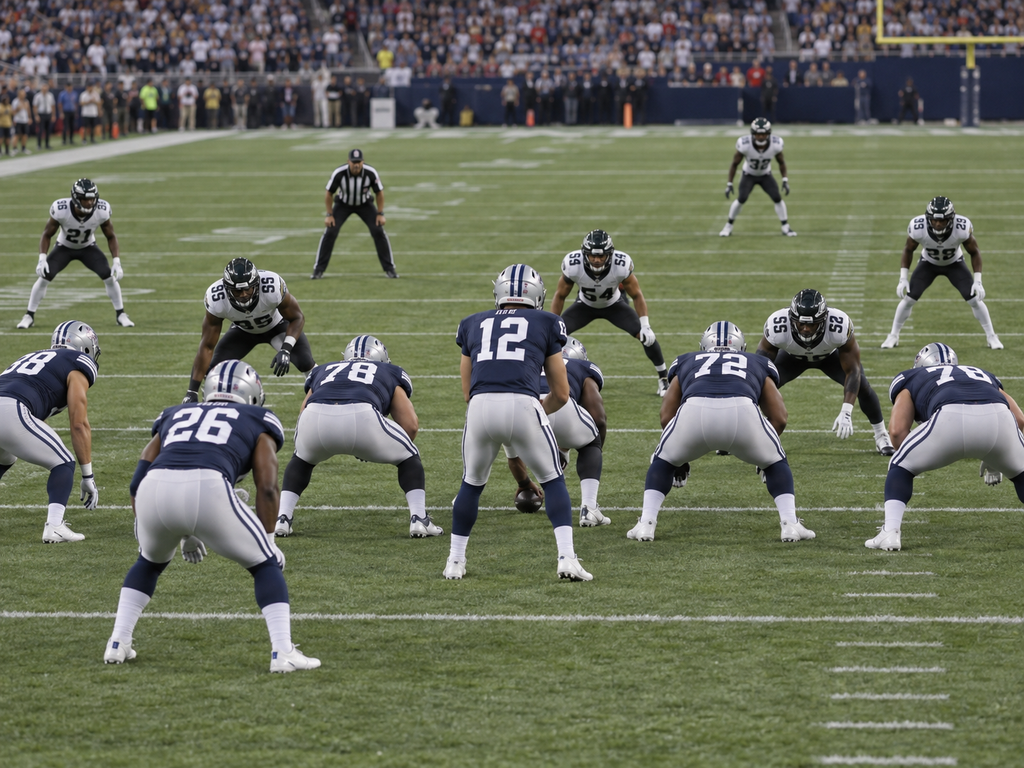
The quarterback approaches the line of scrimmage on third-and-six. The defense shows two deep safeties, three linebackers near the middle of the field and cornerbacks positioned several yards away from the receivers.
At first glance, it appears to be a conventional two-high defensive look.
Then something changes.
One linebacker moves toward the edge of the offensive line. A safety begins creeping closer to the formation, while a cornerback shifts into a tighter position across from the slot receiver.
The quarterback now has several questions to consider. Is the defense preparing to send additional pressure? Will the safeties rotate after the snap? Has the movement created a potential mismatch?
Recognizing these details is an essential part of advanced offensive football.
Learning to read the defense before the snap means understanding how defensive personnel, alignment, movement and positioning provide clues about what may happen when the play begins.
Experienced quarterbacks do not simply look at one safety and identify a coverage. They combine several observations to develop a more complete understanding of the defensive structure.
However, pre-snap recognition is never perfect. Defenses disguise their intentions, change assignments and deliberately present misleading looks.
The goal is not to predict every defensive movement. It is to gather useful information, recognize likely possibilities and prepare to execute the offensive play with greater awareness.
What Is a Pre-Snap Defensive Read?
A pre-snap defensive read is the process of evaluating defensive personnel, formations and positioning before the center snaps the football.
It helps offensive players recognize possible defensive structures and understand how those structures might affect the upcoming play.
A quarterback may examine the number of defensive linemen, linebacker alignment, safety depth and cornerback leverage.
These observations can reveal useful information about potential coverage, pressure and matchups.
For example, a defense showing one deep safety and a crowded line of scrimmage may present different concerns from a defense showing two deep safeties and a lighter defensive front.
Neither formation guarantees a specific play.
Instead, each provides information that helps the quarterback narrow the possibilities.
Pre-Snap Reading Is About Probability, Not Certainty
Consider a defense with two safeties positioned deep.
That alignment could indicate Cover 2, Cover 4 or another split-safety structure.
The defense might also rotate into a single-high coverage after the snap.
An advanced quarterback understands that the starting alignment is only part of the picture.
Rather than deciding that the defense must be playing Cover 2, the quarterback recognizes the two-high structure and looks for additional clues.
That distinction separates useful defensive recognition from unsupported guessing.
Start by Identifying Defensive Personnel
Before examining individual alignments, identify which types of defensive players are on the field.
Personnel grouping can influence the defensive structure and help explain possible matchups.
Understand Common Defensive Personnel Groups
Football defenses commonly organize personnel around defensive linemen, linebackers and defensive backs.
Two familiar groupings are:
- 4-3 personnel: Four defensive linemen and three linebackers, typically accompanied by four defensive backs.
- 3-4 personnel: Three defensive linemen and four linebackers, typically accompanied by four defensive backs.
These labels describe personnel groupings, not necessarily the exact number of defenders who will rush the passer or where everyone will align.
A nominal 3-4 defense may present four players near the line of scrimmage, while a 4-3 defense can shift its front considerably.
Modern defenses frequently use flexible personnel roles, so appearance alone may not reveal a player’s official position.
Recognize Nickel and Dime Personnel
A nickel defense generally uses five defensive backs.
A dime package typically uses six.
These packages are often associated with passing situations because additional defensive backs can provide more coverage flexibility.
However, an offense should not assume that a nickel defense cannot defend the run or that a dime package automatically indicates conservative pass coverage.
Defenses can blitz, disguise assignments or use defensive backs in run-support roles.
Why Personnel Matters
Imagine an offense using three wide receivers against a defense with only four defensive backs.
Depending on the defensive assignments, a linebacker may be responsible for matching a receiver or another eligible target.
That arrangement could create a potential matchup advantage.
But recognizing a mismatch does not automatically mean the quarterback should change the play.
The offensive design, protection, defender positioning and available options all matter.
Advanced pre-snap analysis begins by recognizing possible matchups rather than immediately deciding how to attack them.
Examine the Defensive Front
After identifying personnel, examine how defenders align near the line of scrimmage.
The defensive front can provide information about potential running gaps, pass-rushing threats and offensive blocking responsibilities.
Identify the Number of Defenders Near the Line
Observe which defensive players are positioned close enough to threaten the line of scrimmage.
Some may have their hands on the ground, while others stand in a two-point stance.
The number of players near the line does not necessarily equal the number who will rush.
An outside linebacker might appear ready to rush but drop into coverage after the snap.
A defensive back positioned away from the line could become an additional rusher.
The objective is to recognize possible threats rather than assume every nearby defender will attack.
Understand Defensive Line Techniques
Defensive linemen are often described using alignment numbers.
For example:
| Technique | General alignment |
|---|---|
| 0-technique | Head-up over the center |
| 1-technique | On the center’s shoulder |
| 2-technique | Head-up over a guard |
| 3-technique | On the outside shoulder of a guard |
| 4-technique | Head-up over a tackle |
| 5-technique | On the outside shoulder of a tackle |
Other techniques, including shaded and wider alignments, are also used.
Knowing these alignments helps players understand where defenders begin relative to the offensive line.
It does not reveal the exact stunt, rushing assignment or gap responsibility.
Recognize Overloaded Alignments
Imagine three defenders positioned near one side of the offensive line, with another potential rusher standing outside them.
This may suggest an overloaded pressure look.
The offense needs to recognize whether the formation creates possible protection concerns.
However, some of those defenders may drop into coverage.
An overloaded presentation can be designed to create uncertainty as much as to produce an actual overload.
The important question is whether the offense has recognized the potential threat within its assigned protection system.
Evaluate Safety Alignment and Depth
Safeties provide valuable information about the deeper defensive structure.
A quarterback can begin with a basic question:
Does the defense show one deep safety or two?
Single-High Safety Looks
A single-high structure typically features one safety positioned deep near the middle of the field.
This appearance can be associated with Cover 1, Cover 3 and other defensive concepts.
The remaining safety may align closer to the line of scrimmage, cover a receiving threat or carry another assignment.
However, a single-high structure does not prove the defense is playing man coverage.
The quarterback must consider the cornerbacks, underneath defenders and possible rotations.
Two-High Safety Looks
A two-high structure features two safeties aligned deep across the field.
Cover 2, Cover 4 and other split-field coverage concepts often begin from this arrangement.
The safeties may be positioned at similar depths or slightly different locations depending on the system.
Their alignment gives the offense clues about the potential distribution of deep coverage responsibilities.
It does not guarantee that both safeties will remain deep.
Look for Asymmetrical Safety Positioning
Not every defense presents a perfectly balanced alignment.
One safety might stand deeper than the other.
A safety may also position themselves closer to a particular receiver or side of the field.
These details may reflect coverage responsibilities, formation adjustments or disguise.
Advanced players should notice asymmetry without immediately assigning one explanation.
Recognize Possible Safety Rotation
Suppose two safeties begin deep, but one starts moving toward the line of scrimmage shortly before the snap.
This could indicate a defensive adjustment or the beginning of a rotation.
If the defense eventually moves into a single-high structure, the initial two-high look may have been intended to disguise that possibility.
The quarterback should recognize that the defensive picture may change rather than treating the first alignment as permanent.
Study Cornerback Leverage and Positioning
Cornerbacks provide additional clues about defensive responsibilities and possible passing windows.
Three important observations are alignment depth, leverage and body orientation.
Press Versus Off Alignment
A cornerback aligned close to a wide receiver is presenting a press look.
A defender positioned several yards away is using off alignment.
Press positioning may allow the cornerback to challenge the receiver near the line of scrimmage.
Off positioning may provide more room to react to routes developing downfield.
Neither alignment confirms man or zone coverage.
A defense can use press techniques within different coverage systems.
Inside and Outside Leverage
Leverage describes a defender’s position relative to a receiver.
An inside-leverage defender begins closer to the middle of the field.
An outside-leverage defender positions themselves closer to the sideline.
Consider a receiver aligned near the numbers with a cornerback shaded inside.
That leverage may discourage certain inside releases or influence where the receiver can move comfortably.
But the cornerback could also be expecting help from a safety or another defender.
Leverage should be interpreted together with the larger defensive structure.
Identify Potential Matchups
A quarterback may recognize that a particular receiver faces a defender whose physical characteristics or alignment creates a possible advantage.
For example, a receiver with strong short-area quickness might be aligned against a defender providing considerable space underneath.
That may create an opportunity within the offensive play.
However, the quarterback must also consider underneath defenders, safety help and the intended route timing.
A promising individual matchup does not necessarily mean the entire passing lane is available.
Watch the Linebackers and Underneath Defenders
Linebackers contribute useful information to pre-snap recognition because their alignment can influence both run defense and pass coverage.
Examine Depth and Spacing
Linebackers positioned close to the line of scrimmage may threaten pressure or run support.
Others may align several yards deeper.
A linebacker shaded toward the passing strength might have a particular coverage or run responsibility.
However, alignment alone rarely reveals the exact assignment.
Notice Defenders Near Potential Rush Lanes
A linebacker standing close to an offensive gap could become a rusher.
The quarterback should recognize that possibility, particularly when the defensive front presents more potential rushers than the offense can account for with its existing protection rules.
But a threatening linebacker may drop into coverage after the snap.
An advanced player should understand the difference between a potential pressure indicator and confirmed pressure.
Observe Communication Between Defenders
Defenders frequently communicate and reposition before the snap.
A linebacker might point toward a receiver or signal to a defensive back.
This movement may indicate an adjustment to offensive personnel, formation or motion.
It does not necessarily reveal the defensive call.
The important observation is that the defense is responding to something and may alter its alignment.
Recognize Possible Blitz and Pressure Indicators
Advanced pre-snap recognition includes identifying where additional pressure might originate.
A blitz generally involves sending an additional or unexpected defender as a pass rusher, although terminology can vary among defensive systems.
Recognizing possible pressure is especially important because the offense must understand its protection responsibilities.
Look for Crowded Gaps
If linebackers move toward the gaps between offensive linemen, they may be presenting an interior pressure threat.
A defense may place two linebackers near the A-gaps on either side of the center.
This is commonly associated with a double-A-gap pressure look.
However, both linebackers may rush, one may rush or neither may rush.
The alignment creates a possibility rather than a certainty.
Identify Edge Pressure Threats
A defensive back or linebacker moving toward the outside edge of the formation may indicate possible pressure.
The offense should account for how that player fits within its protection assignments.
Again, a defender may show pressure before dropping into coverage.
Understand the Difference Between Pressure and Disguise
A defense can create confusion by presenting more potential rushers than it actually sends.
Some schemes rush players from unexpected positions while dropping traditional rushers into coverage.
These designs can make the final rush difficult to predict.
Recognizing the indicators is useful, but detailed blitz identification and protection responses belong to more specialized study.
Use Offensive Motion to Gather Information
Offensive motion can sometimes help reveal how defenders respond to changing receiver positions.
Imagine a receiver moving across the formation before the snap.
A defensive back follows the receiver across the field.
That movement may suggest a man-related responsibility.
However, the defense could also be adjusting within a zone or match-coverage system.
Observe Who Responds
When a receiver moves, watch whether:
- One defender follows the receiver.
- Multiple defenders shift their positions.
- Safeties rotate or adjust their depth.
- Linebackers change their spacing.
- The defense maintains its original structure.
These responses provide clues about assignments and communication.
Avoid Assuming Motion Reveals Everything
A defender following motion does not automatically establish man coverage.
Some defenses use coordinated adjustments that resemble individual tracking.
A defense may also disguise its responsibilities by intentionally presenting a familiar response.
Motion is therefore one source of information, not a universal coverage test.
The quarterback should combine the response with other observations.
Recognize Potential Offensive Mismatches
A mismatch occurs when an offensive player may have an advantage over the defender responsible for them.
This advantage might involve speed, size, agility, positioning or familiarity with a particular role.
Personnel Mismatches
A defense may use a linebacker against a receiving threat who is particularly effective in open space.
That could create a potential passing advantage.
However, the linebacker may have nearby coverage help or the defensive scheme may reduce the available space.
Alignment Mismatches
Sometimes the advantage comes from positioning rather than physical characteristics.
A defender aligned far inside may leave a different throwing area more accessible.
A cornerback providing substantial cushion may allow an underneath route to develop.
These observations matter only when they fit the offensive play and the actual defensive movement.
Do Not Confuse a Mismatch With a Guaranteed Completion
A favorable matchup can still produce an unsuccessful play.
The quarterback must consider route timing, protection, defensive help and ball placement.
The value of pre-snap recognition is understanding the opportunity, not forcing the football toward it regardless of the situation.
Build a Consistent Pre-Snap Reading Routine
Experienced quarterbacks benefit from a repeatable observation process.
A consistent routine helps organize information under time pressure.
One useful sequence is:
Step 1: Confirm the Game Situation
Identify down, distance, field position and relevant game circumstances.
These factors help explain why the defense might prioritize certain responsibilities.
Step 2: Identify Defensive Personnel
Determine whether the defense is using its base personnel or a package with additional defensive backs.
Notice unusual substitutions or position groupings.
Step 3: Examine the Defensive Front
Look at the defensive linemen, linebackers and potential rushers near the line.
Recognize possible overloads or unusual alignments.
Step 4: Locate the Safeties
Identify whether the defense presents one-high or two-high structure.
Observe safety depth and any unusual positioning.
Step 5: Evaluate Cornerbacks and Underneath Defenders
Notice leverage, cushion and possible matchups.
Combine these clues with the safety alignment.
Step 6: Watch for Late Movement
Pay attention to defensive shifts, linebacker movement and safety rotation.
Update your initial assessment as necessary.
Step 7: Prepare to Execute the Play
Use the gathered information according to the team’s offensive system.
The quarterback should understand relevant protection or adjustment responsibilities but should not invent changes outside the established play design.
This process does not need to occur as seven slow, separate steps during an actual game.
With repetition, experienced players learn to gather several observations quickly.
Practical Pre-Snap Reading Examples
The following examples demonstrate how multiple clues can be interpreted together.
Example 1: Possible Single-High Pressure Look
The offense faces third-and-seven.
One safety is deep in the middle of the field.
Several defenders align near the line of scrimmage, including a linebacker positioned outside an offensive tackle.
A cornerback plays close to an outside receiver.
What the quarterback can observe:
The defense presents a single-high structure with several possible rushers.
This may create a concern about pressure, particularly from the edge.
However, the cornerback’s alignment does not prove man coverage, and the linebacker may drop into coverage.
The useful conclusion is that the offense should recognize the pressure possibility while remaining prepared for other defensive calls.
Example 2: Two-High Look With a Potential Mismatch
The offense aligns with three wide receivers.
The defense uses two deep safeties and has a linebacker positioned near an inside receiving threat.
One outside cornerback plays several yards away from the receiver.
What the quarterback can observe:
The defensive structure suggests potential split-safety coverage.
The inside matchup may deserve attention depending on the linebacker’s responsibilities.
The outside cornerback’s cushion could also influence a route within the offensive concept.
But the quarterback cannot determine the final coverage simply from these alignments.
The offense must still confirm how defenders respond after the snap.
Example 3: Late Safety Movement
The offense approaches the line against a defense showing two deep safeties.
Shortly before the snap, one safety moves toward the line while a linebacker adjusts laterally.
What the quarterback can observe:
The defense is changing its presentation.
A single-high rotation may be possible, but the final responsibilities remain uncertain.
Rather than treating the original two-high appearance as fixed, the quarterback prepares for a changing defensive picture.
This is an example of why advanced recognition requires continuous observation.
Common Mistakes in Pre-Snap Defensive Reading
Even experienced players can draw incorrect conclusions from defensive alignment.
Relying on One Defender
A quarterback notices one safety standing deep and immediately assumes Cover 1.
Why it fails: Single-high looks can support multiple coverages.
Better approach: Combine safety alignment with the positioning of cornerbacks and underneath defenders.
Assuming Every Threatened Blitz Will Happen
Linebackers move toward the line, and the quarterback assumes all of them will rush.
Why it fails: Defenses can bluff pressure or change rushing assignments.
Better approach: Recognize potential pressure while understanding that the actual rush remains uncertain.
Ignoring Offensive Personnel
A quarterback focuses entirely on the defense without considering how the offense’s own formation creates particular matchups.
Why it fails: Defensive alignment is partly a response to the offensive personnel and formation.
Better approach: Evaluate the relationship between both sides of the formation.
Overreacting to Late Movement
A defense shifts shortly before the snap, causing the quarterback to abandon the planned process.
Why it fails: Late movement can create uncertainty, but an unsupported adjustment may make offensive execution worse.
Better approach: Follow the team’s established rules for recognizing and responding to defensive changes.
Confusing Recognition With Prediction
A player correctly identifies a likely defensive concept and assumes the play will develop exactly as expected.
Why it fails: Defenders can rotate, disguise and adjust.
Better approach: Use pre-snap information to prepare, then confirm relevant movement after the snap.
Drills to Improve Pre-Snap Defensive Recognition
Pre-snap recognition improves through structured repetition and meaningful feedback.
Drill 1: Defensive Personnel Identification
Purpose: Improve the speed of recognizing defensive personnel packages.
A coach displays paused clips or photographs of defensive formations.
The player identifies the likely number of defensive linemen, linebackers and defensive backs.
Discuss any unusual personnel roles.
Begin with obvious formations before introducing more flexible defensive packages.
Drill 2: Front and Safety Recognition
Purpose: Improve the ability to connect defensive fronts with deeper alignment.
Pause a game clip immediately before the snap.
Identify the defensive front and whether the safeties show one-high or two-high structure.
Record observations before watching the play.
Review whether the initial appearance changed after the snap.
Drill 3: Pressure Possibility Recognition
Purpose: Recognize potential pressure without treating it as certain.
Review pre-snap clips showing linebackers or defensive backs near possible rushing lanes.
Identify which defenders could threaten pressure.
Then watch the play to see which players actually rush.
Compare the initial possibilities with the final movement.
Drill 4: Motion Response Observation
Purpose: Develop awareness of defensive adjustments.
Select clips featuring offensive motion.
Watch how defensive backs, linebackers and safeties respond.
Identify whether defenders follow, exchange responsibilities or shift collectively.
Avoid assuming that one response automatically identifies the complete coverage.
Drill 5: Timed Pre-Snap Checklist
Purpose: Improve recognition under realistic time constraints.
A coach displays a defensive formation for a limited period.
The player identifies three useful observations:
- Defensive personnel or front.
- Safety structure.
- A possible pressure or matchup concern.
The coach then reviews the observations for accuracy.
The exercise should emphasize useful recognition rather than rushing through unsupported guesses.
Use Film Study to Improve Your Pre-Snap Reads
Film study allows players to examine defensive structures without the speed and physical demands of live competition.
A useful approach is to compare similar situations.
For example, study multiple third-and-medium defensive looks from the same opponent.
Notice whether the defense changes personnel, front alignment or safety depth.
Record what remained consistent and what changed.
| Pre-snap observation | What to record |
|---|---|
| Down and distance | Game situation |
| Personnel | Defensive player grouping |
| Front | Defensive line and potential rushers |
| Safeties | Starting depth and alignment |
| Cornerbacks | Leverage and cushion |
| Linebackers | Depth, spacing and possible pressure |
| Movement | Shifts, motion response and late rotation |
After documenting the pre-snap picture, watch the play and compare the actual defensive behavior.
This teaches an important distinction between what was visible before the snap and what could only be confirmed afterward.
A quarterback may initially identify several reasonable possibilities. That is not a failure.
The goal is to improve the quality of the information used to prepare for the play.
How to Measure Improvement in Pre-Snap Reading
Improvement should not be evaluated only by whether a quarterback correctly names the defensive coverage.
Coverage identification is useful, but advanced football requires recognizing information relevant to offensive execution.
Consider these measurements:
| Skill | Evidence of progress |
|---|---|
| Personnel recognition | Identifies defensive groupings more consistently |
| Front recognition | Notices potential rush threats and alignment changes |
| Safety recognition | Distinguishes initial shells and possible rotations |
| Leverage awareness | Recognizes cornerback positioning and possible matchups |
| Communication | Shares relevant observations using team terminology |
| Discipline | Avoids unsupported assumptions and unauthorized adjustments |
Review progress with a knowledgeable coach who understands the team’s offensive system.
A quarterback who recognizes fewer defensive labels but consistently identifies the most relevant information may be more effective than one who guesses complex coverage names without understanding their implications.
Final Thoughts: See the Defensive Structure Before the Play Begins
Learning to read the defense before the snap requires more than identifying one-high and two-high safety alignments.
Advanced recognition combines defensive personnel, front positioning, safety depth, cornerback leverage, linebacker movement and potential pressure indicators.
Each observation provides another piece of the defensive picture.
The key is understanding how those pieces fit together without treating any single clue as a guarantee.
Develop a repeatable pre-snap routine, review defensive formations through film study and practice identifying meaningful information under time constraints.
Most importantly, use that information within the team’s offensive system rather than abandoning assigned responsibilities based on a prediction.
As your recognition improves, you can approach each snap with a clearer understanding of the possible defensive challenges and greater preparation for what follows.
Continue developing your game through our Advanced American Football Guides, or explore the American Football Learning Path for structured courses covering football knowledge, execution and strategy.