
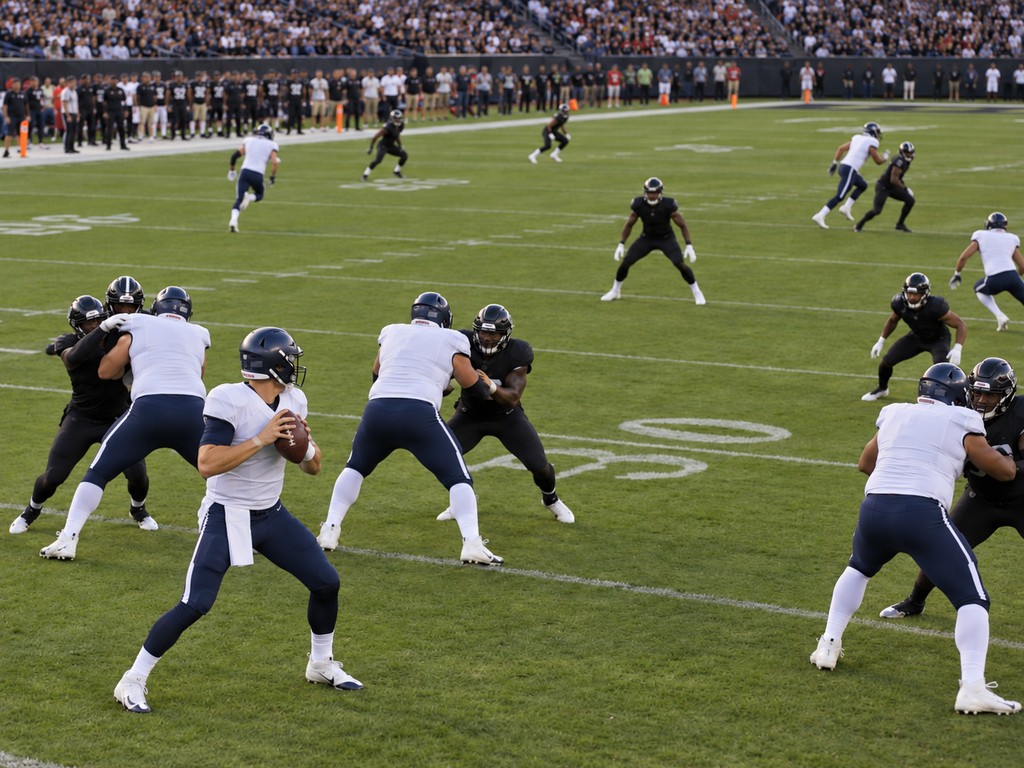
The quarterback takes the snap on second-and-eight. The offense has three receivers to the right, with a running back positioned beside the quarterback.
Before the snap, the defense shows two deep safeties. The quarterback expects a passing concept designed to challenge the underneath coverage.
As the play begins, the middle linebacker drops into the first passing window. The quarterback recognizes that the primary route is covered and shifts attention to the next receiver.
The second option is available, but only briefly.
The quarterback delivers the football before the defender can close the space. The receiver completes the catch and gains a first down.
What made the play successful was not simply throwing accuracy. The quarterback understood the passing concept, recognized the defensive movement and processed the receiving options in the intended sequence.
This is the foundation of advanced quarterback play.
Learning quarterback progressions helps experienced players understand how passing concepts create multiple opportunities and how to move efficiently between those options.
Instead of locking onto one receiver, an advanced quarterback learns to connect route timing, coverage movement and offensive design.
However, reading defenses does not mean searching the entire field randomly for an open player. Effective progressions follow an organized structure established by the offensive system.
This guide explains different progression types, post-snap defensive indicators, concept-based passing reads and practical methods for developing more consistent quarterback decision-making.
What Are Quarterback Progressions?
A quarterback progression is an organized process for evaluating potential receiving options during a passing play.
The sequence is determined by the offensive system and the specific play call.
A progression may instruct the quarterback to examine several receivers in order, evaluate a particular defender or select an option based on the coverage structure.
Different passing concepts use different progression rules.
Some emphasize one side of the field. Others require the quarterback to work across multiple receiving options.
The purpose is to make passing decisions more efficient and predictable.
Why Progressions Matter
Without a clear progression, a quarterback may stare at one receiver for too long.
If that receiver is covered, the quarterback might begin looking around the field without understanding which option should become available next.
That approach wastes valuable time.
A defined progression provides a framework for evaluating the play.
The quarterback understands which route is expected to develop first, where the next option should appear and how the defensive coverage affects those opportunities.
Progressions Must Match the Play
There is no universal sequence that works for every passing concept.
For example, a quick passing play may require a decision immediately after the snap.
A deeper passing concept may involve routes developing at different stages of the quarterback’s drop.
A quarterback should not apply the same progression timing to both situations.
The progression must fit the routes, protection and intended rhythm of the offensive play.
Understand the Main Types of Quarterback Progressions
Advanced passing systems commonly use several approaches to organizing quarterback reads.
These approaches may overlap, and terminology differs between coaching systems.
Pure Progression Reads
A pure progression read directs the quarterback to evaluate receiving options in a predetermined order.
For example:
First receiver → Second receiver → Third receiver → Outlet
The sequence is usually connected to the timing and design of the passing concept.
The quarterback does not necessarily throw to the first receiver simply because that receiver is first in the progression.
The first option must present an acceptable passing opportunity.
If it does not, the quarterback proceeds according to the play’s rules.
Pure progressions can help simplify decision-making because the quarterback knows where to direct attention next.
However, they still require awareness of defensive positioning.
Coverage-Based Progressions
A coverage-based progression uses the defensive structure to determine which receiving concept or option should receive priority.
For example, the offense may have a route combination designed to attack a particular type of coverage.
The quarterback identifies the relevant defensive structure and applies the corresponding progression.
This approach can be effective when the quarterback understands how the passing concept challenges different coverage responsibilities.
However, pre-snap coverage appearance is not always reliable.
The quarterback may need to confirm post-snap movement before committing to the expected option.
Key-Defender Reads
A key-defender read focuses on the movement or positioning of a particular defensive player.
For example, a passing concept may place an underneath defender in conflict between two receiving areas.
If the defender moves toward one option, another passing window may become available.
The quarterback reads the defender according to the design of the play.
The important point is that the coach identifies the correct defender to read.
A quarterback should not invent a key defender simply because one player is moving.
Understand Half-Field and Full-Field Progressions
Another important distinction involves how much of the field the quarterback must process.
Half-Field Progressions
A half-field progression typically concentrates the quarterback’s primary reads on one side of the formation.
For example, a passing concept may feature two or three receivers creating related options on the right side.
The quarterback evaluates those routes according to the concept’s rules.
A half-field structure can help simplify recognition by reducing the initial area of attention.
However, that does not mean the quarterback can ignore every defender outside the selected area.
Safety movement and other coverage responsibilities may still influence the intended throwing window.
Full-Field Progressions
A full-field progression can require the quarterback to move through receiving options distributed across both sides of the field.
For example, the first two reads may develop on the right, while another route becomes available on the left.
The quarterback must understand how the route timing supports the progression.
Moving across the field takes time.
If the final receiving option develops before the quarterback reaches it, the progression may not produce a useful opportunity.
Why Full-Field Does Not Mean Reading Everyone
A full-field progression is not an instruction to examine all eligible receivers equally.
It is still an organized sequence.
The quarterback must understand which option comes next and when that option is expected to be available.
This distinction is important because unnecessary visual searching can disrupt passing rhythm.
Connect Your Footwork to the Progression
Quarterback footwork and passing progressions are closely related.
The quarterback’s drop, balance and throwing preparation should support the intended timing of the route concept.
Match the Drop to the Passing Concept
A quick passing concept may be designed around a short drop or rapid throwing setup.
A deeper concept may require a different rhythm.
The quarterback should arrive at the appropriate throwing position when the intended receiver approaches the expected window.
If the quarterback’s footwork is too slow, the first option may already be covered by the time the player is ready to throw.
If the setup is rushed, the quarterback may not be physically prepared to deliver an accurate pass.
Reset Efficiently Between Reads
Suppose the quarterback checks the first receiver and determines that the passing window is unavailable.
The next read may require turning toward a different area of the field.
The quarterback should move their eyes, shoulders and feet in a coordinated way consistent with the coached technique.
Poor footwork can create unnecessary delays and reduce throwing accuracy.
The objective is not to take large steps between every read.
It is to remain balanced and prepared to throw as the progression develops.
Avoid Standing Still After the First Read
Some quarterbacks recognize that the first option is covered but pause before moving to the next.
That hesitation can cause the entire progression to become late.
A well-practiced progression allows the quarterback to continue efficiently rather than restarting the decision process after each receiver.
Use Post-Snap Coverage Movement to Confirm Your Read
Pre-snap recognition provides useful information, but the quarterback must evaluate the defense as it actually develops.
Safeties can rotate, cornerbacks can change responsibilities and underneath defenders can move into unexpected passing lanes.
Watch Safety Rotation
Imagine the defense begins with two safeties positioned deep.
After the snap, one rotates toward the middle while the other moves into an underneath responsibility.
The passing concept may now face a different coverage structure than the quarterback initially expected.
Recognizing the rotation helps the quarterback avoid relying on an outdated assumption.
However, the quarterback must still follow the progression and relevant coverage rules taught for the play.
Account for Underneath Defenders
Linebackers and nickel defenders often influence intermediate passing windows.
A quarterback may see a receiver approaching an open area, but an underneath defender could be moving into that space.
The quarterback should understand how the defender’s depth and direction affect the throw.
For example, an underneath defender gaining depth may make one route more difficult while changing the available space on a shorter route.
That relationship is often central to concept-based passing reads.
Recognize Coverage Exchange
In certain zone and match-coverage systems, defenders exchange or adjust responsibilities as receivers move.
A receiver initially appears to be separating from one defender, only for another defender to assume responsibility.
The quarterback must evaluate the complete passing window rather than focusing exclusively on the first defender.
This is particularly important against sophisticated coverage systems.
Understand High-Low Passing Concepts
High-low concepts are common examples of reading a defender’s positioning.
A high-low concept generally places receiving options at different depths in a related area of the field.
The offense may attempt to create a decision for an underneath defender.
Example: Two Receiving Levels
Imagine a receiver running a short route while another receiver develops a deeper route in the same general area.
An underneath defender must respond according to their coverage responsibility.
If that defender moves toward the deeper route, the shorter option may become available.
If the defender remains underneath, the deeper passing window may become more attractive.
However, the quarterback must also account for deep coverage and the timing of both routes.
The high-low structure does not guarantee that one receiver will be open.
Read the Correct Defender
The success of a high-low read depends partly on identifying the defender whom the concept is designed to challenge.
Reading the wrong player can produce an incorrect decision.
For example, focusing on a nearby defensive back rather than the assigned underneath defender may cause the quarterback to misunderstand the available window.
The quarterback should learn the concept’s designated key through coaching and film review.
Avoid Turning the Concept Into a Guess
A quarterback should not automatically throw short every time a defender drops deep.
Other defenders may be positioned to challenge the short route.
The decision must account for the complete defensive picture relevant to the play.
Understand Horizontal Stretch Concepts
Some passing concepts challenge defenders across the width of the field rather than primarily at different depths.
A horizontal stretch may place multiple receiving options across neighboring areas.
For example, a flat route and an intermediate route can create a challenge for defenders responsible for nearby passing spaces.
Example: Curl-Flat Concept
A curl-flat concept commonly combines a receiver settling or breaking back at an intermediate depth with another player moving toward the flat.
The defense must account for both threats.
Depending on the coverage, an underneath defender may influence one option more strongly than the other.
The quarterback evaluates the relevant defender movement according to the play’s progression.
Why Spacing Matters
If the receiving routes finish too close together, one defender may influence both options.
Proper spacing helps create distinct passing windows.
The quarterback’s job is to understand how those windows develop and which one becomes appropriate.
Do Not Assume Every Horizontal Stretch Works the Same Way
Different defenses can exchange responsibilities or match routes according to their coverage rules.
A concept that produces a clear window against one defensive structure may be more difficult against another.
The quarterback must understand the concept’s intended response to different looks.
Understand Triangle Reads
Some offensive concepts distribute receiving threats across three related areas.
These are often called triangle reads or triangle stretch concepts.
The three receiving options may challenge different parts of the defensive structure.
Example: Three-Level Passing Concept
Imagine three receivers creating short, intermediate and deep threats along one side of the field.
The quarterback may evaluate the defense according to how those receiving areas develop.
An underneath defender might move toward the short route, while another defender controls an intermediate window.
A deeper defender protects the vertical threat.
The passing opportunity depends on the combined positioning of these players.
Why Triangle Reads Require Discipline
A three-level concept can create several possible options.
However, attempting to evaluate all three without a defined order may slow the quarterback.
The offensive system should establish how the progression works.
One team may use a coverage-based read.
Another may use a predetermined progression.
The same general route distribution can therefore be taught differently.
Recognize When a Passing Window Is Closed
Advanced quarterback play requires understanding when to move beyond a receiver.
A passing window may be closed because a defender is directly positioned to challenge the throw.
It may also be closing because another defender is moving into the anticipated ball path.
Don’t Wait for a Receiver to Become Completely Covered
A quarterback may recognize that a passing window is unavailable before the receiver finishes the route.
Waiting until the receiver is obviously surrounded can waste valuable time.
The quarterback should learn to identify when the first option is no longer appropriate.
Don’t Leave a Read Too Early
The opposite mistake is abandoning an option before its designed window develops.
For example, a receiver may need to reach a particular depth before the intended route becomes available.
If the quarterback moves to the next read prematurely, the offense may miss the designed opportunity.
The correct timing depends on the passing concept and the quarterback’s footwork.
Understand Anticipation
Many advanced throws require the quarterback to release the ball before the receiver reaches the final catching location.
The quarterback anticipates the route based on timing, defender positioning and the offensive system.
Anticipation is not the same as guessing.
It relies on repeatable execution and an appropriate understanding of the developing coverage.
Know When to Move to the Next Read
An effective progression requires timely transitions.
The quarterback must recognize when a receiving option is unavailable and move on without unnecessary hesitation.
Several factors can influence the decision:
- The intended passing window is occupied.
- The relevant defender has positioned themselves to challenge the throw.
- The receiver has not created the required separation.
- The route’s intended timing has passed.
- The offensive concept directs the quarterback to another option.
However, progression timing must be taught within the offensive system.
There is no universal rule that every receiver should receive the same amount of attention.
Some reads occur almost immediately.
Others require the quarterback to wait for a route to develop.
The key is understanding the rhythm of the specific play.
Common Quarterback Progression Mistakes
Staring at the Primary Receiver
A quarterback focuses on the first option for too long.
This can delay later reads and allow defenders to recognize the intended target.
Correction: Practice the complete progression and learn the timing of each option.
Moving Through Reads Too Quickly
The quarterback leaves a receiver before the designed passing window develops.
Correction: Match progression timing to the route concept and quarterback footwork.
Reading the Wrong Defender
A concept requires attention to a particular underneath defender, but the quarterback watches another player.
Correction: Study the designated key defender and understand why their movement matters.
Ignoring Post-Snap Coverage Changes
The quarterback relies entirely on the defensive alignment visible before the snap.
Correction: Confirm relevant coverage movement after the play begins.
Poor Footwork Between Reads
The quarterback recognizes the correct receiver but struggles to deliver an accurate throw because the body is not aligned.
Correction: Coordinate eye movement, footwork and throwing preparation during progression drills.
Treating Every Play as a Full-Field Search
The quarterback looks across the entire field without following a defined sequence.
Correction: Understand whether the concept uses a half-field, full-field, key-defender or coverage-based progression.
Forcing the Final Option
The quarterback reaches the last receiving option and throws regardless of whether the window is available.
Correction: Recognize that completing the progression does not automatically require a pass.
Five Drills to Improve Quarterback Progressions
Advanced progression training should develop accurate recognition before increasing speed and complexity.
Drill 1: Progression Walkthrough
Purpose: Understand the correct sequence for a passing concept.
A coach presents a play and identifies the designated receiving options.
The quarterback walks through the footwork and visual progression without a pass rush.
At each read, the quarterback explains what information determines whether the option is available.
Repeat until the sequence becomes consistent.
Drill 2: Key-Defender Recognition
Purpose: Improve concept-based reads.
Use a passing concept designed to challenge a particular defender.
A coach or defender changes position according to predetermined rules.
The quarterback identifies the movement and selects the appropriate option.
Begin at a controlled pace before introducing realistic speed.
Drill 3: Half-Field Progression Drill
Purpose: Improve reading efficiency within one side of the formation.
Set up two or three receivers executing a familiar route combination.
The defense varies which receiving window is available.
The quarterback follows the coached progression and delivers the appropriate pass.
Review timing, recognition and footwork.
Drill 4: Full-Field Progression Drill
Purpose: Practice moving between receiving options across both sides of the field.
Run an assigned full-field concept with several potential targets.
A coach varies the defensive positioning to make different options available.
The quarterback must follow the correct sequence while keeping the throwing base organized.
The emphasis is on accuracy of the progression rather than simply scanning quickly.
Drill 5: Coverage Rotation Recognition
Purpose: Improve post-snap confirmation.
Show the quarterback a defensive alignment before the snap.
After the play begins, defenders rotate according to a predetermined coverage call.
The quarterback recognizes the final structure and executes the progression appropriate to the concept.
Use non-contact repetitions before adding more realistic defensive movement.
Use Film Study to Analyze Progression Decisions
Film study is useful for identifying whether a quarterback processed the passing concept correctly.
However, reviewing a completed play can create hindsight bias.
A receiver may appear open on video even though the quarterback had already progressed elsewhere or the route became available after the throwing window passed.
Review the Play at the Correct Moment
Pause the film when the quarterback reaches the designated decision point.
Evaluate the receiver’s position, nearby defenders and the quarterback’s throwing readiness.
Then continue the play to see what happened.
This provides a more accurate understanding of the actual decision.
Separate Recognition From Execution
A quarterback may identify the correct receiver but deliver an inaccurate pass.
That is different from throwing accurately to the wrong option.
Similarly, an incomplete pass may result from a receiver mistake rather than an incorrect progression.
Useful film review distinguishes these issues.
Record Your Observations
| Review area | What to evaluate |
|---|---|
| Progression type | Pure, coverage-based or key-defender read |
| Initial coverage | Defensive structure before the snap |
| Post-snap movement | Relevant rotations and defender reactions |
| First read | Was the initial option appropriately evaluated? |
| Next read | Did the quarterback transition at the correct time? |
| Footwork | Was the quarterback prepared to throw? |
| Decision | Was the selected receiving option appropriate? |
| Execution | Was the pass delivered accurately and on time? |
The objective is to identify repeatable improvements rather than criticize every incomplete pass.
Measure Improvement in Quarterback Progressions
Completion percentage alone does not reveal whether a quarterback is reading the defense correctly.
A quarterback may complete a pass after making an incorrect read, or throw an incompletion after choosing the appropriate receiver.
Evaluate progression skills directly.
| Skill | Evidence of improvement |
|---|---|
| Progression knowledge | Correctly identifies the reading sequence |
| Coverage recognition | Notices relevant post-snap changes |
| Key-defender reads | Interprets assigned defenders accurately |
| Timing | Moves between options without unnecessary hesitation |
| Footwork | Maintains readiness to throw throughout the progression |
| Decision quality | Selects appropriate passing windows |
| System discipline | Follows the coached progression consistently |
These areas should be reviewed across several practices and games.
A knowledgeable coach can help determine whether errors originate from recognition, timing, technique or misunderstandings of the play.
Build a Weekly Quarterback Progression Routine
A focused training schedule can help connect classroom understanding with field execution.
| Training focus | Suggested activity |
|---|---|
| Concept understanding | Review play diagrams and progression rules |
| Key-defender reads | Controlled recognition exercises |
| Half-field progressions | Passing repetitions against varied coverage |
| Full-field progressions | Coordinated eye and footwork drills |
| Post-snap coverage | Defensive rotation recognition |
| Film review | Evaluate timing and decision quality |
Training should be integrated into the team’s existing practice schedule.
The goal is not to memorize dozens of progressions simultaneously.
Begin with a manageable selection of concepts and learn them thoroughly.
As recognition becomes more consistent, increase defensive complexity and introduce realistic game conditions.
Final Thoughts: Read With Purpose, Not Guesswork
Developing advanced quarterback progressions requires understanding how passing concepts organize receiving options and how defensive movement affects those opportunities.
A successful quarterback does not simply look for an open player.
The quarterback recognizes the progression structure, identifies relevant defenders, maintains appropriate timing and moves efficiently between options.
Pure progressions provide a defined order. Coverage-based progressions connect passing choices to defensive structures. Key-defender reads help quarterbacks understand how particular defenders influence intended passing windows.
Each approach requires disciplined execution.
Practice reading high-low concepts, horizontal stretches and full-field route combinations. Use film study to examine decisions at the correct moment and identify where timing or recognition can improve.
Most importantly, execute the passing system as designed rather than turning every play into an improvised search for a receiver.
Continue exploring our Advanced American Football Guides for deeper tactical concepts, or visit the American Football Learning Path to develop quarterback knowledge and football strategy through structured courses.