
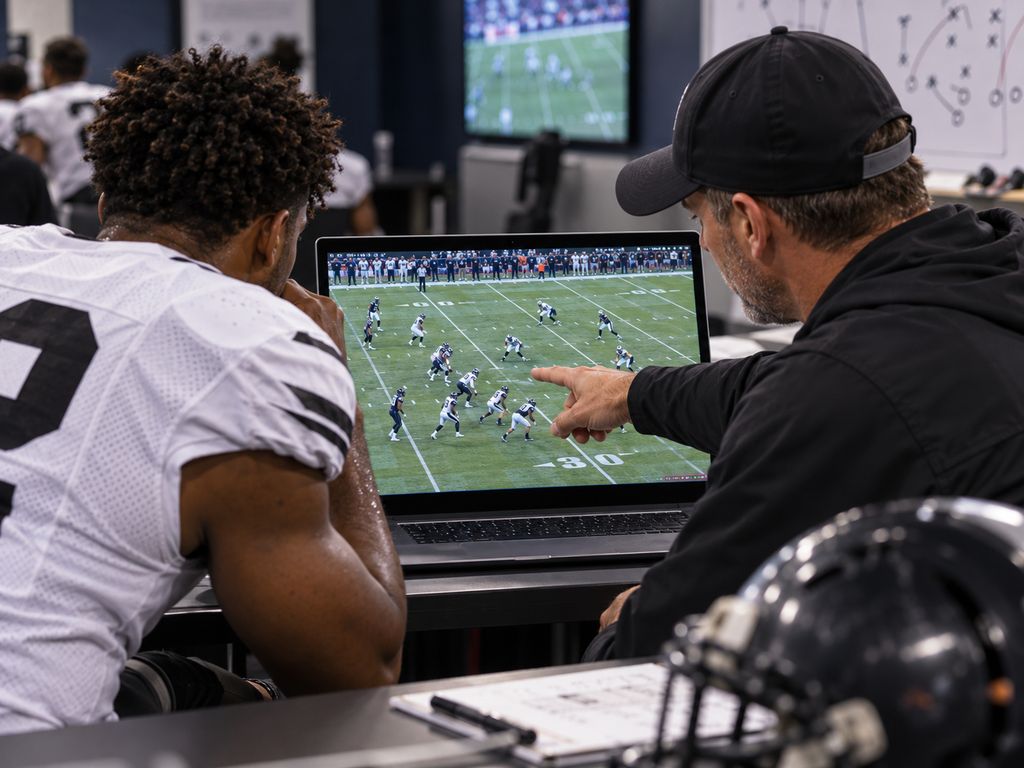
A linebacker watches a recording of last week’s game. On one play, the opposing running back gains twelve yards through the middle of the defense.
At normal speed, it appears that the linebacker reacted too slowly.
The player rewinds the footage and watches again. This time, the offensive guard’s movement becomes more noticeable. The guard blocks toward the linebacker while another offensive lineman creates space at the line of scrimmage.
On the third viewing, the linebacker notices something else: the defensive lineman has been moved out of his assigned area, changing the running lane before the linebacker can reach it.
The original explanation was incomplete.
Instead of simply concluding that he needs to run faster, the linebacker now has specific questions about defensive positioning, blocking recognition and the responsibilities of nearby teammates.
This is what productive football film study should accomplish.
Learning football film study means more than watching highlights or replaying mistakes. It involves breaking down plays systematically, identifying meaningful patterns and using the evidence to improve preparation and execution.
Advanced players use film to understand their assignments, evaluate opponents and recognize details that are difficult to process during live competition.
However, a productive review must separate what the footage actually shows from what the viewer assumes happened.
This guide explains how to organize football game film, study individual plays, recognize tendencies and translate observations into useful practice goals.
What Is Football Film Study?
Football film study is the systematic review of recorded plays to understand formations, assignments, execution, tendencies and game situations.
Players and coaches use it for several purposes.
A quarterback may review passing plays to evaluate timing and decision-making.
An offensive lineman may examine defensive fronts and blocking assignments.
A linebacker may study how opposing offenses create running lanes.
A defensive back may review receiver movement and coverage responsibilities.
Although each position focuses on different details, the underlying process is similar.
The viewer identifies a question, examines the relevant evidence and records a conclusion that can guide future preparation.
Watching Football Is Not the Same as Studying Film
Watching a football game for entertainment usually involves following the ball and enjoying the action.
Film study requires a narrower focus.
For example, a viewer watching a completed pass may focus on the quarterback and receiver.
A player studying the same play might examine the offensive formation, defensive alignment, route spacing and the time available before the throw.
The objective is not simply to describe what happened.
It is to understand how the play developed and which factors contributed to the outcome.
Start With a Clear Film-Study Objective
One of the most common mistakes is opening a full-game recording without deciding what to study.
A player may watch dozens of plays and remember only a few dramatic moments.
A clearer objective makes film study more productive.
Review Your Own Performance
After a game, a player might focus on a recurring technical or assignment problem.
For example, a receiver may want to understand why several routes developed later than expected.
An offensive lineman might review plays involving pressure from a particular defensive alignment.
A defender might examine missed run-fit responsibilities.
Each objective narrows the review to relevant situations.
Study an Upcoming Opponent
Opponent film study focuses on what another team frequently does in identifiable circumstances.
For example, a defense may want to know which formations an offense uses most often on third down.
An offense may examine how an opposing defense responds to shifts or substitutions.
The objective is to identify useful tendencies rather than predict every future play.
Learn a Specific Football Concept
Film can also help players understand a concept that is difficult to visualize from a diagram.
Watching several examples of a particular blocking scheme or passing concept reveals how players move when defenders react differently.
This is especially useful for advanced players who already understand the basic terminology.
Choose the Right Film Angle
The available camera angle influences what can be studied reliably.
Not every recording provides enough detail for every type of analysis.
Broadcast Footage
Broadcast recordings frequently follow the football.
They are useful for reviewing overall game situations, visible quarterback decisions and the result of a play.
However, television cameras may not show every receiver or defensive back throughout the play.
This makes it difficult to identify complete coverage responsibilities.
Sideline View
A wide sideline angle can reveal offensive and defensive formations, movement across the field and the development of many plays.
It may be useful for evaluating route depth, coverage spacing and coordinated movements.
The quality depends on how much of the field the camera captures.
End-Zone View
A camera positioned behind an end zone can provide a useful perspective on offensive and defensive line play.
This angle often helps reveal blocking relationships, gap responsibilities and movement through the interior.
It can also help coaches assess how running lanes develop.
All-22 Footage
All-22 refers to a coaching-film view intended to show all twenty-two players on the field.
It can provide a broader perspective on formations, route distribution and defensive coverage.
All-22 footage is especially useful for studying relationships between players away from the football.
However, access depends on the league, team and available film services.
Use Multiple Angles When Possible
A sideline view may suggest that a running back missed an opening.
An end-zone view might reveal that a defender occupied the lane before the runner could reach it.
Comparing angles reduces the likelihood of drawing conclusions from incomplete information.
When only one angle is available, acknowledge what cannot be seen.
Organize Game Film Before Reviewing Individual Plays
A full football game includes many different situations.
Organizing plays helps prevent unrelated observations from becoming mixed together.
Separate Offensive and Defensive Snaps
Begin by dividing the footage into offensive and defensive possessions.
Special teams plays can be reviewed separately when relevant.
This allows players to concentrate on the responsibilities associated with a particular phase of the game.
Group Plays by Down and Distance
Down-and-distance often influences the type of play an opponent chooses.
For example, third-and-two creates different demands from third-and-twelve.
Useful categories might include:
- First down.
- Second-and-short.
- Second-and-long.
- Third-and-short.
- Third-and-medium.
- Third-and-long.
- Red-zone situations.
The precise yardage boundaries for these categories can follow the team’s coaching terminology.
Record the Game Situation
For each relevant play, record the quarter, time remaining, score and field position.
A team protecting a lead may behave differently from the same team attempting a comeback.
Without context, a tendency can appear stronger than it really is.
Create a Simple Film Log
A spreadsheet or notebook can organize observations.
| Play | Situation | Formation | Observation | Review question |
|---|---|---|---|---|
| 12 | 1st-and-10 | Two-back set | Run gained 8 yards | Which gap opened? |
| 23 | 3rd-and-6 | Trips right | Pass completed to slot | What affected the window? |
| 31 | 2nd-and-8 | Shotgun spread | Pressure reached QB | Where did the rush originate? |
The entries should describe what is visible before assigning a cause.
That distinction becomes important during detailed analysis.
Use a Three-Pass Film Review Method
A structured review can reveal details that are easy to miss when repeatedly watching without a plan.
One practical method is to study each important play in three passes.
First Pass: Watch the Entire Play
Begin at normal speed.
Observe the formation, general movement and final result.
Avoid stopping immediately whenever something unexpected happens.
The purpose is to understand the overall sequence.
Ask:
What was the offense trying to accomplish?
What did the defense appear to be doing?
How did the play end?
At this stage, your answers may be incomplete.
Second Pass: Focus on Your Position Group
Rewind the play.
Now concentrate on the players directly connected to your responsibility.
For example, an offensive lineman may focus on nearby defensive linemen and linebackers.
A receiver may study the immediate coverage defender and the spacing of neighboring routes.
Observe alignment, movement, timing and assignment relationships.
This narrower focus reveals details hidden by watching the entire field.
Third Pass: Examine the Cause
On the final viewing, investigate the specific issue that matters.
If the play gained significant yardage, identify which movements contributed to the opportunity.
If the play failed, determine whether the problem involved execution, defensive response or an incorrect assumption.
Pause or replay specific moments when necessary.
Do not assign blame without understanding the responsibilities involved.
Separate Observation From Interpretation
One of the most important habits in advanced film analysis is distinguishing visible facts from explanations.
Consider a defensive back who is several yards away from the receiver when a pass is completed.
The visible observation is that the defender was separated from the receiver.
It does not automatically prove that the defender made a mistake.
The coverage might have required the defender to protect a different area.
Another player may have missed an assignment.
The offense may have created a difficult matchup through its route design.
Record What You Can See
Useful observations include:
- A linebacker moved toward the line before the snap.
- A safety rotated toward the middle of the field.
- A receiver broke toward the sideline.
- A guard pulled across the formation.
- A defender arrived late to a visible running lane.
These describe actions that can be checked against the footage.
Identify What Requires Confirmation
Statements such as “the linebacker had the wrong assignment” require knowledge of the defensive call.
Similarly, concluding that a quarterback read the wrong receiver requires understanding the intended progression.
Without the playbook or coaching explanation, the viewer may not have enough information.
Use Confidence Levels
For complicated plays, consider labeling conclusions:
Confirmed: Clearly visible and supported by the relevant assignment or coach’s explanation.
Likely: Supported by several observations but not fully verified.
Uncertain: A possible explanation that requires another angle or additional context.
This prevents guesses from becoming established assumptions.
Analyze Offensive Film
Offensive film analysis focuses on how the offense organizes players and attempts to advance the football.
Advanced players should examine several related areas.
Personnel and Formation
Identify the players on the field and where they align.
An offense may use multiple wide receivers, additional tight ends or a heavier backfield.
Notice whether particular personnel groupings appear in specific situations.
However, personnel alone does not determine whether a play will be a run or pass.
Offensive Line Movement
Observe the initial movement of the offensive linemen.
Look for pulling guards, double-team relationships or coordinated movement in one direction.
These details may help identify broad blocking concepts.
Avoid assigning an exact play name when the footage does not provide enough evidence.
Route Distribution
When analyzing passing plays, study how receivers spread across different areas.
Notice the depth, direction and spacing of their routes.
A completed pass may result from a combination of routes rather than the receiver’s individual movement alone.
Timing and Execution
Observe when the quarterback reaches the intended throwing position and when the receiver enters the passing window.
If the pass is late, determine whether the delay originated with the quarterback, receiver or defensive disruption.
Accurate analysis considers how the relevant players’ actions connect.
Analyze Defensive Film
Defensive analysis focuses on alignment, movement, responsibility and the response to offensive concepts.
Defensive Front
Identify the number and positioning of defensive linemen and other potential rushers.
Observe how the front changes against different formations.
Compare the starting alignment with the actual movement after the snap.
Coverage Structure
Study safety positioning, cornerback leverage and underneath defender movement.
A two-high pre-snap alignment does not guarantee a particular coverage after the snap.
Defenses may rotate, disguise or exchange responsibilities.
Use the complete play whenever possible.
Run Fits
For running plays, observe how defenders account for available gaps.
A successful run may involve an offensive blocker displacing a defender or a defensive player leaving an assigned area.
However, the exact responsibility requires knowledge of the defensive call.
Film analysis should identify the visible sequence before deciding which player was responsible.
Pressure and Pursuit
For passing plays, examine where rushers originate and how the offensive protection responds.
For running plays, observe pursuit angles and defensive support.
These movements can explain why a play succeeds or fails.
Detailed blitz recognition and specific defensive adjustments can be studied separately.
Identify Meaningful Opponent Tendencies
One of the most valuable uses of football film study is recognizing repeated behavior.
However, not every repeated action represents a reliable tendency.
Compare Similar Situations
Suppose an offense runs the football toward the right side on four consecutive first downs.
That may suggest a preference.
But those plays might have occurred against different defensive looks or during an unusual game situation.
A stronger analysis compares similar circumstances.
For example, review first-and-ten plays from the same personnel grouping and formation.
Then examine whether the offense consistently selects similar concepts.
Use Simple Counts
A basic tendency report can summarize the available sample.
Imagine reviewing twenty plays from one offensive personnel grouping:
| Play category | Count |
|---|---|
| Runs | 12 |
| Passes | 8 |
| Total | 20 |
In this hypothetical sample, the offense ran on 60% of those plays.
That provides a starting point for analysis.
However, twenty plays may not be sufficient to establish a dependable tendency.
The information should be interpreted alongside down, distance, score and opponent.
Recognize Exceptions
An opponent may deliberately run different plays from familiar formations.
The offense could use a formation that usually produces a run before calling a play-action pass.
Advanced players should consider the possibility of variations rather than preparing for only one result.
Avoid Overstating the Data
A tendency found in a small sample may not continue in another game.
The opponent may also change its approach based on injuries, coaching decisions or different matchups.
Film study should improve preparation without creating false certainty.
Analyze Your Own Assignments
Self-review can be uncomfortable because mistakes are visible.
However, its purpose should be improvement rather than assigning blame.
Begin With the Assigned Responsibility
Before evaluating your performance, confirm what you were supposed to do.
A defensive player should understand the called coverage or run fit.
An offensive player should understand the assigned route, block or progression.
Without this information, a review may criticize the wrong action.
Evaluate the Decision and Execution Separately
A player may choose the correct movement but perform it poorly.
Another player may make an incorrect decision that happens to produce a successful result.
For example, a receiver could run the wrong route and still make a catch.
The completion does not establish that the assignment was executed correctly.
Likewise, a defender might maintain proper coverage but lose a difficult contested catch.
The result and the execution should be evaluated separately.
Identify One Correctable Issue
Avoid ending a film session with a vague conclusion such as “I need to play better.”
Instead, identify something specific.
A linebacker might need to recognize a particular blocking movement earlier.
A receiver might need to reach the assigned route depth more consistently.
An offensive lineman might need to improve communication against a specific defensive alignment.
Specific observations can become practical training objectives.
Review Successful Plays, Not Just Mistakes
Players often spend most of their film-study time reviewing unsuccessful plays.
That can create an incomplete understanding of performance.
Successful plays also contain useful information.
Identify Repeatable Strengths
A receiver may consistently execute a particular route with good timing.
An offensive lineman may handle certain defensive fronts effectively.
A defensive back may maintain strong positioning in repeated coverage situations.
These observations reveal techniques worth preserving.
Determine Whether the Success Was Sustainable
A play might succeed because the opponent made an unusual mistake.
That does not necessarily make the original decision or execution ideal.
When reviewing successful plays, ask whether the movement or decision would remain reasonable against a more effective response.
This helps distinguish repeatable strengths from fortunate outcomes.
Turn Film Findings Into Practice Goals
Film study becomes valuable when observations lead to better preparation.
A player who recognizes a recurring mistake but never practices correcting it may continue repeating the same behavior.
Convert the Finding Into a Specific Objective
Suppose an offensive lineman discovers repeated problems against a defender aligned outside the tackle.
A useful objective might be to improve recognition and execution against that alignment through coach-directed repetitions.
The goal should identify the situation and the intended improvement.
Choose an Appropriate Drill
The drill should address the actual problem.
If the issue involves recognition, use film or controlled walkthroughs.
If the issue involves footwork, practice the relevant movement.
If the issue involves communication, rehearse the calls with teammates.
Avoid selecting an unrelated physical drill simply because it is demanding.
Review the Same Skill Again
After several practices, examine new footage involving similar situations.
Compare the player’s execution with earlier examples.
Look for improvement across multiple repetitions.
This creates a connection between film, practice and subsequent evaluation.
Common Football Film Study Mistakes
Watching Only Highlights
Highlights emphasize unusual or dramatic plays.
They rarely provide enough context to evaluate consistent execution.
Better approach: Review routine plays as well as major gains, sacks and turnovers.
Focusing Only on the Football
Important actions often occur away from the ball.
Better approach: Use wider angles when available and study specific position groups.
Assuming Every Failed Play Was a Mistake
An opponent may execute successfully even when a player performs the assigned responsibility correctly.
Better approach: Evaluate decisions and technique separately from outcomes.
Reaching Conclusions Without Knowing the Play Call
A viewer may misunderstand why a defender moved or why a receiver ran to a particular area.
Better approach: Confirm assignments with a coach or the team’s playbook.
Finding Tendencies in Tiny Samples
Two similar plays do not establish a reliable strategic pattern.
Better approach: Compare multiple examples under similar conditions and acknowledge uncertainty.
Taking Too Many Notes
Recording every visible detail can make it difficult to identify useful conclusions.
Better approach: Focus on information directly connected to the study objective.
Never Applying the Findings
A player may understand a mistake but make no changes during practice.
Better approach: Convert each important conclusion into a specific action.
Five Practical Football Film Study Exercises
Exercise 1: Formation Identification
Purpose: Improve recognition of offensive and defensive alignments.
Choose ten plays from a single game.
Pause each before the snap.
Record the offensive formation, defensive personnel and any unusual alignment.
Compare your observations with a coach or knowledgeable reviewer.
Exercise 2: Three-Pass Breakdown
Purpose: Develop a systematic review habit.
Select five important plays.
Watch each at normal speed.
Review the relevant position group.
Watch a third time to investigate the cause of the result.
Record one confirmed observation and one question requiring additional information.
Exercise 3: Situation-Based Tendency Study
Purpose: Identify patterns without mixing unrelated situations.
Choose a specific down-and-distance category.
Review several plays from the same opponent.
Group the plays by formation and broad concept.
Record the frequency of each outcome while acknowledging the sample size.
Exercise 4: Decision Versus Outcome Review
Purpose: Improve evaluation accuracy.
Select several successful and unsuccessful plays.
For each, determine whether the player’s decision was appropriate according to the assigned responsibility.
Then evaluate the physical execution.
Compare both assessments with the final result.
Exercise 5: Film-to-Practice Planning
Purpose: Turn analysis into an actionable improvement.
Choose one recurring issue identified during review.
Write a specific practice objective.
Select a related drill or walkthrough with a coach.
After practicing, review new footage to evaluate whether the issue improved.
Build an Efficient Weekly Film Study Routine
Film study should be focused enough to fit within the team’s broader practice schedule.
The following is an example of how a player might organize review sessions.
| Session | Main objective |
|---|---|
| Day 1 | Review individual assignments from the previous game |
| Day 2 | Study recurring technical and decision-making mistakes |
| Day 3 | Analyze opponent personnel and formations |
| Day 4 | Compare opponent tendencies in specific situations |
| Day 5 | Review the most important findings and practice objectives |
The schedule can be adjusted according to team meetings, game days and available footage.
Short, focused sessions may produce better understanding than long sessions without a clear purpose.
Players should also follow team rules regarding access to footage, sharing recordings and protecting confidential coaching information.
How to Measure Film Study Improvement
Improvement should be evaluated by the quality of the insights and how effectively they influence performance.
Watching more hours of football does not automatically produce better understanding.
Useful measures include:
| Skill | Evidence of improvement |
|---|---|
| Formation recognition | Identifies familiar alignments more consistently |
| Assignment understanding | Explains responsibilities more accurately |
| Pattern recognition | Distinguishes meaningful tendencies from isolated plays |
| Analysis quality | Separates visible evidence from assumptions |
| Practice application | Converts findings into specific training objectives |
| Performance review | Recognizes recurring issues and tracks improvement |
A player who watches thirty minutes of targeted film and corrects a meaningful mistake may benefit more than one who watches several hours without identifying an actionable conclusion.
The purpose of film study is better football understanding and execution, not simply accumulating viewing time.
Final Thoughts: Study With a Purpose
Effective football film study requires more than replaying important moments.
Advanced players learn to organize footage, review plays systematically and separate observable evidence from unsupported conclusions.
They examine formations, assignments, execution and recurring tendencies while accounting for the situation surrounding each play.
The most important part of the process comes after the review.
A useful observation should lead to better preparation, a clearer understanding of responsibilities or a specific practice improvement.
Start with a focused question, use the best available camera angle and evaluate several related plays before drawing conclusions.
Over time, a disciplined film-study process can help players recognize patterns more accurately, understand their teammates’ responsibilities and approach competition with better preparation.
Continue exploring our Advanced American Football Guides, or visit the American Football Learning Path for structured instruction in advanced football strategy and player development.