
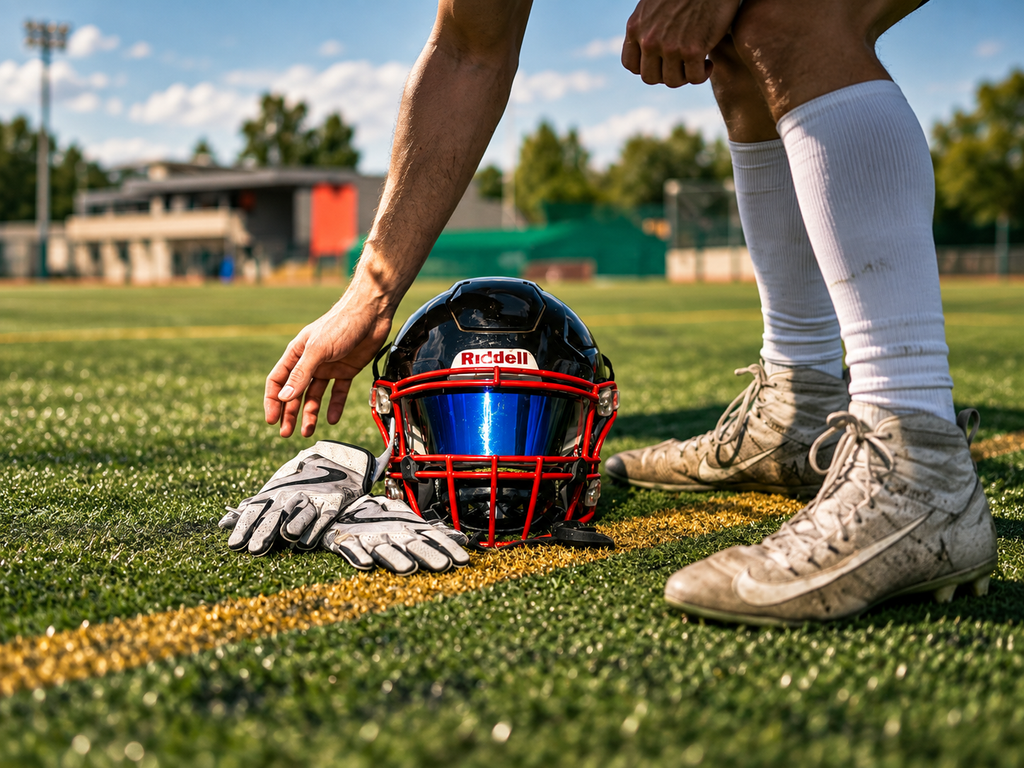
American football is a contact sport, so players wear specialized equipment designed to provide protection, support movement, and make it easier to perform their roles on the field. If you are new to the sport, the amount of gear can seem complicated at first.
This american football equipment guide for beginners explains the main pieces of football equipment, what each one does, and what a new player generally needs before taking part in organized practices or games. It also covers proper fit, equipment inspection, position-specific differences, and important considerations for youth players.
The exact equipment requirements can vary between leagues and organizations, so players should always follow the rules of their team or competition.
The Football
The football itself is the most important piece of game equipment.
An American football has an elongated shape with pointed ends, making it very different from the round balls used in many other sports. Players can carry it, throw it, catch it, kick it, and sometimes intentionally place it on the ground for certain kicks.
Football size can vary according to the age and level of the players. Younger athletes normally use smaller balls that are easier for their hands to grip and control, while adult and professional competitions use larger regulation-size footballs.
For beginners, using the correct ball size makes throwing, catching, and learning proper technique much easier.
Football Helmet
The helmet is one of the most recognizable pieces of football equipment. It is designed to help protect a player’s head during contact.
A modern football helmet normally consists of a hard outer shell, interior padding, a chin strap, and attachment points for a face mask. Different manufacturers use different padding and adjustment systems, but the helmet must fit the player’s head correctly.
A helmet that is too loose can move excessively during play. One that is too tight can be uncomfortable and may not fit as intended. USA Football recommends checking helmet fit regularly throughout the season rather than assuming that a helmet that fitted correctly once will continue to do so.
Helmets used in organized football may also need to meet specified safety standards. In the United States, NOCSAE publishes performance standards for newly manufactured and recertified football helmets.
A football helmet reduces risk, but no helmet can prevent every head injury. Players still need to use proper tackling and blocking techniques and follow the safety rules of the game.
Face Mask
The face mask attaches to the front of the helmet and helps protect the player’s face while still allowing adequate visibility.
Face masks are made in several designs. Some have relatively open fronts, while others contain additional bars around the mouth or jaw area.
The design a player uses can depend partly on position. A quarterback or wide receiver, for example, generally benefits from a wide field of vision. Linemen regularly experience close contact and may use designs that provide additional facial coverage.
The face mask should be compatible with the helmet and approved for use under the rules of the player’s organization.
Mouthguard
A mouthguard, sometimes called a mouthpiece, is worn inside the mouth to help protect the teeth and surrounding areas during contact.
For many organized football competitions, a mouthguard is required rather than optional. High school football rules administered by the National Federation of State High School Associations, for example, require tooth and mouth protectors. The NFHS also introduced additional restrictions for the 2026 season concerning attachments that do not serve a protective purpose or could create a safety risk.
A mouthguard should fit securely and allow the player to breathe and communicate comfortably.
Shoulder Pads
Shoulder pads sit underneath the jersey and cover areas including the shoulders, upper chest, and upper back.
They are built to absorb and distribute some of the forces produced during tackles, blocks, and collisions.
Shoulder pads come in different shapes and sizes. Some models are designed to provide substantial coverage for players who experience frequent contact, while others allow greater freedom of movement for positions that depend heavily on speed and arm mobility.
Proper sizing is essential. USA Football’s fitting guidance recommends measuring the player’s chest and shoulders and then checking coverage at both the front and back once the pads are secured.
Pads should remain securely positioned without unnecessarily restricting the player’s movement.
Hip, Thigh, and Knee Pads
Football players commonly wear additional padding over vulnerable areas of the lower body.
Hip pads help protect the hips and surrounding areas. Thigh pads cover the front of the upper legs, while knee pads protect the knees.
These pads are usually worn inside football pants or in specially designed compression garments that contain pockets for the pads.
Requirements can vary between levels of football. In the NFL, for example, shoulder, thigh, and knee pads are required equipment, although punters and placekickers are permitted to omit thigh and knee pads.
Beginners should not assume professional rules apply to their own league. Youth, high school, college, recreational, and professional organizations may have different equipment requirements.
Football Pants
Football pants are designed specifically to be worn with protective equipment.
Depending on the design, pads may slide into pockets inside the pants, attach separately, or be incorporated into another garment worn underneath them.
Football pants are normally close-fitting. This helps prevent loose material from interfering with movement and helps keep protective pads in their intended positions.
Players should make sure their pants are the correct size and that every required pad remains properly positioned during play.
Football Jersey
The jersey is worn over the shoulder pads.
Football jerseys are usually cut differently from ordinary shirts because they need enough room for the protective equipment underneath. They also display the player’s number, which officials, teammates, coaches, and spectators use to identify the player.
Organized leagues normally have detailed uniform rules covering features such as numbers, colors, markings, and permitted accessories.
For a beginner attending informal practice, comfort and compatibility with the shoulder pads may be the main concerns. For an official game, the team’s uniform requirements must be followed.
Football Cleats
Football cleats provide traction when players run, change direction, block, or push against an opponent.
Instead of having a smooth sole, cleats have studs or projections underneath the shoe that grip the playing surface.
Different playing surfaces may require different types of footwear. A shoe designed for natural grass may not always be the best choice for artificial turf.
Position can also influence preference. A receiver or defensive back may prioritize lightweight footwear and quick changes of direction, while a lineman may prefer additional support and traction.
Whatever the style, the cleats must fit comfortably and comply with the player’s league rules.
Football Gloves
Gloves are extremely common in modern football but are not necessary for every beginner or position.
Wide receivers, tight ends, running backs, and defensive backs often wear gloves designed to improve grip when catching or controlling the football. Linemen may use more heavily padded gloves to protect their hands during repeated contact.
Quarterbacks vary in their preferences, and some players prefer using their bare hands.
Football gloves should fit closely without restricting finger movement. Organized competitions may also regulate which gloves are permitted.
Protective Cups
Some players choose to wear a protective athletic cup to protect the groin area.
Whether a cup is required can depend on the team, player’s age, position, and league regulations. Some players find traditional cups uncomfortable when running or changing direction, while others prefer the additional protection.
Parents and youth players should check directly with their program about what is required or recommended.
Compression Gear
Compression shirts, shorts, and padded compression garments are commonly worn beneath a football uniform.
They can help keep equipment securely positioned while providing a close-fitting layer between the player’s skin and protective gear.
Some compression shorts include built-in pockets for hip, thigh, or tailbone pads. Moisture-management fabrics can also make wearing heavy equipment more comfortable during practices and games.
Compression clothing should not replace required protective equipment unless the garment is specifically designed to hold the approved pads in their correct positions.
Optional Football Accessories
Players may also use accessories that are not part of the basic protective equipment.
Common examples include:
- Arm sleeves
- Wristbands
- Hand warmers
- Towels
- Skull caps or approved head coverings
- Eye shields
- Neck or shoulder protection
- Play-call wristbands
Not every accessory is legal in every competition. Even something that appears harmless may be restricted because of its construction, color, placement, or potential safety risk.
Players should check with a coach before purchasing accessories for competition use.
Why Proper Equipment Fit Matters
Having protective equipment is not enough. It also needs to fit correctly.
A loose helmet, badly positioned shoulder pads, oversized cleats, or pads that continually move out of place can reduce comfort and may interfere with the protection the equipment is designed to provide.
Proper fit can also affect performance. A player needs to be able to run, turn, bend, throw, catch, and tackle without equipment unnecessarily restricting movement.
Helmet and shoulder-pad fitting deserve particular attention because both pieces of equipment must remain correctly positioned during repeated contact.
Beginners should get help from a knowledgeable coach or equipment manager rather than simply choosing equipment based on appearance.
Equipment Differences by Position
Every player does not necessarily wear identical equipment.
A lineman regularly makes contact with opposing players immediately after the snap, so protection and stability are important. A wide receiver spends more time sprinting, changing direction, and catching passes, so lightweight equipment and freedom of movement can be particularly valuable.
Quarterbacks need enough shoulder mobility to throw comfortably. Running backs need protection while still being able to accelerate and change direction. Kickers and punters have different movement requirements from players involved in frequent tackles and blocks.
These differences usually involve the style or design of equipment rather than eliminating essential protective gear.
Beginners should focus first on correct fit, safety, and league compliance before worrying about highly specialized position-specific equipment.
Youth vs. Adult Football Equipment
Youth players should use equipment designed and sized appropriately for their bodies.
Buying oversized equipment with the expectation that a child will “grow into it” is a poor approach to protective gear. A helmet or pair of shoulder pads needs to fit properly while the athlete is using it.
Young players can also grow considerably during a season, so equipment may need to be checked repeatedly.
Adult players generally use larger equipment, but the same principle applies: the correct size depends on the individual rather than simply the person’s age.
Youth organizations may also have their own equipment rules, so parents should obtain the program’s requirements before buying expensive gear.
Safety and Equipment Inspection
Football equipment should be inspected regularly rather than used indefinitely without attention.
Check helmets for damage, missing components, or fitting problems. Inspect face masks and attachment hardware. Look at shoulder pads for cracks or damaged straps, and make sure lower-body pads remain intact and correctly positioned.
Cleats should also be checked for excessive wear or damaged studs.
Football helmets can require professional reconditioning and recertification according to manufacturer instructions and the policies of the organization using them. NOCSAE explains that reconditioning involves inspection, cleaning, sanitizing, and repair or restoration, while recertification involves testing previously certified equipment to determine whether it continues to meet the applicable standard.
Players should never try to repair or modify critical protective equipment in ways that could affect how it performs.
League and Organization Requirements
There is no single equipment checklist that applies identically to every form of American football.
Professional leagues, college programs, high schools, youth organizations, and recreational leagues can have different rules.
For example, the NFL maintains detailed requirements covering helmets, padding, uniforms, shoes, and other player equipment. High school football operates under separate rules established by organizations such as the NFHS and individual state associations.
A beginner should therefore get an official equipment list from the team or league before purchasing gear.
What Beginners Actually Need to Get Started
For organized tackle football, a beginner will typically need the core equipment required by the team, which commonly includes:
- Helmet and face mask
- Mouthguard
- Shoulder pads
- Required hip, thigh, and knee protection
- Football pants
- Team jersey
- Football cleats
- Appropriate socks and base layers
Gloves and many other accessories may be useful, but they are not always essential.
Teams often provide certain expensive items, particularly helmets and shoulder pads. Before buying anything, ask the program what it supplies and what the player is expected to purchase personally.
That can prevent spending money on equipment that is the wrong size, incompatible with the team’s uniform, or not permitted under league rules.
Frequently Asked Questions
Do Beginners Need to Buy Their Own Football Helmet?
Not always. Many schools and youth programs provide helmets and other major protective equipment. Ask the team before purchasing one because the organization may have specific models, certification requirements, colors, or fitting procedures.
Are Football Gloves Required?
Usually not for every player. They are especially common among receivers and other players who regularly handle the ball, but whether they are required or permitted depends on the competition.
Can You Play Tackle Football Without Shoulder Pads?
Organized tackle football normally requires substantial protective equipment, including shoulder pads. The exact rules depend on the league or organization.
How Should a Football Helmet Fit?
A helmet should fit securely without excessive movement while remaining comfortable enough for proper use. Helmet fitting should be performed according to the manufacturer’s instructions and checked regularly, preferably with help from a coach or equipment professional.
Is Youth Football Equipment Different From Adult Equipment?
The basic types of protective equipment are similar, but sizing, design, and league requirements can differ. Youth players should use equipment appropriate for their current body size and competition rather than oversized adult equipment.
Key Takeaways
This american football equipment guide for beginners covers the essential gear used to protect players and help them perform effectively on the field. Helmets, face masks, mouthguards, shoulder pads, lower-body pads, football pants, jerseys, and cleats form the foundation of a typical tackle-football setup.
Gloves, compression clothing, protective cups, and other accessories can provide additional comfort, grip, or protection depending on the player and position.
Most importantly, football equipment needs to fit correctly, remain in good condition, and meet the requirements of the player’s league or organization. Beginners should check with their coach or equipment manager before buying gear and should never assume that equipment rules used in the NFL automatically apply at youth, high school, college, or recreational levels.
Choosing the right equipment is not about collecting as much gear as possible. It is about having the required protection, making sure everything fits properly, and using equipment that is appropriate for the player’s age, position, and level of football.