
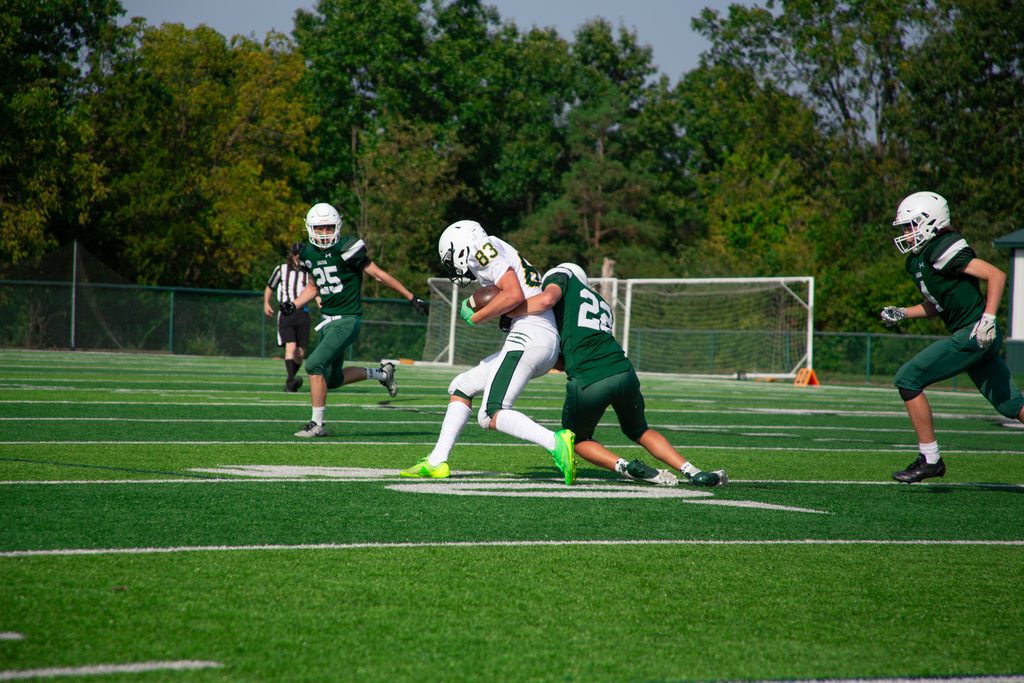
A running back receives the football and moves toward the sideline. A defender approaches from the middle of the field, trying to stop the runner before they gain another ten yards.
The defender has enough speed to reach the ball carrier, but the approach angle is too steep. As the running back changes direction, the defender loses balance and reaches with one arm. The runner escapes and continues downfield.
Now imagine the same situation with a more controlled approach. The defender tracks the runner’s movement, maintains a useful pursuit angle and adjusts their footwork as the distance closes. Instead of lunging, the defender reaches a balanced position from which a properly coached tackle can be made.
The difference is not simply strength or aggression. It is technique, positioning and decision-making.
Learning effective football tackling techniques helps developing defensive players improve their pursuit, control their movements and reduce avoidable mistakes. Tackling is a physical skill, but successful execution begins well before contact.
This guide explains how defenders approach ball carriers, maintain balance, recognize common errors and practice important tackling fundamentals. It also emphasizes safer contact principles because poor tackling habits can increase the risk of serious injury.
Tackling is inherently risky. No technique eliminates the possibility of concussion or other injury. Player-to-player contact should be taught and supervised by qualified football coaches using appropriate protective equipment and age-appropriate training standards.
Why Good Tackling Begins Before Contact
Many developing defenders think the most important part of tackling is the moment they collide with the ball carrier.
In reality, the approach often determines whether a defender reaches a useful tackling position.
Consider a defender running toward an opponent who is moving diagonally across the field.
If the defender simply aims for the runner’s current position, the ball carrier may already have moved by the time the defender arrives.
The defender must anticipate the runner’s likely path, maintain balance and adjust as the situation changes.
Three abilities are especially important:
- Tracking: Following the ball carrier’s movement while accounting for speed and direction.
- Positioning: Approaching from a useful angle and maintaining defensive leverage.
- Control: Managing acceleration and footwork so the defender can react rather than overcommit.
Contact technique builds on these fundamentals.
A player who reaches the correct position under control gives themselves a better opportunity to execute the tackling technique taught by their coach.
Understand Defensive Leverage
Leverage describes the defender’s positioning relative to the ball carrier, field boundaries, teammates and defensive assignment.
Good leverage helps a defender limit the runner’s available choices.
Inside-Out Leverage
Imagine a defender approaching a ball carrier near the sideline.
Depending on the defensive assignment, the defender may need to maintain inside-out leverage, approaching from inside the runner’s path while preventing an easy return toward the middle.
The sideline can limit the available running space.
However, this does not mean every defender should automatically force the runner outside. Defensive leverage depends on the team’s scheme and where teammates are positioned.
Outside-In Leverage
In another situation, a defender may be responsible for protecting the outside edge and preventing the runner from escaping toward the sideline.
That defender must maintain outside leverage and work with inside pursuit.
If they abandon the outside position too early, the runner may exploit the open space.
Know Your Assignment
A defender’s responsibility is not always to reach the ball carrier by the shortest possible route.
Sometimes the correct responsibility is to contain the runner, maintain a gap or direct the play toward supporting defenders.
A player who abandons an assigned position may create a larger opening even if they appear to be pursuing aggressively.
Understanding leverage makes tackling more than an individual challenge. It becomes part of coordinated defensive play.
Take Better Pursuit Angles
A pursuit angle is the path a defender takes to reach a moving ball carrier.
Poor pursuit angles are a common cause of missed tackles.
Avoid Chasing the Runner’s Current Position
Imagine a running back moving toward the right sideline.
A defender begins several yards behind and inside the runner.
If the defender runs directly toward the spot where the running back currently stands, they may remain behind throughout the play.
Instead, the defender needs to pursue an appropriate future meeting point based on the runner’s speed, direction and available field space.
That approach is commonly called taking an angle of pursuit.
Adjust as the Runner Changes Direction
A useful pursuit angle is not necessarily fixed.
Ball carriers accelerate, slow down and change direction. Defenders must respond without making uncontrolled movements.
As the distance closes, a defender may need to adjust stride length and body position.
The objective is to reach the runner with enough control to react to a final movement.
Understand the Role of Teammates
Pursuit changes when several defenders are involved.
An outside defender may maintain contain responsibility while an inside defender approaches the runner.
If both defenders take the same path, they may leave another escape route available.
Coaches should explain how individual pursuit responsibilities fit within the defensive system.
For intermediate players, this awareness is an important step beyond simply running toward the football.
Maintain a Balanced Athletic Position
Balance allows defenders to react to movement without unnecessary hesitation.
A player approaching too upright may struggle to change direction. A player leaning excessively forward may fall or lunge when the runner moves.
Keep the Knees and Hips Ready to Move
During non-contact tracking drills, practice maintaining a comfortable athletic position with the knees and hips slightly flexed.
Keep your weight controlled and your feet positioned to support movement.
Avoid locking your knees or bending entirely at the waist.
As you approach a moving target, use shorter, controlled steps when necessary to manage momentum.
Keep Your Eyes on the Ball Carrier’s Movement
A ball carrier may use head movement, shoulder fakes or changes in stride to influence a defender’s reaction.
Tracking the runner’s hips can provide a useful reference because the hips are closely connected to the direction of the runner’s body.
However, defenders should remain aware of the surrounding field, blockers and other players.
Do not stare at one body part so intensely that you lose awareness of the play.
Avoid Overcommitting
Overcommitting occurs when a defender moves too aggressively in one direction and cannot recover when the ball carrier changes course.
A defender might sprint directly at a runner, plant too late and slide past the intended position.
Controlled deceleration and proper foot placement can help reduce this problem.
The goal is not to approach slowly. It is to preserve the ability to react as the distance closes.
Understand Safer Shoulder-Led Tackling Principles
Once a defender reaches an appropriate position, the next concern is contact technique.
This is where qualified coaching becomes essential.
American football involves substantial collision forces, and incorrect contact mechanics can expose players to head, neck and other injuries.
Keep the Head Out of the Contact
Defenders should never deliberately use the helmet or head as a weapon.
Leading with the crown of the helmet, initiating head-first contact or forcing the head across the front of the runner’s path can create dangerous situations.
Properly coached shoulder tackling emphasizes using the shoulder as the initial contact surface while keeping the head away from the primary impact.
The exact body alignment and contact target depend on the situation and the tackling system being taught.
Players should learn these details directly from trained coaches rather than attempting contact techniques from written instructions alone.
Maintain Strong Body Position
Poor body position can make the head, neck and shoulders more vulnerable during a collision.
A controlled approach helps the defender avoid arriving in an awkward or unstable posture.
During supervised training, coaches evaluate whether the player maintains appropriate alignment, uses the correct contact surface and keeps the head away from dangerous contact positions.
The objective is to develop repeatable mechanics without relying on reckless force.
Learn to Secure the Ball Carrier
A tackle must also prevent the ball carrier from continuing forward.
Coached tackling systems commonly include securing the opponent with the arms after appropriate shoulder contact.
The defender’s grip, body position and finishing movement depend on the tackle type and the relative movement of both players.
These skills should first be developed through non-contact positioning exercises and suitable training equipment before progressing to controlled contact.
Do not practice bringing another person to the ground without qualified supervision.
Common Football Tackling Mistakes
Recognizing mistakes is useful because many missed tackles begin with a predictable problem in positioning or movement.
Mistake 1: Leading With the Head
One of the most serious errors is attempting to initiate contact with the helmet.
This can expose both players to dangerous head and neck forces.
Correction: Never initiate a tackle head-first. Learn approved shoulder-led techniques from a qualified coach, and keep the head out of the contact path.
Mistake 2: Lunging From Too Far Away
A defender may attempt to reach the ball carrier before closing the distance properly.
When the runner changes direction, the defender has little opportunity to adjust.
Correction: Improve tracking and closing footwork through non-contact approach drills. Practice reaching a balanced position instead of diving toward a target.
Mistake 3: Using Only the Arms
An arm-only tackle attempt often occurs when a defender is out of position or reaches while off-balance.
The defender may contact the runner but fail to maintain control.
Correction: Work on pursuit angles, balanced positioning and coached contact preparation rather than trying to compensate with an extended arm.
Mistake 4: Taking a Poor Pursuit Angle
A defender who chases directly behind a faster ball carrier may never close the distance.
Another defender may approach at such a steep angle that the runner easily changes direction.
Correction: Practice anticipating the runner’s path while maintaining the leverage required by the defensive assignment.
Mistake 5: Arriving Out of Control
Excessive speed without proper positioning can make a defender vulnerable to sudden directional changes.
Correction: Develop controlled acceleration and deceleration. Learn when to shorten steps and prepare for the runner’s movement.
Mistake 6: Looking Down Before Contact
Dropping the head toward the ground can reduce awareness and place the neck in a dangerous position.
Correction: Keep the head out of contact and maintain the posture taught by your coach. Never drive forward with the top of the helmet.
Mistake 7: Ignoring Defensive Responsibilities
A defender may abandon their assigned gap or contain responsibility while trying to make a dramatic tackle.
Correction: Maintain team leverage and understand when your role is to direct the runner toward supporting defenders.
Practice Tackling Fundamentals Without Player Contact
Many important tackling abilities can be developed without collisions.
Non-contact practice is especially useful for improving pursuit, footwork, balance and recognition.
These exercises do not replace supervised contact instruction, but they provide a foundation for it.
Drill 1: Pursuit Angle Tracking
Purpose: Improve the ability to approach a moving target along a useful path.
Set up a safe area on a football field.
A partner carrying a football moves along a predetermined route. The defender begins from a separate starting location.
The defender tracks the runner and moves toward an appropriate interception point.
End the repetition before contact.
Review whether the defender maintained a useful approach angle and adjusted effectively as the runner moved.
Repeat using different starting positions.
Drill 2: Controlled Closing Footwork
Purpose: Improve deceleration and balance when approaching a target.
Place a cone several yards from the starting position.
The defender accelerates toward the cone, then transitions into shorter, controlled steps while maintaining balance.
Finish at a marked stopping point without contacting another player.
A coach can observe whether the player remains too upright, overstrides or loses balance.
Drill 3: Mirror Movement
Purpose: Improve reaction and lateral movement.
Two players face one another several yards apart.
One player moves laterally within a clearly defined area while the other mirrors their movement.
Maintain enough separation to avoid contact.
Focus on controlling body position and responding to directional changes.
Begin slowly and increase speed only when movement remains stable.
Drill 4: Leverage Positioning
Purpose: Improve awareness of inside and outside responsibilities.
Use cones to mark the sideline boundary, ball carrier’s route and defender’s assigned leverage.
A runner moves through the marked area while the defender tracks from an assigned position.
The defender attempts to maintain the required leverage without making contact.
Review whether the defender stayed in the proper relationship to the runner and available space.
Drill 5: Pursuit With Supporting Defenders
Purpose: Improve coordinated defensive pursuit.
Assign two defenders different pursuit responsibilities.
A ball carrier follows a predetermined running path.
Each defender moves into the position required by the assigned role.
End the drill before contact.
A coach reviews whether the defenders maintained complementary angles or unintentionally opened an escape path.
This drill reinforces the idea that tackling depends partly on teamwork and positioning.
How Coaches Progress Toward Contact Training
Developing tackling ability requires a structured progression rather than immediately practicing full-speed collisions.
A qualified coach may use several stages:
| Training stage | Primary purpose |
|---|---|
| No-contact movement | Develop tracking, leverage and footwork |
| Training equipment | Introduce coached contact positioning using suitable pads or bags |
| Controlled partner contact | Develop technique at restricted speed and intensity |
| Supervised game simulation | Apply approved skills in increasingly realistic situations |
Players should not advance simply because they have completed a fixed number of repetitions.
Coaches must consider age, physical development, experience, readiness, equipment and governing-body requirements.
Full-contact practice is not appropriate as an unsupervised activity.
Why Tackling Technique Matters for Player Safety
No tackling technique can make collision sports risk-free.
However, proper coaching, controlled practice progressions and avoiding prohibited contact can help address preventable risks.
Never Target the Head or Neck
Players must not deliberately initiate contact with the head or target another player’s head or neck.
Helmet-to-helmet contact, spearing and other dangerous techniques can cause serious injury and may violate applicable playing rules.
Rules differ by league and level, so players should learn the standards that govern their competition.
Recognize Possible Concussion Symptoms
A concussion may occur after a blow to the head or a forceful impact transmitted through the body.
Warning signs can include headache, dizziness, confusion, balance problems, nausea or unusual behavior.
A player does not need to lose consciousness to have a concussion.
If a concussion is suspected, the player must be removed from participation immediately.
They should not return the same day and must receive appropriate healthcare assessment and clearance before returning to sports.
Emergency warning signs, such as worsening headache, repeated vomiting, seizures or decreasing consciousness, require immediate emergency medical attention.
Respect Equipment Limitations
Helmets and shoulder pads are important protective equipment, but they do not eliminate injury risk.
Proper equipment fit and maintenance matter.
Players should not treat protective equipment as permission to initiate reckless contact.
Report Pain and Injuries
Players should communicate significant discomfort or injury symptoms to their coach, athletic trainer or healthcare professional.
Neck pain, neurological symptoms or suspected spinal injury require particular caution.
Do not attempt to move a player with a suspected serious neck or spinal injury unless necessary to address an immediate danger. Activate emergency medical services and follow trained emergency-response procedures.
How to Evaluate Tackling Improvement
Defensive development should not be judged only by the number of tackles recorded during games.
A player may record many tackles while consistently taking poor pursuit angles or abandoning assignments.
Instead, coaches can evaluate several technical qualities.
| Skill | What to Observe |
|---|---|
| Pursuit angle | Does the defender approach an appropriate meeting point? |
| Leverage | Does the defender maintain the assigned inside or outside responsibility? |
| Balance | Can the defender adjust without falling or lunging? |
| Footwork | Does the defender control speed while closing distance? |
| Awareness | Does the defender account for teammates and field position? |
| Coached contact mechanics | Does the player consistently follow the approved tackling system? |
Video review can help identify recurring movement errors.
For example, if a defender repeatedly misses runners near the sideline, a coach can examine whether the problem begins with poor leverage, incorrect pursuit angles or uncontrolled footwork.
Correcting the underlying issue is often more useful than simply telling the player to tackle harder.
Build a Focused Defensive Practice Routine
Intermediate players benefit from organized practice sessions with specific objectives.
A sample non-contact session might include:
| Activity | Approximate time |
|---|---|
| Dynamic warm-up | 5–10 minutes |
| Tracking and pursuit angles | 10 minutes |
| Closing footwork | 5–10 minutes |
| Leverage and mirror drills | 10 minutes |
| Coach feedback and review | 5 minutes |
The duration should be adjusted to the athlete’s age, experience, conditioning and overall team practice schedule.
Contact portions, when appropriate, should be planned separately by qualified coaches and conducted according to applicable safety guidelines.
Do not increase contact intensity simply because a player appears comfortable during a non-contact drill.
Progression should be based on demonstrated technique, readiness and coaching judgment.
Applying Tackling Fundamentals During Games
During competition, defenders rarely encounter ideal, stationary tackling situations.
Ball carriers change direction, blockers interfere and teammates approach from different positions.
That makes preparation particularly important.
Open-Field Situations
An open-field defender may need to cover considerable ground before reaching the runner.
Pursuit angle and controlled closing speed become especially important.
A player who overcommits may allow the ball carrier to escape into open space.
Sideline Situations
Near the sideline, a defender should understand whether the boundary is helping limit the runner’s options.
The correct approach depends on the player’s leverage assignment and nearby support.
Maintaining position may be more important than attempting an aggressive individual tackle.
Crowded Running Plays
Near the line of scrimmage, defenders encounter blockers and limited space.
The defender must understand gap responsibilities and remain aware of surrounding players.
Poor positioning in crowded areas can create dangerous collisions or open running lanes.
Multiple-Defender Pursuit
When several defenders approach the ball carrier, communication and assignment awareness remain important.
Players must avoid uncontrolled collisions with teammates or other defenders.
Proper team pursuit helps maintain leverage and reduces the need for desperate recovery attempts.
Final Thoughts: Better Tackling Starts With Better Control
Improving football tackling techniques requires more than speed, size or physical aggression.
Reliable defensive performance begins with recognizing the runner’s path, taking effective pursuit angles and maintaining the balance needed to respond to changing situations.
Good defenders understand their leverage responsibilities and work with teammates rather than abandoning assignments to chase every tackle.
They also recognize that tackling is a technical contact skill requiring professional instruction and structured development.
Start with non-contact footwork, tracking and positioning drills. Learn shoulder-led contact techniques only under qualified supervision, and consistently avoid dangerous head-first contact.
By developing disciplined movement and understanding common tackling mistakes, players can become more dependable defenders while giving appropriate attention to safety.
Explore more Intermediate American Football Guides to develop your defensive skills, or visit the American Football Learning Path for structured lessons that build your understanding of the game.