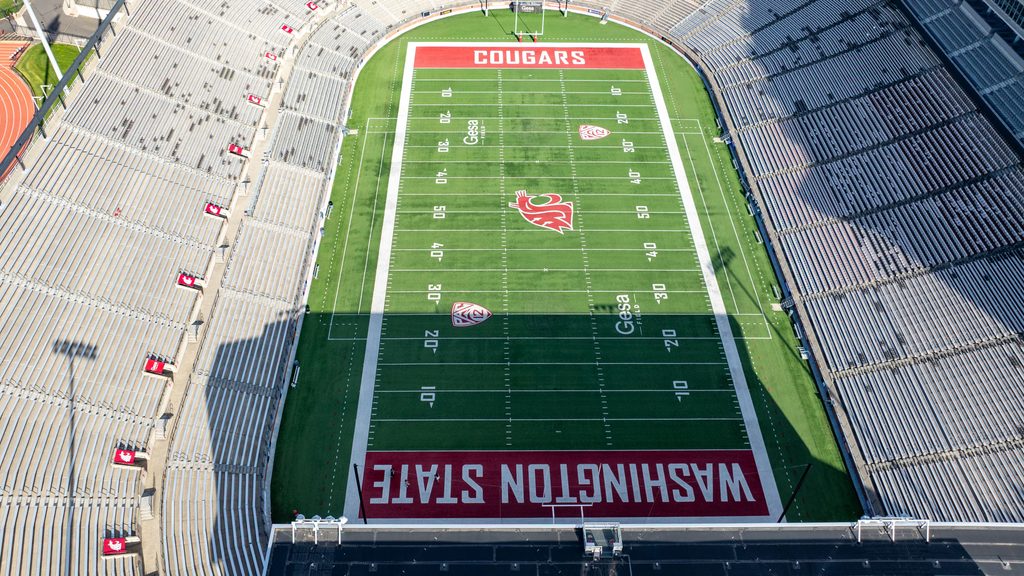
Overall Dimensions: How Big Is a Football Field?
An American football field is a rectangle with precise, standardized dimensions used at every level of organized play. Understanding those dimensions gives you a spatial foundation for everything else on the field.
The playing field measures 100 yards long and 53⅓ yards wide. At each end of the 100-yard playing field sits an end zone, each 10 yards deep. That makes the total length of the field 120 yards from end line to end line. In feet, the total length is 360 feet and the width is 160 feet.
To put 100 yards in perspective: it is the length of a standard city block in many U.S. grids, or roughly the distance of a 10-second sprint for a trained athlete. The width of 53⅓ yards is just under half the length, giving the field a noticeably elongated shape that channels play toward the end zones.
These dimensions are identical in the NFL and college football (NCAA). High school fields use the same overall measurements. The differences between levels appear in specific markings, particularly hash marks, which are covered below.
Yard Lines and the Numbering System
The playing field is divided by a series of horizontal lines running the full width of the field, parallel to the goal lines at each end.
- • Lines appear every 5 yards across the full 100-yard playing field.
- • Numbered yard lines appear every 10 yards, marked with large numerals painted on the field surface.
- • Numbering starts at 10 near each goal line and counts up to 50 at the midfield line, then counts back down to 10 on the other side.
This means the field is symmetrical. The 50-yard line sits exactly at the center. A team’s own 20-yard line is 20 yards from their own goal line and 80 yards from the opponent’s goal line. When broadcasters or coaches refer to “field position,” they are describing where the ball sits within this numbering system.
Reading field position correctly requires knowing which team’s side of the field the ball is on. A ball on a team’s own 30-yard line is 30 yards from that team’s goal line. The same physical spot is also the opponent’s 70-yard line, though that phrasing is rarely used. Convention is to describe position from the perspective of the team that possesses the ball.
Between the numbered 10-yard lines, shorter tick marks appear at every 1-yard interval along the sidelines. These single-yard marks help officials and players judge precise distances, particularly when measuring whether a team has gained the 10 yards needed for a first down.
Hash Marks: Spotting the Ball and Why Position Matters
Running parallel to the sidelines and perpendicular to the yard lines, hash marks are two rows of short lines that run the length of the field inside the sidelines. Their primary function is to determine where the ball is placed, or spotted, at the start of each play.
When a play ends and the ball carrier is stopped between the hash marks, the ball is spotted at the exact location where the play ended. When a play ends outside the hash marks—closer to a sideline—the ball is moved inward and spotted on the nearest hash mark. This rule keeps the offense from starting every play from an extreme angle near the sideline, which would severely limit their options.
The distance between the two rows of hash marks differs significantly by level of play, and this is one of the few level-specific differences that genuinely affects how the game looks:
| Level | Distance Between Hash Marks | Distance from Each Sideline |
|---|---|---|
| NFL | 18 feet 6 inches apart | Approximately 70 feet 9 inches from each sideline |
| NCAA (College) | 40 feet apart | Approximately 60 feet from each sideline |
| High School | 53 feet 4 inches apart | Approximately 53 feet 4 inches from each sideline |
In the NFL, the hash marks are very close together near the center of the field. This means nearly every play starts from a relatively central position, giving offenses more room to attack either side. In high school football, the hash marks are much wider and sit closer to the sidelines, which can create more asymmetric field geometry and limit certain play designs. College sits between the two. When watching games at different levels, the width of the hash marks is one of the first structural differences you will notice.
Sidelines, End Lines, and the Out-of-Bounds Rule
The field is bordered by four boundary lines that define what is in bounds and what is out of bounds.
- • Sidelines run along the two long edges of the field, from end line to end line. They mark the lateral boundary of the playing area.
- • End lines run along the two short edges of the field, at the back of each end zone. They mark the deepest boundary of the playing area.
A player or the ball is considered out of bounds when either touches or crosses a sideline or end line. In the NFL, a receiver must have both feet land in bounds while in possession of the ball for a catch to be ruled complete. In college football, only one foot in bounds is required. This is a meaningful rule difference that affects how receivers run routes near the sideline.
The boundary lines themselves are considered out of bounds. A player standing with one foot on the sideline and one foot in the field is out of bounds. Officials watch the lines closely on every play, particularly on passing plays near the edges of the field.
Beyond the sidelines and end lines lies a team area and then spectator space. Players, coaches, and team personnel are restricted to designated zones along the sidelines during play. These areas are not part of the playing field.
The Goal Line and End Zone
At each end of the 100-yard playing field, a goal line marks the boundary between the field of play and the end zone. The goal line is the threshold a ball carrier or receiver must cross—or reach—to score a touchdown.
The concept of breaking the plane is central here. The goal line extends vertically upward as an imaginary plane. A touchdown is scored the moment the ball crosses that vertical plane, even if the ball carrier is immediately stopped or pushed back. The ball does not need to reach the ground in the end zone; it only needs to cross the plane while the player is in possession.
The end zone is the 10-yard area between the goal line and the end line. It is the scoring area for touchdowns and is also where receivers can catch touchdown passes. A player who catches a pass while standing in the end zone, with both feet (NFL) or one foot (college) in bounds, has scored.
End zones are typically painted with the team name or city name and often feature distinctive color schemes. While visually prominent, these markings are decorative and have no effect on the rules of play.
Goalposts: Placement and Basic Specifications
Each end zone contains one goalpost, positioned at the back of the end zone on the end line. In both the NFL and college football, the goalpost sits at the rear of the end zone, 10 yards behind the goal line.
The structure consists of a single vertical post rising from the ground, which then branches into a horizontal crossbar with two vertical uprights extending upward from its ends. Key measurements:
- • The crossbar sits 10 feet above the ground.
- • The uprights extend 30 feet above the crossbar in the NFL (35 feet in college).
- • The width between the uprights is 18 feet 6 inches at all levels of professional and college play.
The goalpost is the target for field goal attempts and extra point kicks. A kicked ball must pass between the uprights and above the crossbar to count. The scoring rules for these plays are covered in the Scoring lesson.
The Red Zone: An Unofficial but Essential Concept
The red zone is not painted on the field and does not appear in the official rulebook. It is a widely used strategic term referring to the area from the opponent’s 20-yard line to the opponent’s goal line—the final 20 yards before a touchdown.
The term exists because field geometry changes meaningfully in this area. With only 20 yards of depth available behind the defense, the defense has less space to cover and can compress its coverage. The offense has fewer yards to work with for route combinations and running lanes. Scoring becomes harder per yard gained, which is why teams track red zone efficiency—how often they score touchdowns versus settling for field goals when they reach this area.
When a broadcast graphic shows a team’s red zone statistics, it is measuring performance inside that opponent’s 20-yard line. Recognizing where the 20-yard line is on the field lets you immediately understand why play-calling and defensive alignment shift when a team crosses into that territory.
The Line of Scrimmage: The Field’s Moving Boundary
The line of scrimmage is not a painted line. It is an imaginary line that runs the full width of the field at the location where the ball is placed before each play begins. It resets after every play based on where the ball is spotted by the officials.
Before the ball is snapped to start a play, the line of scrimmage acts as a boundary for both teams. Offensive players must be on their side of the line; defensive players must be on theirs. The ball itself sits on the line of scrimmage, and the play begins when the center snaps the ball backward to the quarterback.
Because the line of scrimmage is defined by ball placement rather than a fixed marking, it moves constantly throughout the game. After a 12-yard gain, the line of scrimmage advances 12 yards toward the opponent’s end zone. After a 5-yard loss, it moves back 5 yards. Every play in football is organized around this moving reference point.
Understanding the line of scrimmage as a field-based concept—tied to the yard lines and hash marks already described—gives you the spatial framework to follow what is happening on every snap. When you watch a play develop, the line of scrimmage is the starting point from which all movement is measured.
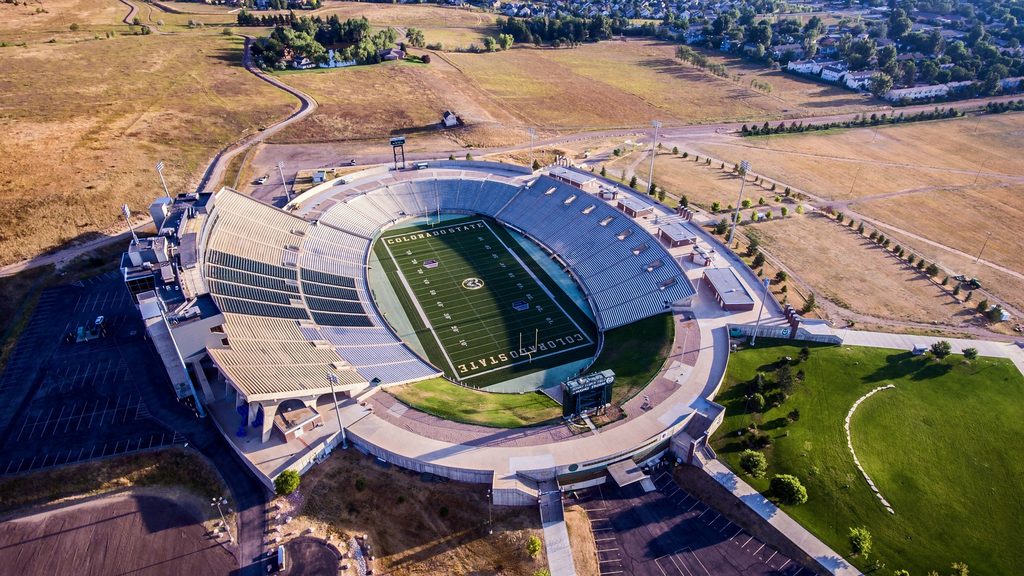
American Football Articles for Beginners
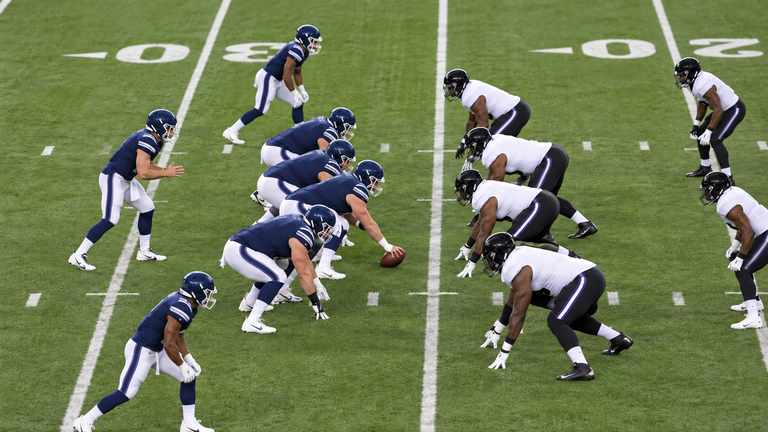
American Football Basics: How the Game Works
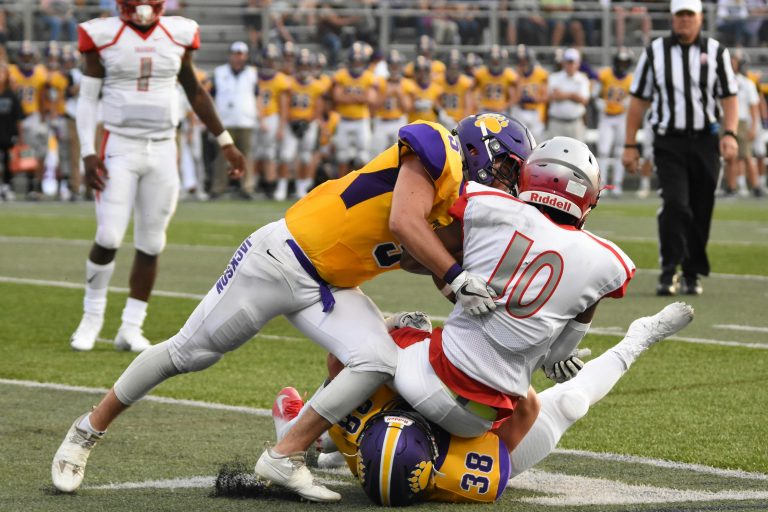
American Football Terms Every Beginner Should Know