

Golf has a vocabulary of its own. When you first hear golfers talk about a tee time, lie, approach shot, fade, or up and down, it can sound as though everyone else already knows a language you have not learned yet.
Fortunately, many common golf terms describe straightforward things: when you play, how the ball is sitting, what type of shot was played, or what the ball did after it was struck. Learning these basic golf terms for beginners makes instruction easier to follow and conversations on the course much easier to understand.
You do not have to memorize a dictionary of golf terminology. Start with the words you are most likely to hear and use.
Why Golf Has Its Own Language
Golf has developed specialized terminology because players regularly need to describe specific situations quickly and accurately.
A golfer might say, “My lie is good, so I’m going to hit an approach shot,” or, “I hit that one thin and it faded right.” Each term communicates something different. Lie describes how the ball is resting, approach shot describes the purpose of the shot, thin describes the contact, and fade describes the ball flight.
Understanding these distinctions is useful because golf instruction depends on precise language. A slice and a push, for example, can both finish to the right for a right-handed golfer, but they do not describe the same ball flight.
Basic Golf Terms Used Before You Play
Several common golf terms appear before anyone hits a shot.
Tee Time
A tee time is the scheduled time when your group is due to begin its round.
If your tee time is 9:10 a.m., that does not normally mean arriving at the golf course at 9:10. It means your group is scheduled to start playing at approximately that time.
Green Fee
A green fee is the charge for playing a golf course.
Despite the name, it does not mean a fee specifically for using the putting greens. It refers to the fee charged for access to play the course.
Foursome
A foursome commonly refers to a group of four golfers playing together.
You may hear someone say, “We have a foursome at 10:30,” meaning four golfers are scheduled to play as a group.
Starter
A starter is a person who helps organize golfers as they begin their rounds. At courses that use one, the starter may confirm groups, manage the order of play, and direct golfers to the first tee at the appropriate time.
Caddie
A caddie assists a golfer during a round. Depending on the situation, a caddie may carry the golfer’s bag and provide information or advice during play.
A caddie is different from a golf-cart attendant or other course employee. The caddie’s role is specifically connected to assisting the golfer.
Terms Used When Preparing to Hit
Golfers also use several important words to describe the situation before a stroke begins.
Address
Address refers to the position a golfer takes in preparation to make a stroke.
If an instructor says, “Look at your position at address,” the instructor is referring to your pre-swing position rather than a location on the golf course.
Lie
The lie describes how and where the golf ball is resting.
For example, a ball sitting cleanly on short grass has a different lie from a ball sitting down in longer grass. Golfers may describe a lie as good, clean, poor, tight, or buried, depending on the situation.
The important distinction is that the lie describes the ball’s resting situation—not the direction you want to hit it.
Target
The target is where you intend the ball to go.
A target can be a specific location rather than simply the final destination of the hole. Golfers often use a tree, section of the course, or another visible reference as a target.
Line
A line is the intended direction along which a golfer wants the shot to travel.
Target and line are related, but they are not identical. The target is the intended destination or reference point; the line describes the intended direction toward it.
Common Golf Shot Terms
Golf shots are often named according to where they are played or what the golfer is trying to accomplish.
Did you know?
The word “mulligan” means an informal do-over—a golfer replays a shot without counting the original in the usual way. It’s a popular casual-golf tradition, but it isn’t an automatic right under the official Rules of Golf.
Drive
A drive is a long shot generally played from the tee. The word describes the shot rather than a specific swing technique.
Although drives are strongly associated with the driver, golfers can use other clubs from the tee as well.
Approach Shot
An approach shot is a shot intended to reach the putting green or finish close to it.
The term describes the purpose of the shot. It does not identify one particular club or distance.
Lay-Up
A lay-up is a deliberately shorter shot played instead of attempting a more difficult or distant target.
Imagine a golfer who could attempt to reach a distant target but chooses to hit to a closer, more manageable location instead. That intentional shorter shot is a lay-up. It should not be confused with simply failing to hit the ball far enough—the shorter result is deliberate.
Chip
A chip is a short shot played around the green that generally has relatively low flight and then rolls after landing.
Pitch
A pitch is another short shot played around the green, but it generally flies higher than a chip.
This distinction is useful when listening to golf instruction: chip and pitch are not simply two interchangeable names for every short shot near a green.
Putt
A putt is a rolling shot normally played on the putting green.
The defining idea is that the golfer is primarily trying to roll the ball rather than send it through the air.
Common Ball-Flight Terms
Ball-flight terminology describes what the ball does after it leaves the clubface. Directional descriptions are normally given from the golfer’s perspective.
For a right-handed golfer, right and left in the definitions below refer to the target direction as that golfer sees it. For a left-handed golfer, the directional descriptions reverse.
Slice
A slice is a shot that curves significantly to the right for a right-handed golfer and to the left for a left-handed golfer.
The important word is curves. A slice is not simply any shot that finishes to that side.
Hook
A hook curves significantly to the left for a right-handed golfer and to the right for a left-handed golfer.
A hook is essentially the opposite directional curve from a slice.
Fade
A fade is a shot with controlled curvature from left to right for a right-handed golfer, or right to left for a left-handed golfer.
A fade and a slice curve in the same general direction, but the terms are not normally used interchangeably. A fade generally describes a more controlled, moderate curve; a slice usually describes greater and often unwanted curvature.
Draw
A draw is a shot with controlled curvature from right to left for a right-handed golfer, or left to right for a left-handed golfer.
A draw and hook curve in the same general direction, but a draw usually describes controlled curvature, while a hook describes a more pronounced curve.
Push
A push starts to the right of the intended direction for a right-handed golfer and generally stays on that side without the pronounced curvature that defines a slice. For a left-handed golfer, a push starts left.
Pull
A pull starts to the left of the intended direction for a right-handed golfer and generally stays on that side without the pronounced curvature that defines a hook. For a left-handed golfer, a pull starts right.
This creates an important vocabulary distinction:
- Push and pull primarily describe directional starts.
- Slice, hook, fade, and draw describe curvature.
That distinction makes golf conversations much more precise.
Did you know?
The flag on a flagstick can help golfers judge wind direction and strength near the green. Watching how it moves can provide a useful clue about conditions before playing a shot.
Common Ball-Contact Terms
Not every poor golf shot is described by its direction. Golfers also use specific words for the type of contact made between the club and ball.
Fat Shot
A fat shot occurs when the club strikes the ground too far behind the ball before reaching it.
Because the ground interferes with the club before contact with the ball, the shot often loses considerable energy and travels shorter than intended. You may also hear this called a heavy shot.
Thin Shot
A thin shot occurs when the club contacts the ball too low relative to the intended strike, rather than producing more centered contact.
Thin shots often launch lower and can feel harsh through the hands. Depending on the club and severity of the strike, the ball may still travel a considerable distance.
Topped Shot
A topped shot occurs when the club strikes the upper portion of the ball. The ball commonly stays very low and may run along the ground.
A topped shot and a thin shot are therefore related descriptions of poor contact, but they are not identical. Topping is the more extreme form in which contact occurs high on the ball.
Shank
A shank is a severe mishit in which the ball is struck by the hosel area of the club rather than the intended clubface.
The hosel is the part of the clubhead where the shaft connects to the head. A shank typically sends the ball sharply away from the intended direction.
Pure or Solid Contact
Golfers often describe a well-struck shot as pure or solid.
These are common expressions rather than descriptions of a particular shot shape. They generally mean the golfer made clean, centered contact and the strike felt and sounded good.
Common Golf Expressions
Some of the most useful golf vocabulary does not describe the swing or ball flight at all.
Fore
Fore! is a warning shouted when a golf ball may be heading toward another person.
It is a safety warning, so it should be loud enough for people in danger to hear it.
Mulligan
A mulligan is an informal replay of a shot without counting the original shot in the usual way.
Mulligans are common in some casual games, but the term describes an informal convention rather than a standard entitlement under the official Rules of Golf.
Gimme
A gimme is a very short putt that another player informally concedes, meaning the golfer does not physically have to hole the putt.
Like a mulligan, a gimme is associated with informal or certain agreed forms of play rather than something a golfer can automatically claim whenever a putt is close to the hole.
Up and Down
Getting up and down means completing the hole in two strokes from a position around the green: one stroke gets the ball onto or toward the green, and the next stroke holes the ball.
For example, if your ball is just off the green, you chip it close and then make the putt, you have gotten up and down.
Scramble
A scramble commonly refers to a team format in which multiple players hit shots, the team selects a preferred result, and the players continue from that selected location.
The word can have other golf-related uses, so context matters. If someone says, “We’re playing in a charity scramble,” they are usually referring to this team format.
Golf Words Beginners Often Confuse
Some golf terms sound interchangeable in everyday conversation but have different meanings.
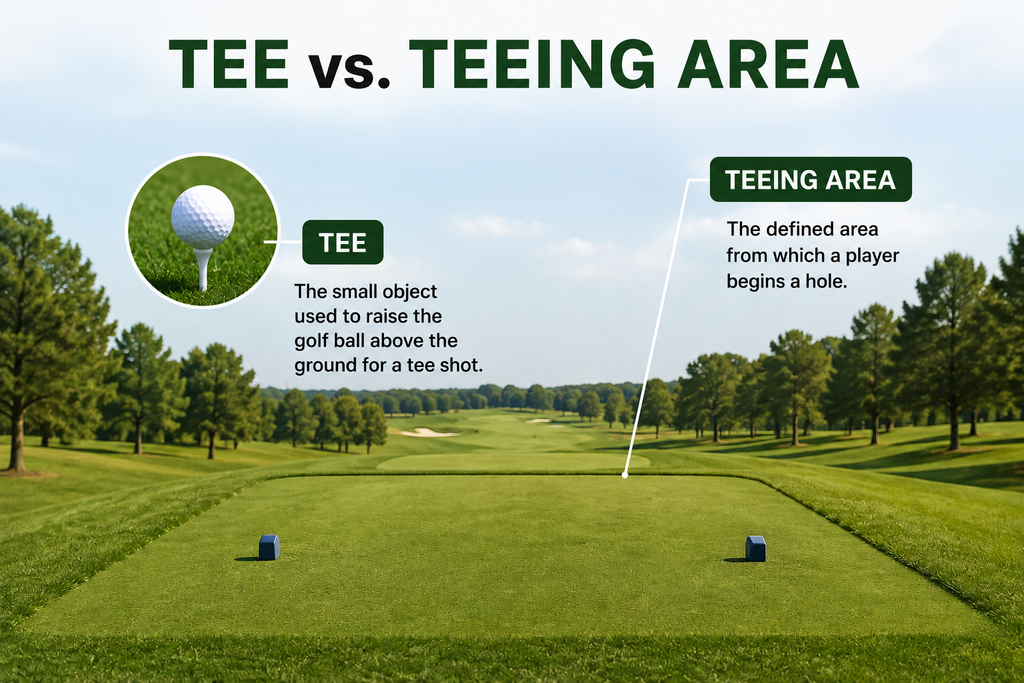
Tee vs. Teeing Area
A tee is the small object that can be used to raise the golf ball above the ground for a tee shot.
The teeing area is the defined area from which a player begins a hole.
Golfers casually call the whole starting location “the tee,” but the two terms technically describe different things.
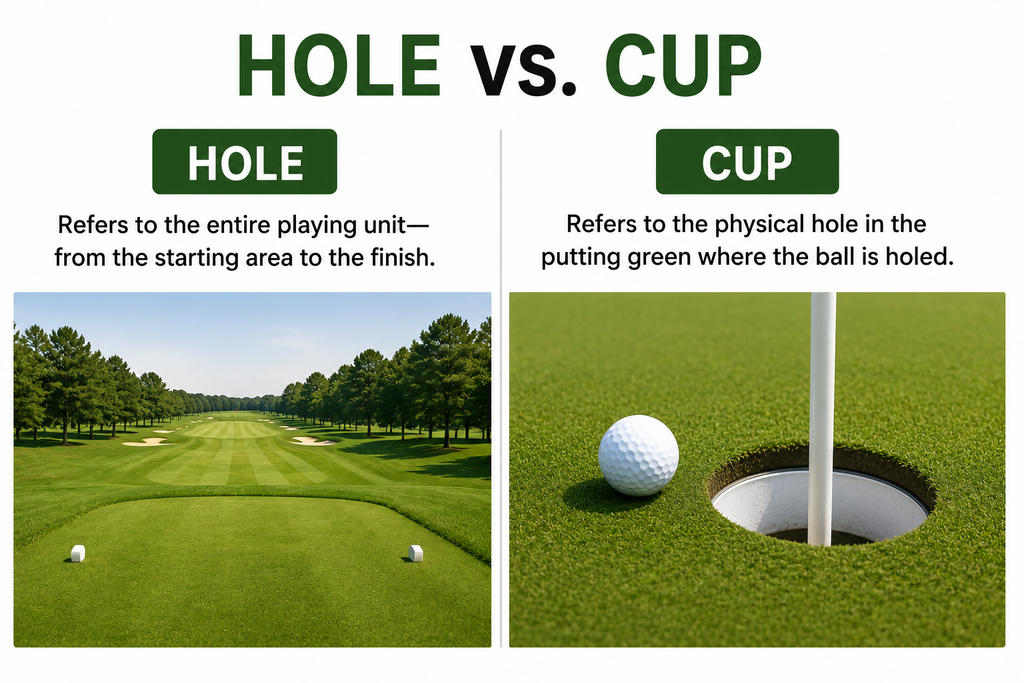
Hole vs. Cup
The cup is the physical hole in the putting green into which the ball is played.
The word hole can refer to that cup, but it also commonly refers to the entire playing unit—from its starting area to its finish. So “the sixth hole” means much more than the small opening in the green.
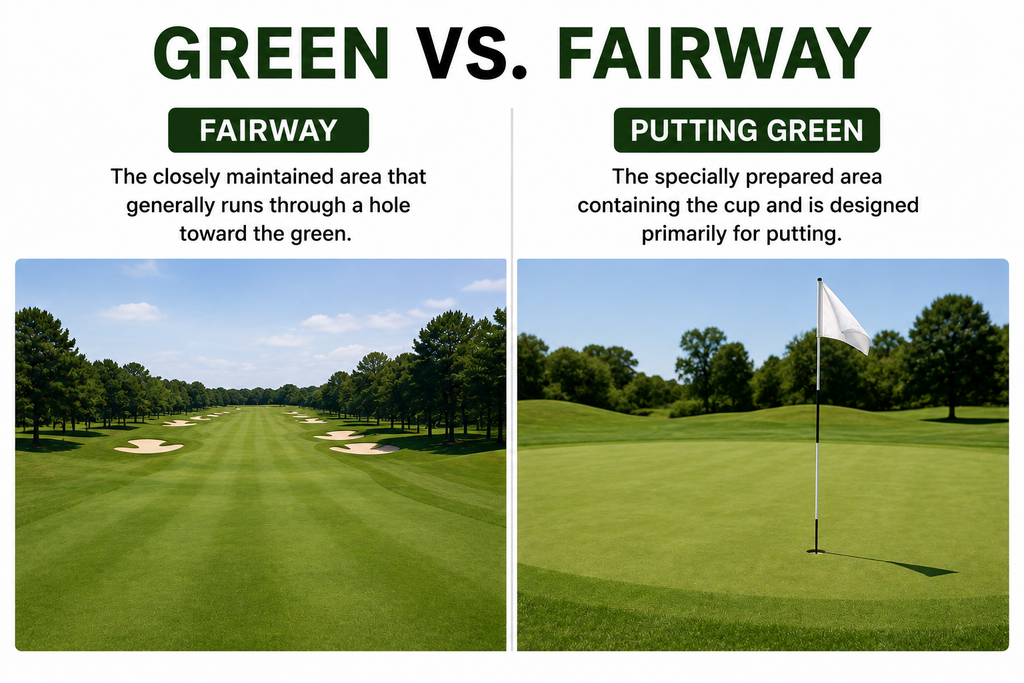
Green vs. Fairway
The fairway is the closely maintained area that generally runs through a hole toward the green.
The putting green is the specially prepared area containing the cup and is designed primarily for putting.
Both have closely cut grass, but they are distinct parts of a golf hole.
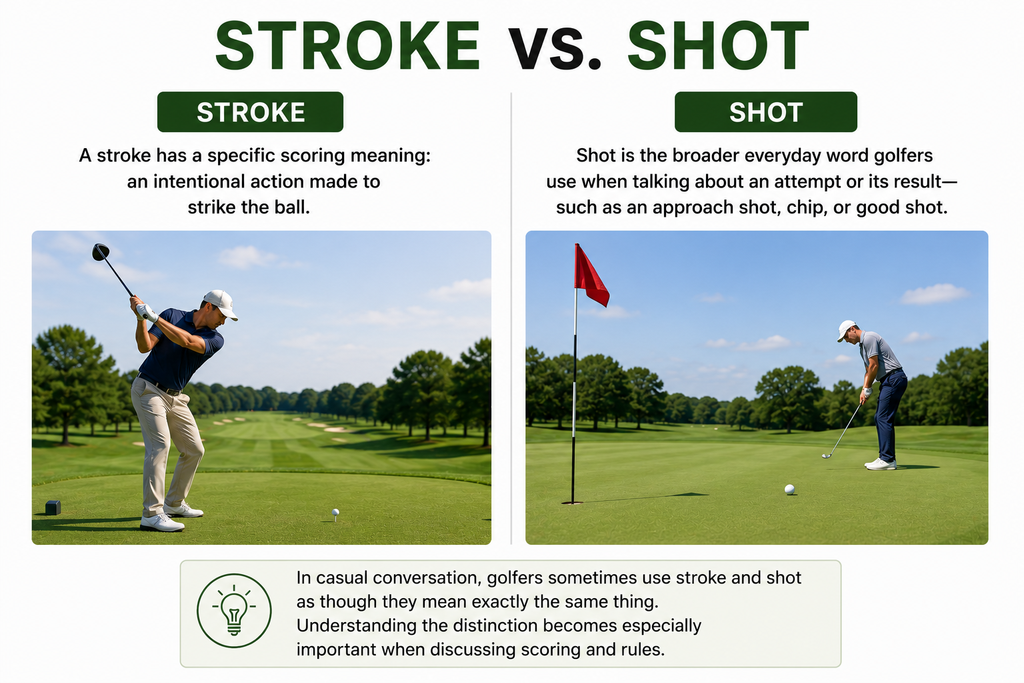
Stroke vs. Shot
A stroke has a specific scoring meaning: an intentional action made to strike the ball.
Shot is the broader everyday word golfers use when talking about an attempt or its result—such as an approach shot, chip, or good shot.
In casual conversation, golfers sometimes use stroke and shot as though they mean exactly the same thing. Understanding the distinction becomes especially important when discussing scoring and rules.
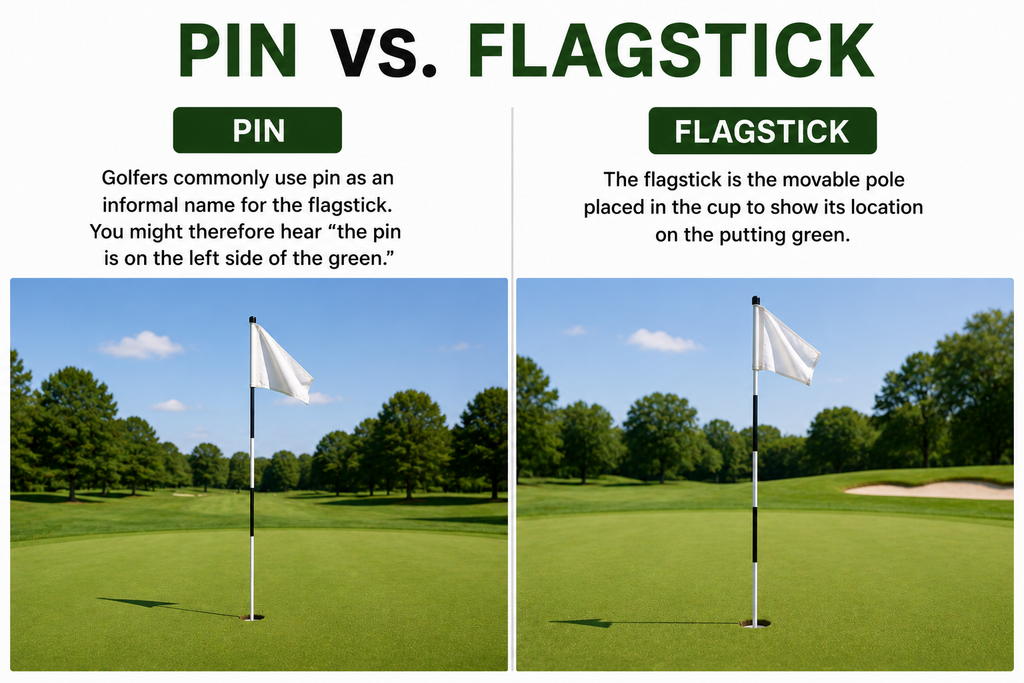
Pin vs. Flagstick
The flagstick is the movable pole placed in the cup to show its location on the putting green.
Golfers commonly use pin as an informal name for the flagstick. You might therefore hear “the pin is on the left side of the green,” even though flagstick is the formal golf term.
Explore more sports and find your next challenge.
Explore Sports
Find a Sport That Fits You Whether you’re looking for a competitive challenge, a fun hobby or a new way to stay active, explore different sports and discover one that matches…
Key Takeaways
- • Golf terminology helps players describe situations, shots, contact, and ball flight precisely.
- • Terms such as drive, approach shot, lay-up, chip, pitch, and putt describe different types or purposes of golf shots.
- • Slice, hook, fade, and draw describe ball curvature, while push and pull primarily describe directional starts.
- • Fat, thin, topped, and shanked describe different types of contact rather than simply meaning “bad shot.”
- • Everyday expressions such as tee time, fore, mulligan, gimme, and up and down are useful for understanding conversations around the golf course.
Knowing this vocabulary will make golf instruction and conversations much easier to follow. In the next lesson, these terms become part of a bigger picture as you learn how a round of golf works from start to finish.
Next: How a Round of Golf Works from Start to Finish >>>
Previous: Understanding the Parts of a Golf Course >>>