

Golf etiquette is the set of behaviors that help golfers play safely, respectfully, and efficiently while taking care of the course. Good etiquette is not about knowing obscure traditions or trying to look like an experienced golfer. It is about understanding how your actions affect the people playing with you, the groups around you, and the condition of the course.
The principles are important enough that the Rules of Golf specifically expect players to show consideration for others, play at a prompt pace, look out for safety, avoid distracting other players, and take good care of the course.
For a beginner, learning these habits makes the course much easier to navigate. You know when to wait, where to stand, how to keep the group moving, and what to do after your shot leaves a mark on the course.
What Is Golf Etiquette?
Golf etiquette refers to the accepted standards of behavior golfers follow while playing. Some are matters of courtesy, while others involve safety, pace of play, or protecting the course.
Etiquette and the Rules of Golf are related, but they are not exactly the same thing. A playing rule determines how the game is played—for example, what happens when a ball is lost or when relief is allowed. Etiquette is primarily concerned with how you conduct yourself while playing.
There is an important qualification to that distinction. Player conduct is not completely separate from the Rules. Rule 1.2 establishes standards of player conduct, and a Committee may adopt a Code of Conduct with penalties for breaches. Serious misconduct can also result in disqualification.
In everyday golf, the easiest way to think about etiquette is through three responsibilities:
- Protect people: Never create an unnecessary risk of someone being struck by a club or ball.
- Respect people: Avoid distracting other golfers and do your part to keep play moving.
- Protect the course: Leave the ground, bunkers, greens, and other areas in good condition for the golfers behind you.
Those three ideas explain most of the etiquette a beginner will encounter.
Safety Comes First
No point of etiquette matters more than safety. A golf ball can travel at high speed, and a swinging club also creates a dangerous area around the golfer.
Never Hit When Someone Is Within Range
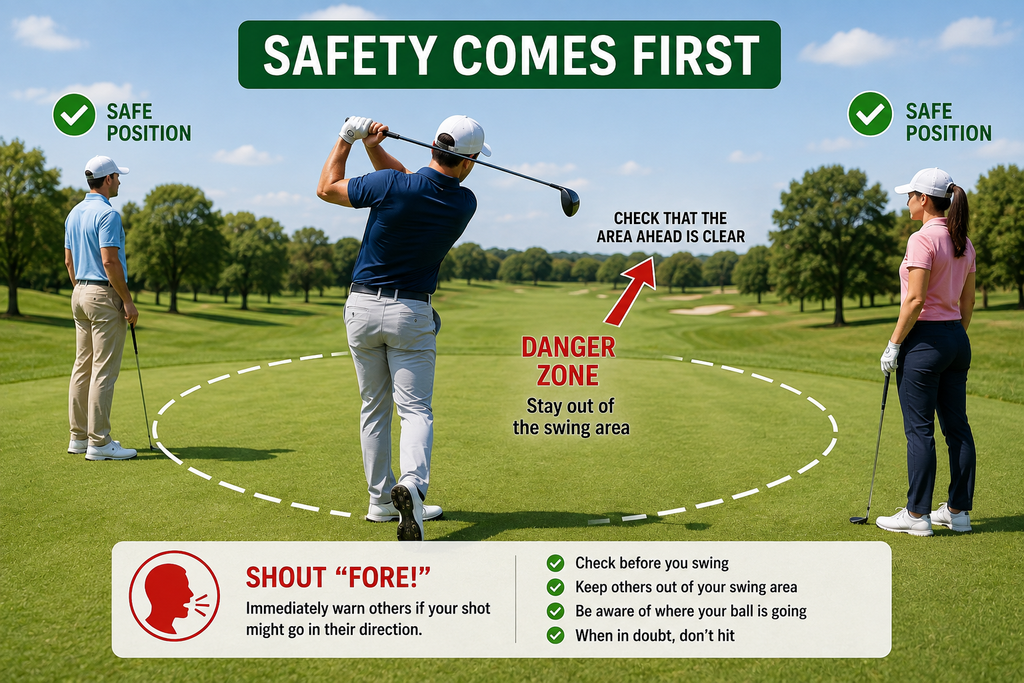
Before every shot, look ahead and make sure the area you could reasonably reach is clear.
Do not assume that the group ahead is far enough away simply because you do not expect to hit a particularly good shot. Beginners often produce unpredictable results, including occasional shots that travel much farther than their typical shot.
If there is genuine doubt about whether you can reach someone, wait.
The same principle applies when a course worker, another golfer, or a golf cart is in the area where your ball could travel.
Stand Safely When Someone Else Is Swinging
Give another golfer enough room to make a full swing without worrying about you.
Do not stand so close that the club could strike you, and avoid positioning yourself directly in the golfer’s intended line of play. A poor shot can leave the clubface at an unexpected angle, so standing slightly behind and safely away from the player is generally more sensible than standing forward of the ball.
Also pay attention during practice swings. A practice swing may not involve a ball, but the club is still moving at considerable speed.
Know When to Shout “Fore!”
“Fore!” is golf’s traditional warning that a ball may be heading toward another person.
If your shot travels toward people and there is a reasonable possibility of hitting them, shout “Fore!” immediately and loudly. Do not wait to see exactly where the ball lands.
The purpose is warning, not embarrassment prevention. The USGA specifically identifies immediately shouting a warning such as “fore” when a ball may endanger someone as part of showing consideration for others.
If you hear “Fore!” and cannot immediately identify where the ball is coming from, protect yourself rather than looking upward trying to find it.
Did you know?
The warning “Fore!” is centuries old. Golfers were using the word as a warning long before modern golf equipment, golf carts, or today’s professionally maintained courses existed.
Be Ready When It Is Your Turn
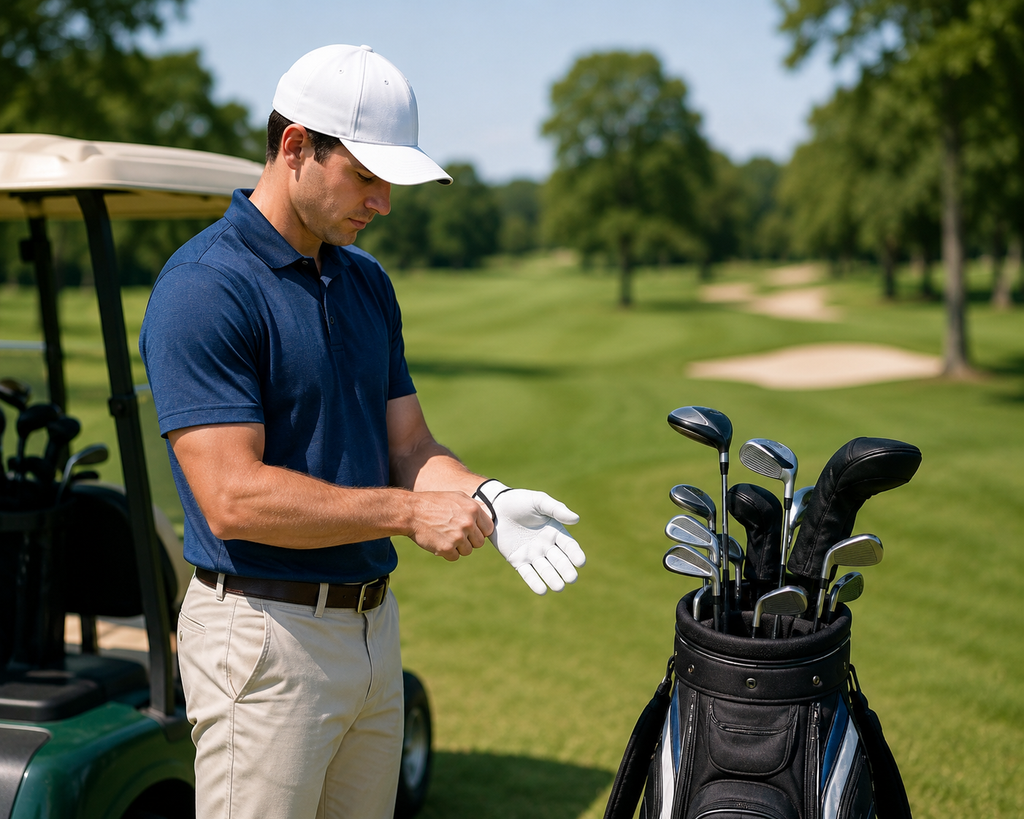
Good pace of play does not mean rushing through your swing. Much of efficient golf comes from using the time between shots well.
While another golfer is playing, you can often:
- • Walk toward your ball when it is safe to do so.
- • Determine your distance and target.
- • Think about the club you are likely to use.
- • Have your glove, club, or other necessary item ready.
- • Begin your normal preparation once doing so will not distract the person playing.
Then, when it is your turn and the area ahead is clear, you can play without beginning the entire decision-making process from scratch.
If you are walking and your ball is some distance from the golf cart or bag, taking two or three likely clubs can also prevent a long walk back because you brought the wrong one.
The goal is prepared golf, not hurried golf. You can still take enough time to make a comfortable shot without creating unnecessary delays.
Understanding Pace of Play
Pace of play describes how efficiently a group progresses around the course.
A common beginner misconception is that keeping pace means playing as quickly as the group behind you wants. A better reference is usually your relationship to the group ahead. If an open hole develops in front of your group while groups continually wait behind you, your group may be falling out of position.
The Rules of Golf state that a round is meant to be played at a prompt pace and that golfers should recognize how their pace affects both their own group and groups following them. Players are encouraged to prepare in advance, move promptly between shots, and be ready when it is their turn. Rule 5.6 also recommends making a stroke within 40 seconds once a player is able to play without interference or distraction—and notes that players should usually be able to play more quickly.
Small Delays Add Up
Slow play is rarely caused by one extra minute alone. It is usually the accumulation of delays across many shots and holes.
For example, a golfer who waits until it is their turn before finding a club, checking a distance, deciding on a target, and taking several practice swings may add a relatively small delay to one shot. Repeating that process dozens of times can significantly affect the group’s round.
Efficient habits include:
- • Walking or riding promptly between shots.
- • Being ready when it is safe to play.
- • Keeping practice swings purposeful rather than repetitive.
- • Watching shots carefully so balls are easier to locate.
- • Avoiding unnecessarily long searches.
- • Leaving the putting green promptly once the group has finished the hole.
Letting a Faster Group Play Through
If your group has lost ground and a faster group is repeatedly waiting behind you, allowing that group to play through may be appropriate.
The exact procedure depends on the situation and course policy, so communicate clearly with the other group rather than unexpectedly waving them into an unsafe position. The Rules specifically encourage allowing faster groups to play through as part of prompt pace of play.
Ready Golf
Ready golf means playing when you are ready and it is safe and responsible to do so rather than rigidly waiting for the traditional playing order when doing so would unnecessarily delay the group.
In stroke play, the Rules expressly encourage ready golf when it is done safely and responsibly.
A simple example: Golfer A is farther from the hole but is still walking to the ball. Golfer B is closer, already at the ball, fully prepared, and can play without interfering with anyone. In an appropriate stroke-play situation, Golfer B may play first rather than making the entire group wait.
Ready golf does not mean:
- • Hitting while someone is in danger.
- • Hitting while another player is making a stroke.
- • Moving into a distracting position just because you are ready.
- • Rushing another golfer.
- • Ignoring the format of play.
Match play has different considerations because order of play can have strategic significance, although players may agree to play out of turn to save time.
The guiding principle is straightforward: save time when you safely can; never save time by compromising safety or interfering with another golfer.
Respect Other Players
Golf requires periods of concentration immediately before and during a stroke. Respecting another player’s opportunity to hit without unnecessary distraction is therefore an important part of golf etiquette.
Stay Quiet During a Swing
When someone begins preparing to hit, give them a quiet, distraction-free space to make the shot. Stop conversations, avoid unnecessary movement, and wait to handle clubs, bags, carts, or other equipment if the noise could be distracting. You do not need to become completely silent every time another golfer approaches their ball, but once they begin settling into the shot, the courteous approach is to let them concentrate.
Remain quiet through the stroke and wait until the ball has been struck before resuming the conversation. Be especially aware if you are standing within the golfer’s field of vision. Even a small movement—taking a practice swing, walking toward your ball, reaching into your bag, or moving a golf cart—can attract attention at the wrong moment.
This applies whether the golfer is hitting a long drive from the tee, an approach shot into the green, a short chip, or a putt. The distance of the shot does not determine whether concentration matters. A three-foot putt may require just as much focus as a full swing with a driver.
It is also good etiquette to extend the same consideration to every golfer in the group regardless of ability. A beginner deserves the same opportunity to make a shot without distraction as an experienced player. Once the stroke is complete, normal conversation and movement can resume as long as doing so does not interfere with another golfer who is preparing to play.
Control Distracting Movement
Movement can be just as distracting as noise, especially when it happens within a golfer’s field of vision. When another player begins preparing to hit, find a safe position and remain reasonably still until the ball has been struck.
Avoid walking toward your ball, taking practice swings, moving a golf cart, or handling equipment while someone is addressing the ball. Even small movements can catch a player’s peripheral vision and interrupt concentration.
Also pay attention to where you stand and where your shadow falls. Avoid positions where you are unnecessarily close, directly in the player’s line of sight, or casting a moving shadow near the ball.
Good etiquette does not require standing motionless throughout the round. Use the time between shots efficiently, but once another golfer begins their final preparation, give them the space to make the stroke without unnecessary visual distractions.
Keep Phones Controlled
Phones are common on the golf course for GPS, scoring, taking photos, and staying in contact, but they should not become a distraction. Keep notification sounds and ringtones silenced or low enough that they will not interrupt another golfer’s preparation or swing.
Avoid taking calls or playing audio near golfers who are hitting. If you need to use your phone, choose a moment when it will not delay the group or interfere with another player’s concentration.
The goal is not to avoid your phone entirely. Use it in a way that respects the people around you and keeps the round moving efficiently.
Respect Different Skill Levels
A beginner may take more shots than an experienced player, while an experienced golfer may have a more established routine. Good etiquette works in both directions.
Avoid unsolicited criticism, visible frustration with another player’s ability, or pressure that makes someone feel they must rush unsafely. At the same time, being new to golf does not remove the responsibility to stay aware of the group’s pace.
Putting Green Etiquette
The putting green demands particular care because small disturbances can affect another player’s putt.
Avoid Another Player’s Putting Line
A player’s putting line is the route they expect the ball to take toward the hole. Avoid walking directly on that line when reasonably possible.
Modern golf shoes cause less damage than older metal spikes, but footprints, scuffs, depressions, sand, and moisture can still affect the surface. More importantly, avoiding another golfer’s line is a basic sign of consideration.
When moving around the green, walk around the line rather than stepping across it unnecessarily.
Be Aware of Where You Stand
Do not stand unnecessarily close to the hole or directly on another player’s line while they putt. Also avoid positioning yourself where movement or your shadow becomes a distraction.
A useful habit is to find a quiet position to the side, remain still during the stroke, and begin moving once the ball has been played and it is safe and appropriate to do so.
Taking Care of the Course
Golf etiquette includes leaving the course in good condition for the people playing behind you.
The Rules of Golf specifically identify replacing divots, smoothing bunkers, repairing ball marks, and avoiding unnecessary course damage as examples of taking good care of the course.
Repair Divots
An iron shot can remove a piece of turf called a divot.
Course practices vary. Some courses prefer the displaced turf to be replaced; others provide a sand or sand-and-seed mixture for filling the damaged area. Follow the course’s method rather than assuming every facility handles divots identically.
The principle is the same: do not simply create damage and walk away when the course provides a method for repairing it.
Repair Ball Marks
A ball landing on a putting green can leave a depression called a ball mark or pitch mark.
Repairing these marks helps preserve the smoothness and health of the green. Use an appropriate repair tool and the method recommended by the course. Avoid aggressively levering the center of the mark upward, which can damage roots and turf.
A good habit is to repair your own ball mark and, when practical, another nearby mark.
Rake Bunkers
After playing from a bunker, smooth the sand you disturbed, including footprints and the area where you played the shot.
The purpose is to give the next golfer a reasonably restored surface rather than leaving a deep footprint or disturbed patch of sand that can create an unnecessarily difficult lie.
After raking, place the rake according to the course’s instructions or established local practice.
Protect the Putting Green
Putting greens are closely maintained surfaces and can be damaged surprisingly easily.
Avoid dragging your feet, dropping clubs, twisting sharply with your shoes, or driving equipment onto areas where it does not belong. Handle the flagstick and other equipment carefully as well.
Golf Cart Etiquette

A golf cart can improve convenience and pace, but improper use can damage turf and create safety problems.
Course conditions determine where carts may travel. Wet weather, maintenance work, or vulnerable turf may result in temporary restrictions.
Follow Posted Cart Instructions
Common instructions include cart-path-only, meaning the cart must remain on designated paths. Other facilities may use directional signs, ropes, restricted zones, or course-specific rules controlling where carts can travel.
Do not treat these as suggestions. Follow the instructions provided by the course.
Stay Away From Sensitive Areas
Do not drive onto putting greens, into bunkers, or through other clearly restricted areas. Courses also commonly restrict carts near greens and teeing areas.
When approaching a green, look for signs, ropes, stakes, or paths showing where carts should go. Following those directions protects heavily maintained turf and prevents unnecessary wear.
Cart restrictions differ by course and can change with conditions, so local instructions take priority over assumptions based on another facility.
When Someone Else Is Playing
Knowing what to do while another golfer hits combines safety, respect, and efficiency.
Position yourself far enough from the player that you cannot interfere with the swing. Stay out of the intended line of play, remain aware of where the ball may travel, and avoid standing where your movement could distract the player.
As the golfer begins the stroke:
- • Stop unnecessary movement.
- • Remain quiet.
- • Watch the shot when practical.
- • Wait until the ball has been struck before moving into an area that could have been dangerous.
Watching other players’ shots is also useful etiquette. If a ball travels into rough, trees, or another difficult-to-see area, several people watching its flight can make it much easier to locate. That saves time for the entire group.
Once everyone who needs to play has done so and it is safe, move forward efficiently.
Beginner Etiquette Mistakes to Avoid
Most etiquette mistakes are not caused by bad intentions. They happen because a new golfer does not yet recognize how one action affects everyone else.
Talking or moving during someone’s swing: The golfer may see or hear the distraction at the exact moment they are trying to make the stroke. Stop unnecessary conversation and movement as the player prepares to hit.
Taking too many practice swings: Several rehearsals before every shot consume time and can tire the golfer without improving the actual stroke. Keep practice swings purposeful.
Leaving equipment in the wrong place: Around a green, leaving a bag or clubs on the opposite side from the next tee can force you to walk backward after finishing the hole. When practical and safe, position equipment where you can collect it efficiently as you leave.
Spending too long searching for a ball: Watch the complete flight and identify a reference point—such as a tree, bunker edge, or patch of rough—near where the ball finished. Better observation makes the search more efficient.
Walking ahead while someone is hitting: Moving forward too soon creates both a distraction and a potential safety hazard. Stay in a safe position until the relevant players have hit.
The common thread is awareness. Good etiquette becomes much easier once you regularly ask: Am I safe here? Am I distracting anyone? Am I delaying the group unnecessarily? Am I leaving the course in good condition?
Explore More Beginner Sports Guides and Start Learning a New Game.
No Posts Found
Key Takeaways
- • Safety has priority over speed. Never hit when people may be within range, stand clear of another golfer’s swing, and shout “Fore!” immediately when a ball may endanger someone.
- • Be prepared rather than rushed. Use the time between shots efficiently so you can play promptly when it is safe and appropriate.
- • Respect other golfers’ concentration. Stay quiet and reasonably still during strokes and be especially considerate around the putting green.
- • Take care of the course. Repair the damage your play creates, smooth bunkers, protect greens, and follow cart restrictions.
- • Good etiquette is situational awareness. Pay attention to the golfers ahead, your playing partners, groups behind you, and the condition of the course.
Understanding golf etiquette gives you the behavioral foundation for sharing a golf course confidently with other players. Next, we’ll look at the basic equipment a beginner needs to start playing.
Previous: Golf Rules Explained for Beginners >>>
Next: Golf Equipment for Beginners >>>