
Golf scoring can seem confusing when you first hear golfers talking about birdies, bogeys, being “two over,” or shooting a certain number for a round. The system becomes much easier once you understand one central idea: your score is based on the number of strokes you take, and lower scores are better.
In this lesson, you’ll learn how golf scoring works from an individual hole through a complete round. You’ll also learn what par means, how common scoring terms relate to par, what information appears on a scorecard, and how penalty strokes affect your total.
The Basic Principle of Golf Scoring
In golf, you count the strokes you take to complete each hole. That number becomes your score for the hole.
If you take 5 strokes to complete a hole, your score is 5. If you take 7 strokes, your score is 7.
Unlike many sports, where a higher point total wins, golf generally works in the opposite direction: the goal is to complete the course in as few strokes as possible.
Your score is recorded hole by hole. At the end of the round, the scores from the individual holes are added together to produce your total score.
For example, suppose two golfers complete the same hole:
- Golfer A takes 4 strokes.
- Golfer B takes 6 strokes.
Golfer A has the lower – and therefore better – score on that hole.
That basic relationship between strokes and score is the foundation for everything else in golf scoring.
What Counts as a Stroke?
Understanding what gets counted is important because your golf score is not simply the number of times the ball moves or the number of times the club makes contact with it.
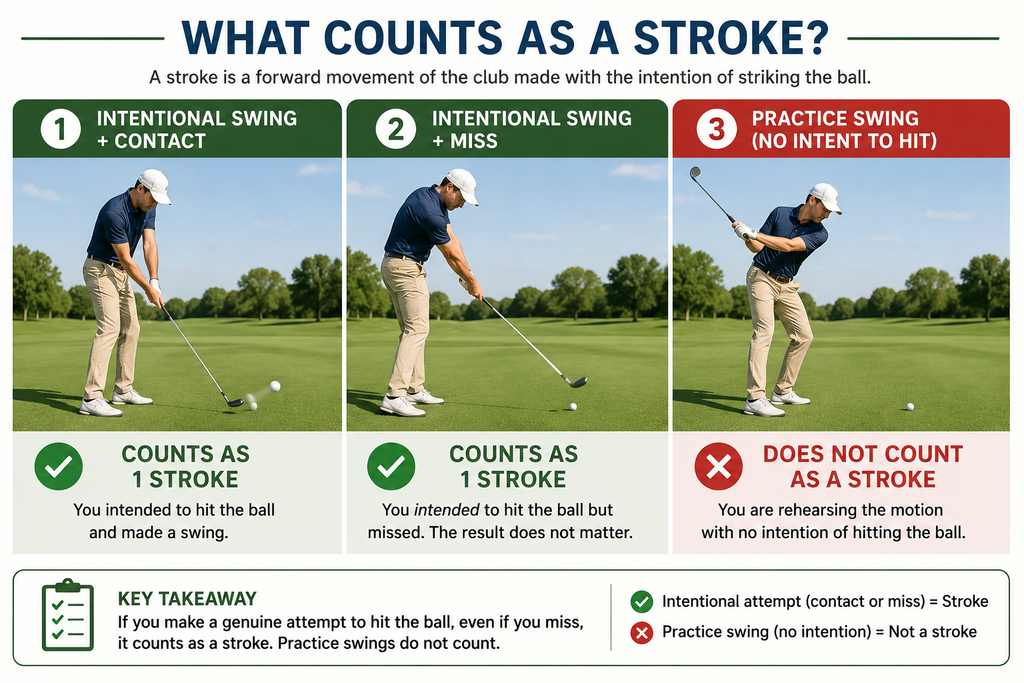
A stroke is the forward movement of the club made with the intention of striking the ball. In practical terms, when you make a swing intending to hit the ball and play it, you have made a stroke.
The important idea for a beginner is intent. The result of the swing does not determine whether it counts. If you make a genuine attempt to strike the ball but swing completely underneath, over, or beside it, the missed swing still counts as a stroke because you intended to hit the ball.
For example, imagine you address the ball and make your first swing, but miss it completely. You then swing again and successfully hit the ball. Even though the ball has moved only once, you have already made two strokes.
This is different from a practice swing. If you deliberately swing beside the ball simply to rehearse the motion and have no intention of striking the ball, that movement is not a stroke.
This distinction is important when keeping an accurate score:
Intentional swing at the ball + complete miss = stroke
Intentional swing at the ball + contact = stroke
Practice swing with no intention of hitting the ball = not a stroke
Your score can also include penalty strokes, which are added under certain Rules of Golf situations even though they are not physical swings at the ball. Detailed penalty rules come later in the course; for now, the key point is that your final score for a hole can include both the strokes you make and any penalty strokes that apply.
A Missed Swing Can Count
Imagine that your ball is sitting on the ground and you make a full swing intending to hit it. The club passes over the ball without touching it.
Although the ball did not move, you made an intentional attempt to strike it. That is a stroke.
If you then hit the ball successfully with your next swing, you have taken two strokes—not one.
A Practice Swing Is Different
A practice swing is not an attempt to strike the ball. You might make one beside or behind the ball to rehearse the movement before actually playing.
Because you did not intend for the practice swing to strike the ball, it is not a stroke.
The distinction is therefore not simply:
Did the club touch the ball?
The more useful question is:
Was the golfer making a stroke – an intentional attempt to strike the ball?
Penalty Strokes Also Affect Your Score
Your final score can include more than the strokes you physically make at the ball. Under the Rules of Golf, certain situations can result in one or more penalty strokes being added to your score.
For example, if you make 5 actual strokes during a hole and incur a one-stroke penalty, your score becomes 6.
The exact rules that create penalties are covered later in the course. For now, remember this scoring principle:
Score = strokes made + any applicable penalty strokes.
What Is Par?
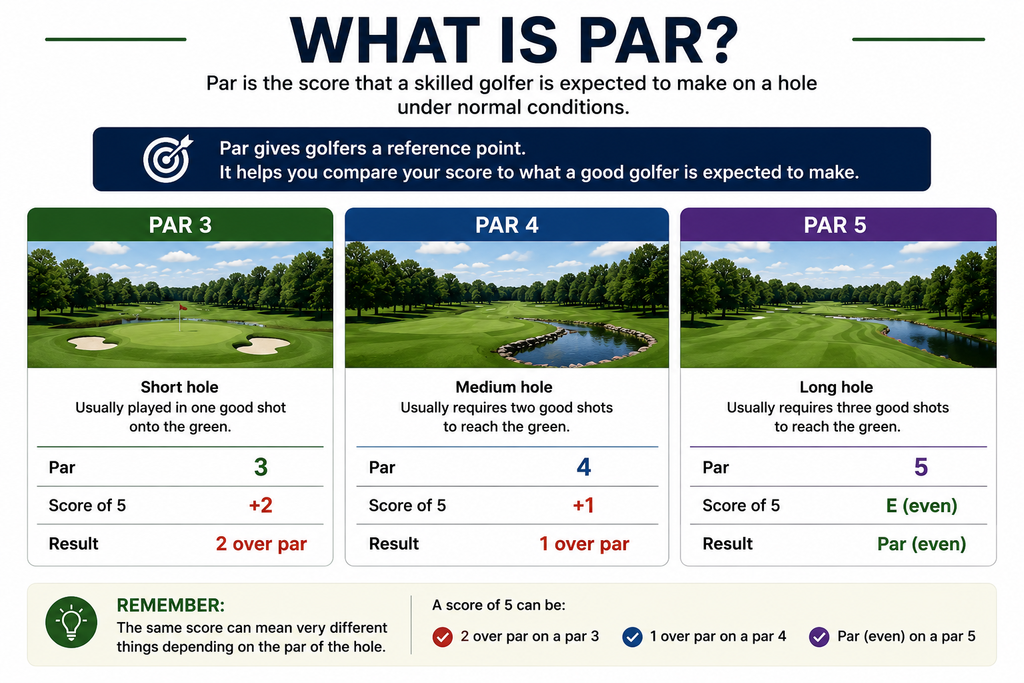
Par is the score that a skilled golfer would be expected to make on a hole under normal conditions.
Every hole is assigned a par, most commonly par 3, par 4, or par 5.
Par gives golfers a reference point for describing a score. Instead of only saying, “I made a 5,” golfers can compare that 5 with the par of the hole.
That comparison matters because a score of 5 can mean very different things:
- A 5 on a par 3 is two strokes over par.
- A 5 on a par 4 is one stroke over par.
- A 5 on a par 5 is par.
The number of strokes is the golfer’s actual score. Par provides the benchmark used to describe that score.
Par 3
A par-3 hole has an expected score of 3.
A score of 3 is par.
A score of 2 is one under par.
A score of 4 is one over par.
Par 4
A par-4 hole has an expected score of 4.
A score of 4 is par.
A score of 3 is one under par.
A score of 5 is one over par.
Par 5
A par-5 hole has an expected score of 5.
A score of 5 is par.
A score of 4 is one under par.
A score of 6 is one over par.
For a beginner, the most important point is that par is a reference score, not a score you must make for the hole to count. New golfers will often score above par, sometimes by several strokes, and their scores are still recorded in the same basic way.
Golf Scoring Terms Explained
| Score Relative to Par | Scoring Term | What It Means | Example on a Par 4 |
|---|---|---|---|
| -3 | Albatross | Three strokes under par | Score of 1 |
| -2 | Eagle | Two strokes under par | Score of 2 |
| -1 | Birdie | One stroke under par | Score of 3 |
| Even | Par | Score equals par | Score of 4 |
| +1 | Bogey | One stroke over par | Score of 5 |
| +2 | Double Bogey | Two strokes over par | Score of 6 |
| +3 | Triple Bogey | Three strokes over par | Score of 7 |
Golf has specific names for scores in relation to par. Once you understand that relationship, terms such as birdie and bogey become much easier to remember.
Hole-in-One or Ace
A hole-in-one, also called an ace, occurs when a golfer completes a hole with a single stroke.
For example:
Par 3 + 1 stroke taken = hole-in-one
A hole-in-one describes the fact that the ball was holed in one stroke. Its relationship to par depends on the par of the hole.
Albatross
An albatross is a score of three strokes under par on a hole.
For example:
Par 5 + score of 2 = albatross
This is an exceptionally rare score.
Eagle
An eagle is two strokes under par.
Examples:
Par 4 + score of 2 = eagle
Par 5 + score of 3 = eagle
Birdie
A birdie is one stroke under par.
Examples:
Par 3 + score of 2 = birdie
Par 4 + score of 3 = birdie
Par 5 + score of 4 = birdie
Did you know?
The word “birdie” is believed to have entered golf vocabulary in the United States in the early 1900s. At the time, “bird” was slang for something excellent, and the expression eventually became the familiar name for scoring one stroke under par on a hole.
Par
Making par means your score equals the assigned par for the hole.
Examples:
Par 3 + score of 3 = par
Par 4 + score of 4 = par
Par 5 + score of 5 = par
Bogey
A bogey is one stroke over par.
Examples:
Par 3 + score of 4 = bogey
Par 4 + score of 5 = bogey
Par 5 + score of 6 = bogey
Double Bogey
A double bogey is two strokes over par.
For example:
Par 4 + score of 6 = double bogey
Triple Bogey and Higher
A triple bogey is three strokes over par.
For example:
Par 4 + score of 7 = triple bogey
Scores can continue above that. A golfer who takes 8 strokes on a par 4 is four over par for that hole.
Beginners do not need a special term for every possible score. The important skill is being able to compare the number of strokes taken with the hole’s par.
How to Calculate Your Score on a Hole
Calculating the score for one hole requires two related pieces of information:
- Count the strokes that make up your score, including any applicable penalty strokes.
- Compare the final score with the hole’s par.
| Example | Par | Final Score | Difference From Par | Result |
|---|---|---|---|---|
| 5 strokes on a par 4 | 4 | 5 | +1 | Bogey |
| 3 strokes on a par 4 | 4 | 3 | -1 | Birdie |
Your recorded score is the actual number of strokes in your score. Terms such as birdie and bogey describe how that number compares with par.
For example, a score of 5 on a par 4 is recorded as 5 and described as a bogey (+1). A score of 3 on a par 4 is recorded as 3 and described as a birdie (-1).
How an 18-Hole Score Is Calculated
For an 18-hole round, your total score is calculated by adding your score from every hole. A simple way to understand this is to separate the round into the front nine and back nine.
| Score Calculation | Strokes |
|---|---|
| Front Nine | 48 |
| Back Nine | 46 |
| Final Score | 94 |
48 + 46 = 94
The golfer therefore shot 94.
You can also compare the golfer’s final score with the course’s total par:
| Comparison | Score |
|---|---|
| Golfer’s Score | 94 |
| Course Par | 72 |
| Difference From Par | +22 |
| Result | 22 over par |
These numbers describe the same round in two different ways. 94 is the golfer’s total score, while 22 over par (+22) describes how that score compares with the course’s par.
Over Par, Under Par and Even Par
Golf scores are often displayed relative to par rather than as a running total of strokes.
The basic notation is:
- +1 = one over par
- -1 = one under par
- E or Even = even par
For example, suppose a golfer has played four holes with these results:
- Hole 1: par
- Hole 2: bogey (+1)
- Hole 3: birdie (-1)
- Hole 4: par
The bogey moves the golfer to one over par. The birdie later cancels that extra stroke relative to par, bringing the golfer back to even.
This type of running score is commonly shown during golf competitions because it allows you to see quickly how a player stands relative to par.
The same idea applies to an entire round. On a par-72 course:
71 = -1, or one under par
72 = even par
73 = +1, or one over par
Understanding a Golf Scorecard
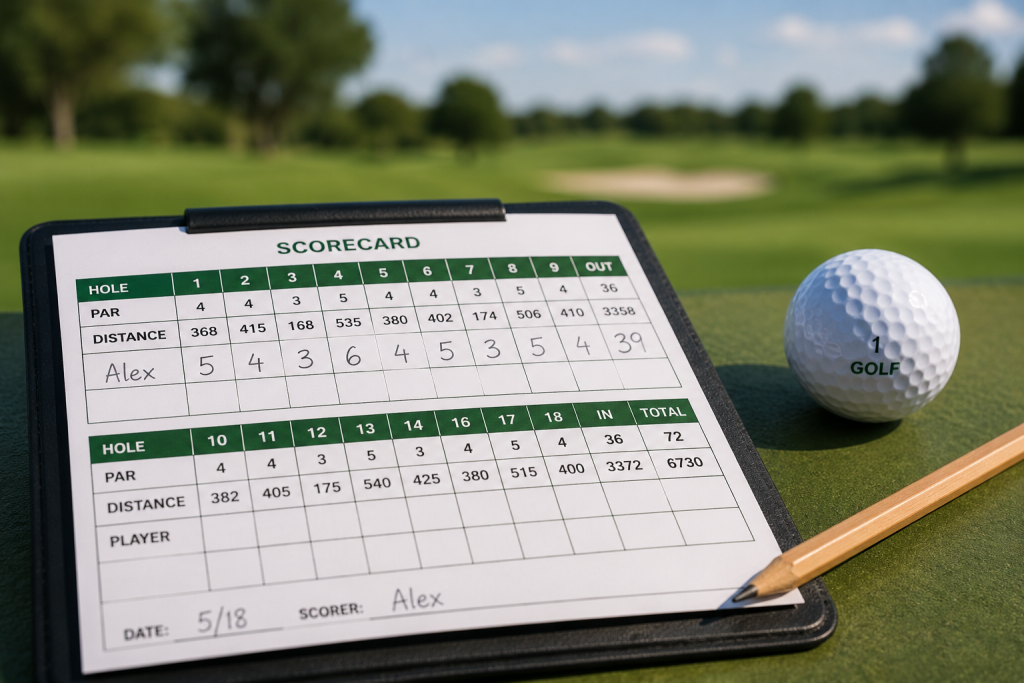
A scorecard provides the information needed to record scores hole by hole and total them at the end of the round. Although scorecard designs vary, a typical scorecard includes the following information:
| Scorecard Item | What It Shows |
|---|---|
| Hole Number | Identifies each hole, usually numbered 1 through 18 on an 18-hole course. |
| Par | Shows the par for each hole, allowing you to compare your score with the hole’s par. |
| Distance | Shows the distance of each hole. Several distance rows may appear because a course can have different sets of tees. |
| Player Score | Records your score for each individual hole. If you score 6 on the first hole, you enter 6 in the appropriate box. |
| Front Nine Total | The combined score for holes 1 through 9. |
| Back Nine Total | The combined score for holes 10 through 18. |
| Final Total | The front-nine and back-nine totals added together to produce your final 18-hole score. |
For example:
| Score | Total |
|---|---|
| Front Nine | 47 |
| Back Nine | 49 |
| Final Score | 96 |
A scorecard therefore lets you see both the individual hole scores that make up your round and your final total score.
At this stage, you only need to recognize distance as information shown on the scorecard. Golf-course layout and choosing where to play from are covered elsewhere in the course.
How Penalties Affect Your Score
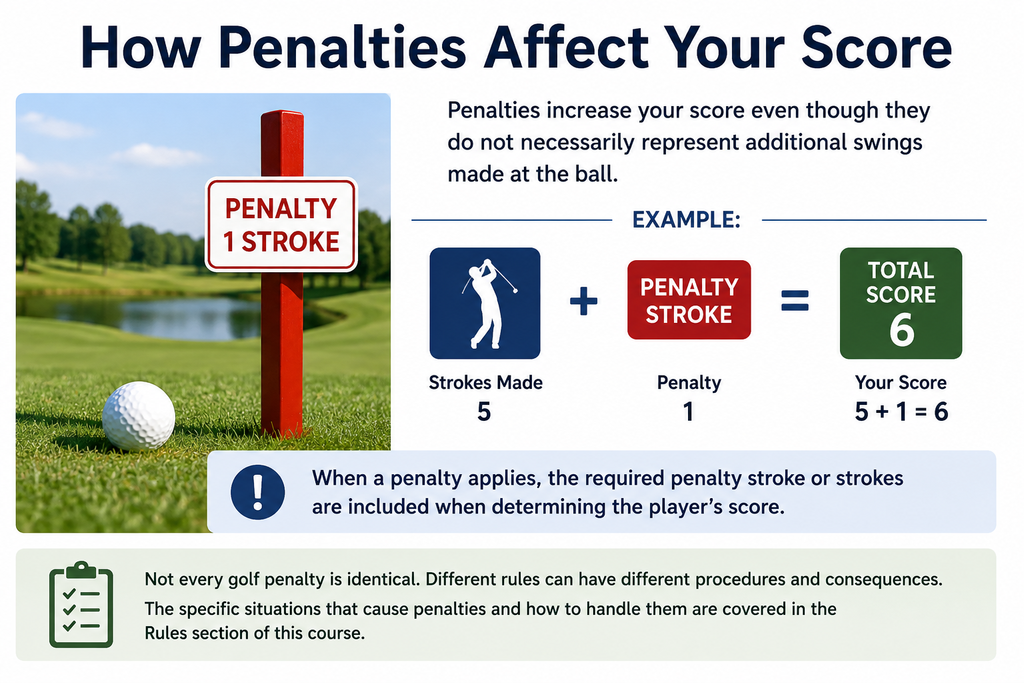
Penalty strokes are important because they increase your score even though they do not necessarily represent additional swings made at the ball.
Suppose you make 5 strokes during a hole and also receive a one-stroke penalty.
Your score is:
5 strokes + 1 penalty stroke = 6
That added stroke matters just as much to the final total as another counted stroke.
Not every golf penalty is identical, so beginners should avoid assuming that every rules situation automatically means “add one.” Different rules can have different procedures and consequences.
For this lesson, the essential scoring concept is simply:
When a penalty applies, the required penalty stroke or strokes are included when determining the player’s score.
The specific situations that cause penalties and the procedures for dealing with them belong in the rules section of the course.
Gross Score and Net Score
You may eventually hear golfers refer to gross score and net score. They are not the same thing.
Gross Score
Your gross score is your score before handicap strokes are applied.
If you complete an 18-hole round with a gross score of 105, your gross score is simply 105.
Net Score
A net score is a score after the appropriate handicap strokes have been applied.
For a simple illustration, if a golfer has a gross score of 100 and 20 handicap strokes are being applied in the relevant format, the resulting net score would be 80.
Gross score: 100
Handicap strokes applied: 20
Net score: 80
That example is only intended to show the distinction between gross and net scoring. Golf handicaps have their own system and should not be understood simply as “subtract this number from every score in every situation.” Handicap calculations and applications are covered later in the beginner course.
For now, remember:
Gross = score before handicap adjustment.
Net = score after the applicable handicap adjustment.
Should Beginners Keep Score?
Keeping score can be useful for a beginner because it creates a record of what actually happened during a round.
Over time, scores can help you see improvement that might otherwise be difficult to notice. A golfer who once needed 120 strokes to complete a course may eventually score 110, then 105. Those numbers provide an objective record of progress.
Scoring can also help you become comfortable with the normal rhythm of golf: finish a hole, record the result, and move on.
However, a beginner does not need to judge every round solely by the final number.
Early in your development, individual shots and holes can vary dramatically. One difficult hole can add several strokes to your total, and that does not mean the entire round was unsuccessful.
There can also be value in informal practice where keeping an official score is not the main purpose. The important distinction is to know when you are keeping a genuine score and when you are simply practicing.
When you do keep score, count accurately. A truthful score—even a high one—is much more useful for measuring progress than a lower number created by ignoring strokes or penalties.
Choose the right golf clubs for your game.

Golf Club Sets
Home SHOP BY CATEGORY Drivers Fairway Woods Hybrids Irons Wedges Putters Golf Club Sets Accessories Golf Club Sets Choosing individual clubs is one way to build a bag but sometimes it’s easier to start with a complete setup built for your…
Key Takeaways
- • Your golf score is based on the strokes you take, plus any applicable penalty strokes; lower scores are better.
- • Par provides the reference point used to describe scores as birdies, pars, bogeys, and other scoring terms.
- • Your score for a hole is the actual number recorded; terms such as “one over” or “one under” describe how that number compares with par.
- • An 18-hole score is calculated by adding the individual hole scores, while a scorecard helps record and total those results.
- • Gross score is the score before handicap adjustments; net score reflects applicable handicap adjustments.
Now that you understand how golf scores are counted and described, the next lesson will introduce the physical areas where those scores are made: the different parts of a golf course.
Previous: What Is Golf? >>>
Next: Understanding the Parts of a Golf Course >>>