
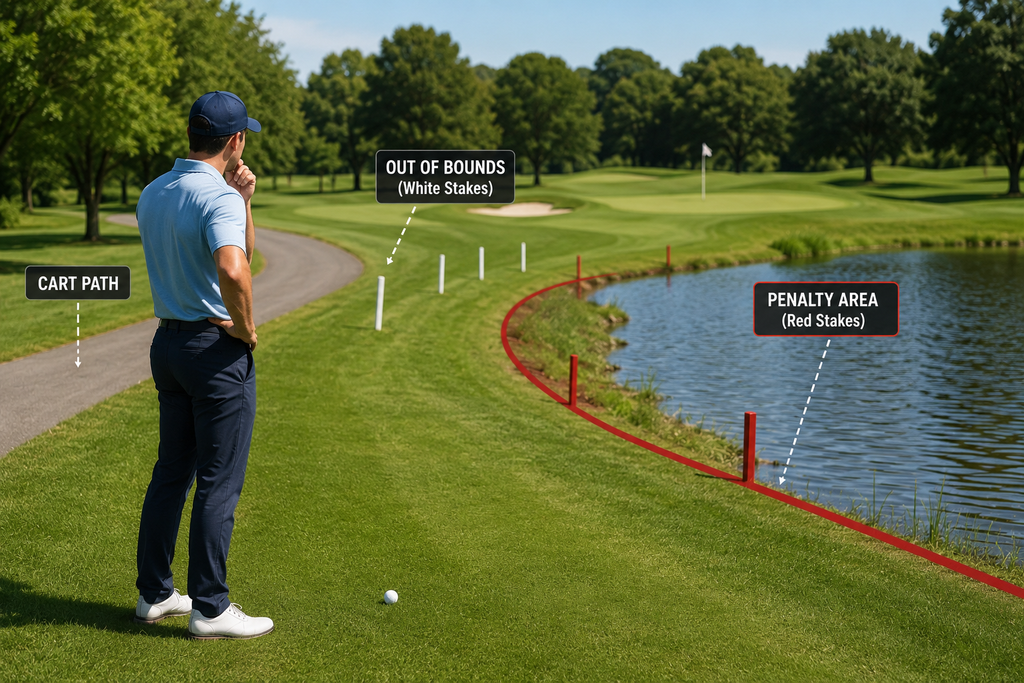
Golf can seem complicated when you first hear about penalties, relief areas, out-of-bounds stakes, and rules about when a ball can or cannot be moved. The good news is that beginners do not need to memorize the entire rulebook before stepping onto the course.
In this lesson, you’ll find golf rules explained in practical, beginner-friendly terms. You’ll learn the essential rules you are most likely to encounter during a round, including what to do with a lost ball, how out of bounds differs from a penalty area, when free relief is available, and how to handle common situations on the putting green.
Understanding these fundamentals will help you make better decisions when something unexpected happens and play with greater confidence while respecting the basic principles of the game.
The Rules information below has also been checked against current USGA Rules resources, consistent with the Start Playing Sports requirement to verify official rules information.
Why Golf Has Rules
Golf presents an unusual challenge because the playing conditions constantly change. Your ball may finish on closely cut grass, beside a tree, on a cart path, in deep vegetation, or in a marked penalty area. The Rules create a consistent way to handle those situations.
At the heart of the game are two closely related principles: play the ball as it lies and play the course as you find it. When a Rule permits you to move the ball or alter a condition, you follow the procedure provided by that Rule. Otherwise, you generally accept the situation your previous stroke created.
That distinction is useful for beginners. A bad lie does not automatically give you relief simply because the next shot is difficult. Conversely, taking relief is not “cheating” when a Rule specifically allows it.
Playing the Ball as It Lies
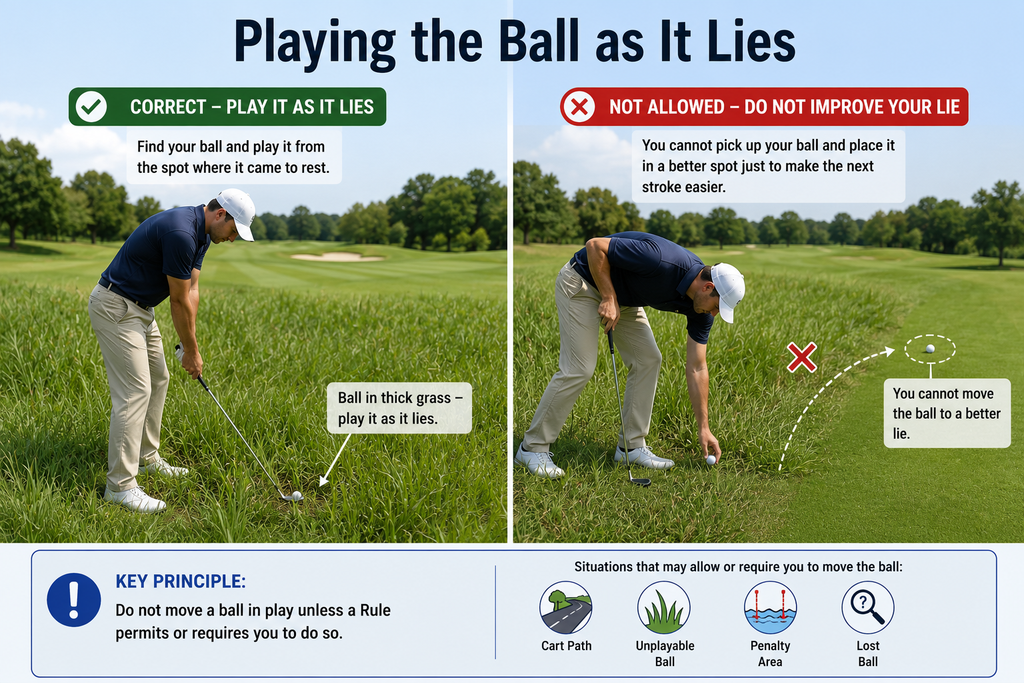
After making a stroke, the normal procedure is simple: find your ball and play it from the spot where it came to rest.
Suppose your ball finishes in thick grass instead of the fairway. You normally cannot pick it up and place it on shorter grass just because that would make the next stroke easier. The lie created by the previous stroke is part of the challenge.
There are, however, important exceptions. The Rules sometimes allow or require a ball to be lifted, replaced, dropped, or played from another location. A cart path, an unplayable ball, a penalty area, and a lost ball can all involve different procedures.
The important beginner principle is therefore not “never move your ball.” It is:
Do not move a ball in play unless a Rule permits or requires you to do so.
That distinction prevents many avoidable rules mistakes.
Playing the Course as You Find It

The same basic principle applies to the conditions surrounding your ball. You generally cannot change the course simply to make the next stroke easier.
For example, you cannot bend or break a growing branch because it interferes with your intended swing if doing so improves the conditions affecting your stroke. You also cannot press down uneven ground, remove dew to improve your line, or otherwise manufacture a better playing condition when the Rules prohibit it.
That does not mean you cannot touch anything around the ball.
A loose impediment is a loose natural object such as a leaf, twig, stone, or pine cone. Loose impediments generally may be removed, although you need to be careful: outside certain exceptions, moving your ball while removing one can result in a penalty and require the ball to be replaced.
The useful distinction is between removing something the Rules allow you to remove and physically changing the conditions to create an advantage.
What Happens When Your Ball Is Lost
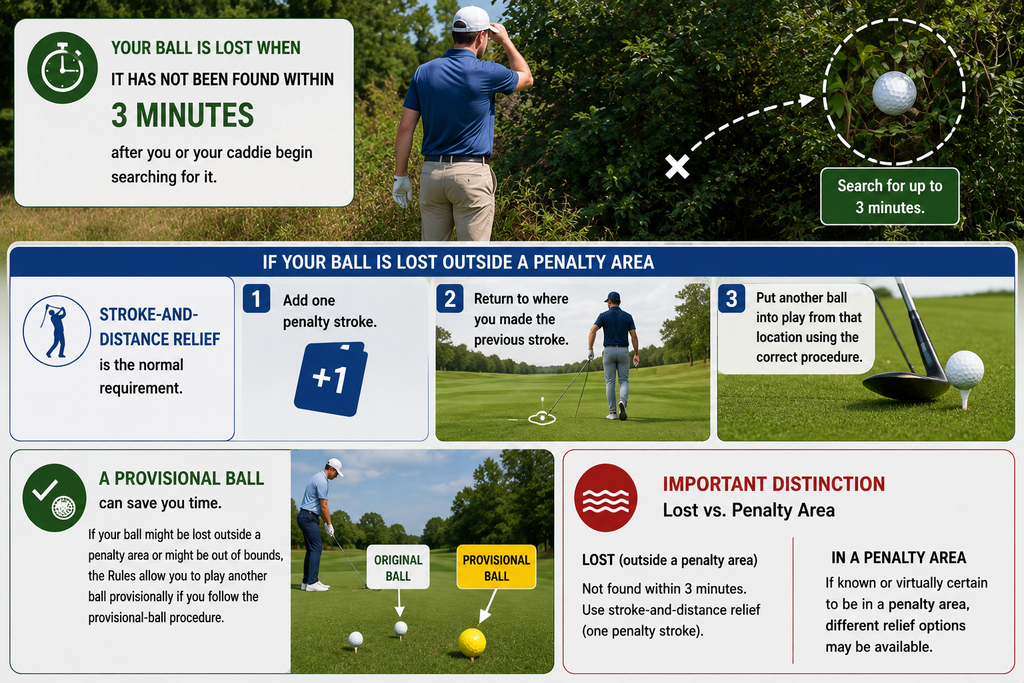
A ball does not become officially lost merely because you cannot see it immediately.
Under the Rules, your ball is lost when it has not been found within three minutes after you or your caddie begin searching for it.
If the ball is lost outside a penalty area, the normal requirement is stroke-and-distance relief. This means:
- Add one penalty stroke.
- Return to where you made the previous stroke.
- Put another ball into play using the correct procedure for that location.
For example, suppose your tee shot disappears into thick vegetation and cannot be found within three minutes. If no other Rule changes the situation, you return and play again from the teeing area with one penalty stroke added.
This is one reason a provisional ball can be useful. If your original ball might be lost outside a penalty area or might be out of bounds, the Rules allow you to play another ball provisionally, provided you follow the provisional-ball procedure. That can save you from having to walk all the way back after searching.
A key distinction is whether the ball is simply lost or is known or virtually certain to be in a penalty area. Penalty areas have their own relief procedures.
What Happens When Your Ball Goes Out of Bounds
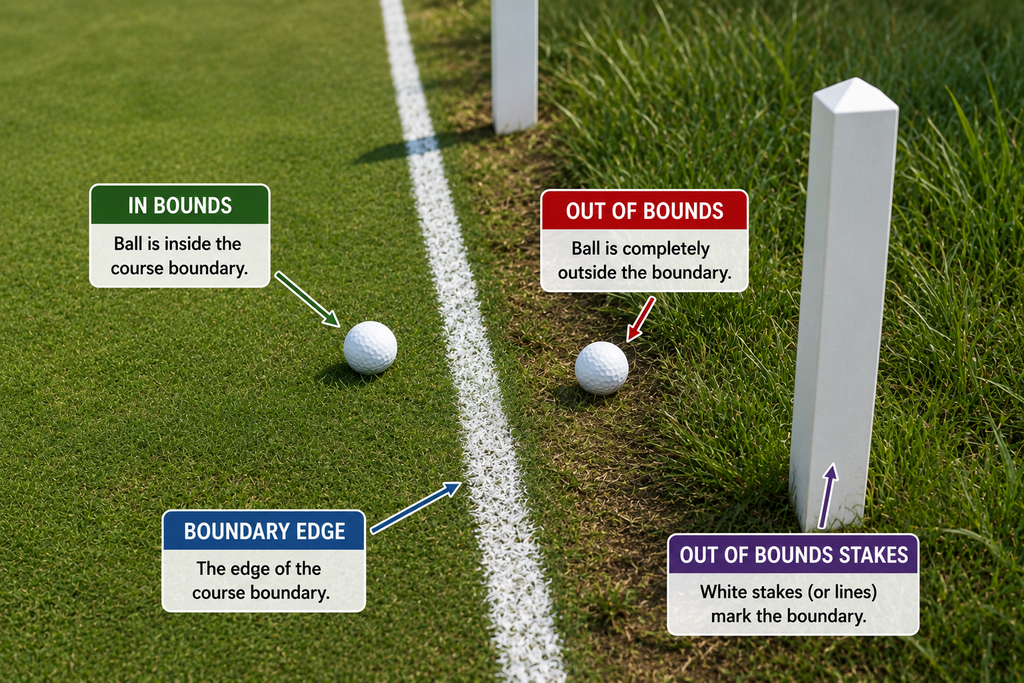
Out of bounds means outside the boundaries of the course. Boundaries are commonly identified by white stakes, white lines, fences, or other objects specified by the course.
A ball is out of bounds only when all of the ball is outside the course’s boundary edge.
Under the standard Rules of Golf, a ball that is out of bounds is handled with stroke and distance, just like a ball lost outside a penalty area. You add one penalty stroke and play again from where the previous stroke was made.
This is an important distinction for beginners because out of bounds and penalty areas can look similar in practical terms – you have hit the ball somewhere you cannot continue normally—but the Rules treat them differently.
Understanding Penalty Areas

A penalty area is a specifically defined area of the course. Penalty areas are identified as either yellow or red, and that color affects the relief options available.
If your ball is in a penalty area, you generally have two broad choices:
- Play the ball as it lies without taking penalty relief, if playing it is possible and allowed.
- Take relief outside the penalty area for one penalty stroke.
For both red and yellow penalty areas, the relief options include stroke-and-distance relief and back-on-the-line relief. Back-on-the-line relief uses a line extending from the hole through the point where the ball last crossed the edge of the penalty area.
A red penalty area provides an additional option: lateral relief. This generally allows you to use a relief area within two club-lengths of the point where the ball last crossed the edge of the red penalty area, no nearer the hole.
That extra lateral option is the practical difference beginners should remember:
Yellow: stroke and distance or back on the line.
Red: those options plus lateral relief.
Also notice the difference from a lost ball. If a ball is not found but it is known or virtually certain that it came to rest in a penalty area, penalty-area relief may be used. If that certainty does not exist and the ball cannot be found within the search time, it is treated as lost instead.
Unplayable Ball
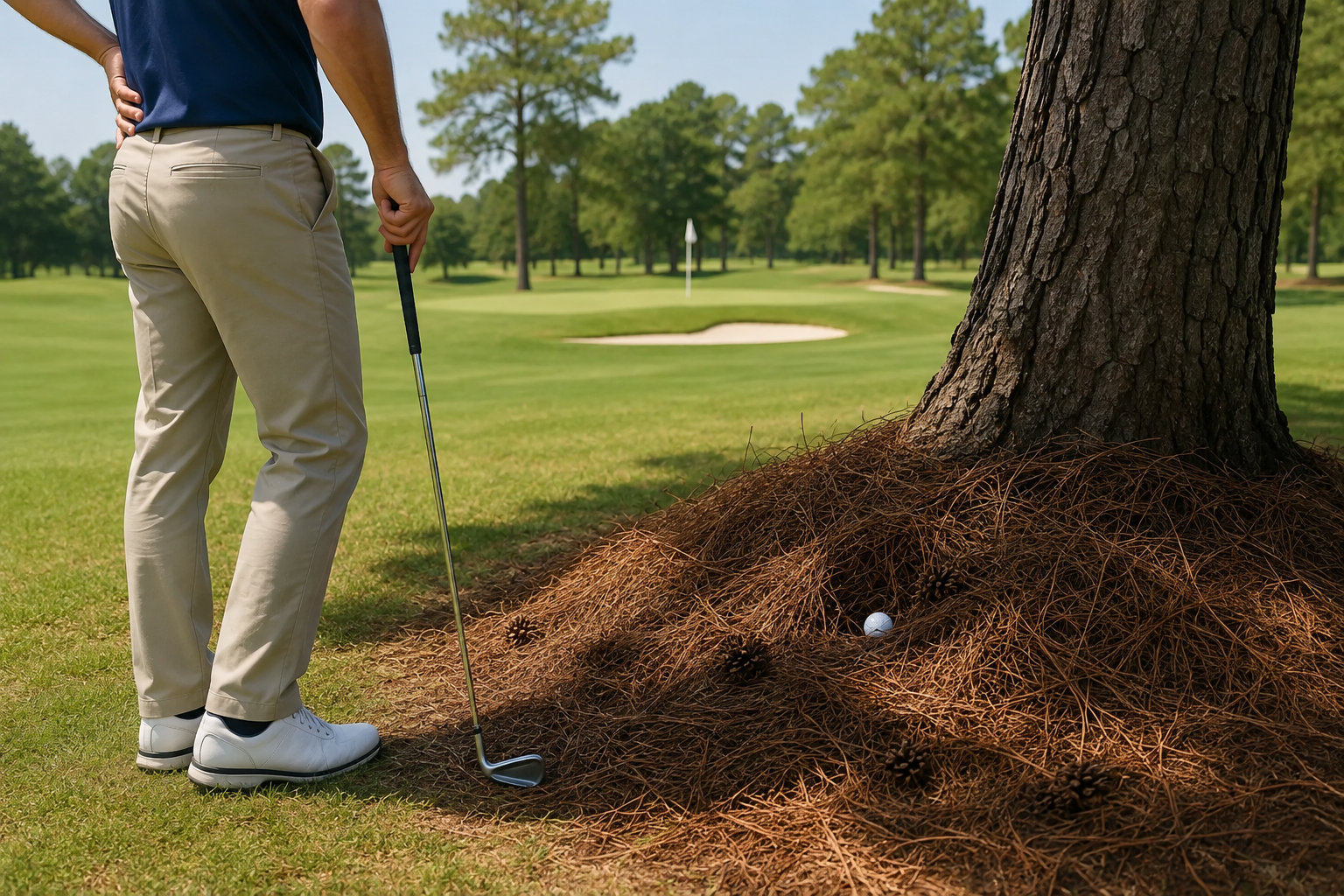
Sometimes you can find your ball perfectly well, but playing it from its current position makes little sense. It might be underneath a bush, pressed against a tree, or sitting somewhere from which you do not reasonably want to attempt a stroke.
Except when your ball is in a penalty area, you are the person who decides whether your ball is unplayable. You do not need another golfer or official to agree that the shot is impossible.
For one penalty stroke, there are three basic relief options:
- Stroke and distance: play again from where the previous stroke was made.
- Back-on-the-line relief: go back on a line from the hole through the position of the unplayable ball.
- Lateral relief: drop within two club-lengths of where the ball lies, no nearer the hole.
Special restrictions apply when the unplayable ball is in a bunker. And importantly, you cannot declare a ball unplayable in a penalty area; penalty-area relief rules apply instead.
The practical lesson is that “unplayable” does not necessarily mean physically impossible to hit. It means you have decided that accepting a penalty and taking an available relief option is preferable to playing the ball from its current position.
Free Relief Situations
Not every relief procedure costs a penalty stroke.
Certain conditions are considered abnormal course conditions, and the Rules generally provide free relief when they interfere in the way specified by the Rule. These include:
- temporary water
- ground under repair
- animal holes
- immovable obstructions such as many artificially surfaced cart paths
An immovable obstruction is an artificial object that cannot readily be moved, such as an artificially surfaced cart path or certain sprinkler-related objects.
When free relief applies in the general area, you normally determine the nearest point of complete relief – the nearest location, no nearer the hole, where the condition no longer interferes as specified by the Rule. The relief area then extends one club-length from that reference point, subject to the applicable limits.
“Nearest” matters. Free relief does not mean you may choose whichever nearby location gives you the nicest lie or clearest shot. The Rule determines the reference point.
Also, the same relief is not automatically available everywhere. For example, free relief from an abnormal course condition is generally not available when the ball lies in a penalty area.
Did you know?
If your ball becomes embedded in its own pitch mark in the general area, the Rules generally allow free relief. This commonly happens when a ball lands in soft or wet ground.
How to Drop a Golf Ball Correctly
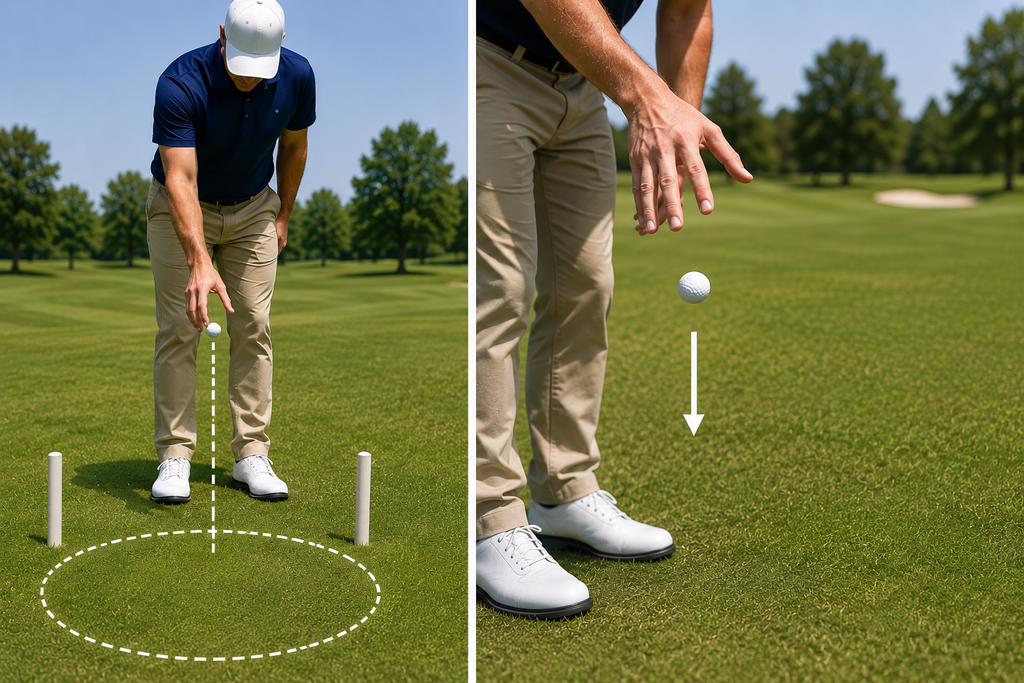
Because several of these rules involve dropping, beginners should know the basic procedure.
When a Rule requires a drop, the ball is released straight down from knee height. You must not throw, roll, or spin it to influence where it finishes, and it must not touch you or your equipment before hitting the ground. The ball must be dropped in the relief area specified by the Rule and must come to rest within the required relief area.
Different Rules create different reference points and relief-area sizes, which is why you should first establish which Rule you are using rather than simply choosing a convenient place and dropping.
Rules on the Putting Green
The putting green has several special Rules because players are permitted to do things there that they normally cannot do elsewhere.
Marking, Lifting, and Replacing the Ball
When your ball is on the putting green, you may mark its position, lift it, and clean it. Before lifting it, mark the spot with a ball-marker or in another permitted way. When it is time to continue, replace the ball on its original spot.
A common beginner mistake is to pick the ball up casually without first marking its position.
Repairing Damage
You may repair certain damage on the putting green, including ball marks, shoe damage, old hole plugs, and various other types of damage identified by the Rules, provided the repair is reasonable and intended to restore the surface rather than create an improved line beyond what the Rules allow.
The Flagstick
You are allowed to putt with the flagstick left in the hole. There is no automatic penalty simply because a ball played from the putting green strikes an unattended flagstick left in the hole. You may also choose to have the flagstick removed or attended under the Rules.
These are Rules questions; behavior around other golfers on the green is part of golf etiquette and is separate from this lesson.
What If You Play the Wrong Ball?
Golf balls can look remarkably similar, particularly when several golfers use the same brand and model.
Under the Rules, you must not make a stroke at a wrong ball. In stroke play, doing so results in the general penalty, which is two penalty strokes, and you must correct the mistake by continuing with your original ball as required by the Rules. The strokes made at the wrong ball do not count toward your score. Match play handles the general penalty differently.
Prevention is much easier than correcting the mistake. Identify your ball before the round with a distinctive mark and check identifying marks when there is uncertainty.
Do not simply assume that a white ball near where yours landed must be yours.
When You Are Unsure of a Rule
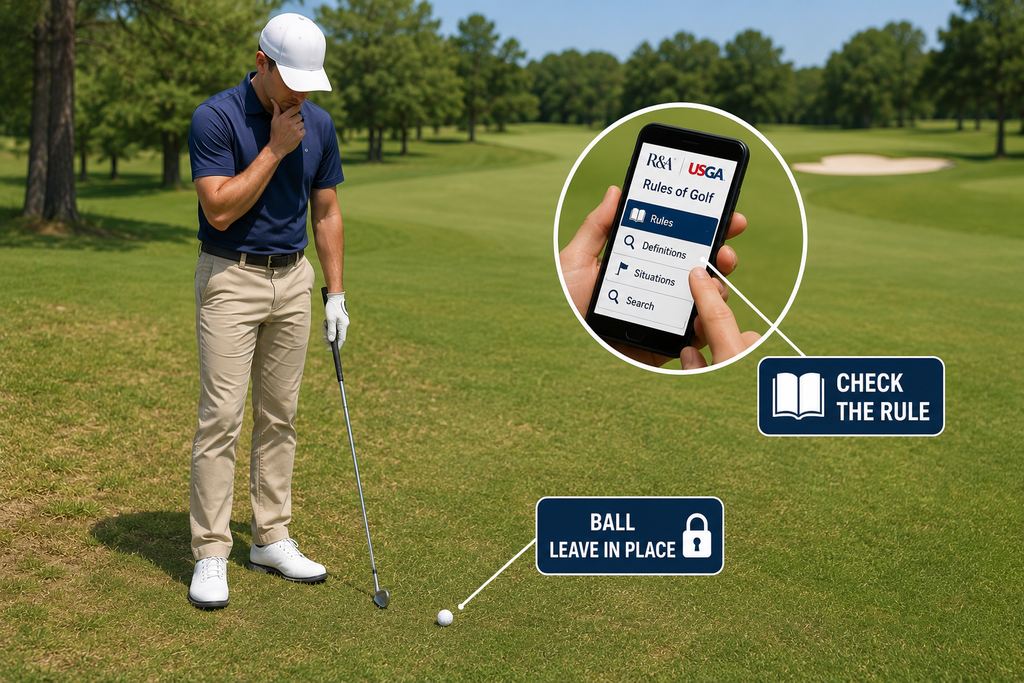
Even experienced golfers occasionally encounter situations that require checking the Rules.
When you are uncertain, avoid guessing and moving the ball immediately. First establish the facts: Where is the ball? Is it in a penalty area? Is it out of bounds? What condition is interfering? Which Rule might provide relief?
Then consult an official Rules resource or seek assistance when appropriate. The SPS standards specifically prioritize authoritative official sources for rules-based information.
One useful preventive procedure is the provisional ball. If your ball might be lost outside a penalty area or might be out of bounds, playing a provisional ball correctly can save considerable time if the original cannot be played.
Rules Beginners Commonly Get Wrong
Several mistakes occur because golfers apply an informal understanding of a Rule rather than its actual procedure.
Improving the lie: A difficult lie does not normally allow you to move the ball or change the surrounding conditions simply to create a better shot.
Moving the ball accidentally: Do not assume every accidental movement has the same result. The correct ruling depends on why and where the ball moved. For example, accidentally moving your ball while reasonably searching for it does not carry the same penalty that may apply when you accidentally move it in other circumstances.
Dropping incorrectly: A relief procedure is not simply “pick the ball up and drop somewhere nearby.” The applicable Rule determines the reference point and relief area, and the ball must be dropped correctly from knee height.
Confusing penalty areas with out of bounds: Penalty areas provide specific relief choices, while a ball that is out of bounds normally requires stroke-and-distance relief under the standard Rules.
Treating a mulligan as an official Rule: A mulligan is an informal replay of a shot that players sometimes allow in casual golf. It is not a standard relief procedure under the Rules of Golf. If a group chooses to use mulligans recreationally, that should not be confused with playing strictly under the official Rules.
Understanding these distinctions is more valuable than trying to memorize dozens of individual rulings. When you understand why you are allowed – or not allowed – to move a ball, change a condition, or take relief, unfamiliar situations become easier to interpret.
Did you know?
If your golf ball accidentally hits you, another player, or equipment after a normal stroke, there is generally no penalty. You normally play the ball from where it comes to rest.
Key Takeaways
- • The basic principles are to play the ball as it lies and play the course as you find it unless a Rule allows otherwise.
- • A ball lost outside a penalty area or out of bounds normally requires stroke-and-distance relief.
- • Red and yellow penalty areas provide specific penalty-relief options; red penalty areas add a lateral-relief option.
- • Some situations, including certain abnormal course conditions such as cart paths, temporary water, and ground under repair, can provide free relief.
- • When uncertain, identify the situation before moving the ball and consult the official Rules rather than inventing a procedure.
Knowing the essential rules tells you how to play the game correctly. The next lesson, Golf Etiquette Every Beginner Should Know, explains the separate but equally important subject of how to play safely, respectfully, and efficiently around other golfers.
Explore more golf equipment and find the right clubs for your game.

Golf Club Sets
Home SHOP BY CATEGORY Drivers Fairway Woods Hybrids Irons Wedges Putters Golf Club Sets Accessories Golf Club Sets Choosing individual clubs is one way to build a bag but sometimes it’s easier to start with a complete setup built for your…
Previous: How a Round of Golf Works from Start to Finish >>>
Next: Golf Etiquette Every Beginner Should Know >>>