
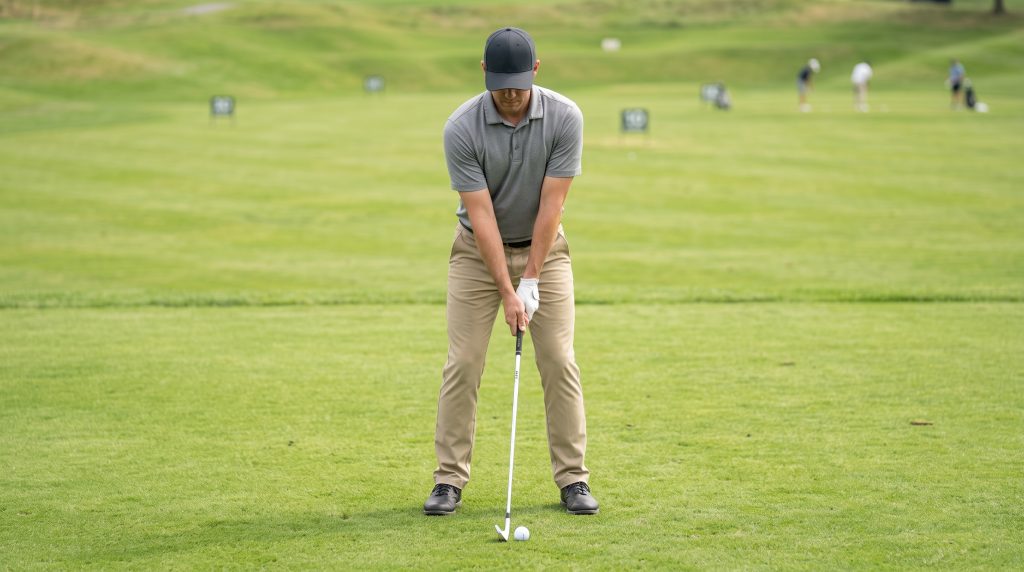
A good golf swing starts with a body position that gives you two things at the same time: stability and freedom of movement. Your stance needs to provide a secure base, while your posture needs to leave enough room for your hips, torso, arms, and club to move without fighting your starting position.
For a beginner, good golf stance and posture should feel athletic rather than rigid. You should not feel as though you are standing perfectly upright, sitting into a deep squat, stretching toward the ball, or balancing on the front or back edges of your feet.
The goal is a balanced address position—the position you establish before starting the swing—from which your body can move naturally and consistently.
What Is the Golf Stance?
Your golf stance and posture is primarily the position of your feet and lower body before you swing. It includes how far apart your feet are, how they sit on the ground, and how your lower body supports your weight and balance.
Stance is one part of your overall setup. Your complete setup also involves other elements such as your grip and the position of the ball, but the stance provides the physical base underneath the rest of your body.
Think of it as creating a platform. If that platform is unstable, excessively narrow, excessively wide, or poorly balanced, your body may have to compensate once the club begins moving.
A useful stance therefore needs to be stable without becoming restrictive.
Finding a Comfortable Stance Width
For a normal golf shot, a good beginner starting point is to place your feet roughly shoulder-width apart. Treat that as a practical reference rather than an exact measurement.
Golfers have different heights, leg lengths, hip mobility, and body proportions. Two players can therefore have slightly different stance widths while both being well balanced.
What matters is what the width allows you to do.
If your stance becomes too narrow, your base of support becomes smaller. That can make it harder to remain balanced as your body moves.
If your stance becomes excessively wide, the opposite problem can occur. You may feel very stable while standing still, but your hips and lower body can become restricted. A stance can therefore be too stable if the extra width prevents you from moving athletically.
The useful middle ground is a stance wide enough to support you but comfortable enough that your knees, hips, and torso do not feel locked in place.
Stance width can vary somewhat with the shot being played, so shoulder width should not be treated as a universal fixed position. It is simply a reliable reference from which a beginner can establish balance and repeatability.
Positioning the Feet
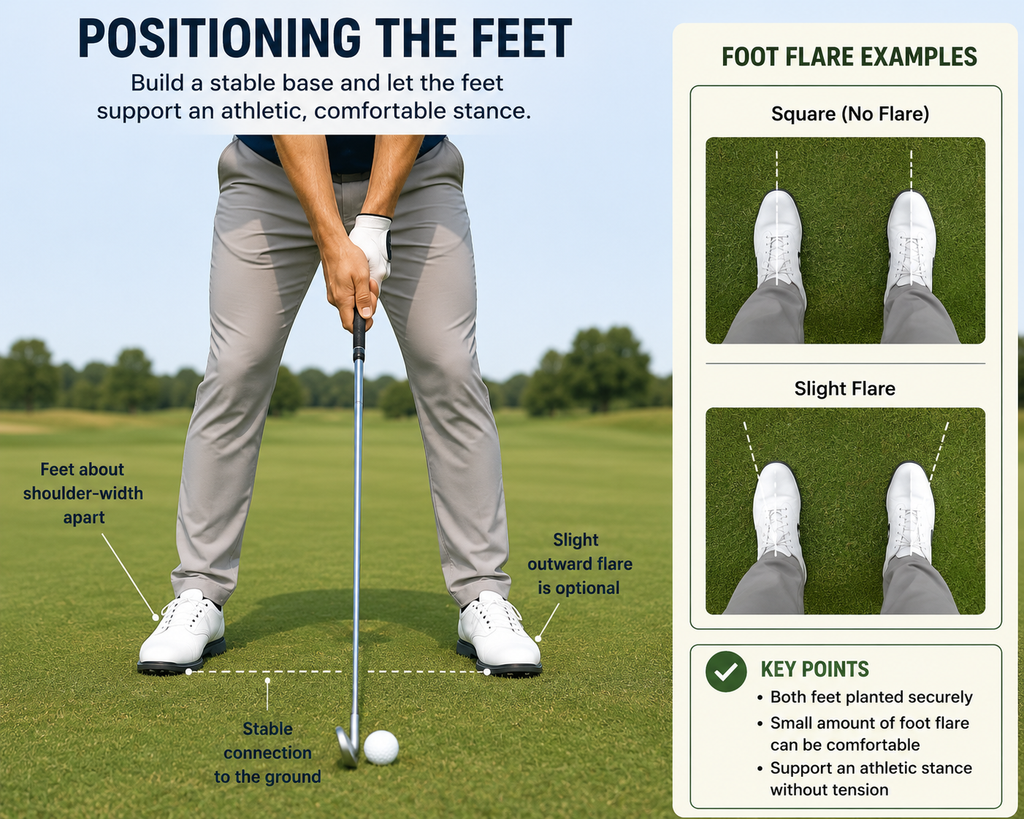
Once you have established a comfortable width, let both feet sit securely on the ground.
You should feel that the feet provide a solid connection to the turf rather than merely being two points where your legs happen to touch the ground. That connection gives your body a dependable base from which it can move.
Your feet do not necessarily have to point perfectly straight ahead. A small amount of foot flare, where one or both toes turn slightly outward, can be comfortable and may make it easier for some golfers to move through the hips.
The amount varies from golfer to golfer. Mobility, body structure, comfort, and individual technique all influence what feels natural. There is no benefit in forcing your feet into an uncomfortable angle simply because you are trying to reproduce a particular-looking setup.
The important principle is that the feet should support an athletic position without creating unnecessary tension.
How to Bend from the Hips
One of the most important posture skills in golf is learning to bend forward correctly.
The forward tilt should come primarily from a hip hinge.
To understand a hip hinge, stand tall and imagine pushing your hips slightly backward while allowing your upper body to tilt forward from the hip joints. Your torso moves forward, but you are not simply curling your shoulders and upper back toward the ground.
This distinction matters.
If you create your forward bend mainly by rounding your back, your chest can collapse and your shoulders may move forward. Your arms then have less natural space in which to hang and move.
A proper hip hinge creates forward tilt while preserving a more neutral relationship through the spine. It places the torso over the lower body without making the golfer look or feel hunched.
A useful sensation is hips back, chest tilted forward, rather than shoulders curled down.
You do not need to force the spine into an exaggeratedly straight or stiff position. “Neutral” is a better goal than “perfectly straight.” The body should still feel athletic and relaxed.
Knee Flex
After hinging from the hips, add a small amount of knee flex.
The knees should be soft rather than locked, but this is not a squat.
Imagine the difference between preparing to move athletically and sitting down into a chair. Golf posture is much closer to the first.
Too much knee flex lowers the body unnecessarily and can push you toward a seated or squatting position. It can also change how your hips sit relative to your upper body, making the entire address position feel cramped.
Too little knee flex creates a different problem. Locked legs can make the stance feel rigid and reduce your ability to respond naturally as the body moves.
The goal is modest flex: enough that the legs feel active and athletic, but not so much that you feel as though your thighs are supporting a squat.
Upper-Body Posture
With the feet secure, hips hinged, and knees slightly flexed, your upper body should remain relatively relaxed.
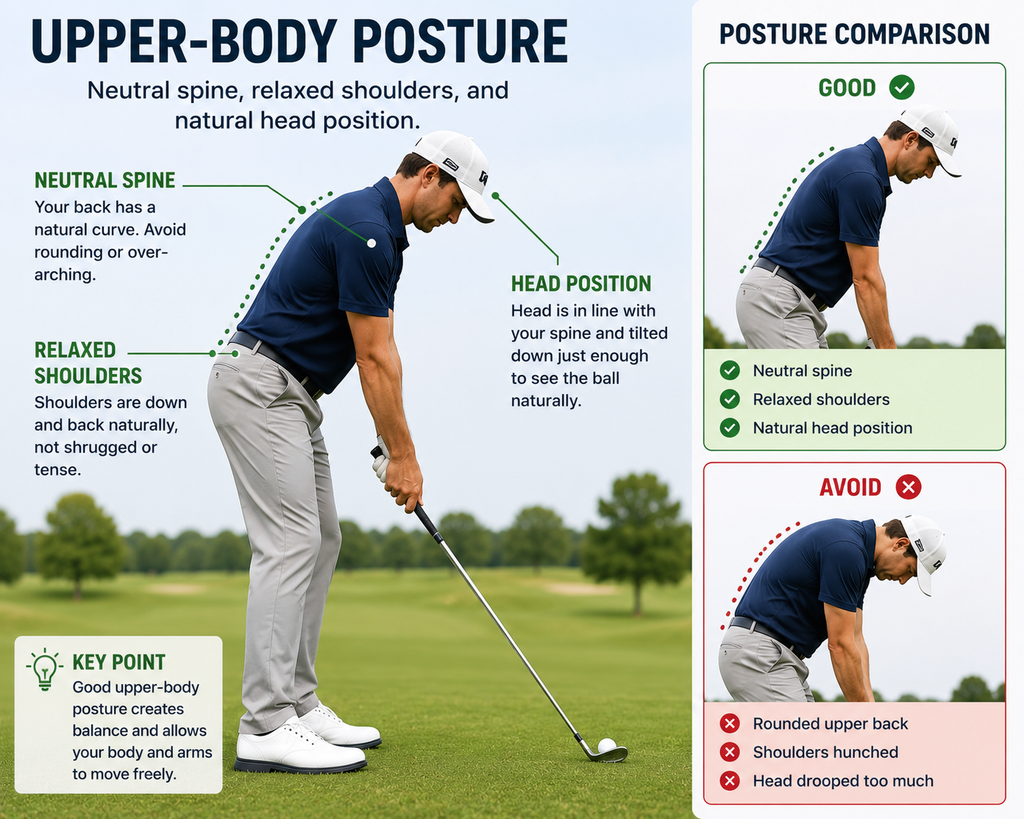
Keep the Spine Neutral
A neutral spine means avoiding an exaggerated rounded or excessively arched position.
You are not trying to hold your back unnaturally straight. Instead, maintain a comfortable posture as the torso tilts forward from the hips.
This gives the torso a more functional position from which it can eventually rotate while helping prevent the collapsed appearance common in beginner setups.
Relax the Shoulders
Allow your shoulders to sit naturally rather than pulling them aggressively backward or shrugging them upward.
Excessive shoulder tension often spreads into the arms and hands. That makes a position intended to be athletic feel rigid before the club has even moved.
Let the Head Follow the Posture
Your head should work naturally with your forward torso tilt.
You need to be able to look down toward the golf ball without forcing your chin tightly into your chest. Avoid trying to keep your head artificially high or pushing it excessively downward.
The objective is simply to see the ball comfortably while maintaining the rest of your posture.
Arm Position
Myth:
You should stretch your arms toward the ball.
Reality:
The arms should hang naturally from relaxed shoulders. Excessive reaching can introduce tension before the swing even begins.
Once the body is positioned correctly, allow your arms to hang naturally from the shoulders.
This is an important checkpoint because the arms can reveal problems elsewhere in the posture.
If you deliberately stretch your arms outward, tension can develop through the shoulders and upper body. You may feel as though you are reaching for the club rather than allowing it to sit naturally beneath you.
At the other extreme, if your arms feel trapped against your torso, the setup may feel crowded and leave insufficient room for them to move.
A good starting position should allow the arms to hang with relatively little muscular effort.
Rather than manufacturing an arm position, build the posture correctly and notice where relaxed arms naturally fall.
Weight and Balance at Address
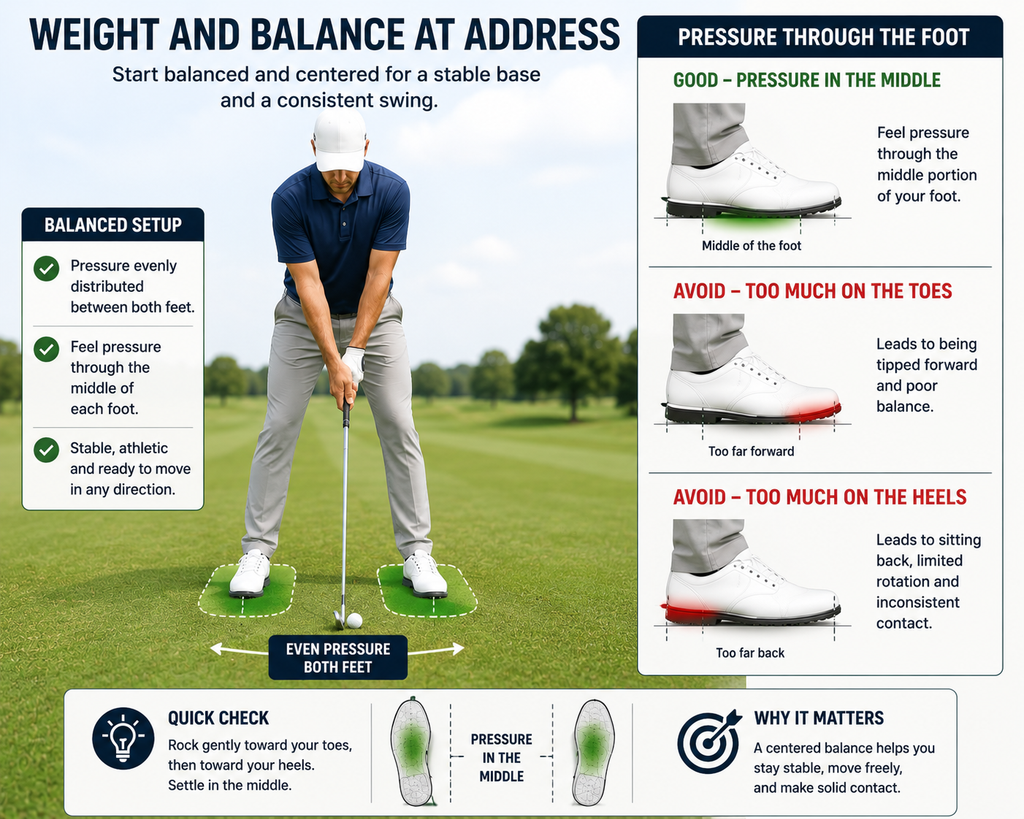
A golfer can look reasonably athletic at address and still be poorly balanced.
Your pressure should feel supported through both feet, with neither foot carrying an extreme amount compared with the other in a normal starting position.
You also want to avoid drifting onto your toes or settling heavily into your heels.
A useful reference is to feel pressure through the middle portion of each foot. You should feel grounded rather than pitched forward or sitting backward.
Why does this matter?
If your pressure begins too far toward your toes, your body may already be fighting to prevent you from falling forward. If it sits excessively in your heels, you can feel as though your body is retreating away from the athletic position you established.
Either extreme can encourage compensating movement.
You can test this without a club. Take your golf posture and gently shift your pressure toward your toes, then toward your heels. Notice how quickly the rest of your body has to react to keep you upright.
Return to the middle and notice how much less effort is required.
That centered feeling is a useful starting reference.
Myth:
Your feet must point perfectly straight ahead.
Reality:
A small amount of foot flare can be perfectly acceptable and may feel more comfortable. The exact position can vary with mobility and body structure.
Why Good Posture Helps the Swing
Good posture is not about making your setup look like a photograph of a professional golfer. Its value is functional.
It Supports Balance
A well-organized stance distributes your body over a stable base. That gives you a better opportunity to remain in control as movement begins.
It Allows the Body to Move
The combination of a comfortable stance, hip hinge, and modest knee flex places the joints in positions that allow movement rather than restricting it.
A golfer who starts excessively upright, deeply squatted, or rigidly locked has already created physical limitations before the swing begins.
It Creates Space for the Arms and Club
Bending properly from the hips allows the arms to hang away from the torso without having to reach.
That space matters because the arms and club need room to move around the body.
It Improves Repeatability
Posture is established before every shot. If the body starts from dramatically different positions each time, the golfer introduces another variable before the club even moves.
A stance and posture that can be reproduced consistently give the golfer a more dependable starting point.
Common Beginner Posture Mistakes
Several setup errors appear frequently when golfers are learning how to address the ball.
Standing Too Upright
A golfer may bend very little from the hips and remain almost vertical.
What happens: The torso does not create enough forward inclination, and the arms may not have a natural place to hang.
What to check: Return to standing tall and create the forward bend from the hip joints rather than trying to manufacture it with the shoulders.
Squatting Too Much
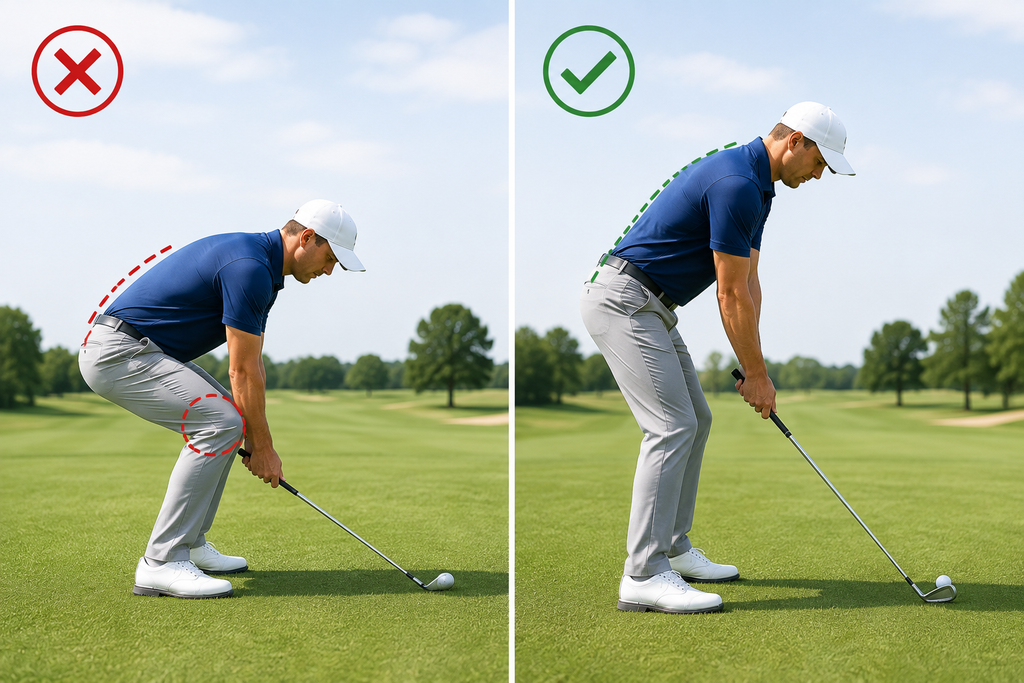
Some beginners interpret “athletic posture” as a deep knee bend.
What happens: The hips drop excessively, the knees move into a pronounced flexed position, and the golfer can feel seated rather than ready to move.
What to check: Reduce the knee bend. Establish the hip hinge first, then add only a modest amount of knee flex.
Reaching Excessively
The arms are stretched away from the shoulders instead of hanging naturally.
What happens: Reaching can create tension in the shoulders and arms and make the setup feel disconnected.
What to check: Relax the shoulders and let the arms fall naturally rather than pushing the hands outward.
Rounding the Back
The golfer creates forward bend by collapsing through the upper body instead of hinging primarily from the hips.
What happens: The chest and shoulders can become cramped, and the arms have less comfortable space to hang.
What to check: Stand tall, move the hips slightly backward, and tilt the torso from the hip joints.
Locking the Knees
The legs remain completely straight and rigid.
What happens: The lower body loses some of the athletic softness that helps the golfer establish a comfortable, responsive position.
What to check: Add a small amount of flex without turning the movement into a squat.
Balancing Too Far Forward or Backward
The golfer begins with pressure concentrated heavily toward the toes or heels.
What happens: The body must compensate simply to maintain equilibrium, making the starting position less stable.
What to check: Rock gently from toes to heels and settle between those extremes, feeling supported through the middle of the feet.
Simple Posture Check
You can practice good golf posture without hitting a ball. A mirror can be useful, but the exercise also works by paying attention to balance and body position.
- Stand tall. Begin from a relaxed upright position with your feet at a comfortable width.
- Bend from the hips. Push the hips slightly backward as your torso tilts forward. Avoid curling the shoulders toward the ground.
- Add slight knee flex. Soften the knees enough to feel athletic without dropping into a squat.
- Let the arms hang. Relax the shoulders and allow the arms to fall naturally beneath them.
- Check your balance. Notice whether your pressure is excessively toward the toes or heels. Settle into a centered, stable position.
Hold the position briefly, stand back up, and repeat.
The purpose is not to freeze yourself into a perfect pose. It is to make the sequence familiar enough that a balanced, athletic posture becomes easier to reproduce.
Find essential golf accessories.
Golf Accessories
Home SHOP BY CATEGORY Drivers Fairway Woods Hybrids Irons Wedges Putters Golf Club Sets Accessories Essential Golf Accessories Accessories won’t fix your swing but they absolutely impact comfort, consistency, and course management. Below are essential add-ons organized by purpose so you…
Key Takeaways
- • A good golf stance provides stability without restricting movement; roughly shoulder width is a useful starting reference for many normal shots.
- • Create forward tilt primarily by hinging from the hips, rather than rounding the upper back.
- • Use slight knee flex, not locked legs and not a deep squat.
- • Keep the shoulders relaxed and allow the arms to hang naturally rather than reaching or crowding the body.
- • Begin in balance, with pressure supported through both feet and generally centered between the toes and heels.
With a stable stance and athletic posture established, the next part of the setup is understanding where the golf ball belongs relative to your body. That consistent reference point helps turn a sound body position into a more repeatable address.
Previous: How to Hold a Golf Club: The Beginner Golf Grip >>>
Next: Golf Ball Position Explained >>>