

Golf ball position is the location of the ball relative to your feet and body when you set up to play a shot. It may look like a small detail, but changing that location changes where the club meets the ball during its motion.
That is why good golf ball position is not simply about putting the ball in roughly the right place. A beginner needs repeatable reference points. With shorter clubs, the ball generally sits closer to the center of the stance. As clubs become longer, the normal starting position moves progressively forward, toward the lead foot. With a driver, it is typically near the inside of the lead heel.
These positions are starting points rather than universal measurements. Golfers differ in stance width, body proportions, equipment, and technique. The important principle is to understand why ball position changes and how to reproduce an appropriate position consistently.
What Is Ball Position?
Ball position describes where the golf ball sits relative to your feet and body at address—the position you establish before beginning the swing.
For a right-handed golfer, moving the ball forward means moving it toward the left, or lead, foot. Moving it back means moving it toward the right, or trail, foot. For a left-handed golfer, those directions are reversed.
Using lead foot and trail foot is therefore more useful than relying on left and right. Your lead foot is the foot closest to the target, while your trail foot is farther from the target.
Ball position is one part of the overall golf setup. Establishing it consistently gives the club and body a predictable relationship to the ball before any movement begins.
Why Golf Ball Position Matters
A golf club travels through a moving arc rather than straight down to the ball and straight back up. Somewhere near the bottom of that arc, the club changes from traveling downward to traveling upward.
Where the ball is positioned relative to that motion influences when the club reaches the ball.
That matters for two major reasons: contact and launch.
Move the ball farther back in the stance and the club generally encounters it earlier in its travel through the hitting area. Move the ball farther forward and the club encounters it later. Those changes can influence the club’s delivery to the ball and the resulting trajectory.
This creates an important cause-and-effect relationship:
Ball location → where the club encounters the ball in its motion → contact and launch conditions
Ball position cannot guarantee a good shot because the swing still determines what the club actually does. But inconsistent ball position introduces another variable. If the ball moves several inches from one setup to the next, the golfer has to deliver the club to a different location each time.
A repeatable ball position removes some of that uncertainty.
Understanding the Center of the Stance
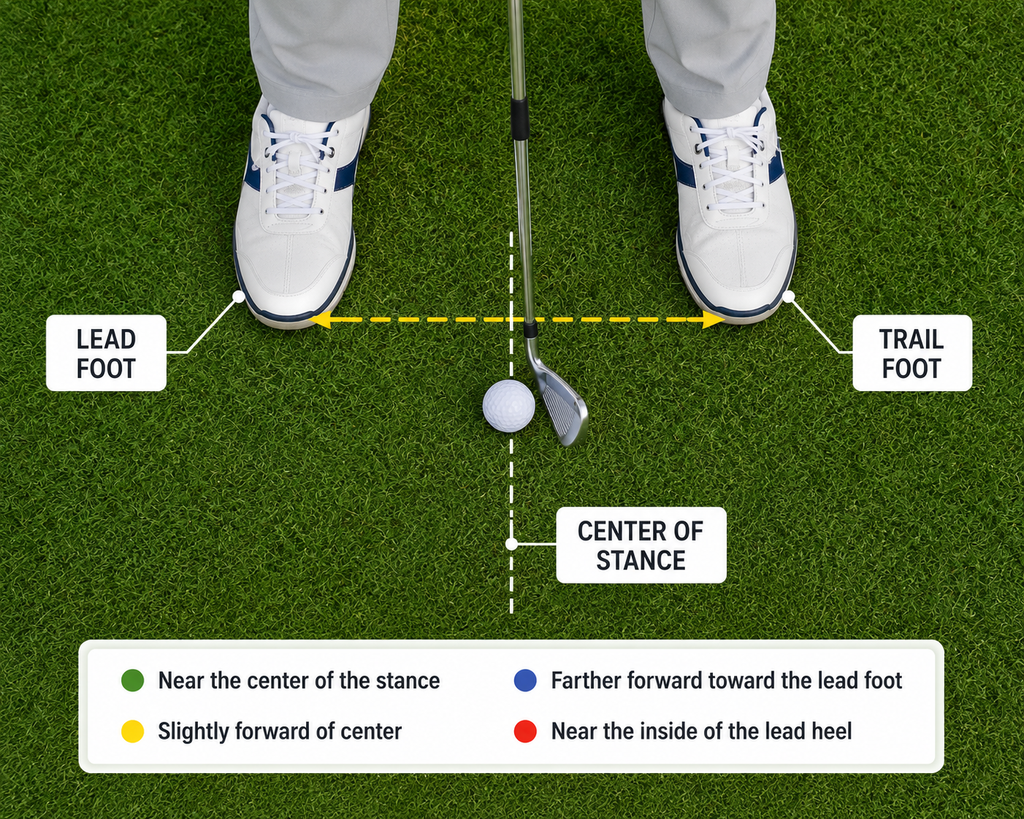
The easiest reference point for a beginner is the center of the stance.
Imagine a line halfway between your two feet. If both feet are positioned evenly, that midpoint gives you a simple visual reference for locating the ball.
Do not confuse the center of the stance with the center of your entire body in every possible setup. The feet provide the practical reference because their spacing is visible and easy to reproduce.
For example, you might describe a ball as:
- • near the center of the stance;
- • slightly forward of center;
- • farther forward toward the lead foot; or
- • near the inside of the lead heel.
These references are usually more useful than trying to place the ball an exact number of inches from one foot. Exact measurements can create false precision because golfers have different body sizes and stance widths.
Ball Position for Shorter Clubs
With shorter clubs, a useful starting point is generally near the center of the stance.
Shorter clubs naturally place the golfer closer to the ball and are commonly used with a more central ball position. This relationship gives the golfer a sensible starting point for meeting the ball within the club’s normal arc.
“Near center” is deliberate. It does not mean every shorter-club shot must be played from an identical spot. Different golfers and different shots can use slightly different positions.
The beginner’s priority is to develop a reliable normal position rather than shifting the ball around without a clear reason.
A useful visual check is simply to identify the midpoint between the feet and see whether the ball is positioned close to that reference.
Ball Position for Mid-Irons
As you move into the mid-irons, the ball can generally move slightly forward of center.
The change should be modest. A common beginner mistake is hearing that longer clubs require the ball farther forward and then making a dramatic adjustment.
Think of ball position as a progression rather than a collection of unrelated locations:
Shorter club → near center
Mid-iron → slightly forward of center
The exact position can vary, but the progression gives you a repeatable framework.
This also makes setup easier to learn. Instead of memorizing a completely different location for every numbered iron, you can understand the broader relationship between club length and ball position.
Ball Position for Longer Clubs
As clubs become longer, the normal ball position generally progresses farther forward toward the lead foot.
The key word is progressively. The ball does not need to jump from the center of the stance to the lead heel simply because you have selected a longer club.
Imagine the positions forming a gradual range across the stance:
Shorter clubs → center area → mid-irons slightly forward → longer clubs farther forward
This is a more useful beginner model than trying to memorize a precise measurement for every club.
Club length is part of the reason these setups change. A longer club changes your overall relationship to the ball, including how far away you stand, so the setup needs to accommodate those dimensions.
The principle is consistent even though individual golfers may use somewhat different exact positions.
Driver Ball Position
The driver is the clearest example of a forward ball position.
A common starting point is to position the ball near the inside of the lead heel.
For a right-handed golfer, that means near the inside of the left heel. For a left-handed golfer, it means near the inside of the right heel.
This places the ball much farther forward than the position normally used with shorter clubs.
The distinction matters because the driver setup differs substantially from a short-club setup. The driver is longer, and the ball is played from a tee. Its forward position places the ball later in the club’s travel through the hitting area, which supports the different contact and launch conditions associated with the club.
The useful setup principle is therefore not “put every golf ball in the middle.” Different clubs create different requirements, and the driver sits at the forward end of the normal ball-position range.
Ball Position Versus Stance Width
One of the easiest ways to misjudge ball position is to look only at the space between the feet.
Suppose the ball stays in exactly the same physical location relative to your body, but you move your trail foot several inches wider. The ball can suddenly look farther forward within the stance even though its relationship to the lead side of your body has not changed.
The opposite can happen when the stance narrows.
This is why consistent body reference points are useful.
The center of the stance works well when learning central positions. For a driver, the inside of the lead heel provides a more stable reference than simply saying “put the ball well forward.”
This distinction also explains why copying a photograph of another golfer can be misleading. Two players may appear to have different ball positions simply because their stance widths differ.
Use the feet as reference points, but pay attention to which reference point you are using.
Did you know?
Whimsical Names: Before clubs had numbers, they had fun names like “niblicks” and “longnoses”.
How Far Should You Stand from the Ball?

Ball position also has a second dimension: distance toward or away from your body.
A ball can be correctly positioned forward or back yet still be too close to you or too far away.
A sound starting point is to establish your normal posture and allow your arms to hang comfortably rather than deliberately reaching toward the ball. The club should then meet the ground at the ball without forcing you to stretch your arms outward or crowd them against your body.
This builds on the posture established earlier in the module rather than changing your body simply to reach the ball.
Club length affects this spacing. A longer club generally places you farther from the ball than a shorter club does. That is normal. You should not try to maintain one fixed ball-to-body distance with every club.
Standing Too Far Away
If the ball is too far away, you may have to reach your arms excessively toward it.
That reaching changes the comfortable relationship between your arms, body, and club. It can also make the setup feel stretched and less balanced.
Instead of reaching farther with the arms to accommodate a misplaced ball, reset the setup and allow the club’s length to help establish the appropriate spacing.
Standing Too Close
If the ball is too close, the arms can become crowded against the body.
That reduces the comfortable space available for the arms and club. A golfer may compensate by standing more upright or otherwise changing the posture simply to fit into the available space.
The better solution is not to distort your posture around the ball. Establish your normal posture, let the arms hang comfortably, and position yourself so the club reaches the ball naturally.
Common Ball Position Mistakes
Ball-position problems are often easier to address when you separate setup inconsistency from the swing itself.
Playing the Ball Too Far Forward
When the ball is excessively forward for the club being used, the club has to travel farther through its arc before reaching it.
That changes the point at which contact occurs. Depending on what the club is doing, the golfer may notice inconsistent contact or trajectory.
The simplest first check is the setup itself: compare the ball with the appropriate body reference rather than immediately changing the swing.
Playing the Ball Too Far Back
A ball that is excessively far back is encountered earlier in the club’s motion through the hitting area.
Again, that can change contact and launch conditions.
If the ball has gradually moved backward during a practice session, restoring the normal reference position may remove the inconsistency without introducing a new swing thought.
Changing Ball Position from Shot to Shot
A golfer may set a mid-iron slightly forward of center on one attempt, near the center on the next, and several inches farther forward on the third without realizing it.
Even if the golfer tries to make the same motion, the club is now being asked to meet a ball in three different places.
Consistency in setup gives you a much better basis for evaluating the resulting shots.
Moving the Ball After Every Poor Shot
One bad result does not automatically mean the ball position was wrong.
Beginners sometimes react to a poor shot by moving the ball forward. The next shot is poor, so they move it backward. Within a few swings, they no longer have a normal reference position at all.
Check whether the setup actually changed before correcting it. If the ball was in the intended position, repeatedly moving it can create a new problem rather than solve the original one.
How to Practice Ball Position
Ball position is particularly well suited to setup-only practice because you can develop the skill without hitting a golf ball.
An alignment stick is useful, but another golf club placed safely on the ground can serve the same purpose.
- Place one stick or club on the ground across your stance so you can clearly see the ball’s location relative to your feet.
- Take your setup with a shorter club and identify the center of the stance.
- Reset completely rather than shuffling the ball or feet into place.
- Repeat until you can consistently establish the intended central position.
- Repeat with a mid-iron, placing the ball slightly forward of center.
- Repeat with a longer club and observe the gradual forward progression.
- With a driver, practice using the inside of the lead heel as the primary reference.
The purpose is not to memorize an exact number of inches. It is to train your eyes and body to recognize repeatable reference points.
After several repetitions, step away and rebuild the setup from scratch. That is more valuable than remaining in one stance and simply changing clubs because golf requires you to establish the position again before each shot.
Looking for your first set of golf accessories?
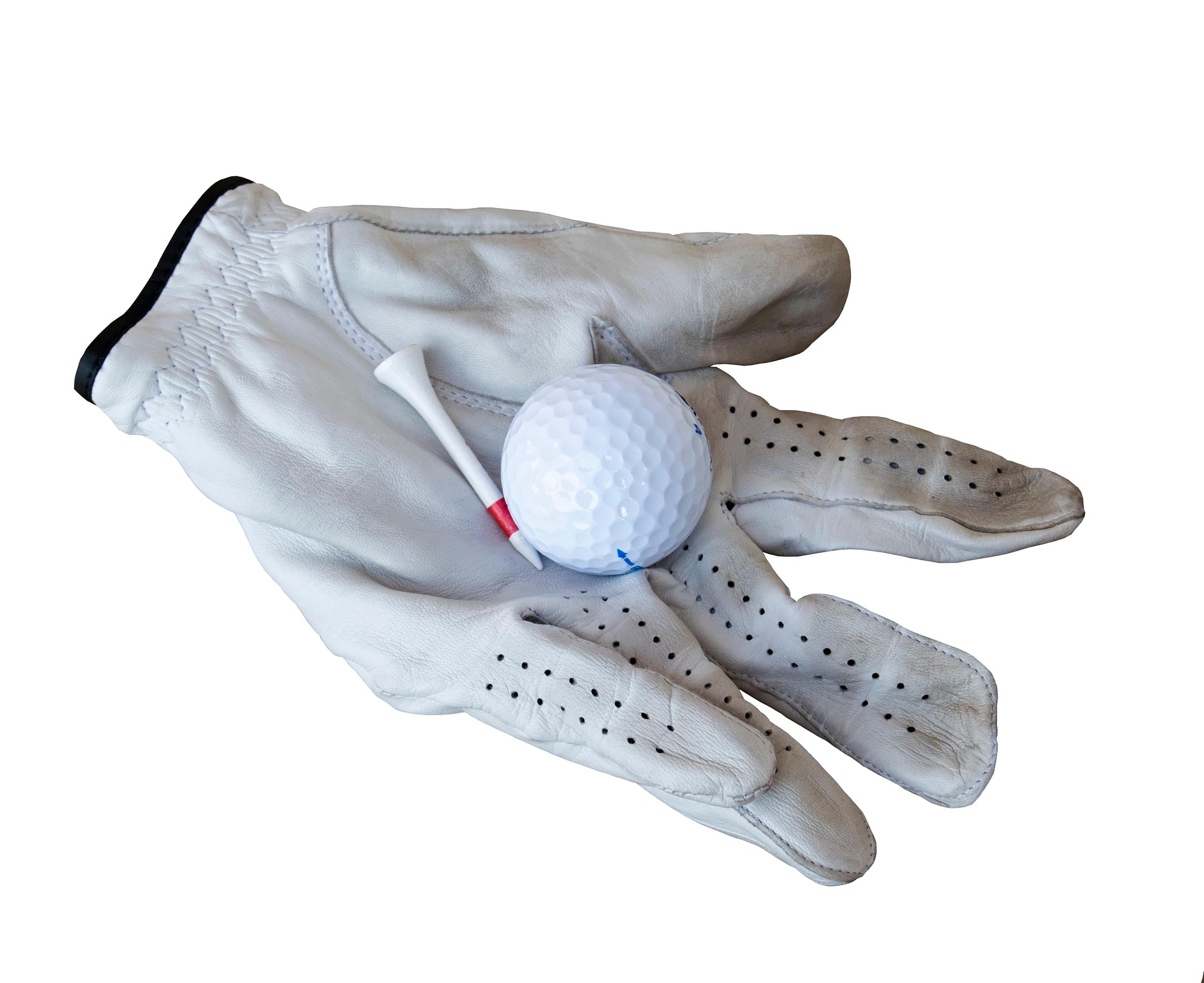
Golf Accessories
Home SHOP BY CATEGORY Drivers Fairway Woods Hybrids Irons Wedges Putters Golf Club Sets Accessories Essential Golf Accessories Accessories won’t fix your swing but they absolutely impact comfort, consistency, and course management. Below are essential add-ons organized by purpose so you…
Key Takeaways
- • Golf ball position describes where the ball sits relative to your feet and body at address.
- • Shorter clubs generally use a position closer to the center, with the normal position moving progressively forward as clubs become longer.
- • Driver ball position is typically near the inside of the lead heel.
- • Stance width can change how ball position looks, so use consistent body and foot reference points rather than relying only on appearance.
- • Distance from the ball matters too: allow the arms to hang comfortably instead of reaching or crowding yourself.
Once you can position the ball consistently relative to your body, the next setup skill is establishing where the club and body point relative to the target. That leads into How to Aim and Align Your Golf Shots.
Previous: Golf Stance and Posture for Beginners >>>
Next: How to Aim and Align Your Golf Shots >>>