

A good golf swing can still send the ball in the wrong direction if the club and body are not aimed where you intend. Before the club ever starts moving, your setup has already established an important directional starting point. If that starting point changes from shot to shot, it becomes much harder to judge whether a poor result came from the swing or simply from being aimed somewhere other than you thought.
Learning how to aim a golf shot begins with understanding two closely related but different parts of the setup: aim and alignment. Aim refers primarily to where the clubface points. Alignment describes how your body—including your feet, knees, hips, and shoulders—is positioned relative to the intended target line. These elements need to work together, but treating them as though they are the same thing is one of the easiest ways to become confused about golf alignment.
Alignment is also more visually deceptive than it first appears. When you stand behind the ball, you can look almost directly along the intended line toward the target. Once you step into your address position, your eyes move beside that line, changing the angle from which you see the target. A setup that looked correct from behind the ball can suddenly feel as though it points left or right when you stand over it. Developing a repeatable alignment process helps you rely on clear references rather than continually changing your setup according to what looks right from beside the ball.
Aim and Alignment Are Not the Same Thing
Golfers often use the words aim and alignment interchangeably, but separating them makes the setup much easier to understand. Aim refers primarily to the direction of the clubface, while alignment refers to the position of the body relative to the target line. You therefore need to consider both the club and the golfer when establishing the direction of a shot.
This distinction matters because the clubface and body can be oriented differently. A golfer can position the feet neatly while leaving the clubface pointed somewhere else. The opposite can also happen: the clubface may be aimed correctly while the feet, hips, or shoulders are turned away from the intended body line. Looking organized at address does not necessarily mean every part of the setup agrees.
For a standard square setup, a useful starting principle is to establish the intended target line, aim the clubface relative to that line, and then position the body parallel to it. This gives each part of the setup a clear job. Instead of trying to make the entire golfer point toward one distant object, you establish the direction of the shot first and organize the body around that reference.
That difference becomes particularly important when you begin looking at the target from your address position. Because your body stands beside the ball rather than directly behind it, correct body alignment does not look exactly the same as clubface aim. Understanding why requires a clear picture of the target line.
Understanding the Target Line

The target line is an imaginary straight line extending from the golf ball toward your intended target. It is the main directional reference used to aim the clubface and organize the rest of your alignment. Imagine placing a very long ruler on the ground with one end beginning at the ball and the other pointing toward your chosen target. The edge of that ruler represents the target line.
The important detail is that the target line is established by the ball and the intended target, not by your feet, hips, or shoulders. Your body does not create the line. Instead, you establish where you intend the ball to go and then position the clubface and body in relation to that direction. This gives the entire setup one consistent reference instead of asking different parts of the body to find the target independently.
Suppose you are practicing on a driving range and choose a particular flag as your target. Imagine a perfectly straight line running from your golf ball toward that flag. If you change targets and choose a marker farther to the right or left, the target line changes with it. The purpose of identifying the line is not to predict the exact flight of the golf ball; it is to establish a precise intended direction before you make the swing.
Without that reference, golfers often begin aiming individual pieces of the setup independently. The clubface may point toward one place, the feet toward another, and the shoulders somewhere else because each position has been adjusted according to what looks comfortable from address. Each adjustment may be small, but together they can produce a setup containing several conflicting directions.
Did you know?
Golf is one of only two sports ever played on the moon (the other being javelin). On February 6, Apollo 14 astronaut Alan Shepard hit two golf balls on the lunar surface.
Why the Target Line Can Look Different at Address
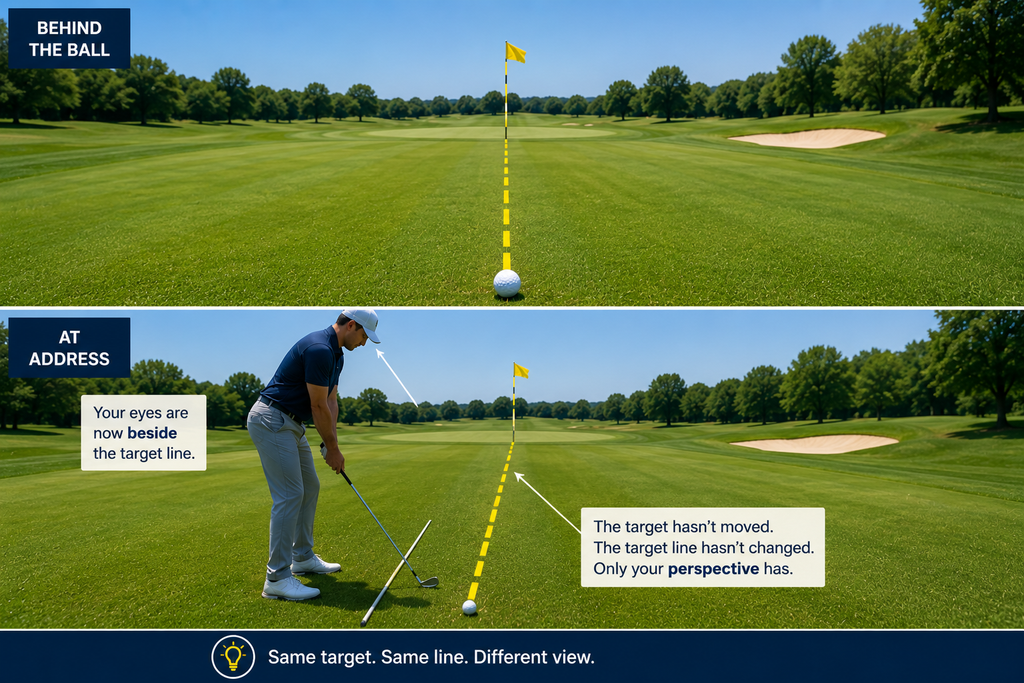
One reason alignment causes so much confusion is that your view of the target changes as you prepare to hit the ball. When you stand directly behind the ball and look toward the target, your eyes can look almost straight down the ball-to-target line. That makes the intended direction relatively easy to visualize.
When you step into your stance, your eyes move away from that line because your body must stand beside the ball. You are now viewing the same target from an offset position. The target has not moved and the target line has not changed, but your perspective has changed.
This is why correct alignment can sometimes look wrong from address. A golfer may establish a good line from behind the ball, step into position, look toward the target, and then feel as though the setup is pointing somewhere else. Making repeated adjustments based on that feeling can gradually destroy the alignment that was established correctly in the first place.
The target line gives you something more reliable than that changing visual impression. You identify the intended direction and then organize the setup relative to it. During practice, an alignment stick can make this concept much easier to understand because it turns the imaginary line into a visible reference on the ground. Looking at that same stick from behind the ball and then from address can show you just how much perspective changes when you move beside the target line.
Choosing a Specific Target
A useful target line begins with a specific target. Beginners sometimes make aiming unnecessarily difficult by choosing a destination that is too broad, such as “down the middle” or “somewhere near that green.” Those descriptions may express a general intention, but they do not provide the eyes with a precise directional reference.
Did you know?
Golfers often use the leading edge of an iron as a visual reference for clubface aim because the face itself can be difficult to judge precisely from the address position.
On a practice range, choose something clearly identifiable such as a particular flag, distance marker, or fixed object. You can still think in terms of an appropriate landing area, but selecting a definite reference within that area makes it easier to establish exactly where the target line should point. Mentally connect the golf ball to that reference, and you now have a much clearer direction around which to organize the setup.
The relationship is straightforward: a vague target produces an uncertain target line, while a specific target produces a defined target line that can be repeated. This does not mean you need to become obsessed with aiming at an impossibly tiny point. The value of specificity is that it removes ambiguity. Two setups pointing several degrees apart might both seem acceptable if your intention is merely to hit “somewhere down there,” whereas a particular flag immediately gives you a way to recognize that the setups are different.
Once that direction is established, the next question is which part of the setup should be aimed first. The answer is the clubface.
Clubface Alignment
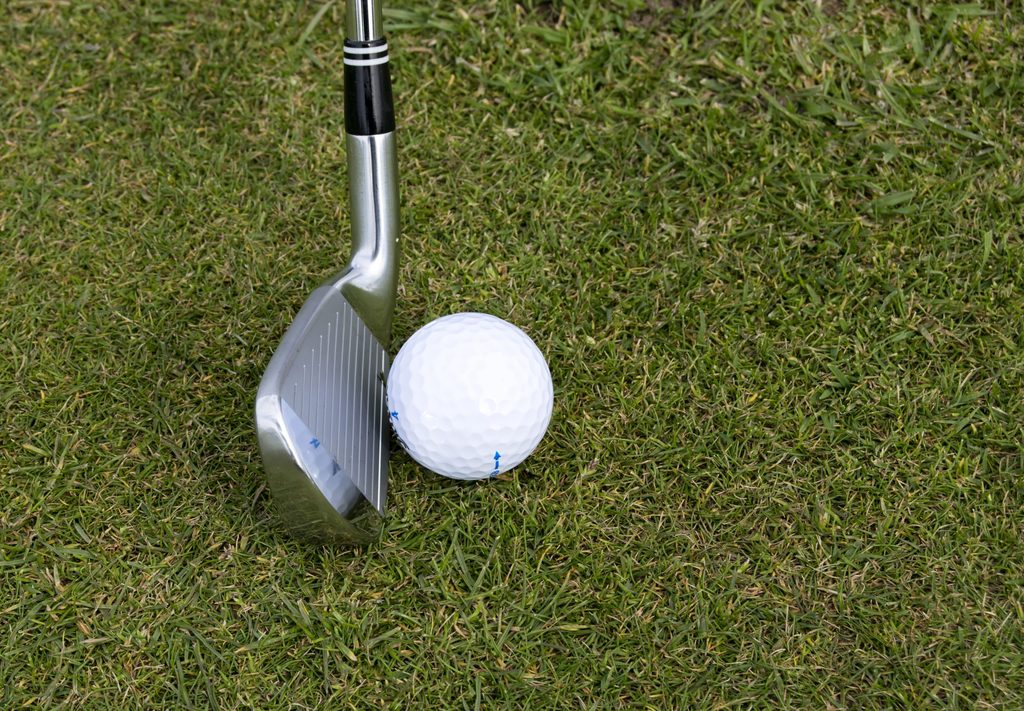
The clubface is the striking surface of the golf club, the part designed to contact the ball. Once you have selected the target and established the target line, the clubface should be deliberately oriented relative to that line rather than simply placed behind the ball and assumed to be correct.
With many irons, the leading edge – the lower edge of the clubface – provides a useful visual reference when looking down at the club. Position the club behind the ball and use the face to establish your intended direction. The exact appearance will differ between club designs, but the underlying principle remains the same: the clubface needs to be aimed deliberately before the body is organized around it.
Beginners frequently reverse this process. They place their feet first, make sure the stance feels comfortable, and then set the club down according to the direction established by the body. The problem is that foot alignment does not automatically guarantee clubface alignment. You can have perfectly neat-looking feet while the clubface points several degrees away from the intended target line.
A more reliable sequence is to choose the target, establish the target line, aim the clubface, and then build the body alignment around those references. This order makes intended direction the foundation of the setup. You are not asking the clubface to fit into a stance that has already been constructed; you are establishing the face first and positioning the golfer relative to it.
Small aiming errors can also be more significant than they appear when you look only at the few inches immediately in front of the club. Imagine two straight lines beginning at the same point but leaving at slightly different angles. Very close to their starting point, they appear almost identical. As the lines extend farther away, however, the separation between them becomes increasingly obvious. A small difference in clubface aim at the ball can therefore represent a much larger directional difference at a distant target.
This is one reason precise visual references are useful. “That looks about right” is difficult to repeat. A specific target and established target line give you something consistent against which to position the clubface.
Body Alignment
Once the clubface has been aimed, you can establish body alignment. The main references are the feet, knees, hips, and shoulders. In a standard square setup, these body lines should generally work together and run parallel to the target line rather than all pointing directly toward the target itself.
Imagine drawing a straight line across your toes. Then picture similar lines across your knees, hips, and shoulders. The goal is not to make every line mechanically perfect down to a fraction of a degree, nor should you force your body into an uncomfortable position simply to make it look symmetrical. The useful principle is that the major body lines should generally agree rather than unintentionally pointing in several different directions.
The feet receive a great deal of attention because they are easy to see. You can look down and immediately notice where your toes appear to be pointing. But foot alignment is only one part of body alignment. A golfer can position the feet parallel to the target line and then rotate the hips or shoulders into a noticeably different orientation without realizing it.
Shoulder alignment deserves particular attention because beginners often check the feet carefully while paying little attention to the upper body. If the feet are parallel to the intended line but the shoulders are substantially open or closed relative to them, the setup contains conflicting directional references before the swing begins. Because the arms connect to the upper body, the shoulders are not merely a cosmetic part of how the stance looks; they are an important part of how the golfer is organized at address.
A useful practice question is therefore not simply, “Where are my feet pointing?” Instead, check whether your feet, knees, hips, and shoulders generally agree with one another. That produces a much more complete picture of body alignment.
There are legitimate situations in golf where players intentionally alter body alignment for a particular technique. A square, parallel relationship is nevertheless a practical reference for learning normal shot alignment because it gives beginners a neutral and repeatable starting point. The easiest way to visualize that relationship is with the railroad-track concept.
The Railroad-Track Concept
Imagine a pair of railroad tracks running into the distance. The two rails travel in the same direction while remaining beside one another. They do not angle inward and meet at the same distant object. This provides an excellent visual model for understanding the relationship between the target line and body alignment.
One rail represents the ball-to-target line. The golf ball sits on this rail, and the clubface is aimed relative to the intended target direction. The second rail represents the body line, with the feet, knees, hips, and shoulders generally organized along it. The two lines travel in the same direction but remain parallel.
For a right-handed golfer, the body line sits to the left of the ball-to-target line. For a left-handed golfer, the body line sits to the right. This is important because a golfer who believes every part of the setup should point directly toward the same distant target will naturally begin angling the body inward toward the ball-to-target line.
Consider what would happen to actual railroad tracks if both rails were pointed at the same flag in the distance. They would gradually converge until they crossed. They would no longer be parallel. Golf alignment follows the same geometric principle: the clubface and ball-to-target line establish one rail, while the golfer stands along the neighboring rail.
This explains a feeling that can initially confuse beginners. A right-handed golfer with square alignment may look toward the target and feel that the body is pointing somewhat left of it. A left-handed golfer may feel that the body is pointing somewhat right. That sensation does not automatically indicate poor alignment. The body is physically offset from the ball-to-target line, so its parallel line cannot occupy exactly the same space.
Understanding the railroad-track relationship helps replace the vague instruction to “aim your whole body at the target” with something much more useful. The clubface and body have related but distinct directional references, and those references should generally remain parallel in a standard square setup.
Did you know?
Alignment is one reason professional golfers and instructors frequently practice with clubs or alignment rods on the ground: even experienced players benefit from an external reference instead of relying entirely on feel.
Using an Intermediate Target
Even after you understand the target line, aiming a clubface at something 100 or 150 yards away can be difficult. A distant flag may be easy to see, but judging the precise orientation of a clubface against something that far away is much harder. An intermediate target simplifies the task by giving you a nearby reference located on the same target line.
Begin by standing behind the ball and looking toward your intended target. Once you can visualize the line connecting the ball and target, identify a small, visible spot a short distance in front of the ball that lies on that same line. Depending on the surface, it might be a distinctive blade or patch of grass, a small discoloration, or another naturally occurring feature that is easy to recognize.
You now have three connected references: the golf ball, intermediate target, and intended target. The intermediate point does not replace the actual target. Its purpose is to represent the same direction at a much shorter distance, where precise visual alignment is easier.
When you approach the ball, orient the clubface using that nearby reference. Because the intermediate target is only a short distance away, it is generally easier to see whether the clubface is positioned consistently with the intended line than it would be if you were continually comparing the face with a distant flag. Once the clubface is established, build your body alignment parallel to the target line.
This approach helps solve two problems at once. First, it makes clubface alignment easier to judge because the visual reference is nearby. Second, it reduces the temptation to keep looking toward the distant target from address and making repeated corrections because your perspective has changed.
The process therefore becomes:
- Choose a specific target.
- View the intended line from behind the ball.
- Select an intermediate target on that line.
- Aim the clubface using the nearby reference.
- Build the body parallel to the established target line.
With practice, these actions begin to form one connected alignment process rather than a collection of separate checks.
Why Beginners Often Aim Incorrectly
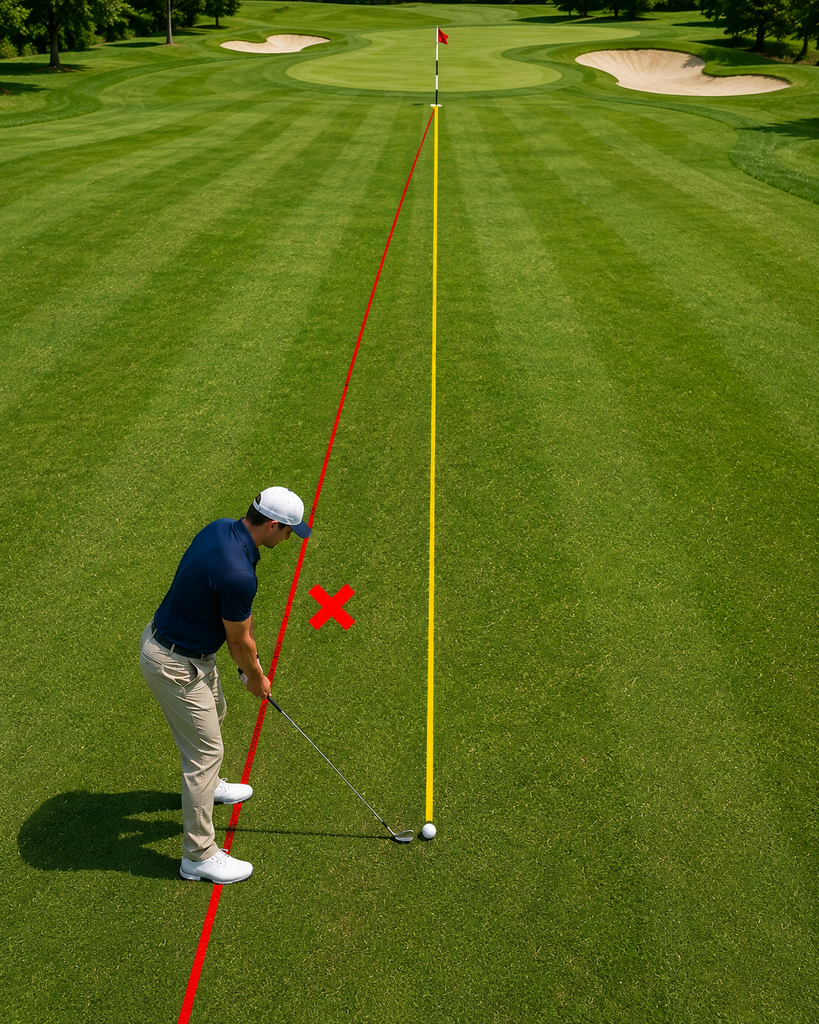
Many alignment errors begin with a reasonable assumption: if you want the ball to go toward a particular target, it seems logical that your entire body should point directly at that target. The problem is that the golfer stands beside the ball-to-target line. A square body position is therefore generally parallel to that line, not aimed directly into the same distant point.
Perspective makes the problem harder to recognize. Looking from behind the ball provides one visual picture; looking from beside it provides another. If you trust only the address-position view, you may continually adjust a correctly established line because it does not look the way you expected.
Beginners can also become overly dependent on their feet. Because the toes are easy to see, golfers may carefully position them and assume everything else must be correct. In reality, the clubface may be aimed differently, or the hips and shoulders may have turned away from the line established by the feet. Good alignment requires the major references to work together.
Another common cause is simply failing to choose a precise target. If the intended direction is vague, there is no reliable standard against which to judge the setup. One shot may be aligned several yards left of the previous one while both feel acceptable because the golfer never established a specific target line.
The practical solution is not to add more and more alignment thoughts. It is to use a consistent sequence: establish a specific target and target line, aim the clubface, and organize the body parallel to that reference. A simple process is easier to repeat and easier to evaluate.
Common Alignment Mistakes
The Feet Are Correct but the Shoulders Are Not
A golfer may carefully place the feet parallel to the target line but unknowingly rotate the shoulders into a different position. This often happens because the golfer treats the toe line as proof that the entire body is aligned correctly.
The result is a setup containing two different body references: the lower body points one way while the upper body points another. During practice, check the feet, knees, hips, and shoulders as a group rather than assuming correct foot alignment guarantees correct body alignment.
The Body Is Aimed Directly at the Target
A beginner may point the clubface at the target and then turn the feet, hips, and shoulders toward exactly the same point. Although this can look logical, the body line and target line are now converging rather than running parallel.
Return to the railroad-track image. The ball occupies one rail and the golfer occupies the neighboring rail. Both travel in the same general direction, but they do not meet at the target.
The Clubface and Body Point in Different Directions
Another golfer may build a neat, square-looking stance without ever deliberately aiming the clubface. In that case, the body may be internally consistent while the face points somewhere else.
The simplest correction is to reverse the order. Establish the target line and clubface direction first, then build the body around them. This gives the stance an external reference instead of allowing the stance to determine the aim.
The Golfer Keeps Rechecking and Readjusting
Looking at the target is useful, but repeatedly rebuilding the setup after you have established it can create new alignment errors. One adjustment changes the feet, another turns the shoulders, and another changes the clubface. The golfer eventually loses the original target line.
A more reliable approach is to establish the line deliberately, build the setup from that reference, make a final visual confirmation, and then trust the alignment you have created. The objective is not to stop paying attention to the target; it is to avoid allowing every new glance to trigger another unnecessary physical adjustment.
Alignment Practice Drill
Alignment is difficult to learn entirely by feel because a misaligned setup can become familiar very quickly. Two alignment sticks provide useful external feedback by making the target line and body line visible on the ground.
Place the first stick so it represents the ball-to-target line, positioning it safely away from the area where the club will strike the ball or turf. Place the second stick along the body line, parallel to the first and close enough to your toes to provide a clear reference without interfering with your stance. Viewed from behind, the two sticks should resemble railroad tracks.
Begin each repetition from behind the ball rather than simply stepping into the same stance repeatedly. Choose your target, identify the target line, and select an intermediate reference. Approach the ball, aim the clubface along the intended line, and then position your feet parallel to the body-line stick. Once settled, check whether your knees, hips, and shoulders generally agree with that relationship.
Step away after each repetition and start again. You do not need to hit a golf ball every time. Rebuilding the setup is valuable practice because the purpose of the drill is to train your ability to recognize and reproduce alignment rather than simply hit shots from a position that has already been established.
When you do hit balls, treat the sticks as alignment feedback, not as a complete explanation for where every shot finishes. A golf ball’s final direction can be affected by what happens during the swing and at impact. The sticks tell you something more specific: whether you began the shot with a clearly defined target line and an organized alignment.
As you become more comfortable, alternate between repetitions with the sticks and repetitions without them. Establish the setup using your normal visual references, then check whether your perception matches the visible lines. That comparison helps develop an alignment process you can reproduce when no practice aids are present.
How to be more consistent in golf?

How to be More Consistent in Golf
You Don’t Need a New Swing. You Need Structure. Turn flashes of great golf into repeatable, dependable performance Jump To What You NeedYou’re Not Starting Over, You’re SharpeningWhy Range Practice Doesn’t Always…
Key Takeaways
- • Aim and alignment are related but different. Aim refers primarily to where the clubface points, while alignment describes how the body is positioned relative to the target line.
- • Establish a specific target and clear target line before building the rest of the setup. A vague target makes consistent alignment much harder to judge.
- • Aim the clubface first and organize the body around that reference. Do not assume correctly positioned feet automatically mean the clubface is aimed correctly.
- • Think of the target line and body line as parallel railroad tracks. The golfer stands beside the ball-to-target line rather than pointing every part of the body directly at the same distant target.
- • Use an intermediate target and alignment sticks to make an otherwise imaginary alignment system easier to see, practice, and repeat.
Once you can establish aim and alignment consistently, these skills can become part of the preparation you use before each shot. The next lesson brings the setup fundamentals together in Building a Consistent Pre-Shot Routine.
Previous: Golf Ball Position Explained >>>
Next: Building a Consistent Pre-Shot Routine >>>