Playing your first round of golf can feel unfamiliar because there is more to the experience than simply arriving and hitting a ball. There is a normal sequence to the day: you check in, get ready, warm up if time allows, report to the starting area, play one hole after another, and finish back near the clubhouse.
Once you understand how a round of golf works, much of that uncertainty disappears. The individual golf shots may still be challenging, but you will have a clearer picture of where to go, what happens next, and how a group progresses around the course.
Did you know?
Golfers can spend several hours completing an 18-hole round, which is why pace of play, moving efficiently between shots and being ready when it is your turn are important parts of the game.
Before the Day of Your Round
Most rounds begin with a tee time, which is the scheduled time your group is expected to start playing. Depending on the golf course, tee times may be reserved online, by phone, through an app, or directly through the pro shop.
Before the day arrives, confirm three basic details: the correct golf course, your tee time, and any course-specific requirements that could affect your visit. A course may have its own check-in procedure, dress requirements, cart arrangements, or instructions for guests.
Your tee time is the time you are supposed to begin playing, not the time you should arrive in the parking lot. Plan to arrive early enough to check in, get organized, and reach the starting area without rushing.
That distinction matters. If your tee time is 9:00 a.m., arriving at 9:00 means the rest of your group—and potentially groups scheduled behind you—may already be waiting.
Arriving at the Golf Course

When you arrive, your first destination will usually be the clubhouse or pro shop.
Tell the staff your name and tee time and complete the course’s check-in process. If you are playing with other golfers, the reservation may be under one person’s name, so it helps to know whose name was used when the tee time was booked.
During check-in, you may also receive practical information about the day. For example, staff might tell you where to find your cart, where the first tee is located, whether your starting time has changed slightly, or whether there are special course conditions to be aware of.
Golf facilities differ, so asking a simple question such as, “Where should I go before my tee time?” is completely appropriate if the layout is unfamiliar.
What Happens After Check-In
After checking in, you have a short period to get organized before play begins.
Depending on the facility and how much time you have, you might:
- Get your golf bag and personal belongings ready.
- Locate the practice facilities.
- Meet the other golfers in your group.
- Find the first tee or designated starting area.
- Confirm whether you need to report to a starter.
The important point is that you should know where you need to be and when you need to be there. A large golf facility may have the practice range some distance from the first tee, so allow enough time to make that transition.
Warming Up Before Playing

If the course has practice facilities and you have enough time, a short warm-up can help you make the transition from arriving at the facility to actually playing golf.
A typical pre-round sequence might begin with some light physical movement, followed by a short period of hitting practice shots. You may then spend a few minutes on the practice putting green before heading toward the first tee.
This is a warm-up rather than a full practice session. The purpose is to get your body moving, make a few golf swings, become accustomed to the feel of the club and ball, and be ready when your group is called to start.
Keep an eye on the time. A golfer who becomes absorbed in hitting practice balls and reaches the first tee late has defeated the purpose of arriving early.
Going to the First Tee
As your tee time approaches, leave the practice area and head to the starting area.
Some courses have a starter, a staff member who organizes groups and controls when they begin. If there is a starter, report to that person and let them know which tee time you are part of. At other courses, the process may be less formal.
You may be playing with friends, family members, or golfers you have never met. Golf courses commonly combine players into groups, so a reservation for one or two golfers can result in playing alongside other people.
Wait until your group is told to begin or until the appropriate starting time arrives. Once your group is ready, the round moves from preparation into actual play.
Starting the First Hole
The first hole establishes the basic pattern you will repeat throughout the round.
One golfer begins, followed by the other players in the group. After everyone has played their opening shot, the group moves forward to where the balls have finished.
Each golfer then continues playing their own ball. One player’s ball may be farther ahead, another may be off to one side, and another may have traveled only a short distance. That is normal. The group progresses through the hole as each player continues from the location of their ball.
For a new golfer, this is an important part of understanding the experience: the group travels together, but each player is completing an individual sequence of shots.
Moving Through a Hole
Although no two golf holes look exactly alike, the basic playing sequence is straightforward:
- Start the hole.
- Locate your ball.
- Play your next shot.
- Continue toward the target.
- Finish the hole.
- Record the result if you are keeping score.
- Move to the next hole.
A longer hole may require several shots before you reach the finishing area. A shorter hole may require fewer. A beginner may also take more shots than an experienced player.
The sequence itself does not change. You keep advancing your ball, finish the hole, and then move on.
This repeated pattern is what gives a round of golf its rhythm.
What Happens Between Shots

A surprising amount of a round is spent moving between golf shots, rather than actually swinging a club.
After hitting, watch where your ball finishes. You then walk or ride toward it, locate it, prepare for the next shot, play again, and continue forward.
If several people are in the group, their balls will often finish in different locations. The group therefore moves around the course in a way that allows each golfer to reach and play their ball while continuing toward the end of the hole.
This creates a repeating cycle:
Play → move to the ball → locate it → prepare → play again → move forward.
Once you have experienced a few holes, this cycle begins to feel much more natural.
Completing a Hole
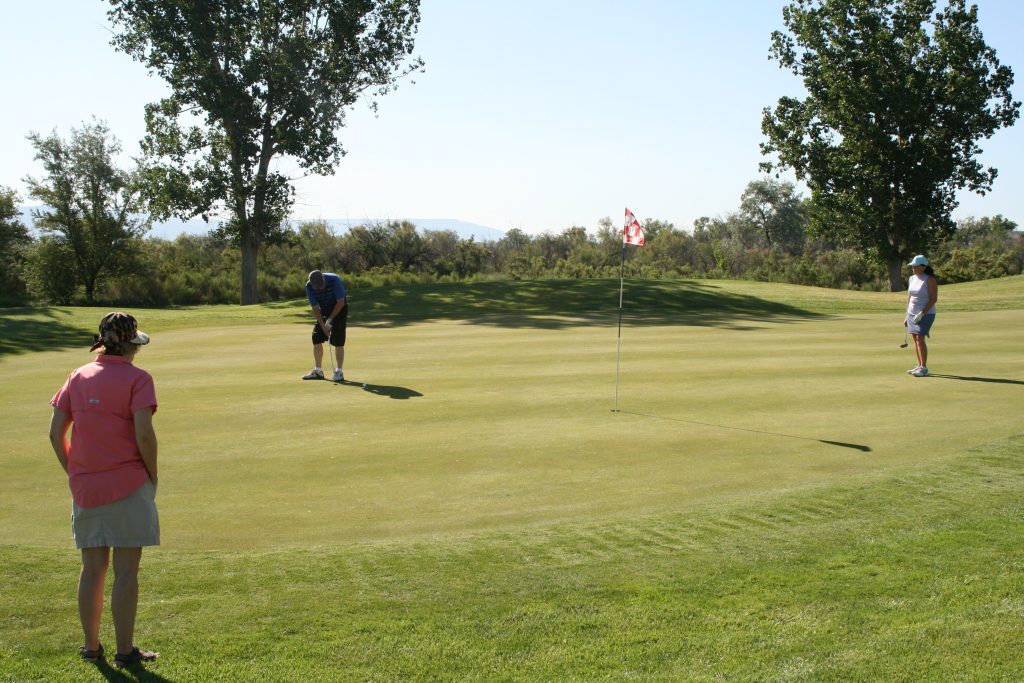
A hole ends when each golfer has completed play.
If you are keeping score, record the result. The score represents what happened on that hole; the method for calculating and understanding golf scores was introduced in How Golf Scoring Works.
Once everyone has finished, gather anything you have brought into the immediate area and move away so the group behind can continue playing.
Your group then heads toward the next tee.
There is no major reset between holes. Finishing one hole and beginning the next is part of a continuous journey around the course.
Moving from Hole to Hole
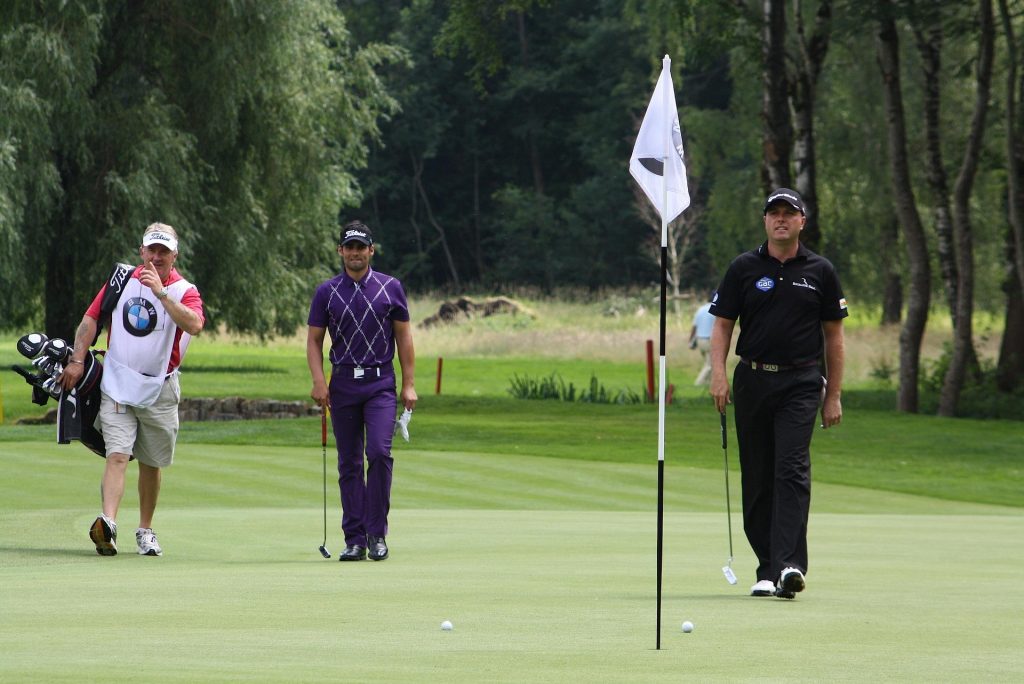
Golf courses are designed so players can progress from one hole to the next in order.
After completing Hole 1, follow the course layout or directional signs to Hole 2. After Hole 2 comes Hole 3, and the same process continues throughout the round.
If you are walking, you carry or move your golf bag with you. If you are using a golf cart, you drive between playing locations and from one hole to the next according to the course’s designated routes and instructions.
At an unfamiliar course, occasionally having to look for the next tee is not unusual. Signs, cart paths, course maps, GPS systems, and other golfers can help indicate the route.
The important concept is continuous forward movement. You are not returning to the clubhouse after every hole. You are following a route through the golf course, completing each hole in sequence.
What Happens After Nine Holes
On an 18-hole course, completing the ninth hole brings you to the turn.
The first nine holes are commonly called the front nine, while Holes 10 through 18 are the back nine. The transition between them is the turn.
At some courses, the route around the property naturally brings golfers close to the clubhouse or another facility after the ninth hole. There may be an opportunity for a brief stop before continuing.
The key word is brief. Your round is still in progress, and the next part begins with Hole 10.
If you are playing only nine holes, of course, your round finishes after the ninth.
Completing the Final Hole

On a standard 18-hole round, Hole 18 is the final hole.
Once everyone in the group has finished, the playing portion of the round is complete. If you have been keeping score, you can confirm that your scorecard is complete.
From there, follow the course route away from the playing area and return any rented items or golf cart as required. Check the cart, golf bag, storage compartments, and surrounding area for personal belongings before leaving.
The transition after the final hole can feel surprisingly abrupt on a first round. For several hours, the routine has been hit, move, hit, finish, and continue to the next tee. After the final hole, there simply is no next tee.
Did you know?
A golf round does not always begin on the first hole. In some events or busy courses, players may start from different holes, but they still complete the required set of holes for the round.
How Long Does a Round Usually Take?
The length of a round varies considerably, so there is no single time that applies to every golf course and every group.
As a practical expectation, nine holes often take roughly two hours, while 18 holes commonly take around four hours, but either can be shorter or longer.
Several factors influence the total time:
- Number of holes: Eighteen holes naturally require substantially more time than nine.
- Group size: A group of four generally has more individual shots and movement to coordinate than one or two golfers.
- Course traffic: A busy course can create waiting between shots.
- Walking or riding: A cart can reduce some travel time, although riding does not guarantee a faster round if the course is busy.
- Course layout: The distance and terrain between shots and holes can affect how quickly players move.
- Player experience: New golfers may need more time to locate balls and become comfortable with the routine.
Treat those times as approximate expectations rather than promises. Golf is played across a large outdoor area, and the conditions surrounding one round can be very different from another.
What Your First Round Will Probably Feel Like
Your first round will likely feel different from practicing at a driving range.
At a range, you generally stay in one place and hit a series of balls. During a round, every shot creates the situation for the next one. You hit a ball, travel to wherever it finishes, play again, finish the hole, and then begin somewhere new.
That constant change is part of golf.
You may initially wonder where the next tee is, when your group is supposed to move, where your ball finished, or what everyone is doing between shots. After several holes, you begin recognizing the pattern.
Your shots will not all be good, and they do not need to be for you to understand how a round works. One of the most useful things you can gain from an early round is familiarity with the rhythm of playing golf on an actual course.
By the end, actions that seemed unfamiliar in the parking lot—checking in, finding the first tee, moving from shot to shot, finishing a hole, and finding the next tee—should make considerably more sense.
What Comes Next
You have now completed the foundation of Module 1. You understand what golf is, how its scoring system works, the basic layout of a golf course, common golf language, and how an actual round unfolds from arrival through the final hole.
The next module builds on that understanding by introducing the practical knowledge that helps you participate properly when you play, beginning with the essential rules of golf.
Explore more golf equipment

Golf Fairway Woods
Home SHOP BY CATEGORY Drivers Fairway Woods Hybrids Irons Wedges Putters Golf Club Sets Accessories Fairway Woods Fairway woods are designed for long shots from the fairway or tee when a driver isn’t ideal. They vary mainly in launch height, forgiveness,…
Module 1 Key Takeaways
- • A round begins before the first shot: confirm your tee time, arrive early, check in, and be at the starting area when your group is due to play.
- • Once play begins, each golfer plays their own ball and the group progresses continuously from one hole to the next.
- • The basic rhythm of a hole is simple: start, find your ball, play forward, finish, record the result, and continue to the next tee.
- • Nine holes often take roughly two hours and 18 holes around four, although course traffic, group size, layout, and other factors can change the total time.
- • Your first round may initially feel unfamiliar, but the repeated sequence of playing, moving, finishing holes, and continuing around the course quickly becomes easier to recognize.
Previous: Basic Golf Terms Every Beginner Should Know >>>
Next: Golf Rules Explained for Beginners >>>