

A good golf shot starts before the club moves.
A pre-shot routine is the repeatable sequence you use to prepare for a shot—from choosing your target to completing your setup and starting the swing. Instead of walking up to the ball and arranging everything differently each time, you follow a familiar process that organizes your preparation.
For a beginner, a consistent routine has an especially important job: it connects the grip, posture, ball position, and alignment fundamentals you have learned into one practical sequence.
The goal is not to create a complicated ritual. A useful pre-shot routine for beginners should be simple enough to repeat, purposeful enough to improve preparation, and efficient enough to use throughout a round.
What Is a Pre-Shot Routine?
A pre-shot routine is the sequence of actions you perform before making a golf swing.
It begins before you address the ball – the position where you have completed your setup and are ready to swing—and finishes when the swing begins.
A routine might include choosing a target, picturing the intended shot, making a practice swing, approaching the ball, aiming the clubface, establishing your stance and ball position, settling your grip, taking a final look at the target, and then swinging.
The individual actions are important, but so is their order.
When the sequence stays reasonably consistent, you are less likely to forget a setup fundamental or make an unnecessary last-second adjustment.
Why a Routine Helps Beginners
Golf presents you with a new situation on almost every shot. The distance changes. The target changes. The lie may change. You may be using a different club.
A repeatable preparation process provides consistency within all of that variation.
Instead of asking yourself several questions while standing over the ball—Where am I aiming? Are my feet right? Where should the ball be? Does my grip feel different?—you deal with those tasks in an organized sequence.
That creates several practical benefits.
It reduces uncertainty. You know what you are going to do before each shot.
It improves setup consistency. Following the same sequence makes it easier to reproduce your grip, stance, posture, ball position, and alignment.
It prevents rushing. A routine gives you a deliberate way to prepare rather than simply walking up and hitting.
It can also prevent overthinking. Once the preparation is complete, there should be less reason to continue making changes while standing over the ball.
The routine does not guarantee a good shot. Golfers can make poor swings from good setups. Its purpose is to give each swing a more consistent starting point.
Step 1: Choose the Target
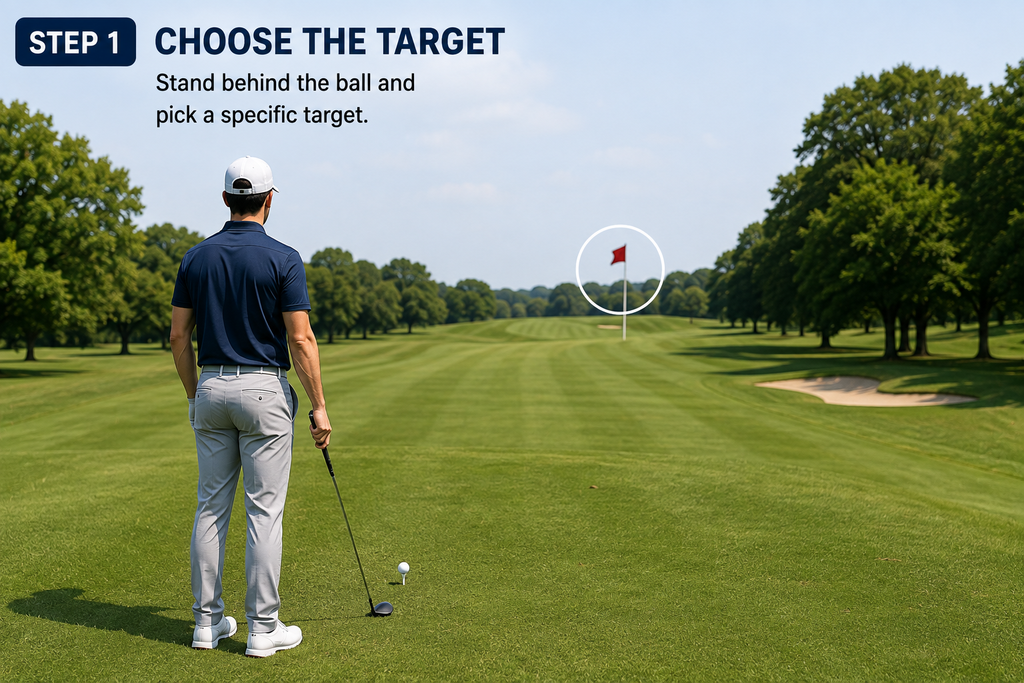
Begin behind the ball, where you can look down the intended line of the shot.
Choose a specific target rather than a vague direction.
“Toward the green” or “down the fairway” gives you relatively little directional information. A particular point—a section of fairway, part of the green, or another clearly identifiable reference—provides a much better picture of where you intend the ball to travel.
This decision should happen before you build your stance.
That order matters because your target provides the reference for the alignment process. If you establish your feet and body first and decide exactly where you are aiming afterward, you may have to manipulate the setup you just created.
Choose the target first. Then build the setup around that decision.
Step 2: Visualize the Intended Shot
Once you have a target, form a simple picture of the shot you intend to play.
This does not need to be elaborate.
Look from the ball toward the target and picture the basic direction of the shot and the general trajectory you expect. A shorter club may produce a visibly higher flight than a longer club, for example, but the purpose of visualization is not to predict every detail of the ball’s flight.
It gives the shot a clear intention.
There is an important difference between standing over a ball thinking, Don’t hit it over there, and preparing with a picture of where you actually want the ball to go.
Your routine works better when it is organized around an intended shot rather than around avoiding a bad one.
Step 3: Make a Practice Swing if Needed
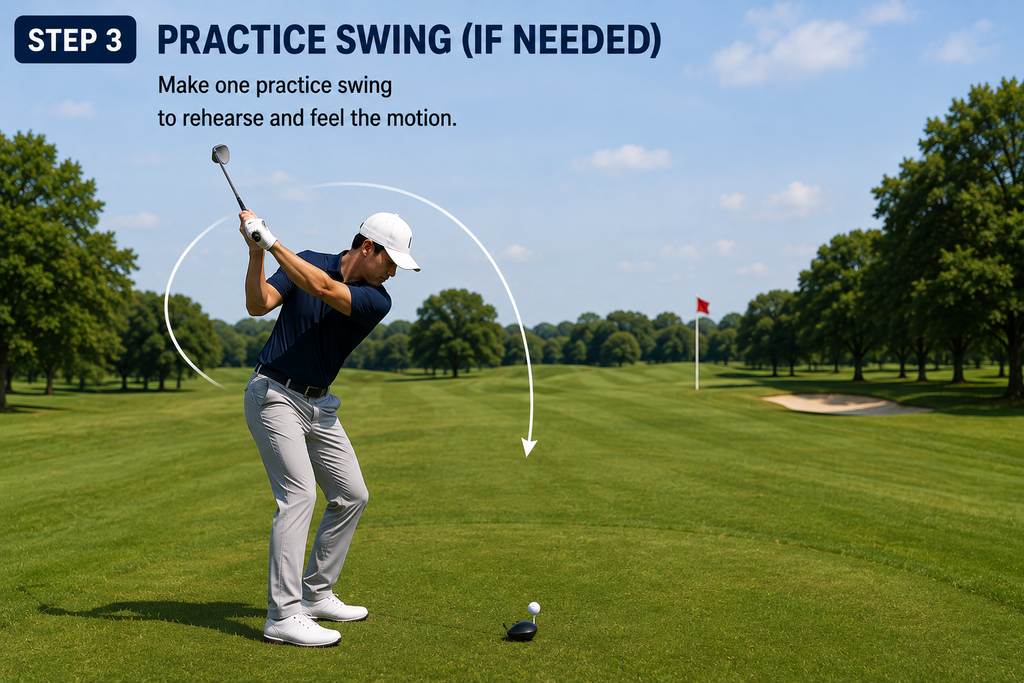
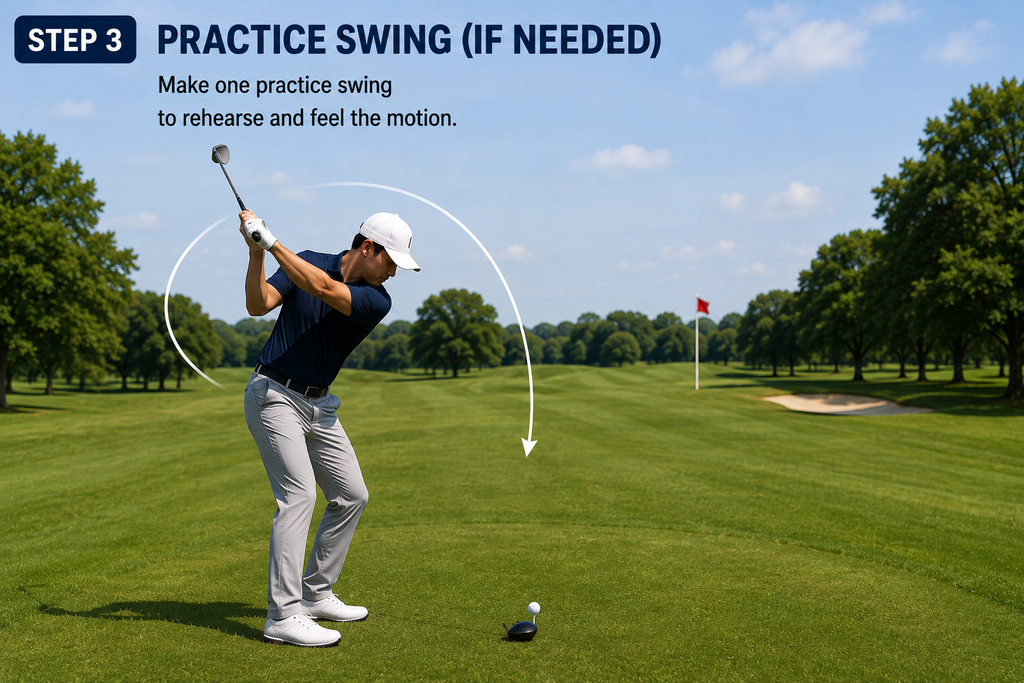
A practice swing can be useful when it has a purpose.
It can help you feel the motion you intend to make, loosen excessive tension, or rehearse the general rhythm of the upcoming swing. It should feel like preparation for the shot rather than an attempt to solve several technical problems before hitting.
One purposeful rehearsal is often sufficient. A second can be useful when there is a clear reason for it.
Repeated practice swings can have the opposite effect. They make the routine longer, can introduce additional thoughts, and may create a situation in which the golfer’s rehearsals feel increasingly disconnected from the actual shot.
A practice swing is also optional. If you feel prepared without one, it does not need to become a compulsory part of the routine.
The useful principle is simple: if you rehearse, know what the rehearsal is for.
Step 4: Approach the Ball
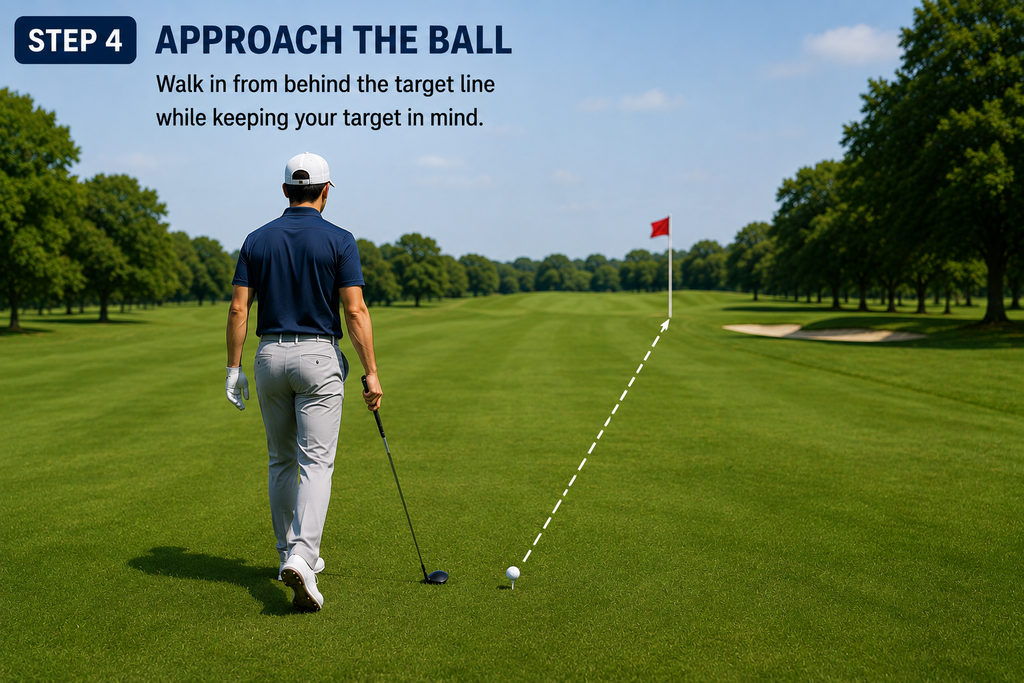
After choosing the target and completing any rehearsal, approach the ball with the target line still clear in your mind.
Walking in from behind the ball is useful because the view from behind gives you a direct perspective along the intended line. Once you move beside the ball, that perspective changes.
As you approach, keep the intended target and line in mind rather than simply walking into a comfortable-looking stance.
This creates an important sequence:
See the line → approach the ball → establish the clubface → build the body around it.
That sequence reduces the tendency to plant the feet first and then try to aim the club around a stance that may already be misaligned.
Step 5: Set the Clubface
Place the club behind the ball and set the clubface toward the intended target using the alignment principles you have already learned.
This is an important checkpoint because the clubface and body have different jobs in the setup. Your feet do not need to point directly at the target for the clubface to be aimed correctly.
If you use an intermediate target—a small spot on the intended line a short distance in front of the ball—this is where it becomes especially useful. A nearby reference can be easier to aim the clubface toward than a target dozens or hundreds of yards away.
Set the face deliberately rather than repeatedly twisting it after the rest of your setup is established.
Once the clubface is set, you have a reference around which to organize your body.
Step 6: Build Your Stance
With the clubface established, place your feet and settle into the stance and posture learned earlier in this module.
The important point within the pre-shot routine is repeatability.
You do not want the stance to be an improvised position that changes because one foot happened to land differently as you walked toward the ball. Give yourself enough time to establish your feet, create your normal balanced posture, and let your arms settle naturally.
This should increasingly become one continuous setup action rather than a collection of separate corrections.
A useful routine does not require you to mentally recite every posture checkpoint before every shot. Practice builds familiarity so that the setup can gradually become more automatic.
Step 7: Confirm Ball Position
Before becoming fully settled over the ball, make a quick ball-position check.
Use the body references established in the earlier ball-position lesson rather than judging the position only by how it looks from above.
This check matters because ball position can quietly drift when you approach the ball differently from shot to shot. A golfer may believe the ball moved when, in reality, the feet were placed differently around it.
The routine gives you a consistent moment to verify the position.
It should be a confirmation, not an extended search for a perfect spot.
If the position is appropriate, continue. If it is clearly wrong, correct the setup before beginning the swing.
Step 8: Settle the Grip
As the setup comes together, confirm that your hands are comfortable and secure on the club using the grip established earlier in the module.
Notice the word confirm.
You should not need to reconstruct your grip through a long series of hand-position checks before every shot. Those details belong in your grip practice. During the routine, the objective is to recognize that the grip feels familiar, connected, and ready.
Pay particular attention to unnecessary tension.
It is common for a golfer to begin with reasonable grip pressure and then squeeze harder while standing over the ball. That extra tension can spread through the hands, forearms, and shoulders.
Settle the hands, maintain control of the club, and allow yourself to proceed.
Step 9: Take a Final Look at the Target
Once the setup is established, look at the target one final time.
This look reconnects the physical setup with the intention you established at the beginning of the routine.
Then return your eyes to the ball.
This is not the moment to reopen the entire preparation process.
A common beginner pattern is:
Look at target → look at ball → look at feet → adjust clubface → look at target again → change stance → check grip → look at target again.
The golfer may eventually spend so long over the ball that the setup feels less comfortable than it did initially.
A final look should function as confirmation: That is where I am going.
Then bring your attention back to the ball and prepare to move.
Step 10: Commit and Swing
The final step is commitment.
Once you have chosen the target, completed your preparation, and confirmed the setup, allow the swing to begin.
Avoid introducing several new technical instructions in the final seconds before movement. A thought such as keep my head down, don’t swing too fast, straighten my arm, turn more, don’t slice it creates competing instructions at exactly the moment you are trying to perform an athletic motion.
Preparation and execution have different jobs.
The routine organizes the decisions and setup before the swing. Once those jobs are complete, trust the preparation enough to start the motion naturally.
Commitment does not mean expecting a perfect result. It means making the shot you prepared to make without repeatedly changing the plan.
How Long Should a Pre-Shot Routine Take?
There is no single correct number of seconds for every golfer.
A routine should be long enough to prepare properly but short enough to remain efficient. What matters more than hitting an exact time is that the process does not contain unnecessary delays.
A golfer who makes five practice swings, repeatedly checks alignment, backs away several times, and stands motionless over the ball is not necessarily preparing more carefully. Much of that activity may simply be repetition.
A better routine has a clear progression:
Decide → prepare → set up → confirm → swing.
As you become familiar with that sequence, it should flow more naturally.
Efficiency also matters to other golfers. A routine is repeated many times during a round, so small unnecessary delays can accumulate. Being deliberate and being slow are not the same thing.
What Should Stay the Same Every Time?
Consistency does not mean reproducing every movement to the exact inch or second. It means maintaining a recognizable process.
Four elements are especially useful to keep consistent.
The overall sequence. Choose the target before building the setup rather than changing the order randomly from shot to shot.
Target selection. Begin with a clear intention for where the shot should go.
Setup checks. Use the same basic process to establish the clubface, stance, ball position, and grip.
Commitment. Give yourself a clear point at which preparation ends and the swing begins.
This predictability is one of the major advantages of a routine. Even when the golf shot changes, your method of preparing for it remains familiar.
What Can Change?
A consistent routine should not become rigid.
The club may change from one shot to another.
The target changes according to the shot you are preparing to play.
The ball position may change when the club and shot require a different position.
The shot situation may also influence what you need to observe before addressing the ball.
Those variables can change without destroying the routine because the sequence remains recognizable.
Think of the routine as a framework rather than a fixed pose. The details of the shot fit inside the framework.
Common Pre-Shot Routine Mistakes
Taking Too Many Practice Swings
Several rehearsals can make a golfer feel busy without making the preparation better.
Cause: The player is searching for the perfect feeling before approaching the ball.
Effect: The routine becomes longer and more technically focused.
Result: The actual shot can feel like another test of the swing rather than the natural completion of the preparation.
Simplest correction: Use one purposeful practice swing when a rehearsal is useful, then move into the setup.
Constantly Changing the Setup
A golfer sets the clubface, moves the feet, changes the grip, adjusts the feet again, and then re-aims the club.
Cause: The player does not trust the original setup or has no consistent order for building it.
Effect: One adjustment changes the relationship between other setup pieces.
Result: The golfer may feel increasingly uncertain even though the original setup was acceptable.
Simplest correction: Follow the same order and make a correction only when you have identified something specific that needs correcting.
Standing Over the Ball Too Long
The golfer completes the setup but does not begin the swing.
Cause: Preparation continues after the preparation should be finished.
Effect: More thoughts and tension have time to enter.
Result: The golfer can become less committed to the shot while waiting to start it.
Simplest correction: Use the final target look as a clear signal that the routine is nearly complete. Return your eyes to the ball, settle, and begin.
Thinking About Too Many Technical Points
Golf contains many moving parts, so it is tempting to monitor several of them at once.
Cause: The golfer tries to correct the swing while preparing to hit.
Effect: Attention moves away from the target and the simple task of making the shot.
Result: The golfer may become hesitant or attempt to consciously control too many movements.
Simplest correction: Keep technical practice separate from the final moments of the routine. Prepare the shot, confirm the setup, and commit.
Abandoning the Routine After a Bad Shot
One poor result often tempts beginners to change everything before the next swing.
Cause: The golfer assumes the routine failed because the shot failed.
Effect: The preparation sequence changes in response to every result.
Result: It becomes difficult to develop a repeatable setup or determine whether a change actually helped.
Simplest correction: Return to the normal routine on the next shot. A repeatable process is most valuable when the previous result creates an urge to rush or overcorrect.
A Simple Beginner Pre-Shot Routine
Use this sequence as a practical starting point:
- Target — Stand behind the ball and choose a specific target.
- Practice — Make one purposeful practice swing if it helps you prepare.
- Approach — Walk toward the ball while keeping the intended line in mind.
- Aim — Set the clubface toward the intended target.
- Stance — Build your normal balanced stance and posture around that aim.
- Ball Position — Confirm that the ball is appropriately positioned for the shot.
- Grip — Settle your hands and check that the grip feels familiar and secure.
- Look — Take one final look at the target.
- Swing — Return your eyes to the ball, commit, and begin.
Target → Practice → Approach → Aim → Stance → Ball Position → Grip → Look → Swing
Practice this sequence away from the course as well as when hitting balls. The purpose is not to memorize nine words. It is to make the order familiar enough that you stop having to invent your preparation before every shot.
When that happens, the routine starts doing its real job: giving different golf shots a consistent starting process.
Explore other tips and tricks

Can Better Golf Equipment Improve Your Game?
Golf equipment can influence how well you play, but buying newer or more expensive clubs does not automatically produce lower scores. The biggest improvements usually happen when your equipment fits your…
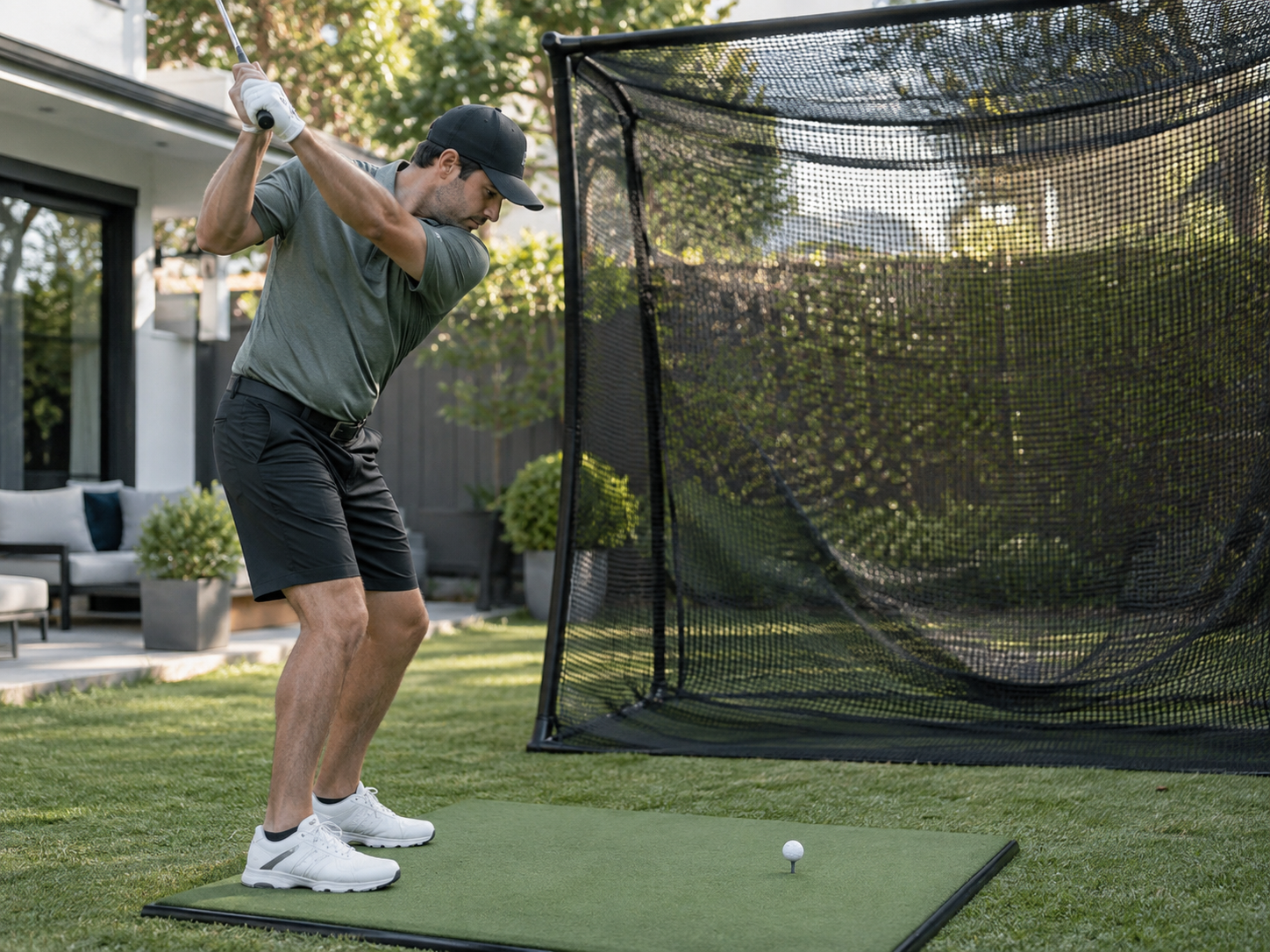
Practice Nets and Hitting Mats
Practicing golf at home can make it much easier to work on your swing regularly. You do not need a full driving range or a large backyard to get useful…

Putting Mats and Training Aids for Home Practice
Practicing putting at home can be one of the easiest ways to build a more reliable stroke without needing to visit a golf course or practice green. A simple putting mat…
Key Takeaways
- • A pre-shot routine is the repeatable process that connects target selection to the beginning of the swing.
- • Choose the target before building your setup so your aim and body position have a clear reference.
- • Use your established grip, posture, ball-position, and alignment fundamentals as checkpoints rather than rebuilding them from scratch before every shot.
- • Keep the routine purposeful and efficient; more practice swings, checks, and adjustments do not automatically create better preparation.
- Once the setup is complete, take your final look, commit to the intended shot, and allow the swing to begin.
With a repeatable setup process in place, you have completed the foundation that happens before the club starts moving. The next lesson begins with the golf swing itself and explains how the major phases of that motion work together.
Next: The Golf Swing Explained for Beginners >>>
Previous: How to Aim and Align Your Golf Shots >>>