
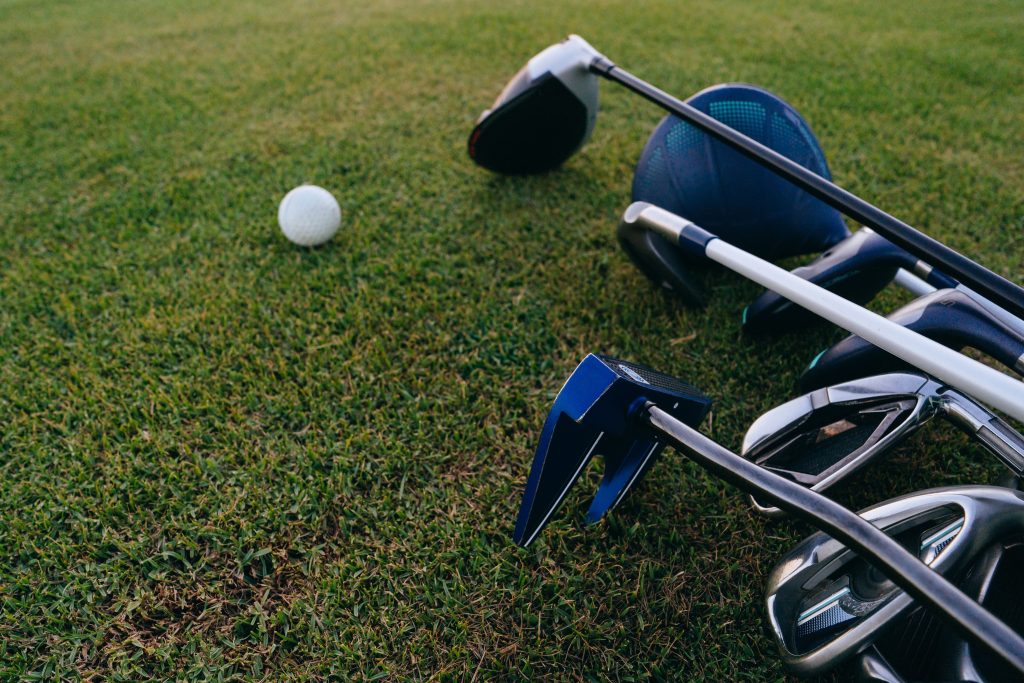
Walk into a golf shop or look inside an experienced golfer’s bag and the number of different golf clubs can seem confusing. Drivers have large heads and long shafts. Irons are numbered. Wedges can look almost identical but carry different names. Then there are fairway woods, hybrids, and putters.
Those differences exist because golf asks you to produce very different shots. One club may be designed primarily for maximum distance from a tee, while another is built to launch the ball higher from the fairway. A wedge gives you more control on shorter shots, while a putter is designed to roll the ball along the green.
Understanding the types of golf clubs is therefore less about memorizing names and more about understanding the job each club is designed to perform.
Why Golfers Use Different Clubs
A golf club influences how easily a player can produce a particular combination of distance, trajectory and control.
Imagine playing a hole where your first shot must cover a long distance, your next shot needs to travel a moderate distance toward the green, and your final shot only needs to roll several feet into the cup. Trying to perform all three jobs with the same club would be inefficient.
The major club categories solve different problems:
- • Drivers are designed primarily for long tee shots.
- • Fairway woods provide substantial distance and can be used from the ground or tee.
- • Hybrids combine characteristics associated with woods and irons and often replace harder-to-use long irons.
- • Irons cover a broad range of distances and trajectories.
- • Wedges specialize in shorter, higher-control shots.
- • Putters are designed primarily to roll the ball on the putting green.
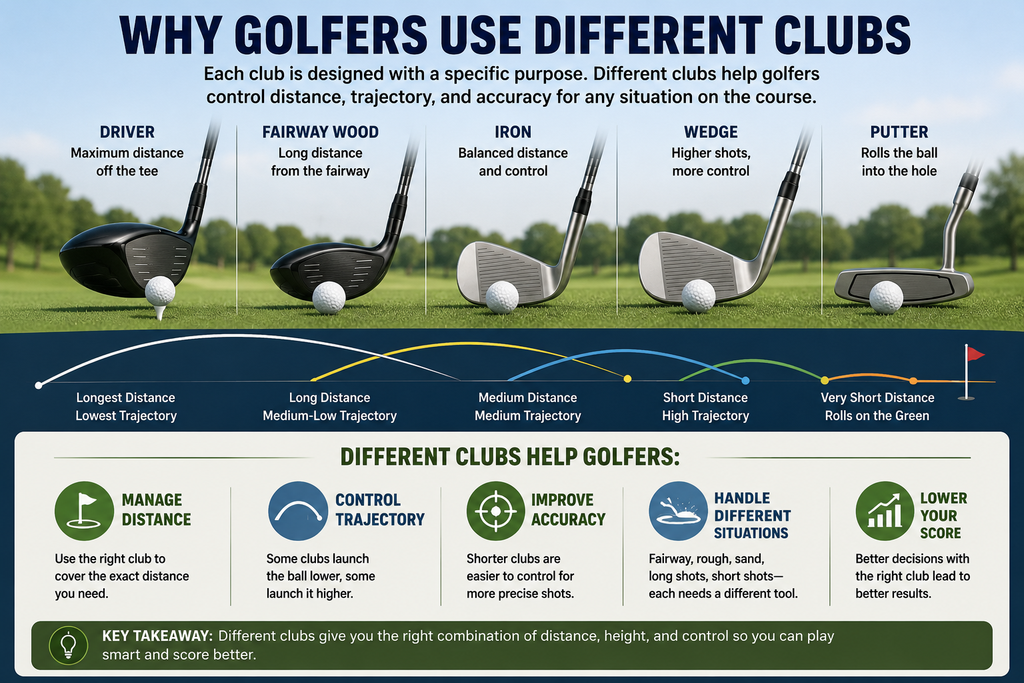
Two important design characteristics help explain these differences: loft and club length. We will examine both later in this lesson.
The Driver
The driver is usually the longest club in the bag and has less loft than the other major club categories.
Its primary purpose is distance. It is normally used from the teeing area on longer holes, where the ball can be elevated on a tee and the golfer has room to make use of the driver’s distance potential.
A driver also has a much larger clubhead than an iron. Its combination of a long shaft, relatively low loft, and large head is designed around producing speed and distance.
For a beginner, however, “driver equals longest shot” should not be interpreted as “every golfer must use a driver whenever possible.” The driver’s length and low loft can make control more demanding. A beginner may sometimes feel more comfortable using a shorter or more lofted club from the tee.
The important distinction here is the driver’s function: it is the club primarily designed to maximize distance from the tee. The technique for actually hitting a driver is a separate skill.
Fairway Woods
Fairway woods are also distance-oriented clubs, but they occupy a useful position between the driver and shorter clubs.
Common examples include the 3-wood and 5-wood. Despite the word wood, modern fairway woods are generally constructed with metal clubheads.
Fairway woods have smaller heads and shorter shafts than drivers and generally have more loft. They can be used from a tee, but unlike the driver, they are also commonly designed to be played directly from the ground.
That versatility gives them two common roles:
- • producing a long shot from the fairway or another suitable lie;
- • providing a distance-oriented alternative from the tee.
Within the fairway-wood family, a 3-wood generally has less loft and a longer shaft than a 5-wood. All else being reasonably equal, that gives the 3-wood more distance potential, while the additional loft and shorter length of the 5-wood can make it easier to produce a higher flight and greater control.
The exact result still depends heavily on the golfer. Club design creates the potential for different shots; it does not guarantee them.
Hybrids
A hybrid is designed to combine useful characteristics of woods and irons.
Its head is deeper and more wood-like than a traditional iron, but the club is intended to fill many of the distance roles associated with longer irons. This is why you may hear golfers describe a hybrid as an “iron replacement.”
For example, a golfer might carry a hybrid instead of a 3-iron or 4-iron.
Hybrids are especially relevant to beginners because long irons can be demanding to strike consistently. A hybrid’s design can make it easier for many golfers to launch the ball and achieve useful distance without requiring them to rely on a traditional long iron.
That does not mean hybrids are automatically better than irons or that every golfer needs the same combination. Their value is practical: they provide another way to cover longer distances between fairway woods and the shorter irons.
Irons
Irons make up a large and versatile family of golf clubs. They are used across a broad range of distances and are identified primarily by numbers.
Traditional iron sets may extend from long irons such as a 3- or 4-iron through mid-irons such as a 5-, 6-, or 7-iron and into shorter irons such as an 8- and 9-iron. The exact makeup of a modern set varies, particularly because hybrids often replace some of the longest irons.
Long Irons
Long irons have lower lofts and longer shafts than the other irons in the same set. They are intended to cover longer distances but can be more demanding for beginners to use consistently.
Examples traditionally include the 3- and 4-iron.
Mid-Irons
Mid-irons occupy the middle of the iron range. Clubs such as the 5-, 6-, and 7-iron generally provide a balance of distance, trajectory, and control.
Short Irons
Short irons, such as the 8- and 9-iron, are shorter and more lofted. They generally produce less distance and a higher trajectory than lower-numbered irons.
The basic pattern is important:
Lower iron number → generally less loft, longer club, lower trajectory, and greater distance potential.
Higher iron number → generally more loft, shorter club, higher trajectory, and less distance potential.
These are relationships rather than exact guarantees. Differences in club design and individual golfers mean a 7-iron does not travel one universal distance.
Wedges
Wedges are highly lofted clubs designed primarily for shorter-distance shots where trajectory and distance control become especially important.
Several wedge types may appear in a golf set.
Pitching Wedge
The pitching wedge usually sits at the transition between the numbered irons and more specialized wedges. It typically has the lowest loft among a golfer’s wedges and therefore tends to cover the longest distance within the wedge category.
Gap Wedge
The gap wedge is intended to help fill the loft and distance space between a pitching wedge and a sand wedge.
The name describes its purpose: it fills a gap that could otherwise leave the golfer without a comfortable club for certain shorter distances.
Sand Wedge
The sand wedge has more loft than a typical pitching wedge and was developed with features useful for shorter shots and bunker play.
Its name does not mean it can only be used from sand. Golfers also use sand wedges for many shorter shots elsewhere on the course.
Lob Wedge
A lob wedge typically has the most loft of these common wedge categories. Its design allows for a relatively high trajectory and shorter distance.
For a beginner, the main lesson is not that four wedges are required. It is that increasing wedge loft generally provides a club designed for progressively shorter, higher shots.
The actual techniques used to produce different wedge shots belong to later instruction.
The Putter
The putter is the most specialized club in the bag.
While the other major club categories are designed to send the ball through the air to varying degrees, the putter is primarily designed to start the ball rolling along the ground.
It is normally used on the putting green, where the golfer needs precise control over the ball’s starting direction and speed rather than significant carry distance.
Putters come in many shapes and designs, but they share the same fundamental job: rolling the ball toward the cup with control.
That makes the putter fundamentally different from a driver, wood, hybrid, iron, or wedge. Those clubs must produce useful combinations of launch and distance. A putter is overwhelmingly concerned with controlled roll.
Ready to Find the Right Golf Gear?
Shop Golf Gear
Home Golf Gear for Every Type of Player Find golf clubs, sets, and accessories based on how you play. Explore forgiving equipment for an easier game, balanced options as your skills improve,…
Understanding Club Loft
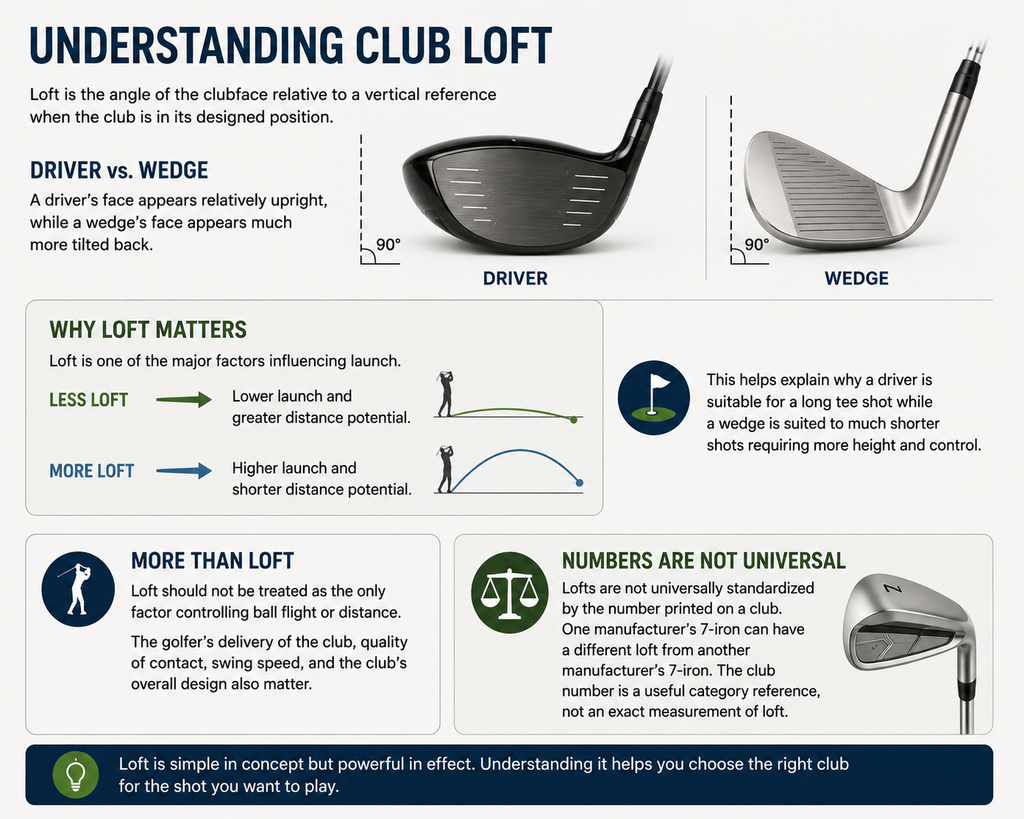
Loft is the angle of the clubface relative to a vertical reference when the club is in its designed position.
You can see the concept easily by comparing a driver and a wedge. A driver’s face appears relatively upright, while a wedge’s face appears much more tilted back.
That difference matters because loft is one of the major factors influencing launch.
In general:
Less loft → lower launch and greater distance potential.
More loft → higher launch and shorter distance potential.
This helps explain why a driver is suitable for a long tee shot while a wedge is suited to much shorter shots requiring more height and control.
However, loft should not be treated as the only factor controlling ball flight or distance. The golfer’s delivery of the club, quality of contact, swing speed, and the club’s overall design also matter.
Another important point is that lofts are not universally standardized by the number printed on a club. One manufacturer’s 7-iron can have a different loft from another manufacturer’s 7-iron. The club number is therefore a useful category reference, not an exact measurement of loft.
Understanding Club Length
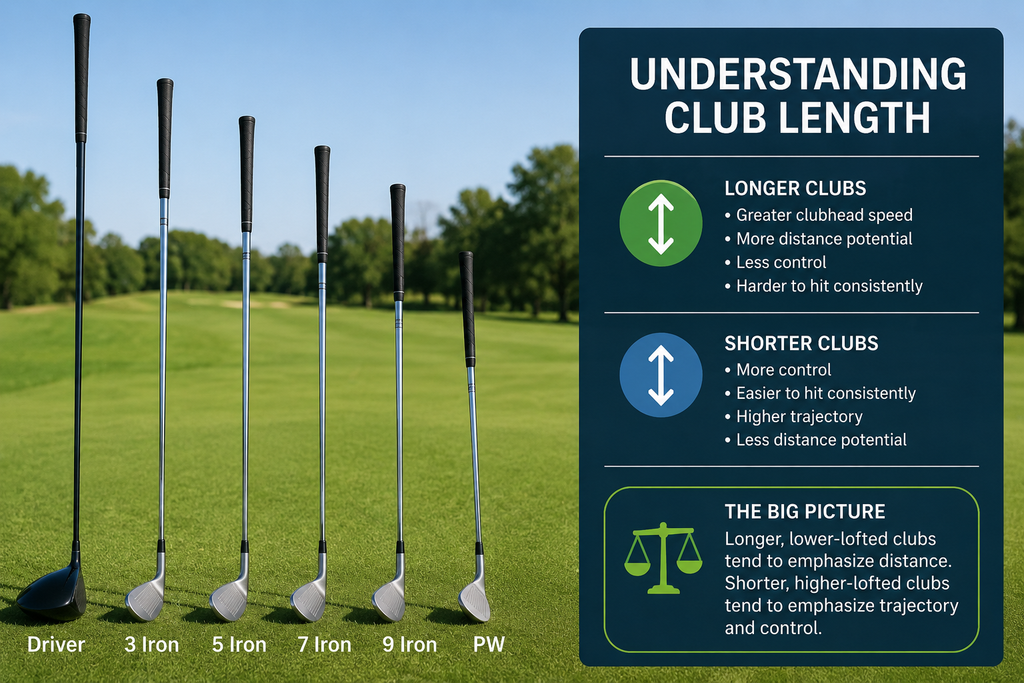
Club length also changes as you move through the bag.
A driver is much longer than a wedge, for example. Within a typical iron set, the lower-numbered irons are generally longer than the higher-numbered irons.
Why?
A longer club can create greater clubhead speed and therefore greater distance potential. But added length also means the clubhead is farther from the golfer, which can make precise control and centered contact more challenging.
A shorter club generally sacrifices some distance potential while giving the golfer a more manageable tool for controlling the strike.
This creates an important relationship throughout a golf set:
Longer, lower-lofted clubs tend to emphasize distance. Shorter, higher-lofted clubs tend to emphasize trajectory and control.
It is one of the simplest ways to understand why a golf bag contains clubs of visibly different lengths.
Golf Club Numbers Explained
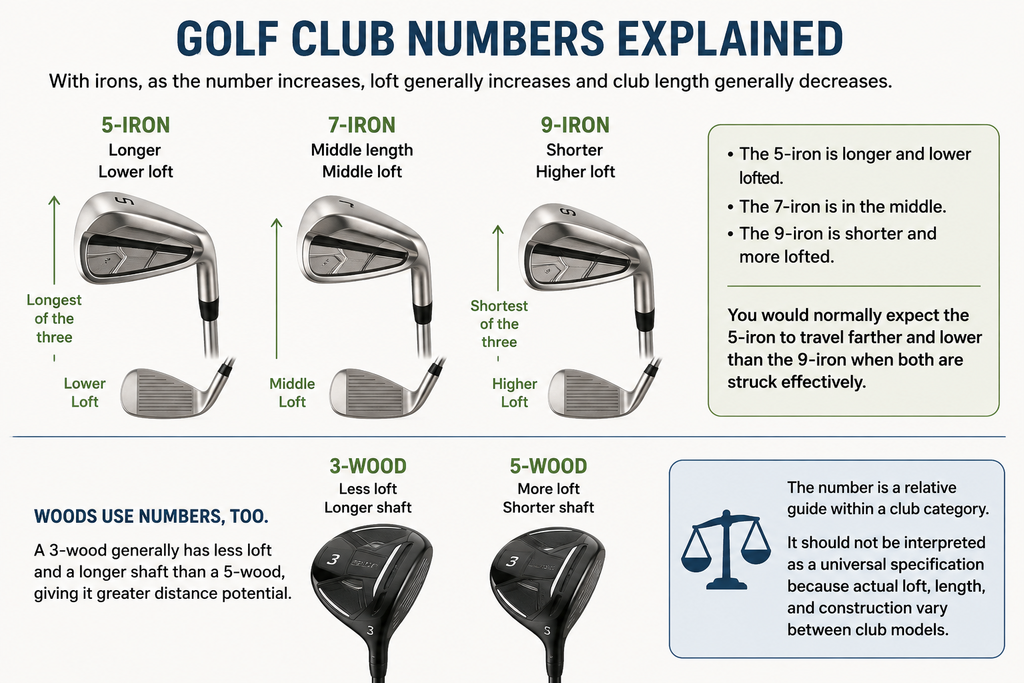
Golf club numbers provide a practical way to distinguish clubs within the same family.
With irons, the basic relationship is straightforward. As the number increases, loft generally increases and club length generally decreases.
For example, within the same set:
5-iron → 7-iron → 9-iron
The 5-iron would generally be longer and lower lofted. The 7-iron occupies a middle position. The 9-iron would generally be shorter and more lofted.
As a result, the golfer would normally expect the 5-iron to travel farther and lower than the 9-iron when both are struck effectively.
Woods use numbers as well. A 3-wood generally has less loft and a longer shaft than a 5-wood, giving it greater distance potential.
The number is therefore best viewed as a relative guide within a club category. It should not be interpreted as a universal specification because actual loft, length, and construction vary between club models.
How Far Does Each Golf Club Go?
There is no single correct distance that every golfer should hit a particular club.
Two beginners can use 7-irons and produce substantially different distances. Even the same golfer can produce different results depending on the quality of the strike.
Club distance is influenced by several factors, including:
- • Swing speed: More clubhead speed can create more ball speed and distance.
- • Contact: A centered strike generally transfers energy more effectively than an off-center strike.
- • Technique: How the golfer delivers the club influences launch and the resulting shot.
- • Club specifications: Loft, length, clubhead design, and other equipment characteristics affect performance.
- • The individual golfer: Physical capabilities and consistency vary considerably.
This is why generic distance charts should be treated cautiously. A chart can illustrate broad patterns, but it cannot tell a beginner how far their 6-iron or hybrid will actually travel.
What matters is the spacing between your own clubs.
Suppose a golfer eventually learns that one iron reliably carries farther than the next higher-numbered iron. That developing pattern becomes far more useful on the golf course than trying to match someone else’s distances.
Learning your personal club distances comes with experience and more consistent contact.
How Many Clubs Does a Beginner Really Need?
A beginner does not need every possible club category or every numbered iron to begin learning golf.
A practical reduced set can cover the essential jobs with something like:
- • a driver or fairway wood for longer shots;
- • a hybrid for another longer-distance option;
- • several irons covering different distances;
- • a wedge for shorter shots;
- • a putter for the green.
The principle is more important than the exact combination.
A beginner needs enough variation to experience the progression from long-distance clubs through shorter, more lofted clubs and finally to the putter. Carrying several clubs that perform nearly identical jobs is much less important when first learning the game.
As skill and experience develop, the golfer can better understand where additional clubs would provide genuinely useful distance or shot options.
Did you know?
A golfer is allowed to carry a maximum of 14 clubs in their bag during a standard official round.
Key Takeaways
- • Golfers use different clubs because different shots require different combinations of distance, trajectory, and control.
- • Drivers, fairway woods, hybrids, irons, wedges, and putters each have a distinct general purpose.
- • Loft and club length help explain why some clubs tend to fly farther and lower while others tend to produce shorter, higher shots.
- • Club numbers indicate general relationships within woods and irons, but they do not represent universal lofts or distances.
- • There is no required distance for a beginner to hit each club. Learning your own reliable distances is more useful than trying to match someone else’s numbers.
Now that you understand the different clubs and the jobs they are designed to perform, the next lesson turns to practical preparation: what to bring for your first round of golf.
Previous: Golf Equipment for Beginners >>>
Next: What to Bring for Your First Round of Golf >>>