
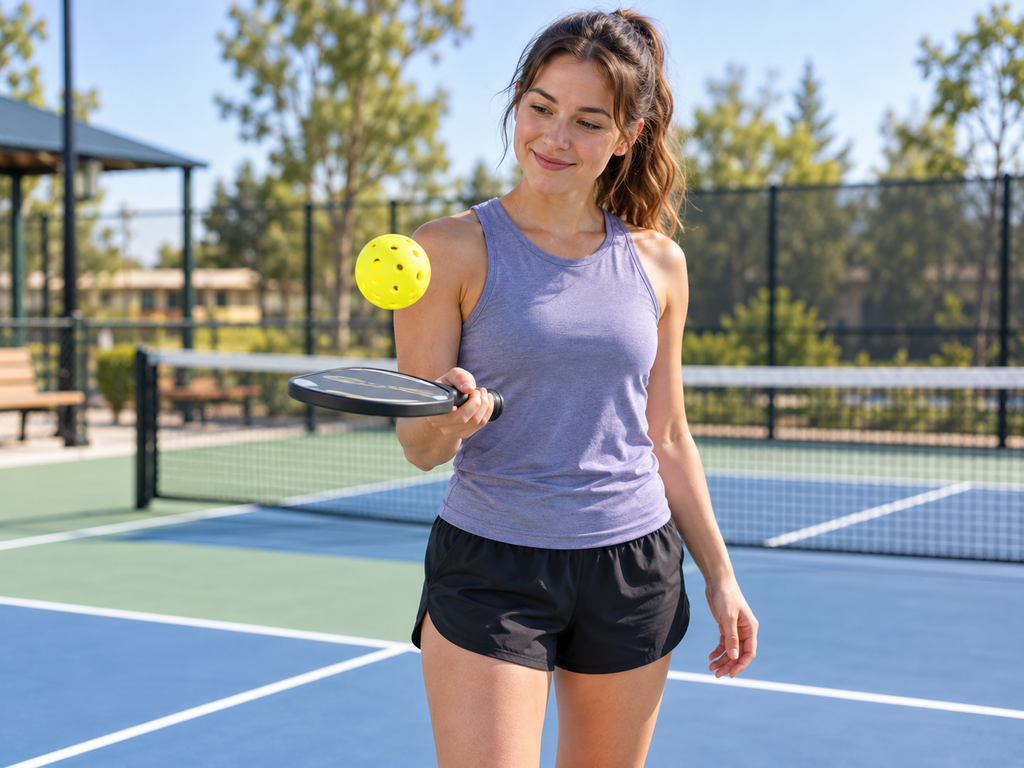
Pickleball is a court sport played with a paddle and a ball across a net. Players can compete one against one in singles or with a partner in doubles. Each rally begins with a serve, and the players then try to return the ball successfully while controlling where it goes and preparing for the next shot.
For someone asking what is pickleball, the basic idea is straightforward: send the ball over the net, keep it in play, and make the next return difficult for your opponent. That simple exchange forms the foundation of the game.
Pickleball shares several familiar ideas with tennis, badminton, and table tennis, but it also has its own court areas, equipment, terminology, scoring structure, and style of play. The game combines movement, positioning, controlled shots, faster exchanges, and softer touches, giving players several different ways to handle a rally.
What is Pickleball and How Does it Work?
A pickleball game is made up of a series of rallies.
A rally begins when one player serves the ball. The player on the other side attempts to return it, and if the ball remains in play, the exchange continues. Each side responds to the previous shot until the rally ends.
During that exchange, players must do more than simply hit the ball back. They watch where the ball is traveling, move into position, prepare the paddle, make contact, and recover for the next shot.
A player may direct the ball toward different parts of the court, change its pace, or use a softer shot depending on the situation. The opponent then has to react and make another controlled return.
This cycle of hitting, moving, recovering, and preparing gives pickleball its rhythm.
Some rallies end after only a few shots. Others continue through a longer exchange as both sides successfully control the ball.
The Objective of the Game
The overall objective of pickleball is to score points and ultimately win the game.
During an individual rally, however, the immediate goal is to keep the ball in play while making the opponent’s next return more difficult.
That can be accomplished in several ways. A player might place the ball into an open area, send it deeper into the court, change its direction, or simply return it with enough control to stay in the rally.
This is one reason power alone does not define successful pickleball.
A hard shot that travels out of play does not help the player who hit it. A controlled shot that lands in a useful area can create a much better result.
For beginners, consistency is especially valuable. Making clean contact and keeping more balls in play creates more opportunities to move, respond, and develop control during actual rallies.
Singles and Doubles Pickleball
Pickleball can be played in two main formats: singles and doubles.
Singles
Singles is played with one player on each side of the net.
Each player is responsible for covering their entire side of the court. Without a partner to share that responsibility, players must pay close attention to movement, positioning, and recovery after every shot.
A singles player may have to move from one side of the court to the other during a rally. After hitting the ball, that player must prepare immediately for the opponent’s response and reposition as needed.
The basic flow remains the same: the rally begins with a serve, the opponent attempts a return, and the players continue exchanging shots while trying to control the rally.
Doubles
Doubles is played with two players on each side of the net.
The two partners share responsibility for their side of the court. This introduces another important part of pickleball: teamwork.
Partners need to remain aware of each other’s position while watching the ball and opponents. When a shot travels between them, they may need to communicate about who will play it. They also need to maintain useful spacing so they can cover the court without interfering with one another.
Doubles therefore combines individual paddle skills with partner movement and communication.
Both singles and doubles use the same fundamental idea of serving, returning, rallying, and controlling the ball, but the movement and decision-making can feel different because of the number of players on the court.
Serving, Returning, and Rally Flow
The serve is the action that begins a rally.
The player making the serve is called the server. The opponent who receives the serve is the receiver.
The receiver attempts to send the served ball back into play. That first response is called the return of serve.
If the rally continues, the players begin exchanging additional shots. Each player must respond to the ball that arrives rather than simply repeating the same swing or movement every time.
A ball may arrive toward the forehand side, backhand side, middle of the body, or another area that requires movement before contact. Players may need to adjust their position quickly while maintaining enough balance to control the shot.
Once a rally ends, the players reset and prepare for the next serve.
This repeating pattern—serve, return, exchange shots, reset—is the basic flow that players experience throughout a pickleball game.
How Scoring Fits Into the Game
Scoring organizes the rallies that make up a complete game.
Players keep track of the score as the game progresses, and the score is connected to the serving sequence. Before play begins again, the score is normally called so the players know the current game situation.
For an introductory understanding of what is pickleball, it is enough to recognize that serving, rallies, and scoring work together. Individual rallies do not happen in isolation. Their results affect the progress of the game and determine what happens before the next rally begins.
The scoring system gives those rallies structure and allows players to follow the progress of the match from beginning to end.
How Pickleball Compares With Other Racket Sports
Players who are familiar with tennis, badminton, or table tennis will recognize several ideas in pickleball.
Like tennis, pickleball is played across a net on a marked court. Players serve, return, move into position, and use shots such as forehands, backhands, and volleys.
Badminton players may recognize the importance of quick preparation, reacting to changes in direction, and moving efficiently around a defined playing area.
Table tennis players may recognize the importance of paddle control, placement, reaction time, and changing the pace of an exchange.
These similarities can make certain parts of pickleball easier to recognize for players who already have racket-sport experience.
At the same time, the game should not be treated as a smaller version of tennis, badminton, or table tennis. Pickleball has its own equipment, court areas, rules, terminology, scoring, and patterns of play.
Experience in another sport may help with coordination or familiarity with certain movements, but pickleball still requires players to adjust to its particular style.
What Makes Pickleball Different?
Several features help give pickleball its distinct character.
Players use paddles rather than strung rackets, and the game uses a pickleball designed for this particular sport. The court also has specific areas that affect positioning and the way rallies develop.
One of the most recognizable features is the area close to the net known as the non-volley zone, commonly called the kitchen. Its presence influences how players position themselves and how the game develops near the net.
Pickleball also combines different types of exchanges within the same rally. Some shots may be hit from deeper in the court. Other exchanges happen closer to the net. Players may use firmer shots in some situations and softer, more controlled shots in others.
This change of pace is an important part of the game.
A player who tries to hit every ball as hard as possible may lose control. A player who can adjust pace, placement, and position has more ways to respond to different situations.
That mixture of court awareness, controlled placement, soft play, faster exchanges, and positioning gives pickleball a playing style of its own.
Why Pickleball Is Accessible to Beginners
The basic structure of pickleball is relatively easy to recognize.
A serve begins the rally. The receiving side responds. The players continue exchanging shots until play stops.
A beginner can participate by focusing on a few practical goals: making contact with the ball, sending it across the net, staying balanced, moving into position, and trying to keep the rally going.
These goals do not require complicated tactics or powerful shots.
As control improves, players can begin directing the ball more intentionally and making better decisions based on their position and the type of shot they receive.
This allows a beginner to start with the basic game while gradually developing more skills through practice and play.
Recreational and Competitive Play
Pickleball is played in both recreational and competitive settings.
Recreational games may take place between friends, family members, club players, or people meeting through local playing groups. The emphasis may include exercise, social interaction, skill development, and friendly competition.
Competitive play places more emphasis on performance and results. Players may participate in organized matches or other structured competition.
The basic game remains recognizable in either setting. Players serve, return, rally, keep score, move around the court, and use their skills to respond to opponents.
The difference is mainly in the purpose and intensity of the play rather than in the fundamental identity of the sport.
What to Expect During a Typical Game
A typical pickleball game follows a repeating pattern that becomes easier to recognize once play begins.
Players take their positions before the rally. The server prepares the ball and begins play. The receiver reacts to the serve, and the rally develops from there.
During the exchange, players move according to the direction of the ball. They prepare for forehand or backhand shots, adjust their court position, and try to remain ready for the opponent’s next response.
In doubles, partners also pay attention to one another. They may communicate about balls traveling through the middle and adjust their spacing as the rally changes.
When the rally ends, play briefly stops. The players reset, the score is confirmed, and everyone prepares for the next rally.
Some exchanges may feel quick, especially when the ball is moving rapidly near the net. Others may develop at a more controlled pace.
A new player will also hear unfamiliar terms during a game and see players changing positions as rallies begin and end. Once the basic pattern of play becomes familiar, those individual parts are easier to follow.
The Skills Used in Pickleball
Understanding what is pickleball also means recognizing that several skills work together during a game.
Serving starts the rally, while returning gives the receiving side its first opportunity to respond.
Groundstrokes allow players to hit balls after a bounce using forehand or backhand movements. Dinks and other soft shots add another form of control, particularly during closer exchanges. Volleys allow players to handle certain balls before they bounce.
Footwork helps players reach the ball in better balance. Positioning helps them cover useful areas of the court and prepare for the next shot.
In doubles, communication becomes another important skill because partners share responsibility for court coverage.
Players also learn to make decisions about direction, pace, placement, and which type of shot fits the situation.
These skills are connected. Better movement can improve contact. Better positioning can make the next shot easier to reach. Better control can help extend rallies. Clearer communication can improve teamwork in doubles.
Together, these elements create the complete playing experience.
Key Takeaways
- Pickleball is a paddle sport played across a net and can be played as singles or doubles.
- The overall objective is to score points and win the game, while the immediate goal during a rally is to keep the ball in play and make the opponent’s return more difficult.
- Every rally begins with a serve. If play continues, the receiving side returns the ball and the players exchange shots until the rally ends.
- Singles requires one player to cover an entire side of the court, while doubles adds shared court coverage, partner positioning, and communication.
- Scoring provides structure to the rallies and works together with the serving sequence as the game progresses.
- Pickleball shares several concepts with tennis, badminton, and table tennis but has its own equipment, court areas, terminology, scoring, and style of play.
- Control, placement, movement, positioning, and changes of pace are important parts of pickleball, so successful play is not based on power alone.
- Beginners can participate by focusing first on clean contact, controlled returns, balanced movement, and keeping the ball in play.