
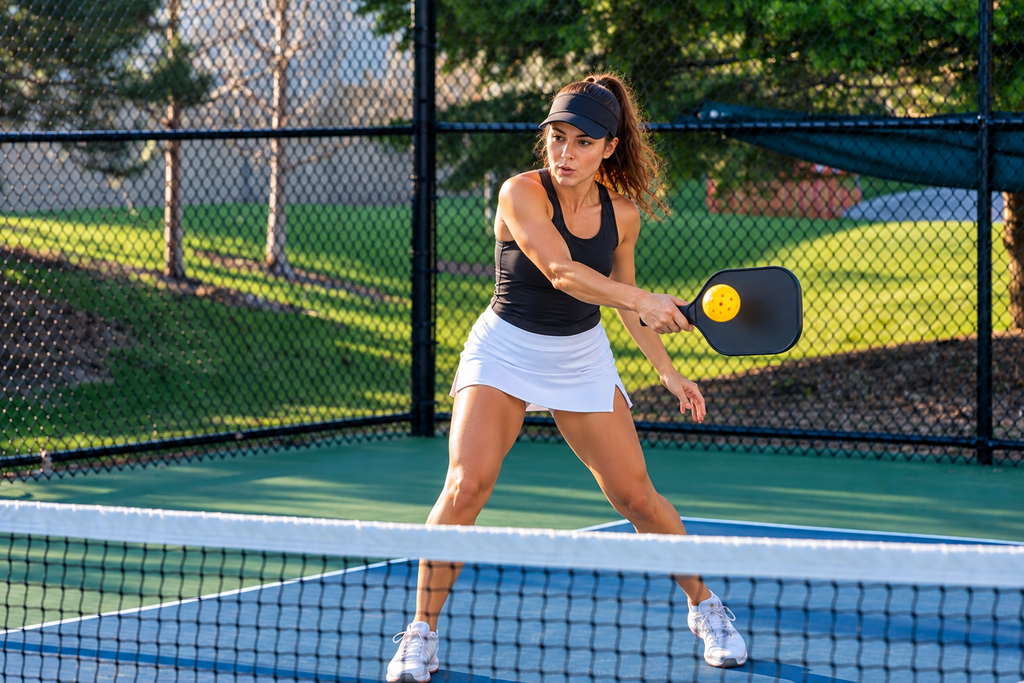
Backhand Fundamentals
A reliable backhand gives you a comfortable way to handle balls that arrive on the non-dominant side of your body. Instead of reaching awkwardly, running around the ball to use your forehand, or simply pushing the ball back, you can use a controlled stroke that keeps you balanced and ready for the next shot.
For beginners, the goal of the pickleball backhand is not power. The priority is early preparation, clean contact, a stable paddle face, and a simple swing you can repeat. This lesson focuses on a one-handed backhand groundstroke and the fundamental movement needed to use it effectively.
Understanding the Backhand
A backhand is a shot played on the side of your body opposite your dominant hand. If you hold the paddle in your right hand, your backhand side is generally your left side. If you are left-handed, it is generally your right side.
The backhand becomes especially important when the ball travels far enough toward that side that hitting a forehand would require you to move unnecessarily around the ball.
A groundstroke is a shot played after the ball has bounced. With a basic backhand groundstroke, you allow the ball to bounce, move into position, prepare the paddle, and swing forward through the ball.
Beginners sometimes avoid their backhand because the forehand feels more natural. That can create a bad habit of trying to run around every ball to hit a forehand. Doing so takes extra time, can pull you out of position, and may leave you off balance.
Developing a dependable backhand allows you to cover your side of the court more efficiently.
Start From the Ready Position
Good backhands begin before the swing.
Start in a balanced ready position with your knees slightly bent, your weight comfortable, and your paddle held in front of your body. Keep your upper body relaxed and be prepared to move in either direction.
Holding the paddle in front is important because it reduces the amount of movement required when you recognize that the ball is coming toward your backhand side.
Avoid allowing the paddle to hang beside your hip between shots. From that position, you have farther to move before you can prepare for the ball.
As soon as you recognize a backhand, begin your preparation.
Turn Your Shoulders Early
One of the most useful habits for a beginner pickleball backhand is an early shoulder turn.
Rather than waiting until the ball is beside you, turn your upper body as the ball approaches. This helps bring the paddle into position and gives you time to organize your feet before making contact.
The movement does not need to be large. Pickleball is played on a relatively compact court, so an exaggerated turn can make the stroke harder to control.
Think of your shoulders and paddle preparing together.
An early turn also helps prevent a common problem: trying to create the entire stroke with your arm. When your body participates naturally in the movement, the stroke can feel smoother and require less effort.
Late preparation creates the opposite situation. You may find yourself rushing the paddle forward, contacting the ball beside your body, or flicking your wrist in an attempt to catch up.
Prepare early enough that the forward swing can remain comfortable.
Keep the Backswing Compact
A beginner backhand does not require a large backswing.
Bring the paddle back enough to prepare for the forward motion, but avoid taking it far behind your body. A compact backswing gives you more time to respond to the ball and makes the paddle easier to control.
Large backswings can create unnecessary speed and make timing more difficult. They may also encourage you to focus on hitting hard instead of making clean contact.
Your preparation should feel simple: recognize the backhand, turn your shoulders, position the paddle, and move your feet.
From there, you are ready to swing forward.
Move Into Position Instead of Reaching
Your feet play an important role in every backhand.
When possible, move so the ball reaches a comfortable distance from your body. Small adjustment steps can help you create that spacing.
If you are too close to the ball, your arm may become cramped and you will have difficulty swinging freely. If you are too far away, you may have to stretch or lean toward the ball.
Neither position gives you good control.
Try to create enough space that your arm and paddle can move comfortably through the contact area while you remain balanced.
This is why moving your feet is usually better than reaching with your upper body. Reaching may occasionally be necessary during a rally, but it should not become your normal technique.
Find a Comfortable Contact Point
The contact point is where the paddle meets the ball.
For a basic backhand, try to make contact in front of your body rather than allowing the ball to travel too far beside or behind you. The exact position will vary slightly depending on the incoming ball and your movement, but the general principle remains the same.
Contact in front gives you better control of the paddle face and allows the forward swing to continue naturally.
Watch the ball carefully as it approaches and keep your head reasonably steady through contact. You do not need to stare at the paddle after hitting. The goal is simply to avoid looking away before contact occurs.
If you repeatedly hit the ball late, examine your preparation first. Late contact is often the result of recognizing the shot too slowly, turning too late, or failing to move into position.
Maintain a Stable Paddle Face
The angle of the paddle face has a major influence on where the ball travels.
A paddle face that opens too much can send the ball higher than intended. A face that closes excessively can drive the ball downward or into the net.
For a beginner backhand, aim for a stable paddle face throughout the important part of the swing.
Your wrist should remain controlled rather than flicking dramatically at contact. Small natural movements may occur, but the wrist should not be responsible for creating the entire shot.
A relaxed grip helps.
Holding the paddle too tightly can create tension in your hand, wrist, forearm, and shoulder. That tension often makes the stroke feel stiff and makes controlling the paddle face more difficult.
Hold the paddle securely enough that it remains stable, but not so tightly that your arm becomes rigid.
Swing Forward Through the Ball
Once you are prepared and positioned, move the paddle forward through the ball.
A basic beginner backhand uses a controlled low-to-high motion. The paddle begins somewhat below the expected contact point and travels forward and upward through the hitting area.
This should be a smooth movement rather than a sudden upward scoop.
Think about sending the paddle through the ball toward your intended direction. You are not trying to slap at the ball or stop the paddle immediately at contact.
The shoulder can contribute naturally to the movement. Your arm and shoulder should work together rather than relying entirely on your forearm or wrist.
The swing should be large enough to produce a clean, controlled shot but compact enough that you remain balanced.
Use Natural Shoulder Rotation
Your body does not need to remain completely still while you hit.
As you prepare, your shoulders turn. As you swing forward, they can rotate naturally with the stroke.
This movement helps connect the paddle swing to the rest of your body instead of forcing your arm to do all the work.
Avoid exaggerating the rotation. You do not need a dramatic body turn to produce an effective beginner backhand.
The goal is coordinated movement.
Your feet establish a balanced position, your shoulders prepare the stroke, and your arm guides the paddle forward through the ball.
When these movements work together, generating enough pace to send the ball across the net becomes much easier.
Follow Through Naturally
After contact, allow the paddle to continue in the direction of the shot.
A natural follow-through helps prevent the stroke from becoming abrupt. You do not need an enormous finish or a paddle wrapped around your body.
Instead, let the paddle continue forward and upward comfortably.
Pay attention to your balance at the end of the stroke. If the swing consistently pulls you sideways, spins your body around, or leaves you stumbling, you may be swinging harder than necessary.
A controlled pickleball backhand should allow you to finish the shot in a stable position.
From there, bring the paddle back in front of your body and recover to your ready position.
The rally may continue immediately, so the backhand is not finished when the ball leaves your paddle. Recovery is part of the stroke.
Handling Balls Close to Your Body
Not every ball will arrive at an ideal distance.
Balls directed close to your body can make a full backhand groundstroke uncomfortable. Your first option, when you have enough time, is to use your feet to create better spacing.
A small adjustment step may be enough.
Avoid trying to force a large swing when the ball crowds you. Compact movement becomes even more important in this situation.
Keeping the paddle in front and preparing early can help you manage these balls without becoming jammed.
If you regularly feel crowded on your backhand, pay attention to your movement before assuming the problem is your swing. Often, better spacing solves much of the difficulty.
Handling Wider Backhands
A ball traveling farther toward your backhand side requires more movement.
Move toward the ball as early as possible and use your feet to establish a balanced hitting position. Avoid immediately stretching your arm toward the ball while leaving your feet behind.
If you can reach the ball comfortably, use the same basic fundamentals: prepare early, create space, contact in front, keep the paddle face stable, and swing smoothly through the ball.
Do not turn a wider ball into an excuse to swing harder.
Your first goal is still to make controlled contact and send a playable ball across the net.
After the shot, recover your balance and begin moving back toward a useful court position.
Common Backhand Mistakes
One common mistake is preparing too late. If the paddle does not move into position until the ball is already close, you may rush the swing and contact the ball late. Earlier recognition and shoulder rotation usually help.
Another mistake is using too much arm. An arm-only swing can feel forced and inconsistent. Allow your shoulders to participate naturally while keeping the overall motion compact.
Excessive wrist movement is another frequent problem. Flicking the wrist may occasionally produce a successful shot, but it makes the paddle face harder to control consistently. Keep the wrist controlled and let the forward swing do the work.
Reaching instead of moving is also common. If you continually stretch toward backhands, work on taking small adjustment steps before swinging.
Some beginners also use an oversized backswing because they are trying to generate more power. This adds timing demands without necessarily producing a better shot. Shorten the preparation and concentrate on clean contact.
Finally, avoid judging the stroke only by how fast the ball travels. A slower ball that clears the net and lands where you intended is more useful for developing your fundamentals than a hard shot you cannot repeat.
Practice the Backhand Without a Ball
Shadow swings are a simple way to learn the movement.
Stand in your ready position and imagine a ball approaching your backhand side. Turn your shoulders, prepare the paddle with a compact backswing, and move forward through an imaginary contact point in front of your body.
Finish in balance and return the paddle to the ready position.
Repeat the movement slowly enough that you can notice your preparation, contact position, and recovery.
The purpose is not to swing as many times as possible. It is to make each repetition similar.
Once the movement feels organized, add footwork. Start from the ready position, take a small step or adjustment toward an imaginary ball, perform the backhand, and recover.
This connects the stroke to the movement required during an actual rally.
Build Your Backhand With Repetition
When you begin hitting balls, start with controlled repetitions rather than difficult shots.
Have a partner send comfortable balls toward your backhand side. Concentrate on preparing early and making clean contact in front of your body.
Use a moderate swing and give yourself enough height over the net. Try to repeat the same basic movement instead of changing your technique after every shot.
You can also practice alternating between forehands and backhands. This forces you to recognize which side the ball is approaching and move accordingly.
Begin slowly. The objective is to move, prepare, hit, and recover while maintaining balance.
As your repetitions become more consistent, the backhand becomes less of an isolated movement and more of a normal part of your groundstroke game.
Key Takeaways
- Use a backhand when the ball arrives on your non-dominant side and moving around it for a forehand would be inefficient.
- Start from a balanced ready position and prepare early by turning your shoulders and positioning the paddle.
- Keep the backswing compact and move your feet to create comfortable spacing instead of reaching unnecessarily.
- Contact the ball in front of your body with a stable paddle face, relaxed grip, and controlled wrist.
- Swing smoothly forward with a controlled low-to-high motion, using natural shoulder rotation rather than relying only on your arm.
- Follow through naturally, finish in balance, and recover immediately to your ready position.
- Use shadow swings, controlled backhand repetitions, and alternating forehand-and-backhand practice to develop a dependable, repeatable stroke.