
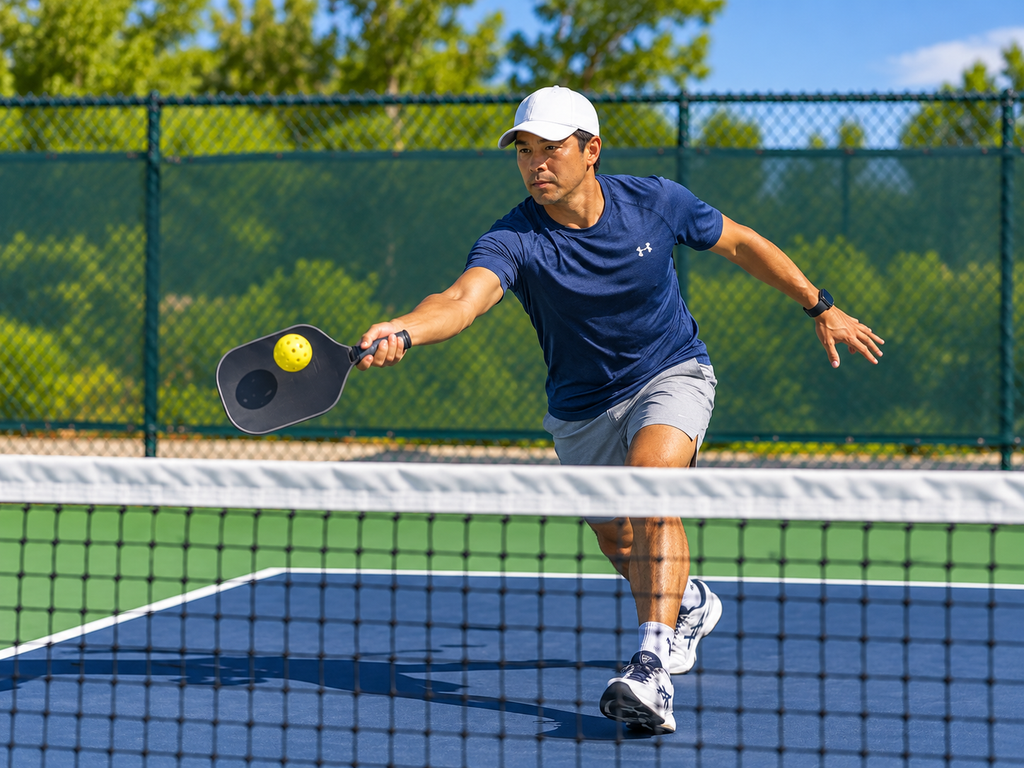
Forehand Fundamentals
A dependable forehand gives you a simple way to return balls that arrive on your dominant side. For a right-handed player, that is generally the right side of the body; for a left-handed player, it is generally the left.
The goal of a beginner pickleball forehand is not to hit the ball as hard as possible. It is to make clean contact, control the ball, and finish the stroke in balance.
A good forehand is built from a few connected actions: preparing early, moving your feet into position, turning your shoulders, contacting the ball in front of your body, and following through toward your target. When these actions work together, the stroke becomes easier to repeat.
When to Use a Forehand
A forehand is normally used when the ball comes to the same side as your paddle hand. If you hold the paddle in your right hand, a ball arriving comfortably to your right is usually a forehand. If you are left-handed, the opposite is true.
You do not need to move around every ball just to hit a forehand. The better choice is usually the stroke that allows you to reach the ball comfortably while remaining balanced.
As you judge an incoming ball, pay attention to where it will bounce rather than only where it is now. This helps you move early and create enough room between your body and the ball.
Start From the Ready Position
Your forehand begins before the paddle moves forward. Start in a balanced ready position with your knees slightly bent, your weight comfortable, and your paddle in front of your body.
As soon as you recognize that the ball is coming to your forehand, begin preparing. Waiting until the ball is beside you often creates a rushed swing. Early preparation gives you more time to move, establish comfortable spacing, and make a controlled stroke.
Keep your upper body relaxed. A tense starting position can make the swing stiff and encourage you to grip the paddle too tightly.
Turn Your Shoulders and Prepare Early
Once you identify a forehand, turn your shoulders slightly so your body is prepared to swing forward. This does not need to be a dramatic rotation. A simple shoulder turn helps organize the stroke and allows your arm and body to work together.
Move the paddle back as you turn, but keep the backswing compact. Beginners sometimes assume that a larger backswing produces a better shot. In pickleball, an oversized backswing can make timing more difficult and give you more movement to control.
Think of the preparation as getting the paddle into a comfortable starting position rather than winding up for a powerful hit.
Your paddle should be ready early enough that you are not still taking it backward when the ball reaches your hitting area. A compact preparation also makes it easier to adjust if the ball bounces differently than expected.
Move Your Feet Into Position
Good pickleball forehand technique depends heavily on footwork. Instead of reaching for the ball with your arm, move your body so the ball arrives at a comfortable distance from you.
Use small adjustment steps as the ball approaches. These steps allow you to fine-tune your position after you judge the bounce. Your goal is to create enough space to swing freely without having the ball jam your elbow or force you to stretch.
If you stand too close to the ball, your arm becomes cramped and the paddle is harder to control. If you remain too far away, you may lean or reach, which makes clean contact less reliable.
Try to arrive in position before making the main forward swing. You do not have to be completely still, but your body should feel controlled rather than rushed. Moving first and swinging from a balanced position is more dependable than trying to correct poor spacing with your arm at the last moment.
Find the Right Contact Point
One of the most important parts of the forehand is the contact point. For a basic groundstroke, aim to meet the ball slightly in front of your body rather than beside you or behind you.
Contact in front gives the paddle room to travel toward the target. It also makes it easier to keep the paddle face stable.
If you contact the ball too late, the stroke may feel cramped and the ball can travel in an unintended direction. If you reach too far forward, you can lose balance and control. The ideal contact point should feel comfortably forward and within easy reach.
Keep your eyes on the ball as it approaches the paddle. Avoid looking toward your target too early. Decide where you want to hit before the swing, then keep your attention on the incoming ball through the contact area.
Keep the Paddle Face Stable
The angle of the paddle face has a major effect on where the ball goes. A paddle face that changes suddenly near contact can send the ball higher, lower, or farther sideways than you intended.
Keep the paddle controlled as you approach the ball. You do not need a rigid wrist, but avoid unnecessary wrist flicking. For a beginner forehand, a quieter wrist generally makes the paddle face easier to control.
Grip pressure matters as well. Hold the paddle securely enough that it does not move in your hand, but avoid squeezing it excessively. Too much tension can make your arm stiff and reduce your ability to control the stroke.
A relaxed, controlled grip allows the paddle to move smoothly while maintaining a more predictable face angle.
Use a Low-to-High Swing Path
As you begin the forward swing, move the paddle through the contact area instead of poking at the ball. A smooth swing gives you a larger and more reliable contact zone.
For a basic forehand, use a gentle low-to-high swing path. The paddle begins somewhat below the expected contact point and travels forward and upward through the ball. This helps provide useful height over the net while maintaining a natural motion.
The upward movement should be controlled. An exaggerated lifting action can send the ball too high. The idea is to swing forward through the ball with a modest rise, not to scoop underneath it.
Let your shoulder, arm, and natural body rotation work together. Trying to produce the entire stroke with your arm can make the movement feel forced.
Transfer Your Weight Smoothly
Your weight can shift naturally as you swing. As you move into position and hit the ball, allow your body weight to move smoothly in the direction of the shot.
This does not require a large step or dramatic movement. The purpose of weight transfer is to support balance and a flowing stroke, not to create maximum force.
Avoid leaning heavily into the shot. If your upper body falls forward or sideways, paddle control usually suffers. Your feet and legs should support the stroke so you remain stable through contact.
Your finish provides a useful check. If you can complete the forehand without stumbling or needing an extra step simply to regain balance, you are more likely to be controlling your weight effectively.
Follow Through Toward the Target
After contact, allow the paddle to continue naturally forward and upward. The follow-through should feel like a continuation of the swing rather than a separate action.
Directing the paddle toward your intended target can help reinforce a controlled swing path. You do not need to force the paddle into an exact finishing position. Let it finish comfortably while your body remains balanced.
Stopping the paddle abruptly at contact can make the stroke less fluid. A smooth follow-through encourages you to swing through the ball rather than merely tap it.
The follow-through does not need to be large. Compact, controlled movement is easier for a beginner to repeat.
Control the Ball Before Adding Speed
A useful forehand gets the ball over the net and into the court consistently. Extra speed has little value if it produces frequent errors.
Give the ball enough height to clear the net safely. Trying to hit every forehand extremely low and fast reduces your margin for error.
Use a comfortable swing speed that allows you to maintain your balance, spacing, and paddle control. If those fundamentals begin to break down, reduce the pace.
Control also comes from repeating the same basic preparation and contact pattern. The more consistent your setup becomes, the easier it is to predict how the ball will leave your paddle.
Common Forehand Mistakes
One common mistake is using too much wrist. A last-second wrist flick can change the paddle angle and make the ball difficult to control. Keep the wrist relatively quiet and allow the larger parts of the arm and body to guide the stroke.
Another problem is an oversized swing. A large backswing takes more time and can make contact inconsistent. Shorten your preparation until you can meet the ball comfortably and repeatedly.
Reaching is another frequent problem. If you stretch your arm toward the ball instead of moving your feet, your contact point and balance can change from shot to shot. Use adjustment steps to create comfortable hitting space before swinging.
Late preparation can cause several problems at once. When you recognize the forehand too late, you may rush the backswing, reach for the ball, and flick the paddle simply to make contact. Preparing earlier often improves several parts of the stroke at the same time.
Finally, avoid squeezing the handle harder when you are uncertain. Excessive grip pressure usually adds tension rather than control.
Practice Your Pickleball Forehand
Start with simple forehand repetitions rather than difficult shots. Have a partner gently send balls to your forehand side at a manageable pace. Focus on preparing early, moving into position, contacting the ball in front, and finishing in balance.
Do not judge success by speed. Pay attention to the quality of your contact and whether the ball travels over the net with a controlled trajectory.
You can also practice shadow swings without a ball. Begin in your ready position, turn your shoulders, make a compact preparation, swing forward on a controlled low-to-high path, and finish balanced. Then return to the ready position.
Once the motion feels comfortable, practice a cooperative forehand rally with a partner. Try to send the ball back to a comfortable area so both players can continue hitting. The purpose is to repeat the stroke rather than end the rally.
Count consecutive successful forehands as a simple measure of consistency. If your technique begins to break down, slow the rally and restore your preparation, spacing, and contact point.
Recover to the Ready Position
The forehand is not finished when the ball leaves your paddle. After the follow-through, regain your balance and bring the paddle back in front of your body.
Return toward a useful court position rather than standing where you finished the stroke. Avoid watching your shot for too long or leaving the paddle off to the side. The ball may come back quickly.
Think of the sequence as hit, recover, prepare. A controlled forehand should leave you ready to continue the rally.
Putting the Forehand Together
A reliable pickleball forehand is a sequence rather than a single swing. Recognize the ball early, turn your shoulders, prepare the paddle, and move your feet until you have comfortable spacing.
Meet the ball slightly in front of your body with a stable paddle face. Swing smoothly forward and upward, using natural body rotation and controlled weight transfer. Keep your grip relaxed, watch the ball through contact, and follow through toward your target.
Finish in balance, then recover to your ready position.
The goal is repeatability. A compact stroke with clean contact and good balance gives you much more useful control than a large, powerful swing that is difficult to reproduce.
Key Takeaways
- Use the forehand for balls that arrive comfortably on your paddle-hand side, and begin preparing as soon as you recognize the shot.
- Move your feet to create comfortable spacing. Good positioning is more reliable than reaching for the ball.
- Keep the backswing compact and contact the ball slightly in front of your body with a stable paddle face.
- Use a smooth low-to-high swing, natural body rotation, relaxed grip pressure, and controlled weight transfer.
- Follow through toward your target, finish in balance, and recover immediately to the ready position.
- Build control and consistency before adding speed. Clean contact and repeatable mechanics are the foundation of a dependable forehand.