
Learning basic pickleball terminology makes the game much easier to understand. Players, instructors, and partners regularly use short terms to describe shots, court areas, rules, positions, and situations during a rally. Once you know what these words mean, instructions such as “dink cross-court,” “stay behind the baseline,” or “that was a side out” become much clearer.
This beginner dictionary explains the most common terms you are likely to hear during lessons and recreational games. These terms form part of the basic vocabulary needed to understand pickleball instruction and gameplay.
Serving And Rally Terms
Serve
A serve is the shot used to begin a rally. The player serving sends the ball diagonally across the net into the opponent’s correct service court.
Every rally starts with a serve, so when someone says, “Your serve,” they are telling you that you are the player responsible for putting the ball into play.
The serve is different from most other shots because it is performed from behind the baseline and must follow specific serving rules.
Server
The server is the player who performs the serve.
In singles, there is one server and one receiver at the beginning of a rally. In doubles, the serving team has two players, but only one of them is the active server at a particular moment.
When players call the score before serving, the identity and position of the server help determine where the serve should begin.
Receiver
The receiver is the player who receives the serve.
The receiver stands diagonally across the court from the server and waits for the served ball to arrive. The serve must bounce before the receiver plays it.
In doubles, the receiver’s partner is also on the court, but the player positioned diagonally opposite the server is the person designated to receive that serve.
Return Of Serve
The return of serve is the shot made by the receiver after the serve bounces.
For example, if your opponent serves to you and you allow the ball to bounce before hitting it back across the net, you have made a return of serve.
A return can be hit with a forehand or backhand. Beginners commonly try to send the return deep into the opponent’s court while maintaining control.
Rally
A rally is the sequence of shots exchanged after the serve until play stops.
A rally might last only two or three shots, or it can continue through many exchanges. Every legal shot that keeps the ball in play extends the rally.
A rally ends when a fault occurs, such as a ball being hit into the net, landing out of bounds, or bouncing twice before being returned.
Common Pickleball Shots
Volley
A volley is a shot in which you hit the ball out of the air before it bounces.
Volleys are commonly used when players are positioned near the non-volley zone line. Because volleying involves hitting the ball before it reaches the ground, it can result in quick exchanges between players.
A player must also be aware of the non-volley zone when attempting a volley because special rules apply around that area.
Groundstroke
A groundstroke is a shot made after the ball has bounced.
Forehands and backhands played from the baseline or other areas of the court are common examples of groundstrokes.
The important distinction is the bounce. If the ball bounces before you hit it, the shot can be considered a groundstroke. If you strike it before it bounces, you are generally playing a volley.
Forehand
A forehand is a shot played on the same side of the body as your paddle hand.
For a right-handed player, this is normally the right side. For a left-handed player, it is normally the left side.
Forehands can be used for groundstrokes, dinks, volleys, and other shots. Beginners often find the forehand comfortable because the paddle can move naturally forward from the dominant side.
Backhand
A backhand is a shot played on the side opposite your paddle hand or with the back of the paddle hand generally facing the direction of the shot.
For a right-handed player, a ball arriving on the left side will often be played with a backhand. For a left-handed player, the opposite is usually true.
Backhands are especially important for balls that arrive near the middle of the body or on the non-dominant side.
Dink
A dink is a soft, controlled shot intended to travel over the net and land in the opponent’s non-volley zone.
Unlike a hard drive, a dink is designed primarily around touch and placement. Players commonly use dinks when they are positioned near the kitchen line.
A well-controlled dink usually stays low enough that the opponent cannot easily attack it with a powerful downward shot.
Drop Shot
A drop shot is a softly hit ball intended to land short in the opponent’s court, often in or near the non-volley zone.
The purpose is to reduce the pace of the rally and make the opponent play a lower ball closer to the net.
You may hear the word “drop” used for several soft shots, but the basic idea is the same: instead of driving the ball deep, the player intentionally makes it land short.
Lob
A lob is a high shot that travels over an opponent and lands deeper in the court.
A player might use a lob when opponents are positioned near the kitchen line. Instead of trying to pass them with a low shot, the ball is sent high enough to travel over their reach.
A lob requires control because a ball hit too short can give an opponent an easy overhead.
Overhead
An overhead is a shot played above the player’s head, usually against a high ball.
The motion may resemble an overhead action used in other racket sports. It is often used when an opponent sends a lob or another high ball that can be contacted comfortably above shoulder level.
Smash
A smash is an aggressive overhead shot directed forcefully toward the opponent’s court.
Although an overhead describes the type of stroke, the word smash usually emphasizes an attacking result. A player contacts a high ball and drives it downward or deep with greater pace.
Not every overhead has to be a smash. Players can also use controlled overheads when accuracy is more important than maximum speed.
Pickleball Court Terms
Understanding court-related pickleball terminology helps you know where to stand and where the ball is supposed to land.
Non-Volley Zone
The non-volley zone is the seven-foot area extending from the net on both sides of the court.
Players cannot volley a ball while touching this area or its boundary line. However, the name sometimes causes confusion: players are allowed to enter the non-volley zone when the ball has bounced.
The restriction applies specifically to volleying.
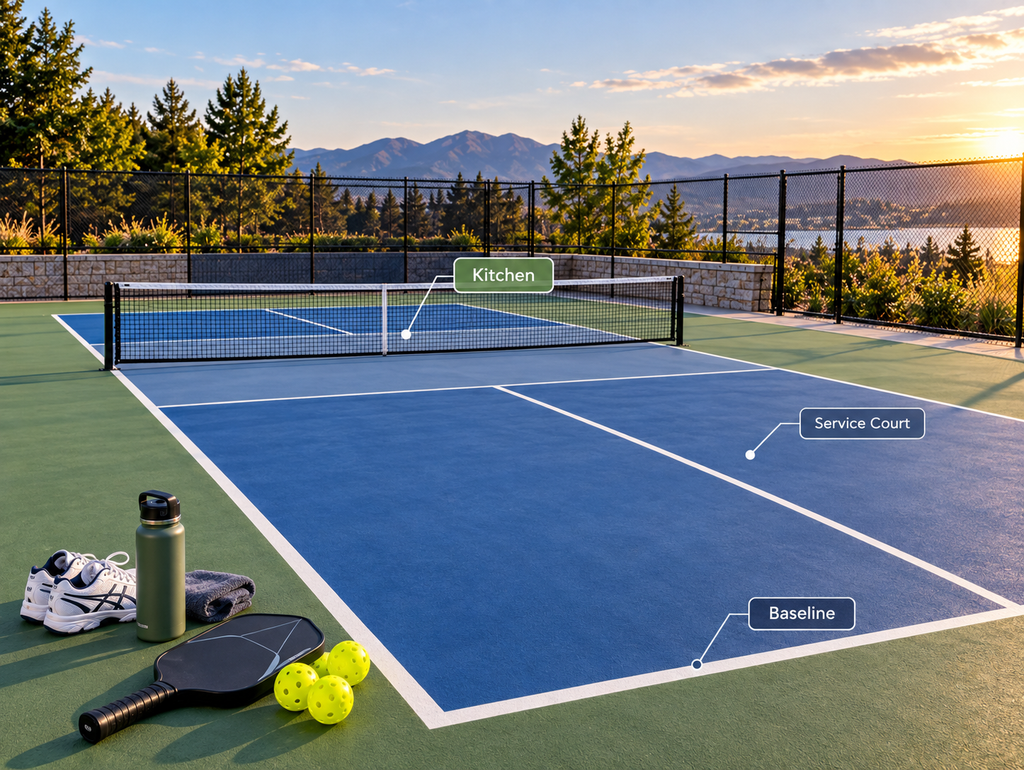
Kitchen
The kitchen is the common nickname for the non-volley zone.
When someone says, “Move up to the kitchen,” they normally mean move toward the non-volley zone line near the net.
Similarly, “kitchen line” commonly refers to the boundary of the non-volley zone.
Baseline
The baseline is the line forming the back boundary of each end of the pickleball court.
Players serve from behind the baseline. During rallies, beginners also spend considerable time near the baseline when receiving serves or playing groundstrokes.
A ball that lands beyond the baseline is normally out.
Sideline
A sideline is one of the lines running along the sides of the court.
Together with the baselines, the sidelines help define the outer boundaries of the playing area.
When someone describes a shot as being “near the sideline,” they mean the ball is traveling close to one of these side boundaries.
Centerline
The centerline divides the area between the non-volley zone and baseline into the left and right service courts.
It is especially important during serving because the server must send the ball diagonally into the correct service court.
Service Court
A service court is the area into which a legal serve must land.
There is a left service court and a right service court on each side of the net. The server sends the ball diagonally into the appropriate service court on the opponent’s side.
The non-volley zone is not part of the service court where the served ball is intended to land.
Rules And Scoring Terms
Fault
A fault is a rule violation that ends the rally.
Common examples include hitting the ball into the net, hitting it out of bounds, allowing it to bounce twice, violating the two-bounce requirement, or committing certain non-volley zone violations.
What happens after the fault depends on which team was serving and the scoring format being used.
Two-Bounce Rule
The two-bounce rule, also called the two-bounce requirement, means that the serve must bounce once on the receiving side and the return must then bounce once on the serving side before either team may begin volleying.
Think of the opening sequence as:
Serve, bounce, return, bounce.
After those two required bounces have occurred, players may hit the ball either after a bounce or out of the air when the rules allow.
This rule is an important part of basic pickleball terminology because it explains why players cannot immediately rush forward and volley the first two shots of the rally.
Side Out
A side out occurs when the serving side loses its opportunity to continue serving and service passes to the opposing side.
You will commonly hear the phrase during traditional side-out scoring, in which only the serving team can score a point.
In doubles, the serving team’s first server may lose a rally and service may then pass to the second server rather than immediately producing a side out. Once the team’s available service turns have ended, the opponents gain the serve.
Server Number
In traditional doubles scoring, the server number identifies whether the current player is the team’s first or second server for that service turn.
This is why a doubles score commonly contains three numbers: the serving team’s score, the receiving team’s score, and the server number.
For example, the final number in a score call identifies whether the current server is server one or server two.
Rally Scoring
Rally scoring is a scoring format in which a point can be awarded at the end of a rally regardless of which side served.
This differs from traditional side-out scoring, where normally only the serving team can score a point.
You may encounter different scoring systems in recreational or organized play, so recognizing the term is useful even when your games use traditional scoring.
Traditional Scoring
Traditional scoring, often called side-out scoring, is the familiar scoring system in which only the serving team can normally earn a point.
If the receiving team wins the rally, it gains a serving opportunity rather than automatically receiving a point.
When joining a game, it is useful to know which scoring format the players have agreed to use.
Shot Direction And Placement Terms
Cross-Court
Cross-court means hitting the ball diagonally from one side of the court toward the opposite side.
For example, a player near the right sideline might direct the ball toward the opponent’s right side from that opponent’s perspective, creating a diagonal path across the court.
Cross-court shots are common on serves, returns, groundstrokes, and dinks.
Down The Line
Down the line describes a shot traveling more directly along one side of the court rather than diagonally across it.
If you are positioned near the sideline and send the ball toward the opponent’s same-side sideline, you are generally hitting down the line.
Because the sideline is nearby, accurate control is important.
Deep Shot
A deep shot lands toward the back portion of the opponent’s court, closer to the baseline than the net.
Serves and returns are often described as deep when they push the opponent farther back.
“Deep” describes where the ball lands rather than how hard it was hit. A controlled shot can still have good depth.
Short Shot
A short shot lands closer to the net than a typical deep groundstroke.
A dink and a drop shot are examples of shots that may intentionally land short.
The term can also describe an unintended result. If someone says, “That return was short,” they may simply mean the ball did not travel very deep into the opponent’s court.
Results And Error Terms
Unforced Error
An unforced error is a mistake made when a player had a reasonable opportunity to make a successful shot but missed without being forced into the error by an especially difficult opponent’s shot.
Examples might include hitting a comfortable ball into the net or sending an easy shot well beyond the baseline.
The term helps distinguish ordinary mistakes from errors caused by heavy pressure or an extremely difficult ball.
Winner
A winner is a successful shot that the opponent cannot return.
A player might hit a ball into open court, pass an opponent with a well-placed shot, or attack a high ball so effectively that the opponent cannot reach it.
Beginners should understand the term without assuming that every shot needs to become a winner. Many rallies are decided because one side simply keeps the ball in play longer.
Common Doubles Communication Terms
Good communication becomes especially important when two players share the same side of the court.
Mine
“Mine” tells your partner that you intend to play the ball.
The call is especially useful when the ball travels toward the middle and either partner might reasonably attempt the shot.
Calling early gives your partner time to stay clear and prepare for the next ball.
Yours
“Yours” tells your partner that you expect them to play the ball.
It can help prevent both players from swinging at the same ball or colliding while trying to reach it.
The call should be made early enough for the partner to react.
Out
“Out” is commonly used to communicate that a ball appears likely to land outside the court.
Players may use the call to help a partner decide not to hit a ball that is traveling beyond the boundary.
An actual line call is based on where the ball lands, so predicting “out” while the ball is still traveling and making an official call after it lands are not exactly the same thing.
Using Pickleball Terminology During Play
You do not need complicated language to communicate effectively on a pickleball court. Most of the vocabulary describes something practical: a court location, a type of shot, a rule, a direction, or a player’s responsibility.
For example, an instructor might say, “Return the serve deep, move toward the kitchen, and get ready for a volley.” Understanding the terms tells you exactly what the instruction means: let the serve bounce, send your return toward the back of the opponent’s court, move forward toward the non-volley zone line, and prepare to hit an incoming ball before it bounces.
Another instruction might be, “Dink cross-court instead of going down the line.” That means using a soft shot intended to land in the opponent’s kitchen and sending it diagonally rather than straight along the sideline.
Learning pickleball terminology is therefore not about memorizing definitions simply for the sake of vocabulary. These words give players a shared language for understanding rules, following instruction, discussing shots, and communicating during games.
Key Takeaways
- A serve begins the rally, the server puts the ball into play, and the receiver plays the return after the serve bounces.
- A groundstroke is played after a bounce, while a volley is struck before the ball bounces.
- Forehand, backhand, dink, drop shot, lob, overhead, and smash describe common types of pickleball shots.
- The baseline, sideline, centerline, service courts, and non-volley zone describe important parts of the court.
- The kitchen is another name for the non-volley zone, and special restrictions apply when volleying near or inside it.
- A fault is a rule violation that ends a rally, while the two-bounce rule requires the serve and return to bounce before volleys are allowed.
- Cross-court, down the line, deep, and short describe the direction or placement of a shot.
- Side out, server number, traditional scoring, and rally scoring are important scoring terms you may hear during play.
- Mine, yours, and out are simple communication terms that help doubles partners coordinate safely and effectively.
- Understanding basic pickleball terminology makes it easier to follow instructions, communicate with other players, understand the rules, and recognize what is happening during a rally.