
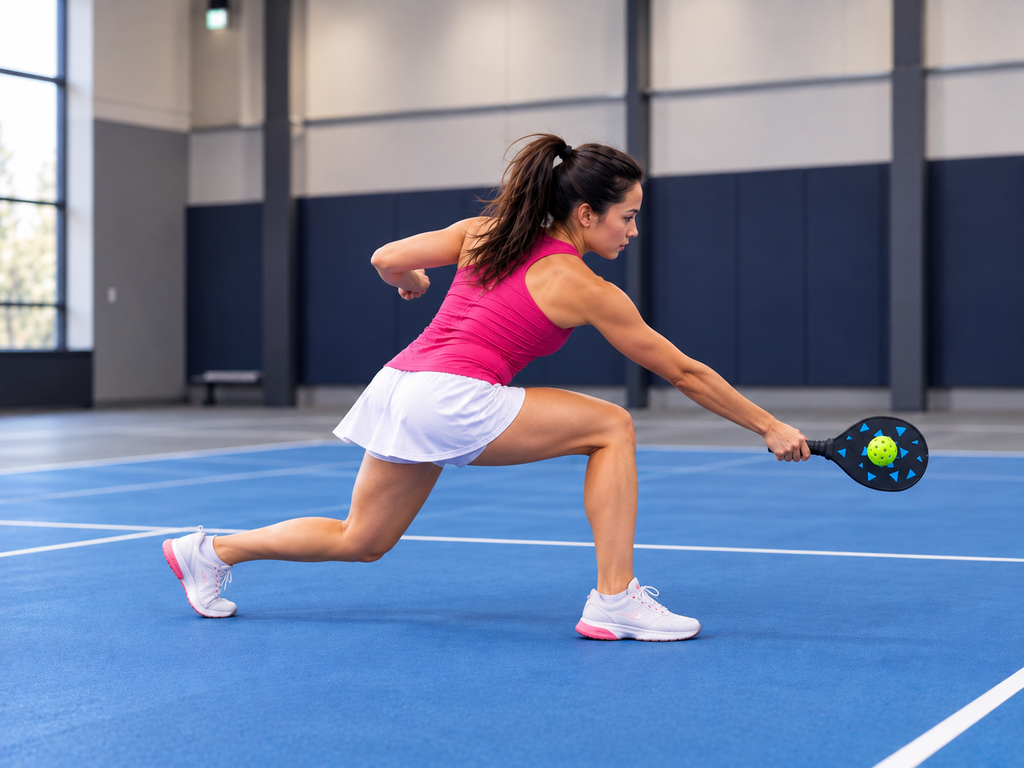
Building Consistent Groundstrokes
Consistency is one of the most useful skills a beginner can develop in pickleball. A consistent groundstroke is not necessarily fast, powerful, or difficult for an opponent to return. It is a shot you can repeat with enough control to keep the ball in play and continue the rally.
At this stage, your forehand, backhand, footwork, and directional control need to work together. The goal of pickleball groundstrokes is not to hit harder. It is to produce more playable shots in a row while maintaining balance and control.
A dependable groundstroke comes from repeatable preparation, good movement, clean contact, controlled placement, and recovery after every shot. When these pieces become consistent, rallies become easier to manage and unforced errors begin to decrease. Course Pickleball for Beginners
What Consistency Means in Pickleball
Consistency means being able to repeat a useful shot under normal playing conditions.
For a beginner, that usually means clearing the net comfortably, keeping the ball inside the court, maintaining reasonable control of direction, and recovering in time for the next shot. A ball does not need to land close to a sideline or travel at high speed to be successful.
Suppose you are practicing from the baseline with a partner. You hit one hard forehand that lands near the corner, but your next three shots go into the net or out of bounds. That impressive first shot does not represent consistency.
Now imagine hitting ten moderate groundstrokes, with eight or nine landing safely in the court. Those shots may look less dramatic, but they demonstrate much better control.
For beginners, the second pattern is far more valuable.
Prioritize Playable Shots
A playable shot is a ball that safely clears the net and lands within the opponent’s court while giving you a reasonable chance to prepare for what comes back.
This should be your first objective when building consistent pickleball groundstrokes.
Trying to make every shot difficult for your opponent often creates unnecessary errors. You may swing harder than you can control, aim too close to a line, or change your technique in an attempt to produce a perfect shot.
Instead, give yourself room for error.
Aim toward larger areas of the court rather than small targets near the boundaries. Send the ball high enough over the net that a minor difference in your swing does not immediately produce a net error.
The question to ask is not, “How hard can I hit this?”
A more useful question is, “Can I make this shot again?”
Start From a Repeatable Ready Position
Consistency begins before you swing.
After each shot, return to a balanced ready position. Keep your knees slightly bent, your body relaxed, and your paddle in front where it can move comfortably toward either a forehand or backhand.
A repeatable starting position reduces the number of adjustments you need to make when the next ball arrives.
If your paddle is hanging at your side after one shot, behind your body after another, and high above your waist after the next, every stroke begins differently. That makes consistent preparation more difficult.
Your ready position gives each stroke a familiar starting point.
Once you complete a groundstroke, recover your balance and bring the paddle back to ready. Watch your opponent or practice partner and prepare to move again.
Prepare Early
Late preparation is a common cause of inconsistent groundstrokes.
Watch the incoming ball as early as possible. As you recognize whether it is approaching your forehand or backhand side, begin preparing your body and paddle.
Early preparation does not mean taking a large backswing. It means getting organized before the ball reaches you.
Turn your shoulders, prepare the paddle, and begin moving toward an appropriate hitting position. When you prepare early, you have more time to make small adjustments with your feet instead of rushing your swing.
When preparation happens too late, several problems tend to appear at once. You may reach for the ball, make contact beside or behind your body, rush the paddle forward, or lose balance.
Those problems make the result much harder to repeat.
Move Into Position Before Swinging
Your feet play a major role in groundstroke consistency.
Whenever possible, move your body into a comfortable position relative to the ball instead of stretching your arm toward it. Use small adjustment steps as the ball approaches so you can create enough space for a natural swing.
Try to arrive in position before beginning the main forward movement of the paddle.
This does not mean your feet must be completely motionless. It means you should avoid making a rushed swing while your body is still trying to catch up with the ball.
If a shot is slightly wide, move toward it. If it comes closer to your body, adjust your feet to create hitting space.
Better positioning makes clean contact easier, and cleaner contact makes your groundstrokes more predictable.
Develop a Consistent Contact Point
One of the clearest signs of reliable technique is a repeatable contact point.
For basic forehand and backhand groundstrokes, you generally want to meet the ball in front of your body rather than allowing it to travel too far behind you.
The exact position will vary slightly depending on the incoming ball, but the principle remains the same: create enough space to make comfortable contact while your body remains balanced.
Contacting one ball well in front of you and the next beside or behind you changes the relationship between your paddle and the ball. That can change the ball’s height, direction, and distance.
Watch the ball carefully through contact and use your feet to help establish a comfortable hitting position.
You are trying to make your contact feel familiar from one stroke to the next.
Keep Your Stroke Compact
Large swings create more moving parts, which can make timing difficult for beginners.
Use a compact preparation and a controlled swing through the ball. You need enough paddle movement to send the ball across the net, but you do not need an oversized backswing or an exaggerated follow-through.
A compact stroke is especially useful when the incoming ball gives you limited preparation time.
Keep your grip relaxed, prepare the paddle early, swing smoothly through the ball, and finish under control.
The goal is repeatability.
If your stroke feels completely different every time you hit the ball, simplify it. A smaller, smoother motion is generally easier to reproduce than a large, forceful one.
Control the Paddle Face
The angle of the paddle face at contact strongly influences where the ball travels.
If the paddle face opens too much, the ball may rise higher than intended or travel long. If it closes excessively, the ball may travel too low and end up in the net.
For consistent pickleball groundstrokes, try to maintain a stable paddle face through contact.
Avoid sudden wrist movements immediately before hitting the ball. Last-second changes make the paddle face less predictable and make directional control more difficult.
Your grip should be secure enough to control the paddle without becoming unnecessarily tight. Excessive tension can interfere with smooth movement and make subtle adjustments harder.
Think of the paddle face as the steering surface of the shot. The more stable and predictable it is, the easier it becomes to control the ball.
Use a Comfortable Swing Speed
Beginners often assume that a better groundstroke must be a faster groundstroke. That can lead to swinging harder than necessary.
Choose a swing speed that allows you to maintain balance, clean contact, and control.
If increasing your swing speed causes your contact point to become inconsistent or your paddle face to move unpredictably, reduce the pace.
A moderate shot that lands safely is more useful than a powerful shot you cannot reliably repeat.
This becomes especially important during longer rallies. You need a stroke that you can reproduce several times without constantly changing effort.
Give Yourself Net Clearance
The net is an immediate obstacle on every groundstroke, so there is little benefit in repeatedly trying to skim the ball just above it.
Give your shots adequate clearance.
Aiming somewhat higher over the net creates a larger margin for small variations in your swing. The ball still needs to stay inside the court, so the goal is controlled clearance rather than simply hitting the ball as high as possible.
If many of your shots are going into the net, examine your paddle face, contact point, swing path, and body position. You may also be aiming with too little margin.
A slightly safer ball can dramatically improve rally consistency.
Aim Toward Larger Areas
Directional control becomes more reliable when you choose realistic targets.
Instead of trying to hit a tiny area close to a sideline, aim toward a larger section of the court. Give yourself space from the boundaries and concentrate on directing the ball generally where you want it to go.
You can practice straight-ahead shots as well as cross-court shots.
A cross-court groundstroke travels diagonally across the court. A straight-ahead groundstroke travels more directly toward the opposite side.
Both are useful for consistency practice because they allow you to repeat a clear direction rather than changing your target after every shot.
As your control improves, targets can gradually become more specific. At the beginner level, however, a generous target helps you build successful repetitions.
Combine Forehands and Backhands
A rally will not always send the ball conveniently to your strongest side.
Practice both forehand and backhand groundstrokes so you can maintain control when the direction of the incoming ball changes.
Begin with separate practice. Hit several forehands in a row and concentrate on repeating your preparation, contact point, paddle control, and recovery. Then do the same with your backhand.
After that, alternate between the two.
For example, your partner can send one ball toward your forehand and the next toward your backhand. Your job is to move into position, make a controlled stroke, recover, and prepare again.
This forces you to return to a reliable ready position instead of simply repeating the same movement.
Recover After Every Groundstroke
Your responsibility does not end when the ball leaves your paddle.
Finish the stroke in balance and prepare for the next ball. Return the paddle to ready position, recover your court position, and keep your attention on the rally.
Beginners sometimes watch their shot for too long. While they are observing where the ball lands, the opponent is already preparing the next shot.
Develop a simple rhythm:
Hit, recover, prepare.
That rhythm should become part of every groundstroke.
Good recovery also prevents one slightly difficult shot from causing several more problems. Even when your contact is not perfect, recovering quickly can put you in a better position to handle the next ball.
Maintain Rhythm During Longer Rallies
When you can keep several balls in play, begin paying attention to rhythm.
You do not need to swing at exactly the same speed on every ball because incoming shots will vary. Instead, look for a consistent pattern of preparation, movement, contact, and recovery.
Avoid rushing simply because the rally becomes longer.
Beginners sometimes become increasingly aggressive after several successful shots. The first few groundstrokes are controlled, but then they try to hit the next ball much harder. That sudden change often ends the rally.
Stay with the pace you can control.
Longer rallies are useful because they reveal whether your technique remains dependable beyond the first few shots.
Recognize When Your Technique Breaks Down
Pay attention to patterns rather than treating every missed shot as a separate problem.
If several balls go into the net, look for a repeated cause. You may be contacting the ball late, closing the paddle face, rushing the stroke, or failing to move into position.
If several shots travel long, you may be opening the paddle face, swinging too aggressively, or losing control of your contact point.
If your shots repeatedly miss to one side, check your alignment, paddle direction, and follow-through.
Correct one issue at a time.
Trying to change your feet, grip, backswing, paddle face, contact point, and follow-through simultaneously makes it difficult to know which adjustment actually helped.
Choose the clearest recurring problem and work on that first.
Maintain Consistency as You Get Tired
Fatigue can change your technique.
As a practice session or rally continues, your feet may become less active. You may reach for balls instead of moving into position, grip the paddle more tightly, or shorten your preparation because you are rushing.
When you notice this happening, reduce the pace and concentrate on fundamentals.
Good practice is not simply accumulating as many repetitions as possible. Repeating poor technique while tired can make the exercise less useful.
Pay attention to whether you can still prepare early, move into position, make controlled contact, and recover properly.
Consistency includes maintaining those habits over repeated shots.
Practice With Measurable Goals
One of the simplest ways to improve consistency is to count successful shots.
Start with cooperative rally practice. Instead of trying to beat your partner, work together to keep the ball going.
You might begin with a goal of five consecutive groundstrokes. Once that becomes comfortable, try eight, ten, or more.
You can also practice specific patterns.
For straight-ahead rallies, stand opposite your partner and try to keep the ball traveling within the same general lane.
For cross-court practice, position yourselves diagonally and maintain a controlled rally across the court.
For forehand-to-forehand practice, arrange the rally so both players primarily use forehands. Repeat the exercise with backhands.
Finally, alternate forehands and backhands so movement and recovery become part of the drill.
Track the number of consecutive successful shots rather than how hard you hit them. This gives you a simple measure of whether your control is improving. These cooperative, cross-court, straight-ahead, forehand, backhand, and alternating drills are specifically useful for developing groundstroke consistency. Course Pickleball for Beginners
Build Consistency Through Quality Repetition
Repetition matters, but only when you pay attention to what you are repeating.
Do not rush through a large number of balls simply to finish a drill. Give yourself enough time to reset your ready position and prepare properly for each repetition.
When a shot works well, notice what made it successful. Were you balanced? Did you move into position early? Was your contact comfortably in front? Did the paddle face remain stable?
When a shot misses, use the ball flight as information rather than immediately changing everything.
Make small corrections and continue.
Over time, you are looking for fewer unnecessary variations in your preparation, contact, swing, and recovery.
That is what turns individual forehands and backhands into dependable pickleball groundstrokes.
Key Takeaways
- Groundstroke consistency means producing playable shots repeatedly, not hitting every ball hard or close to a line.
- Start each shot from a reliable ready position, prepare early, and move your feet to create comfortable hitting space.
- Use a consistent contact point, compact stroke, stable paddle face, and comfortable swing speed.
- Give yourself adequate net clearance and aim toward larger court areas instead of low-percentage targets.
- Recover after every shot and return to ready position so you are prepared for the next ball.
- Practice forehands, backhands, straight-ahead rallies, cross-court rallies, and alternating strokes without rushing your repetitions.
- Measure improvement by how many controlled shots you can keep in play. Building reliable pickleball groundstrokes comes from repeating sound movement, contact, placement, and recovery rather than adding unnecessary power.