
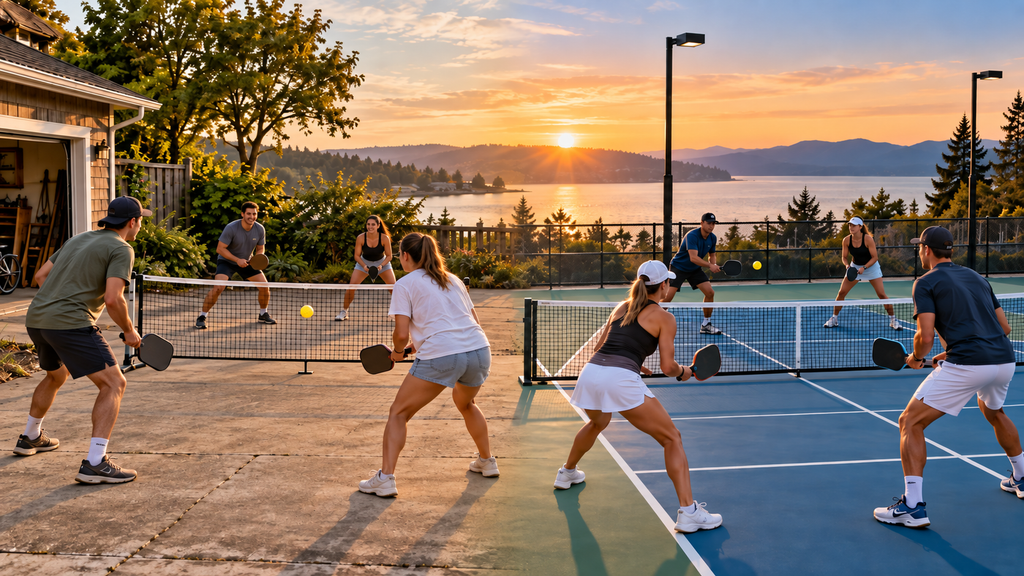
Pickleball may feel like a modern sport because of its rapid rise in popularity, but its story began more than 60 years ago. What started as an improvised family activity eventually developed into an organized sport played recreationally and competitively around the world.
Understanding pickleball history gives you useful context for the game you are learning today. Many features that make pickleball distinctive—including its compact court, simple equipment, and accessibility—can be traced back to the way the game was originally created.
Where Pickleball Began
Pickleball was created in the summer of 1965 on Bainbridge Island, Washington, near Seattle. The game is associated with three men: Joel Pritchard, Bill Bell, and Barney McCallum.
According to the history recorded by USA Pickleball, Pritchard and Bell returned to Pritchard’s home after playing golf and found their families looking for something to do. There was an old badminton court on the property, but they could not find a complete set of badminton rackets.
Instead of abandoning the idea, they improvised.
They began playing with ping-pong paddles and a perforated plastic ball. The badminton net was initially left at its normal height, but the players soon discovered that the plastic ball bounced well on the asphalt surface. The net was lowered, changing the game from something resembling badminton into a sport that could also be played after the ball bounced.
Barney McCallum joined them the following weekend. The three men then began developing rules for their new game, drawing heavily from badminton while keeping their original goal in mind: creating an activity that the whole family could play together.
That simple beginning is an important part of pickleball history because it explains much of the game’s character. Pickleball was not originally designed as an elite competitive sport. It was created as an accessible recreational activity that people with different ages and abilities could enjoy together.
The First Pickleball Equipment
The earliest players did not have specialized pickleball equipment because no such equipment existed.
Ping-pong paddles provided a practical starting point, while a lightweight perforated plastic ball made it possible to play on the available court. The existing badminton court provided the basic playing area.
As the game developed, its equipment began changing with it.
The simple paddles used in the early days eventually gave way to paddles made specifically for pickleball. Over time, paddle design expanded to include different materials and construction methods. The balls also became purpose-built for the sport rather than simply being whatever perforated plastic ball happened to be available.
The court developed as well. In 1967, the first permanent court built specifically for pickleball was constructed at Joel and Joan Pritchard’s home in Seattle.
This progression from improvised equipment to dedicated equipment and courts was one of the first signs that pickleball was becoming more than a backyard activity.
How The Rules Developed
The original players needed rules that would make their improvised game playable and fair.
Badminton provided much of the early inspiration, but pickleball gradually developed its own identity. As players experimented with the ball, paddles, net, and court, they adjusted the game to suit the way the equipment behaved.
The result was a sport with characteristics of several familiar racket and paddle sports without being identical to any of them.
As more people began playing, consistent rules became increasingly important. Informal rules may work when a small group of friends or family members plays together, but organized competition requires players to agree on how the game should be played.
An important step came in 1984, when the United States Amateur Pickleball Association was organized to support the sport’s growth and advancement. The organization published its first rulebook that year. It later evolved into the organization now known as USA Pickleball.
Standardized rules helped players in different communities play the same basic game. They also made tournaments, instruction, equipment standards, and organized competition easier to develop.
Where The Name “Pickleball” Came From
One of the most memorable parts of pickleball history is also one of the most debated: the origin of the name.
There are two well-known accounts.
According to one account attributed to Joan Pritchard, the name was connected to the term “pickle boat” in rowing. A pickle boat could be made up of rowers drawn from other crews, and the new game similarly combined elements associated with several existing sports.
Another account, associated with Barney McCallum, connected the name with the Pritchard family’s dog, Pickles.
Historical accounts do not completely agree on which explanation should receive the credit. USA Pickleball has documented both versions, including the complication that the Pritchards may have acquired the dog after the game itself had already been created.
For a beginner, the useful point is simple: the name has a colorful history, and more than one version of its origin has been passed down. Treating either story as completely undisputed overlooks that uncertainty.
From A Family Game To An Organized Sport
Pickleball did not become a major sport overnight.
During its early years, it spread largely because people introduced it to other people. Families, friends, recreation groups, and local communities could set up games without needing an enormous playing area or complicated equipment.
By the 1970s, the sport was beginning to receive wider attention.
Pickle-Ball, Inc. was formed in 1972, helping support the development of equipment for the growing game. Articles about pickleball appeared in national publications during the middle of the decade, exposing more people to the sport. In 1976, the first known pickleball tournament was held at the South Center Athletic Club in Tukwila, Washington.
Organized play continued expanding during the following decades.
By 1990, USA Pickleball’s historical record says the sport was being played in all 50 U.S. states. The arrival of the internet provided another way for players to discover equipment, places to play, and information about the game. The first pickleball website launched in 1999.
These developments helped transform pickleball from a game spread mainly through personal connections into a sport supported by a broader community.
The Importance Of Recreation And Community Play
Community recreation has played a major role in pickleball’s growth.
The game works well in recreational settings because a relatively small playing area can support singles or doubles play. Existing facilities can sometimes be adapted for pickleball, while dedicated courts provide communities with permanent places to organize games.
The social nature of doubles has also contributed to the sport’s appeal. Four people can share a court, communicate throughout a game, rotate partners, and play several games during a recreational session.
This creates a different experience from sports that require large teams, large fields, or highly specialized facilities.
Pickleball also has a relatively approachable starting point. New players can begin participating without first developing powerful strokes or advanced athletic skills. That does not mean the game lacks difficulty. As players improve, pickleball offers increasingly demanding challenges involving control, positioning, touch, reactions, and decision-making.
The combination of an accessible entry point and room for continued improvement helps explain why the sport can attract both casual recreational players and serious competitors.
The Rise Of Organized Competition
As participation increased, tournaments became more common and organized pickleball became more structured.
The establishment of national organizations, official rules, equipment standards, player development programs, and sanctioned events helped create a clearer competitive pathway.
Pickleball also began appearing at larger multi-sport events. It was introduced at the Arizona Senior Olympics in 2001, entered the Huntsman World Senior Games in 2003, and was included in the National Senior Games in 2008.
National championships grew as well. Competitive players could increasingly find tournaments designed for different ages and skill levels, while recreational players continued to enjoy the game in community settings.
Professional competition became another part of the sport’s development. Professional tours, organized leagues, broadcasts, sponsorships, and dedicated events created opportunities for highly skilled players to compete at a level far beyond the informal family games of pickleball’s early years.
This growth has not replaced recreational pickleball. Instead, the sport now operates at several levels at once. Someone can play a friendly game at a neighborhood court while experienced competitors participate in major tournaments using the same fundamental game.
Pickleball Goes International
Although pickleball began in Washington State, it did not remain an American activity.
The sport gradually expanded into other countries as players, coaches, recreation organizations, clubs, and national associations introduced it to new communities.
International organization has grown along with participation. By 2024, the Global Pickleball Federation reported member countries across five continents, demonstrating how far the sport had moved beyond its North American origins.
That expansion means beginners today may encounter pickleball clubs, tournaments, coaching programs, and organized communities in many different parts of the world.
International growth also creates a need for coordination. Organizations involved in the sport work on areas such as competition standards, officiating, coaching, national federations, and consistent rules. These structures become increasingly important as players from different countries compete with one another.
The sport continues to develop internationally, so its organizational structure is still evolving.
Why Pickleball Has Grown So Quickly
There is no single reason for pickleball’s growth.
Accessibility is an important part of the explanation. The basic idea of sending a ball over a net with a paddle is easy for a new player to understand. Beginners can often participate in simple rallies relatively quickly, even though developing consistent and advanced skills takes considerably longer.
The sport also accommodates different styles of play.
A recreational group may focus on social games and friendly competition. Other players may prefer structured practice, leagues, tournaments, or higher-level competition. Singles can provide a physically demanding game with more individual court coverage, while doubles creates a strong emphasis on positioning, teamwork, and communication.
The relatively compact court is another factor. Pickleball can be incorporated into recreation centers, parks, clubs, and other sporting facilities without requiring the space of a full-sized field sport.
Perhaps most importantly, pickleball retains the social character that was present at its beginning. Players meet at courts, rotate into games, play with different partners, and become part of local playing communities.
In 2025, USA Pickleball reported more than 100,000 members and estimated U.S. participation at 24.3 million players. Its records also show how dramatically the supporting infrastructure has expanded, including thousands of courts and a large volunteer ambassador network.
A Sport That Has Changed Without Losing Its Roots
Modern pickleball looks very different from the improvised game played on Bainbridge Island in 1965.
Players can now choose from purpose-built paddles, specialized balls, dedicated shoes, permanent courts, coaching programs, clubs, tournaments, leagues, and professional competition. Rules and equipment standards are formalized, and organized bodies support the sport at national and international levels.
Yet the basic character of the game remains recognizable.
You still need only a court, net, paddle, ball, and other people to begin playing. Recreational games can include players with different backgrounds and experience levels, while the basic rules remain approachable enough for beginners to start learning without an enormous technical barrier.
That connection between accessibility and depth is an important part of pickleball’s development.
The game began because a few families wanted something they could play together. Decades later, that same beginner-friendly quality remains one of the reasons people continue discovering it.
Key Takeaways
- Pickleball began in 1965 on Bainbridge Island, Washington, and Joel Pritchard, Bill Bell, and Barney McCallum are associated with its creation.
- The original game used improvised equipment, including ping-pong paddles, a perforated plastic ball, and an existing badminton court.
- The rules gradually became more organized as the game spread, eventually leading to formal rulebooks, governing organizations, tournaments, and dedicated equipment.
- Two commonly repeated explanations exist for the name “pickleball”: one involving the rowing term “pickle boat” and another involving the Pritchard family’s dog, Pickles. Historical accounts differ on the exact origin.
- Community recreation helped the sport spread before organized tournaments, national championships, professional competition, and international organizations expanded its reach.
- Pickleball’s appeal comes partly from its combination of accessibility, social play, compact playing space, and enough technical and strategic depth to remain challenging as players improve.
- Despite enormous growth, the sport still reflects its original purpose: providing a game that people can learn relatively easily and enjoy together.
:::