
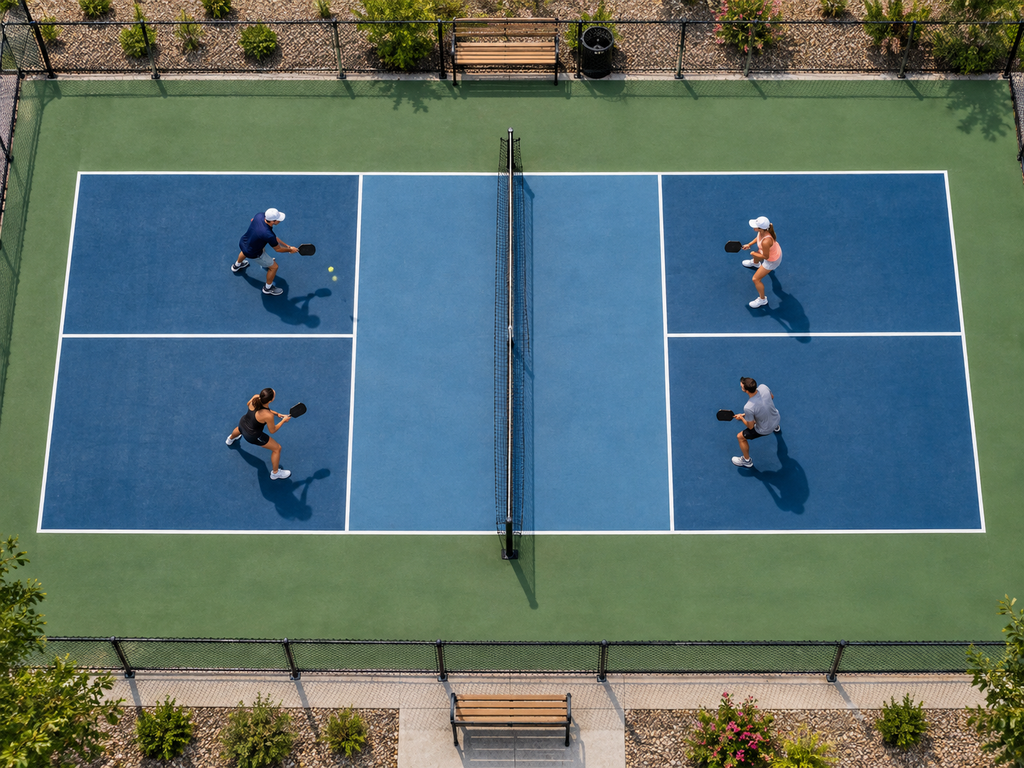
Before you can move confidently, serve from the correct place, or know whether a ball is in or out, you need to understand the pickleball court itself. The court may look simple at first, but each line and area has a specific purpose.
Learning the layout gives you a clear mental picture of where you should stand and where the ball should go. It also makes common terms such as baseline, sideline, service court, centerline, and non-volley zone much easier to understand during play.
A standard pickleball court is compact compared with a tennis court, which is one reason players can quickly learn to recognize its different areas. Once you know what each part of the court represents, positioning and movement become much easier to follow.
Pickleball Court Dimensions
A standard pickleball court measures 20 feet wide by 44 feet long. These dimensions are the same for both singles and doubles.
The net divides the court into two equal halves. Each player or team is responsible for one half of the court.
Although singles uses fewer players, the court does not become narrower. Singles players use the same sidelines and baselines that doubles players use.
The playing surface around the marked court is often larger than 20 by 44 feet because players need extra room to move beyond the lines safely. The painted or marked court itself, however, remains 20 feet wide and 44 feet long.
Knowing the basic dimensions helps you appreciate how quickly the ball can travel from one side to the other. It also explains why positioning is so important. A few steps can make a large difference on a relatively small court.
The Net
The net stretches across the middle of the court and separates the two sides.
A regulation pickleball net is 36 inches high at the sidelines and 34 inches high in the center. That slight drop in the middle makes the center of the net a little lower than the edges.
The net is more than simply a divider. Every legal shot traveling from one side of the court to the other must pass over it.
When looking at the court, use the net as your main reference point. The areas closest to the net are the non-volley zones, while the areas farther back contain the service courts and baselines.
Understanding your distance from the net also helps you recognize whether you are playing close to the front of the court, from the middle, or deeper near the baseline.
The Baselines
The baseline is the line running across the back of each end of the court.
Each side has one baseline. It marks the rear boundary of the playing area.
The baseline is especially important when serving because the server begins behind it. If you are preparing to serve, you should be able to identify the baseline immediately and understand that the serving position is outside the court behind this line.
The baseline also gives players an important positioning reference. A player who is described as being “at the baseline” is positioned near the back of the court rather than near the net.
During a rally, players may move behind the baseline to reach a deep ball. The line marks the boundary of the court, but players are free to move outside the marked playing area when necessary to play a ball that is still in the rally.
The Sidelines
The sidelines are the two long lines running from one baseline to the other.
Together with the baselines, they form the outside boundaries of the court.
Because the same court width is used for singles and doubles, both types of games use the same sidelines. There are no separate narrower singles sidelines like those found on a tennis court.
The sidelines are useful visual guides when you are learning where to stand. If you move too close to one sideline without a reason, you may leave a large amount of open court on the opposite side.
They are also important when judging whether a shot lands inside or outside the court boundaries.
The Centerline
The centerline divides the area between the non-volley zone and the baseline into two service courts.
It runs from the non-volley zone line toward the baseline, stopping at the baseline.
The centerline does not divide the entire court from net to baseline. It is used to separate the left and right service courts.
When serving, the centerline helps identify the diagonal service area where the ball must be directed. It also helps players recognize whether they are standing on the left or right side of their half of the court.
For beginners, becoming comfortable with the centerline is especially useful because it provides a simple reference for serving positions and court orientation.
Left And Right Service Courts
Each side of the court contains a left service court and a right service court.
These areas are located between the baseline and the non-volley zone line. The centerline separates them.
When you stand behind your baseline and face the net, one service court is on your left and the other is on your right.
The service courts are important because serves are directed diagonally across the net. A player serving from one side sends the ball toward the corresponding diagonal service court on the opponent’s side.
For example, a server positioned on the right side of the court aims toward the opponent’s service court that is diagonally across the net.
You do not need to treat the service courts as separate areas during every rally. Their main visual importance is helping players understand serving locations and starting positions.
The Non-Volley Zone
The area next to the net is called the non-volley zone, commonly known as the kitchen.
The non-volley zone extends 7 feet from the net on each side of the court. It stretches across the entire 20-foot width of the court.
The line marking the back edge of this area is called the non-volley zone line, although many players simply call it the kitchen line.
Because there is a non-volley zone on each side of the net, the space around the middle of the court looks different from the service-court areas behind it.
The centerline does not divide the kitchen into service boxes. Instead, the non-volley zone stretches continuously from one sideline to the other.
When learning the court, make sure you can visually separate the kitchen from the service courts. This distinction becomes important whenever players move close to the net.
The Kitchen Line
The kitchen line marks the boundary between the non-volley zone and the service-court area behind it.
It runs parallel to the net.
A beginner may hear players say they are “at the kitchen line.” This usually means they are positioned immediately behind the non-volley zone line, close to the front of the court.
The line itself is part of the non-volley zone. For court recognition, think of the kitchen as beginning at the net and extending back through the kitchen line.
Being able to identify this line quickly is useful because many rallies involve players moving between deeper positions and the area near the kitchen.
How The Service Courts And Kitchen Fit Together
Looking at one half of the pickleball court, you can divide it into two major sections.
Closest to the net is the non-volley zone. Behind that area are the left and right service courts.
The kitchen occupies the full width of the court for the first seven feet from the net. Behind the kitchen line, the centerline separates the remaining space into the two service courts.
This creates a simple layout. From the net moving backward, you first encounter the kitchen, then the service courts, and finally the baseline.
Visualizing the court in this order makes it easier to remember where each area belongs.
Where The Server Stands
The server begins behind the baseline.
The exact side of the court used depends on the game situation, but the important court-layout principle is that the server stands outside the back boundary rather than inside the service court.
From that position, the server sends the ball diagonally across the net toward the opponent’s correct service court.
The baseline, centerline, sideline, and opposite service court therefore work together as visual references for the server.
A useful habit is to identify these landmarks before beginning a point. Know where the baseline is, recognize which side you are serving from, and locate the diagonal service court across the net.
Where The Receiver Stands
The receiver positions themselves on the opposite side of the net in relation to the server’s diagonal target area.
Unlike the server, the receiver usually begins inside or near the back portion of the court, where there is enough room to react to the incoming serve.
Standing too far forward can make a deep serve difficult to handle. Starting with some room behind you gives you a better chance to move toward the ball while remaining balanced.
The receiver should also know which service court they are responsible for. Recognizing the centerline, sideline, and baseline makes this much easier.
Basic Starting Positions In Singles
In singles, one player covers the entire width of each side of the court.
The server begins behind the appropriate side of the baseline, while the receiver positions on the diagonally opposite side.
Because there is no partner helping to cover the court, singles players need to remain aware of the full width between both sidelines.
A balanced position is generally more useful than standing unnecessarily close to one edge. From a central and controlled position, a player has a better chance of moving toward balls directed to either side.
Court awareness becomes especially important in singles because every open area must be covered by one player.
Basic Starting Positions In Doubles
In doubles, two players share each side of the court.
At the beginning of a rally, the server and partner may occupy different positions based on which player is serving and the situation in the game. The receiving team also positions its players according to who is receiving the serve.
The main beginner principle is to understand your relationship to your partner and the court boundaries.
You should know whether you are on the left or right side, where the centerline is, and how much space exists between you and your partner.
Two players standing too close together may leave large parts of the court uncovered. Players standing too far apart can also create openings, especially through the middle.
Good positioning begins with knowing exactly where you are on the court.
How Court Lines Affect In And Out Calls
Court lines determine whether a ball has landed within the legal playing area.
When judging most shots during a rally, a ball that touches a boundary line is considered to have touched the court rather than completely missing it.
The important visual skill is learning to watch where the ball actually contacts the ground.
A ball may travel through the air outside a line and still curve or angle back onto the court. What matters is the point where the ball lands.
Likewise, a ball can look close to a sideline or baseline but still land clearly beyond it.
Beginners sometimes watch the player who hit the shot instead of following the ball all the way to the bounce. Keeping your attention on the ball makes line judgments easier.
Court lines are narrow, so close calls can happen. Knowing exactly which lines form the boundaries helps you make better judgments.
Why Court Awareness Matters
Understanding the court is not simply a matter of memorizing names.
Court awareness helps you know where you are without constantly looking down at your feet. It helps you recognize how close you are to the baseline, sideline, centerline, net, or kitchen.
That awareness supports better movement.
If you know you are close to a sideline, you can recognize how much open space remains toward the middle. If you know you are deep near the baseline, you can judge how far you would need to move to reach the front of the court.
Court awareness also helps you recover after hitting a ball. Instead of remaining wherever your previous shot took you, you can recognize your position and move toward a more useful location.
A simple way to improve awareness is to walk around an empty court before playing. Stand behind the baseline, step into each service court, follow the centerline, move toward the kitchen line, and look at the court from several positions.
Seeing the layout from ground level can be more useful than only looking at a diagram.
Building A Mental Map Of The Court
Try to picture one half of the court as a simple arrangement of areas.
At the very back is the baseline. The sidelines run along the left and right edges. The centerline divides the left and right service courts. Moving toward the net, the service courts end at the kitchen line. From that line to the net is the non-volley zone.
The opposite half of the court mirrors the same layout.
Once this mental map becomes familiar, terms such as “deep,” “wide,” “middle,” “service court,” and “kitchen line” become much easier to understand.
You also spend less time searching for the lines and more time watching the ball and preparing to move.
Key Takeaways
- A standard pickleball court measures 20 feet wide by 44 feet long for both singles and doubles.
- The net divides the court in half and is 36 inches high at the sidelines and 34 inches high in the center.
- Baselines mark the back boundaries, while sidelines mark the long outer boundaries of the court.
- The centerline divides the area behind the kitchen into left and right service courts.
- The non-volley zone, or kitchen, extends 7 feet from the net on each side and stretches across the entire width of the court.
- Servers begin behind the baseline and serve diagonally toward the appropriate service court.
- Understanding the court lines and major areas helps you judge boundaries, recognize starting positions, move more efficiently, and maintain better court awareness during play.