
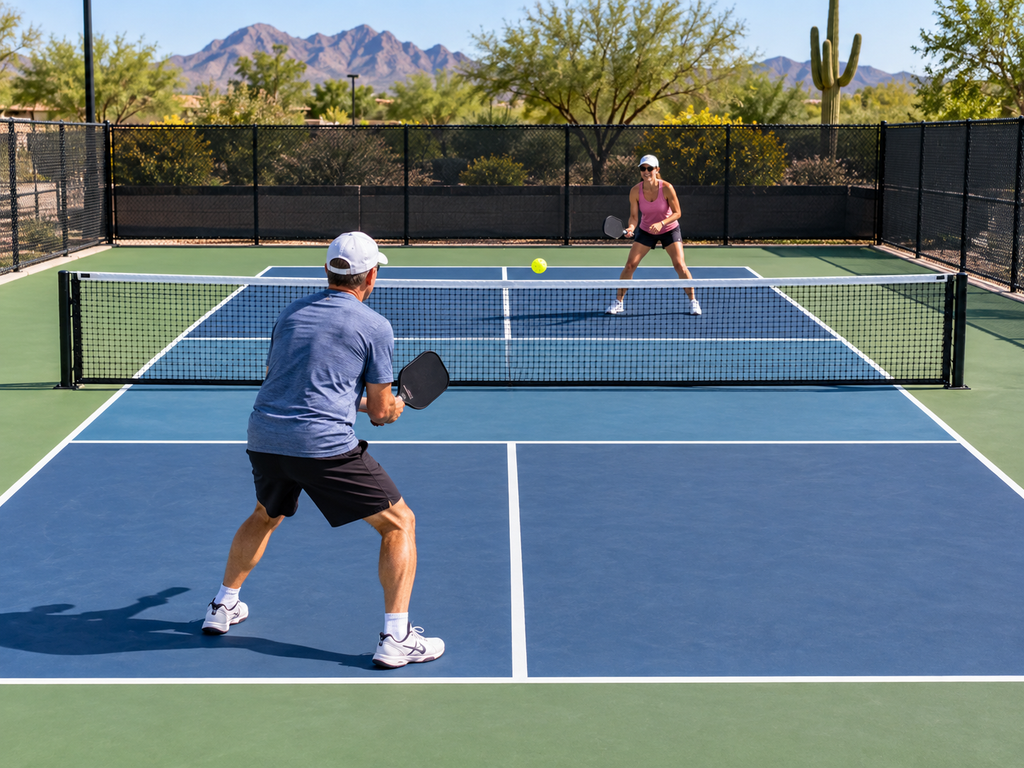
Pickleball is easy to start playing once you understand the basic flow of a game. You do not need to memorize an entire rulebook before stepping onto the court, but you do need to know the basic pickleball rules that determine how a rally begins, where the ball may land, when you can hit it, and what causes play to stop.
The basic objective is simple: send the ball over the net and into the opponent’s court in a way that keeps you in the rally while making it difficult for your opponent to return the ball legally.
Pickleball can be played as singles, with one player on each side, or doubles, with two players on each side. The same basic court and many of the same rules apply to both formats.
Understanding these fundamentals will make recreational games much easier to follow and help prevent the confusion that often slows down beginner play.
The Basic Objective of Pickleball
A pickleball rally begins with a serve and continues as players hit the ball back and forth over the net.
Your goal during each rally is to return the ball legally while trying to create a situation in which your opponent cannot make a legal return.
A rally can end in several common ways. A player may hit the ball into the net, send it outside the court boundaries, allow it to bounce twice, violate a serving rule, or commit another fault.
The rules are designed to create an organized exchange rather than simply rewarding whoever can hit the ball hardest. Placement, consistency, movement, and control all matter.
For beginners, one of the best ways to understand the game is to think of each rally as a sequence: serve, return, continue exchanging shots, and stop when a fault occurs.
Singles and Doubles
Pickleball is played in two main formats.
In singles, one player covers each side of the court. Because there is only one player per side, each person is responsible for covering the entire width of the playable court.
In doubles, two players form a team on each side. Partners share court coverage and must pay attention to both their own position and their teammate’s position.
Doubles is extremely common in recreational pickleball because players can share the workload and use teamwork to cover the court.
Although positioning and serving sequences differ between singles and doubles, the basic rally rules remain familiar. The ball must cross the net, remain inside the court boundaries, and be returned before it bounces twice.
How a Pickleball Game Begins
Every rally begins with a serve.
The server stands behind the baseline and sends the ball diagonally across the net into the opponent’s correct service court. The serve must land in the proper area for play to continue.
Before serving, players should be ready and aware of the score, serving position, and receiver.
A recreational game should begin only when everyone is prepared. Serving while an opponent is clearly not ready creates unnecessary confusion and is poor court etiquette.
The serve puts the ball into play. Once a legal serve has been made and returned according to the rules, the rally develops into normal play.
The Basic Serving Sequence
Serving is governed by several rules, but beginners first need to understand its basic purpose and direction.
The server starts from behind the baseline. The ball is served diagonally into the opponent’s service court rather than straight ahead.
The server must use the correct side of the court according to the game situation. In doubles, serving responsibilities can move between partners before service passes to the opposing team.
In singles, one player handles all serving duties for that side.
Before beginning the serving motion, the server should call the score clearly enough for the other players to hear.
Serving has more detailed requirements involving position, legal contact, and service sequence, but the essential idea is straightforward: begin from the correct location, send the ball diagonally into the correct service court, and allow the rally to develop from there.
How a Rally Works
After the serve, players attempt to return the ball over the net while keeping it inside the court.
A rally can include many different types of shots. The ball may be hit after a bounce, or in certain situations it may be hit before it touches the ground.
A ball hit before bouncing is called a volley. A ball hit after bouncing is commonly played as a groundstroke or another type of bounce-based shot.
During a rally, players should watch the ball carefully and move into position before making contact whenever possible.
A legal return should cross the net and land inside the opponent’s playable court unless the opponent contacts it before it bounces.
If both sides continue making legal returns, the rally continues. Once a fault occurs, the rally immediately ends.
Understanding In And Out
Court boundaries determine whether many shots remain in play.
A ball that lands completely outside the legal boundary is out.
A ball that touches a boundary line is generally considered in. This is an important part of the pickleball rules because beginners sometimes call a ball out simply because most of it appears outside the court.
The key question is whether the ball touched the line.
If any part of the ball makes contact with a boundary line that defines the playable area for that shot, the ball is normally considered in.
Close calls are common because pickleballs can move quickly and bounce in unexpected ways. Players should make line calls based on what they actually see rather than guessing.
If you are not certain that an opponent’s ball landed out, the fair approach in recreational play is to give the opponent the benefit of the doubt.
The Non-Volley Zone
One feature that makes pickleball distinctive is the non-volley zone, commonly called the kitchen.
This area extends from the net toward the court on both sides and is marked by the non-volley zone line.
The name describes its main purpose: players may not volley the ball while touching the non-volley zone.
That does not mean the kitchen is an area that players are never allowed to enter. A player may step into it under legal circumstances, such as when playing a ball that has already bounced.
The important beginner distinction is between being inside the kitchen and hitting a volley while touching it.
A volley is a shot made before the ball bounces. If you are touching the non-volley zone or its boundary line while making that type of shot, a fault occurs.
For basic play, develop the habit of staying aware of your feet whenever you are close to the kitchen line.
The Two-Bounce Rule
Another important part of the basic pickleball rules is the two-bounce rule.
After the serve lands in the receiving court, the receiving side must allow the ball to bounce before returning it.
Then the serving side must also allow the returned ball to bounce before hitting its next shot.
This creates two required bounces: one on the receiving side after the serve and one on the serving side after the return.
Only after those two required bounces have occurred can players begin volleying legally.
A common beginner mistake is to forget the second required bounce and attempt to volley the return of serve. If the serving side hits the returned ball before it bounces, the rally ends because of a fault.
A simple way to remember the sequence is: serve, bounce, return, bounce, then normal rally play.
What Is A Fault?
A fault is a rule violation that stops play.
Faults are a normal part of pickleball. Even experienced players commit them. The important thing for a beginner is to recognize when a rally has ended and restart play correctly.
One common fault happens when the ball is hit into the net and fails to cross to the opponent’s side.
Another occurs when the ball lands outside the court boundaries.
A player also commits a fault if the ball bounces twice on their side before they return it.
Violating the two-bounce rule can also end the rally.
Non-volley zone violations are another common source of faults, especially when players move close to the net and forget where their feet are positioned.
Serving mistakes can also produce faults.
You do not need to stop after every rally and analyze every possible rule. As a beginner, concentrate on recognizing the obvious situations that end play.
When A Rally Ends
Every rally continues until a fault occurs or another rule brings play to an end.
Suppose a player serves legally and the receiver returns the ball after one bounce. The serving team lets that return bounce and sends it back across the net. The exchange continues for several shots.
If one player then hits the ball into the net, the rally ends immediately.
If a player sends the ball beyond the baseline or sideline without the opponent touching it first, the rally also ends.
If the ball lands in and a player cannot reach it before a second bounce, the rally is over.
Once play stops, players should identify the result, confirm who serves next, and prepare for the next rally.
Keeping this process calm and organized helps recreational games move smoothly.
Changing Service Between Players And Teams
Service does not remain with one player for an entire game.
When the serving side loses a rally, the serving situation changes according to whether the game is singles or doubles and according to the applicable serving sequence.
In doubles, both partners may have serving responsibilities before service moves to the opposing team, depending on the stage of the game.
When the opposing team gains the right to serve, this change is commonly called a side out.
Beginners do not need to rush through this process. Before every serve, players should confirm who is serving, who is receiving, and whether everyone is in the proper position.
Clear score calling also helps the group identify the correct server and reduce disagreements.
Recreational Play And Officiated Play
Most beginners first experience pickleball through recreational games.
In recreational play, the players usually handle their own score, line calls, serving order, and basic rule decisions. There may be no referee or official watching the match.
That makes sportsmanship especially important.
In officiated competition, referees or other officials may handle certain calls and procedures according to formal tournament rules.
The absence of an official during recreational games does not make the rules optional. Players are still responsible for making a reasonable effort to play correctly and fairly.
When confusion occurs, the goal should be to resolve it calmly rather than turn a recreational game into an argument.
Your Responsibility As A Player
Every player has some responsibility for understanding the basic rules of the game.
You should know when you are serving, recognize the main court boundaries, understand that the serve travels diagonally, follow the two-bounce rule, and recognize obvious faults.
You should also pay attention to the score and listen when other players communicate during the game.
If you are unsure about what happened during a rally, ask calmly. A short question is better than pretending to understand and repeatedly creating the same confusion.
Learning the rules also means being willing to acknowledge your own mistakes. If you clearly see that your shot landed out or that you committed a fault, accept the result and prepare for the next rally.
That attitude keeps games moving and makes the court more enjoyable for everyone.
Sportsmanship And Fair Play
Rules organize the game, but sportsmanship determines how enjoyable the game feels.
Make honest line calls. If you clearly see the opponent’s ball land outside the boundary, call it out. If you are uncertain, do not invent certainty simply because the call would benefit your team.
Respect your partner and opponents when disagreements occur.
Avoid arguing over every close ball. Recreational pickleball works best when players understand that human judgment is imperfect and that an occasional uncertain call is part of the game.
Call the score clearly, return balls safely to the correct court, and avoid distracting players during active rallies.
Fair play also means accepting faults when they occur. Mistakes are part of normal play. A fault is simply the end of one rally, not a reason for conflict.
Putting The Basic Rules Together
A beginner-friendly way to understand a complete rally is to follow one simple example.
The server stands behind the baseline and serves diagonally into the correct service court.
The receiver lets the ball bounce and returns it over the net.
The serving side also lets that return bounce before playing the next shot.
From that point, either side may continue returning the ball according to the normal rules, including using volleys when legally positioned.
The rally continues until someone hits the ball out, sends it into the net, allows it to bounce twice, commits a non-volley zone violation, or makes another fault.
The players then recognize the result, determine the proper server, call the score, and begin the next rally.
Once this basic sequence makes sense, the game becomes much easier to follow.
Key Takeaways
- Pickleball can be played as singles or doubles, and every rally begins with a serve sent diagonally into the correct service court.
- The receiving side must let the serve bounce, and the serving side must let the return bounce. After those two required bounces, normal rally play can continue.
- A ball touching a valid boundary line is generally considered in, while a ball landing completely outside the boundary is out.
- Players may not volley while touching the non-volley zone or its boundary line.
- A fault ends the rally. Common examples include hitting into the net, hitting out of bounds, allowing two bounces, or violating the two-bounce or non-volley zone rules.
- In recreational play, players are responsible for understanding the basic rules, keeping track of the game, making fair calls, and treating partners and opponents respectfully.