
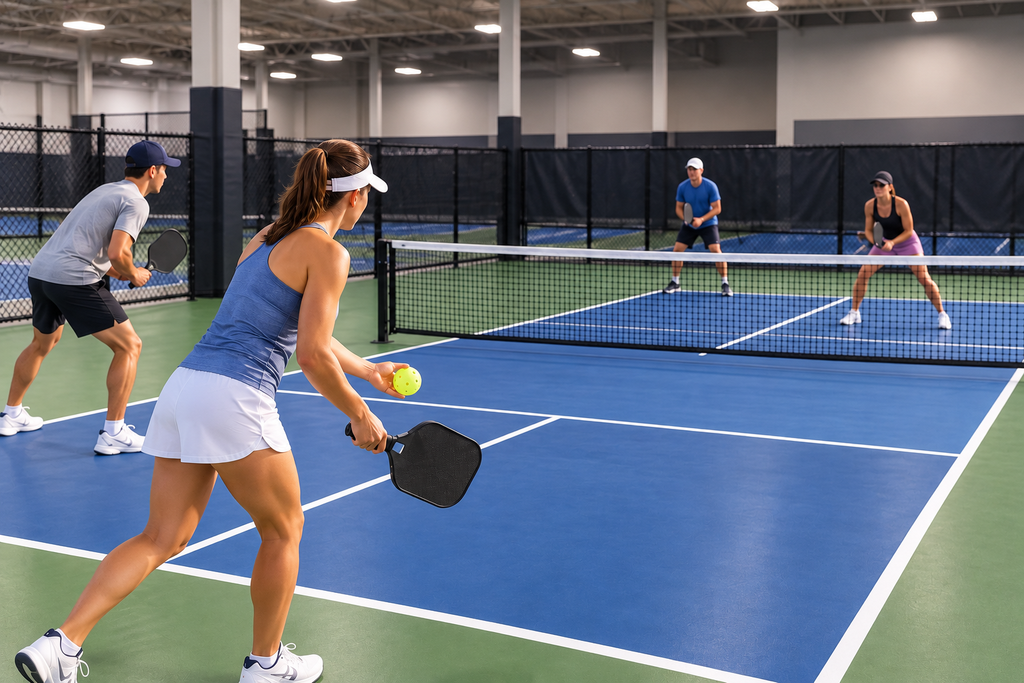
A legal serve is the starting point of every pickleball rally. Understanding the pickleball serving rules helps you know where to stand, where the ball must travel, and what can cause a service fault before the rally even begins.
Serving in pickleball is different from serving in sports such as tennis. The serve must be made from behind the baseline and sent diagonally across the court into the opponent’s correct service area. The rules also control who serves, who receives, and how service moves between players.
The goal here is to understand what makes a serve legal. You do not need a powerful serve to begin a rally correctly. You need to start from the correct position, use a legal serving action, send the ball to the correct service court, and follow the proper serving sequence.
The Purpose of the Serve
Every rally begins with a serve. The server puts the ball into play by hitting it from one side of the court to the diagonally opposite service court.
The serve gives the receiving player an opportunity to return the ball and begin the rally. Unlike some racket sports, pickleball does not encourage the server to use an extremely powerful motion simply to overwhelm the receiver. A legal serve is primarily a way to start the point.
Before serving, the server should know three things: where to stand, which opponent should receive the ball, and which service court the ball must enter.
Getting these details right makes the rest of the serving sequence much easier to follow.
Where the Server Must Stand
The server begins behind the baseline on the correct side of the court.
The baseline is the line that forms the back boundary of the pickleball court. When serving, the server must remain behind this line when contacting the ball.
The server also needs to stay within the area between the imaginary extensions of the centerline and sideline. The centerline is the line separating the right and left service courts. The sideline forms the outside edge of the court.
Think of these two lines as extending backward beyond the baseline. The server must stand within that space when making the serve.
For example, if you are serving from the right side, you cannot move far beyond the right sideline to create an extreme angle. You also cannot move across the imaginary extension of the centerline into the left serving area.
Knowing where your feet are positioned before starting the serve is an important part of following the pickleball serving rules.
Serving From Behind the Baseline
Your position in relation to the baseline matters during the serve.
At the moment the ball is served, your feet must not be improperly placed on or beyond the serving boundary. A violation involving the server’s foot position is called a service foot fault.
Beginners sometimes step forward too early because they are concentrating completely on the paddle and ball. A simple way to avoid this problem is to begin with enough space between your feet and the baseline that your normal serving movement does not carry you onto the line before contact.
You can move into the court after the serve has been made. The restriction applies to your position while the serve is being performed.
Good awareness of the baseline makes legal serving much easier.
The Serve Must Travel Diagonally
A pickleball serve does not go straight ahead into the service court directly across from the server.
Instead, it must travel diagonally cross-court.
A player serving from the right side sends the ball to the opponent’s right service court from the server’s perspective across the diagonal. When the server later serves from the left side, the ball travels diagonally toward the opposite service court.
This diagonal pattern is a basic part of every legal serve.
Before serving, look across the net and identify the service court you are aiming for. This quick check helps prevent one of the most common beginner errors: serving into the wrong side of the court.
Where the Serve Must Land
A legal serve must land inside the correct diagonal service court.
The ball needs to travel over the net and beyond the non-volley zone before bouncing in the receiving service area.
The non-volley zone, often called the kitchen, is the seven-foot area on each side of the net. Its boundary line is the non-volley zone line.
On a serve, the ball cannot land on the non-volley zone line. A serve that hits that line has not reached the legal service area.
However, the other boundary lines of the correct service court are treated according to normal line rules. The important distinction for a beginner is that the serve must clear the kitchen and reach the proper diagonal service box.
A ball that lands short in the kitchen is a service fault.
The Correct Receiver
The serve must be directed not only to the correct area of the court but also to the correct receiver.
In singles, this is relatively simple because there is only one opponent. In doubles, each side has two players, so the serving sequence determines which player should receive the serve.
The receiver normally stands in or near the appropriate diagonal service court and prepares to let the serve bounce before returning it.
Serving toward the wrong receiver or serving from the wrong position can create confusion about whether the proper sequence is being followed. Before beginning the point, both teams should be aware of who is serving and who is receiving.
This becomes especially important in doubles, where players may change court positions as the score changes.
Calling the Score Before Serving
The score should be called before the serve is made.
Calling the score helps everyone confirm that the game is ready to continue. It also gives players a chance to notice a scoring or positioning mistake before the ball is put into play.
In singles, the score is called using two numbers: the server’s score followed by the receiver’s score.
Traditional doubles scoring normally uses three numbers. The first number is the serving team’s score, the second is the receiving team’s score, and the third identifies whether the first or second server on that team is serving.
The important serving habit is simple: establish the score first, then serve.
Starting the serving motion before the players are ready or before the score has been properly established can create unnecessary confusion.
Legal Volley Serves
One way to put the ball into play is with a volley serve.
A volley serve means the server strikes the ball before it bounces. The ball is released and contacted directly with the paddle.
The serving action must meet the requirements for a legal serve. The server should use a clear underhand-style motion rather than hitting the ball with an overhead action like a tennis serve.
The contact and paddle movement must remain within the legal requirements of the serving action.
For beginners, the main rule to remember is that a volley serve is made by releasing the ball and striking it before it touches the court.
The exact quality, speed, or placement of the serve does not determine whether it is legal. The serving action itself and where the ball lands are what matter.
Legal Drop Serves
Pickleball also allows a drop serve.
With a drop serve, the server releases the ball and allows it to bounce before striking it. The ball is then hit after the bounce and sent diagonally toward the correct service court.
The ball should be released rather than forcefully propelled downward or manipulated to create an artificial bounce.
Once the ball has bounced naturally, the server can strike it and complete the serve.
The drop serve can feel different from a volley serve because the contact occurs after the bounce. However, the same court requirements still apply. The server must be positioned legally, the ball must travel diagonally, and it must land in the correct service area beyond the non-volley zone.
Serving to the Wrong Court
Serving into the wrong service court is one of the easiest mistakes for a beginner to recognize.
Imagine that you are standing on the right side of the baseline. Your serve must travel diagonally across the net. If you instead hit the ball straight ahead into the service court directly opposite you, the serve is not legal.
The same principle applies when serving from the left side.
A useful habit is to identify your target court before beginning the serving motion. Look diagonally across the net and mentally confirm where the ball needs to land.
This takes only a moment and can prevent a surprising number of serving mistakes.
Serving From the Wrong Position
A serve can also become a problem when the correct player serves from the wrong side of the court.
Your serving position depends on the score and the game format. In singles, even and odd scores help determine which side the server should use. Doubles also follows a serving rotation that determines where players should be positioned.
Because positioning and scoring are connected, losing track of the score can also cause players to lose track of where the next serve belongs.
When there is uncertainty during a recreational game, it is better to clarify the score and player positions before serving instead of continuing and creating more confusion.
The pickleball serving rules work together with the scoring system, so knowing the score helps you identify the correct serving position.
Serving Sequence in Singles
Singles uses one server on each side.
The server continues serving while winning rallies that allow the serving side to keep service under traditional side-out scoring. The serving position changes according to the server’s score.
A common positioning guide is that an even score places the server on the right side, while an odd score places the server on the left side.
When the server loses the rally and service changes sides, the opponent becomes the new server.
Because there are only two players, singles serving order is easier to track than doubles. Even so, remembering the score before every serve remains important because the score helps determine the correct side of the court.
Serving Sequence in Doubles
Doubles requires more attention because each team has two players.
During a normal service turn, both partners can have an opportunity to serve before the other team gains service. These players are commonly referred to as the first server and second server for that service turn.
When the first server loses a rally, service passes to the partner. When the second server loses a rally, the opposing team receives the serve. This transfer of service to the other team is commonly called a side out.
The beginning of a doubles game uses a special first-service sequence, so players should listen carefully to the score and server number.
The key beginner habit is to keep track of whose turn it is rather than serving simply because you happen to be holding the ball.
What Happens When the Serving Side Loses a Rally
Under traditional side-out scoring, losing a rally does not always mean the opposing team immediately becomes the serving team.
In singles, losing the rally causes service to pass to the opponent.
In doubles, the result depends on whether the current player is the first or second server for that service turn. If the first server loses the rally, service normally moves to the partner. If the second server loses the rally, a side out occurs and the opposing team serves.
This is why the server number in doubles matters.
Understanding the basic sequence prevents players from accidentally skipping a server or giving one team an extra service opportunity.
Common Serving-Rule Mistakes
Many beginner serving faults come from positioning rather than from the paddle swing itself.
A player may accidentally touch or cross the serving boundary too early. Another may stand on the wrong side of the court, send the serve to the wrong service box, or forget which player is supposed to receive.
Another common problem is a serve that lands short in the non-volley zone or touches the non-volley zone line.
Beginners may also become so focused on making contact that they forget to call the score before serving.
A simple pre-serve check can prevent most of these mistakes. Confirm the score, identify the correct server and receiver, check your position behind the baseline, locate the diagonal service court, and then begin the serve.
Serving Rules Versus Serving Technique
It is useful to separate serving rules from serving technique.
The rules determine whether you are serving legally. They tell you where to stand, which direction to serve, where the ball must land, and how the serving order works.
Technique describes how you physically control the paddle and ball to produce the serve you want.
A serve can feel smooth and powerful but still be illegal if it is made from the wrong place or lands in the wrong service court. Likewise, a simple serve with very little speed can be completely legal if it follows the required rules.
For a beginner, legality and consistency are more valuable than trying to make the serve difficult for the opponent.
Once you understand the pickleball serving rules, you can begin every rally knowing that your position, target, and serving sequence are correct.
Key Takeaways
- A legal pickleball serve begins from behind the baseline and within the correct serving area.
- The serve must travel diagonally across the net into the correct service court.
- The serve must clear the non-volley zone, and a serve that lands on the non-volley zone line is not in the legal service area.
- Pickleball allows both volley serves and drop serves, provided the applicable serving requirements are followed.
- The score should be called before the serve, and players should confirm the correct server, receiver, and court position.
- Singles uses one server per side, while doubles uses a serving sequence involving first and second servers during normal service turns.
- Common service faults include incorrect foot position, serving from the wrong location, serving to the wrong court, and failing to reach the legal service area.
- Understanding the pickleball serving rules gives you a reliable framework for starting every rally correctly and avoiding preventable faults.